
Terminal growth rate is the steady long-term growth assumption applied to cash flows after the explicit forecast period in a valuation model. It is commonly represented by g in the perpetuity-growth formula. The assumption can materially change terminal value, particularly when the difference between the discount rate and g is small.
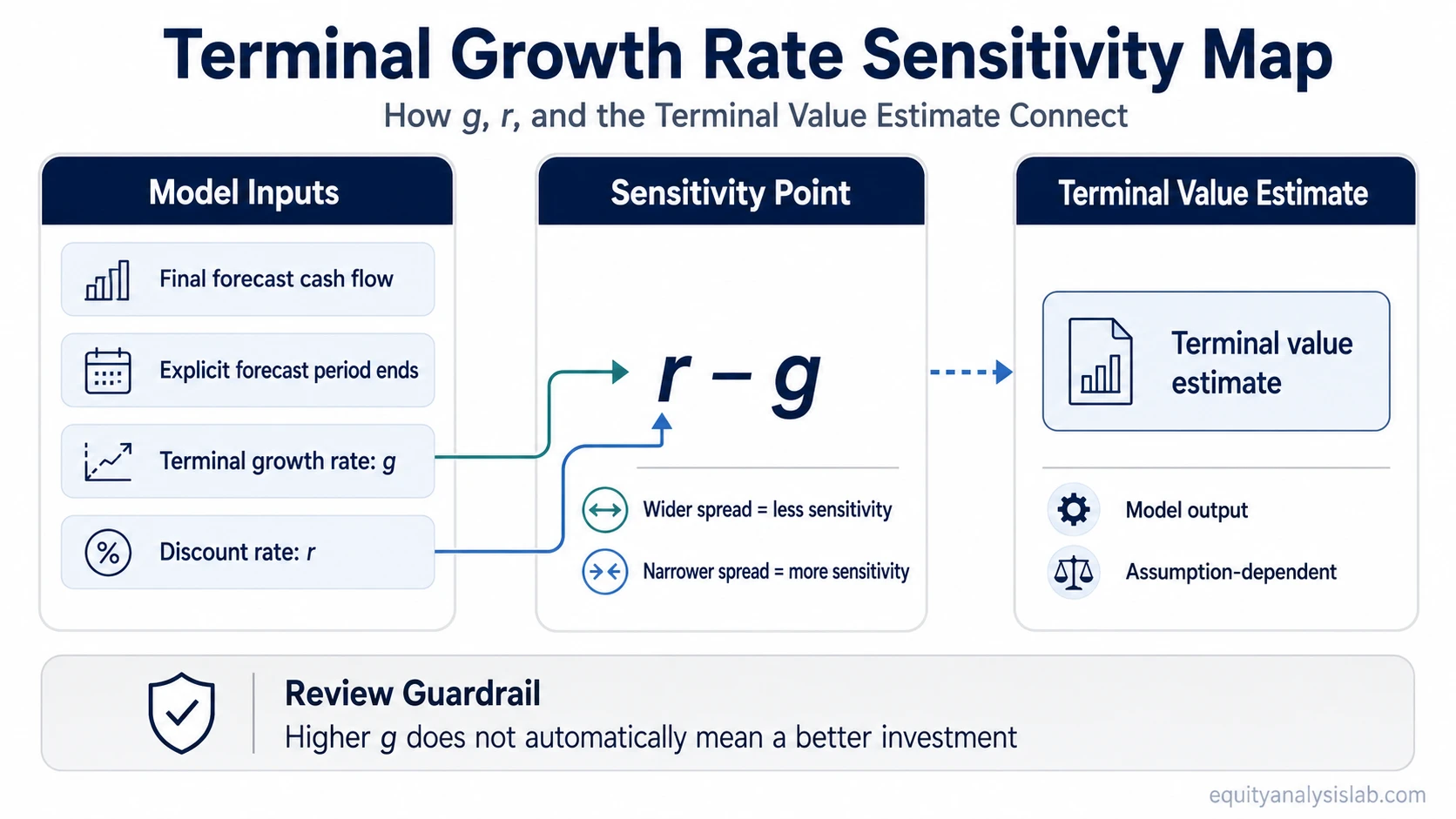
Terminal Growth Rate Formula
The perpetuity-growth method estimates the value of cash flows beyond the last explicit forecast year. At the end of Year n, the formula is:
Terminal Valuen = FCFn × (1 + g) ÷ (r − g)
Required condition: g < r
| Input | Meaning | Model requirement |
|---|---|---|
| FCFn | Normalized free cash flow in the final explicit forecast year. | Must reflect the cash-flow claim and sustainable economics being valued. |
| g | Growth assumed from Year n+1 onward. | Must be supportable over the long run and consistent with reinvestment. |
| r | The applicable discount rate. | Must match the cash-flow claim. For an FCFF-based enterprise valuation, this is normally WACC. |
Terminal value is measured at the end of the explicit forecast period. It must then be discounted to the valuation date before being combined with the present value of the explicitly forecast cash flows.
Why Small Changes in Terminal Growth Rate Matter
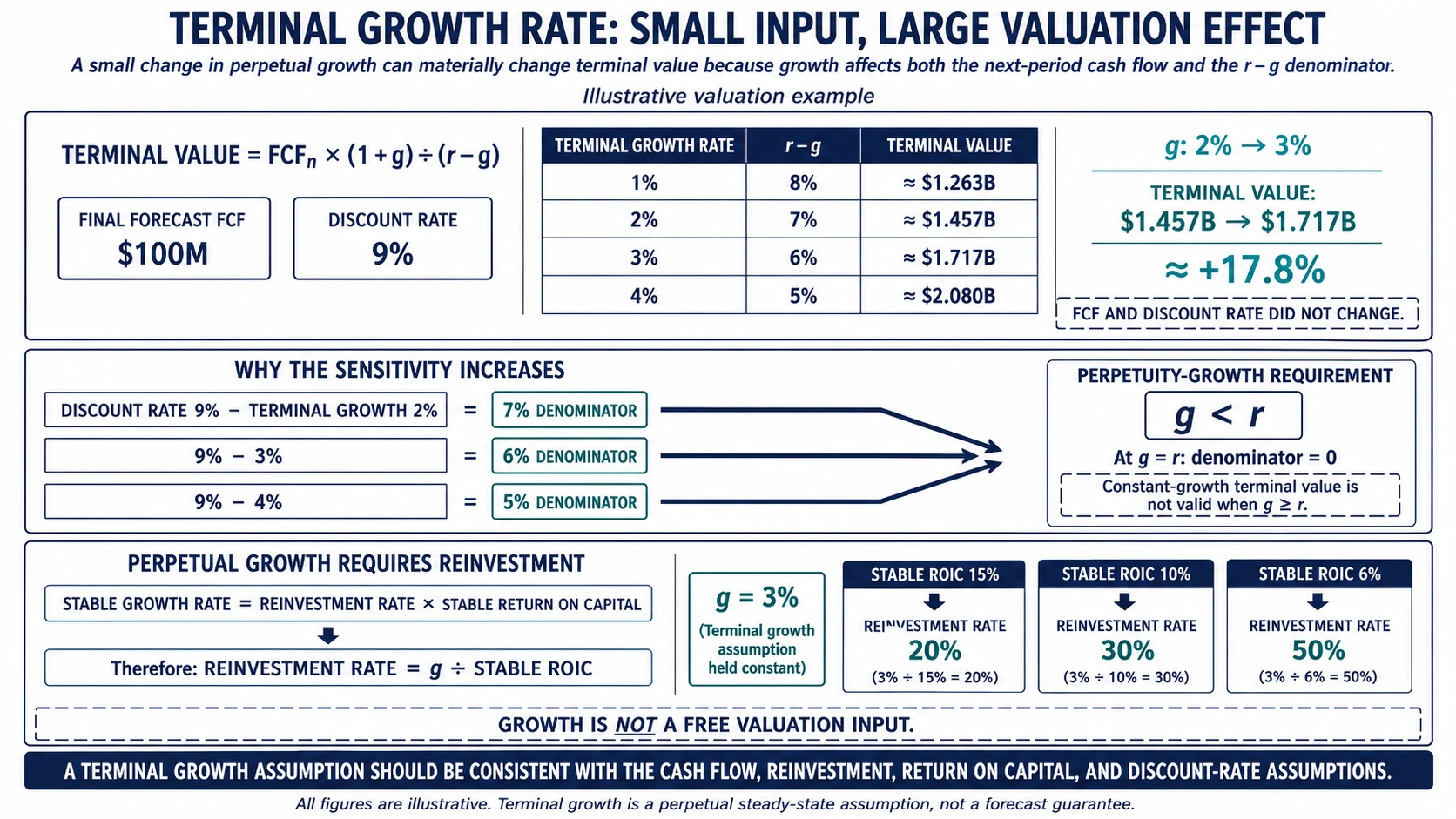
Assume final forecast-period free cash flow of $100 million and a discount rate of 9%. Hold both inputs fixed while varying g from 1% to 4%.
| Terminal growth rate | r − g | Illustrative terminal value |
|---|---|---|
| 1% | 8% | ≈ $1.263 billion |
| 2% | 7% | ≈ $1.457 billion |
| 3% | 6% | ≈ $1.717 billion |
| 4% | 5% | ≈ $2.080 billion |
Raising g from 2% to 3% increases the calculated terminal value by approximately 17.8%. Growth increases the next-period cash flow in the numerator while reducing the denominator, so the two effects reinforce each other in this fixed-input calculation.
This is a mechanical sensitivity test. It holds the final forecast cash flow constant across cases and does not recalculate how much reinvestment each long-term growth assumption would require. Economically consistent valuation scenarios also need that adjustment.
Why Terminal Growth Must Stay Below the Discount Rate
The constant-growth perpetuity requires g < r. If the growth rate equals the discount rate, the denominator is zero. Above that boundary, the standard formula no longer produces a meaningful positive perpetuity value under its assumptions.
As g approaches r from below, the calculated terminal value becomes increasingly sensitive to small changes in either rate. A positive denominator is necessary for the formula, but it is not sufficient evidence that the growth assumption is economically reasonable.
Growth Has to Be Funded
A business may need additional capital to support higher sales and operating income. In a steady-state FCFF framework, the sustainable growth rate can be related to reinvestment and return on capital:
Stable growth rate = Reinvestment rate × Stable return on capital
Implied reinvestment rate = Stable growth rate ÷ Stable return on capital
For an assumed stable growth rate of 3%, different returns on capital imply different reinvestment requirements.
| Stable return on capital | Implied reinvestment rate |
|---|---|
| 15% | 20% |
| 10% | 30% |
| 6% | 50% |
At a 6% return on capital, half of the relevant after-tax operating earnings would need to be reinvested to support 3% stable growth under this simplified relationship. At a 15% return, the implied share is 20%.
When a model increases perpetual growth, it should also check the resulting reinvestment and free cash flow. If stable return on capital equals the cost of capital, extra growth does not create additional economic value under a consistently modeled perpetuity. A business that can earn more than its cost of capital may create value through growth, subject to the durability of that excess return.
What Makes a Terminal Growth Rate Reasonable?
Terminal growth should represent a sustainable phase, rather than extending an unusually strong forecast year forever. The assumption needs to agree with the business’s mature margins, capital requirements, competitive position, and expected return on capital.
Long-run economic growth provides another check. The comparison must use a consistent currency and distinguish nominal from real growth. A nominal cash-flow model, for example, needs nominal growth and discount-rate inputs. There is no single terminal growth percentage that is appropriate for every business or valuation.
The model should explain the transition from its detailed forecast to a mature, sustainable operating state.
The growth rate during the final explicit forecast year. It can still reflect a period of expansion or normalization.
The steady rate assumed after the explicit forecast. It must be consistent with the long-term cash-flow and reinvestment assumptions.
Corporate Finance Institute explains the perpetuity-growth terminal-value formula and the need to discount terminal value back to the valuation date. Aswath Damodaran derives the stable-growth reinvestment relationship and explains why changes in growth need not increase value when the related reinvestment is modeled consistently.
The calculated value can depend heavily on a narrow r − g spread, an optimistic cash-flow base, or assumed excess returns that may not persist. Test plausible combinations of growth, discount rate, and reinvestment rather than treating one terminal-growth input as a precise forecast or a guarantee of future company performance.
Related Valuation Concepts
See how the terminal value estimate captures cash flows beyond the explicit forecast and how that output enters a DCF.
Review the required rate of return and its role in valuing future cash flows under a stated risk assumption.