
Terminal value estimates the value of a business or cash-flow stream beyond the explicit forecast period. In a discounted cash flow (DCF) model, it is calculated at the end of the forecast and then discounted back to the valuation date. The estimate usually comes from a perpetuity-growth assumption or an exit multiple.
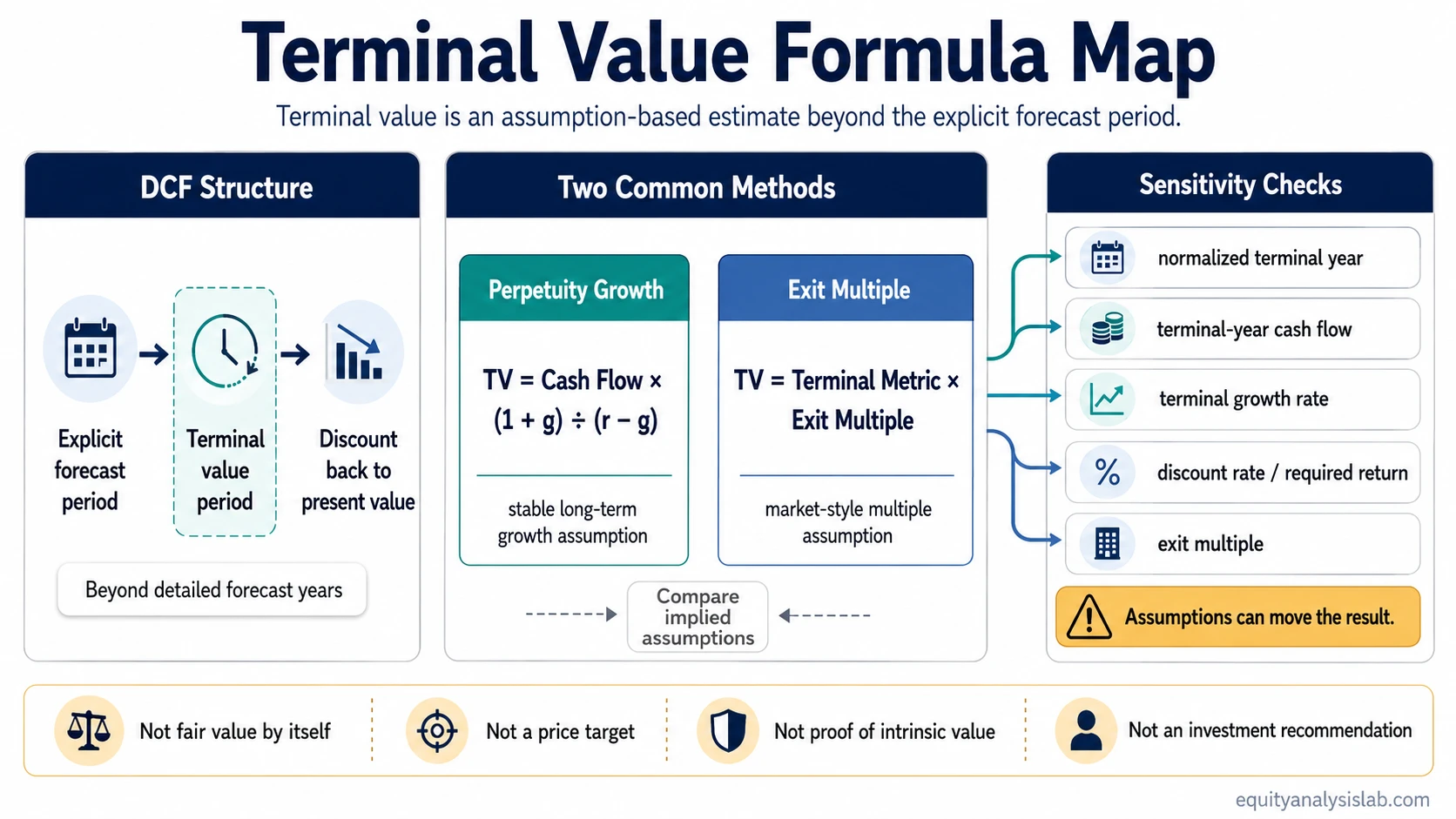
How Terminal Value Fits Into a DCF
A DCF separates future cash flows into a detailed forecast and a terminal period. Cash flows during the explicit forecast are estimated year by year. Terminal value represents the cash flows that follow, without requiring an individual forecast for every later year.
Present value of terminal value = Terminal value at Year n ÷ (1 + discount rate)n
Estimated firm value = Present value of forecast FCFF + Present value of terminal value
These formulas describe a firm valuation based on free cash flow to the firm (FCFF). If the model values cash flows available to common shareholders instead, the cash-flow basis and discount rate must both change to the corresponding equity measures.
Terminal Value Formula Methods
Perpetuity growth and exit multiples estimate continuing value from different assumptions.
| Method | Formula at the end of Year n | What must be checked |
|---|---|---|
| Perpetuity growth | TVn = FCFn × (1 + g) ÷ (r − g) | Normalized cash flow, sustainable growth, reinvestment and a matching discount rate. The formula requires g < r. |
| Exit multiple | TVn = Terminal-year metric × Selected multiple | A sustainable financial metric, a matching multiple, comparable businesses and a defensible future market context. |
In an FCFF-based enterprise valuation, r is normally WACC. When using an EBITDA-based exit multiple, the selected multiple should also be enterprise-value-based, such as EV/EBITDA. An equity multiple belongs with the corresponding equity-level financial measure.
The methods can be cross-checked by examining the growth and multiple assumptions implied by their outputs. Agreement between two estimates does not, by itself, establish that the assumptions are reasonable.
Worked Example: Terminal Value and Present Value
Assume a hypothetical firm has $100 million of normalized FCFF in Year 5. The model uses a 10% WACC and a 3% perpetual growth rate.
Year 6 FCFF = $100 million × 1.03 = $103 million
Terminal value at the end of Year 5 = $103 million ÷ (0.10 − 0.03) = $1,471.43 million
Present value of terminal value = $1,471.43 million ÷ 1.105 = $913.64 million
The $1,471.43 million figure is the estimated continuing value at the end of Year 5. The $913.64 million figure is its value at the model’s starting date under end-of-year discounting. The latter is added to the present value of the five explicitly forecast FCFF amounts to estimate firm value.
For a separate exit-multiple illustration, $200 million of normalized terminal-year EBITDA at an 8× EV/EBITDA multiple would produce a $1.6 billion terminal value before discounting. That figure reflects a different set of assumptions; it is not an independent confirmation of the perpetuity-growth result.
Normalize the Terminal Year Before Applying a Formula
Suppose Year 5 benefits from unusually strong demand and temporarily low costs. Capitalizing that year’s elevated cash flow or EBITDA as a permanent level may overstate continuing value.
The terminal base should reflect the operating level the business can reasonably sustain. A review may require adjustments to margins, working capital, taxes, maintenance investment and other reinvestment needs. The same normalization problem affects both terminal-value methods.
The transition from the detailed forecast to steady-state operations also needs to be coherent. A company still expanding rapidly in its final forecast year cannot automatically carry that operating structure into perpetuity.
Terminal Value Assumption Checks
| Input | Potential source of distortion | Review |
|---|---|---|
| Terminal-year cash flow or metric | A temporary earnings peak, unusually low capital expenditure or one-time working-capital release. | Compare the last forecast year with a sustainable operating level. |
| Perpetual growth rate | Growth that exceeds plausible long-run business economics or is unsupported by reinvestment. | Test growth and reinvestment together, including the return earned on additional capital. |
| Discount rate | A narrow r − g spread or a rate that does not match the cash-flow claim. | Run sensitivity cases and verify consistency between FCFF/WACC or FCFE/cost of equity. |
| Exit multiple | A peer mismatch, cyclical peak or a multiple inconsistent with the terminal business. | Check the selected metric, peer economics and the future operating conditions implied by the multiple. |
| Terminal-value timing | Using a Year n terminal value as though it were already a present value. | Discount it from the correct forecast date using the model’s timing convention. |
The cash-flow claim determines what the terminal amount represents and which adjustments are needed afterward.
Terminal value derived from FCFF or a consistent enterprise multiple contributes to estimated firm or operating-business value after discounting.
After firm value is estimated, debt, cash, non-operating assets and other relevant claims or adjustments may be needed to reach the value attributable to common shareholders.
CFA Institute distinguishes FCFF and FCFE valuation and their corresponding required returns. Aswath Damodaran explains the steady-state assumptions behind terminal value and why using a market multiple introduces relative-valuation assumptions into a DCF.
A narrow r − g spread, a high exit multiple or an overstated terminal cash-flow base can materially change the result. Review plausible assumption ranges and the share of estimated value attributable to the terminal period. The calculated terminal value is a model output, not a guaranteed future transaction price or a standalone conclusion about whether a stock is attractively valued.
Related Valuation Concepts
Review Terminal growth rate to test the perpetual-growth input and its relationship with reinvestment.
See how Enterprise value connects discounted firm cash flows with the broader valuation of the business.
Use Equity value to understand the adjustments between firm value and common-shareholder value.
Read Fair value for the broader valuation estimate in which terminal value may be one component.