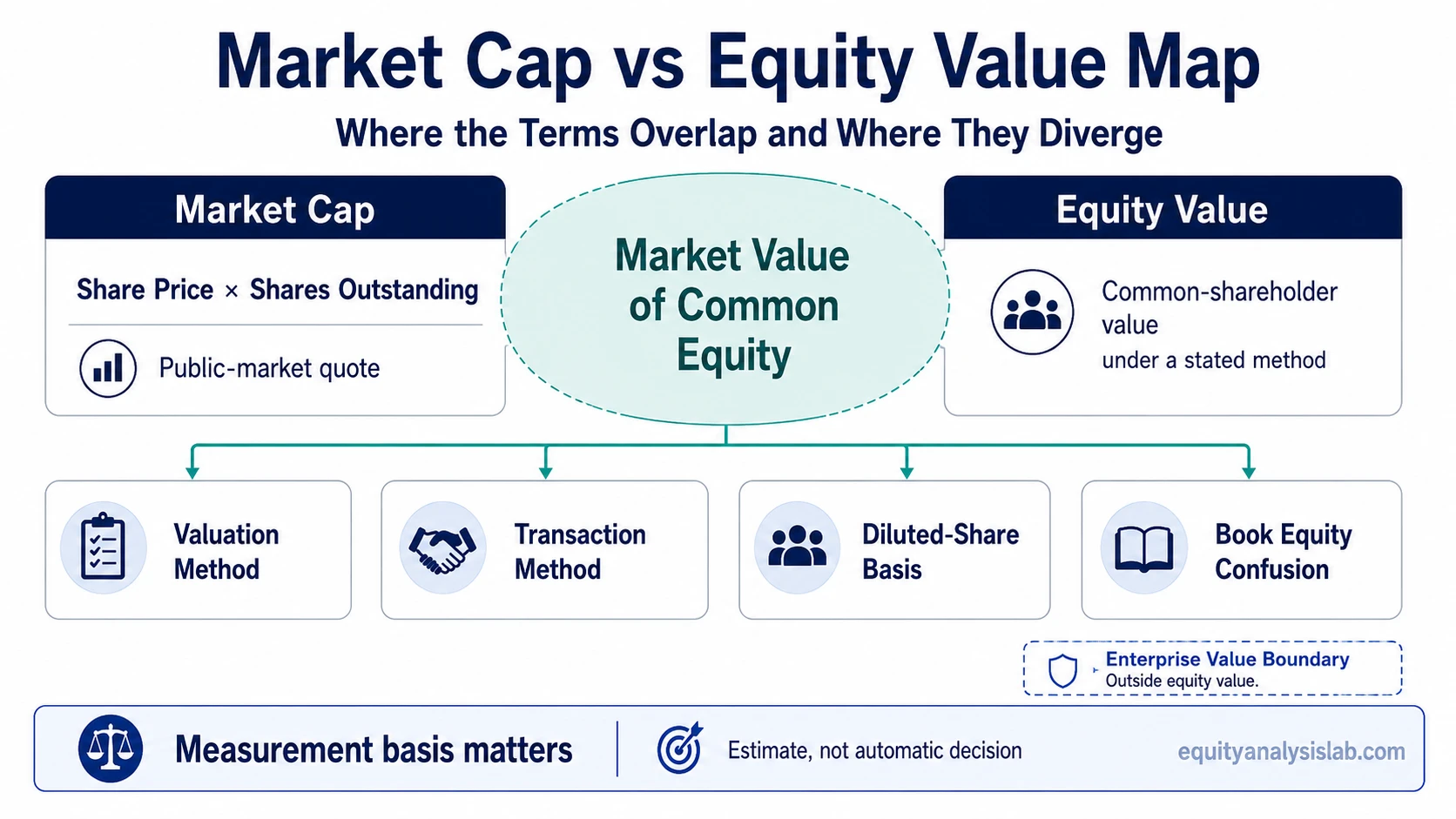
Market cap and equity value can point to the same common-shareholder claim, but they are not always used for the same investor question. Market cap is usually the public-market value of common shares at the current share price. Equity value can mean that same market value, or it can refer to a valuation method, transaction setting, diluted-share estimate, or book-equity basis where the inputs and interpretation change.
Market capitalization is calculated as share price multiplied by shares outstanding.
Equity value is broader in usage: it can describe the value attributable to common shareholders, but the calculation depends on whether the analyst is using a market quote, a valuation model, a transaction bridge, or an accounting statement.
Short answer: market cap and equity value overlap when both refer to the market value of a company’s common equity. They diverge when equity value is used as a valuation output, a transaction value to common shareholders, a diluted-share estimate, or when it is confused with book shareholders’ equity.
Key Points
- Market cap is usually a market quote: current share price multiplied by shares outstanding.
- Equity value can equal market value of equity, but the term changes meaning across valuation, transaction, dilution, and accounting use cases.
- Shareholders’ equity is a book accounting figure, not the same thing as market cap.
- Enterprise value is a separate firm-value concept that adjusts for capital structure items such as debt and cash.
The Short Difference
Market cap starts with the stock market. It answers a narrow question: what is the market currently assigning to the company’s listed common equity based on share price and shares outstanding?
Equity value starts with the common-shareholder claim. That claim may be measured through the market price, but it may also be estimated through valuation work, transaction analysis, or diluted ownership assumptions. The same phrase can therefore be accurate in one use case and misleading in another.
Overlap: if an analyst says “equity value” and means market value of common equity, it may be effectively the same as market cap.
Divergence: if an analyst is adjusting for diluted shares, moving from enterprise value to equity value, comparing book equity, or building a valuation model, market cap is only one possible reference point.
Market Cap vs Equity Value: Comparison Criteria
The useful distinction is the question each term answers.
| Criteria | Market Cap | Equity Value |
|---|---|---|
| Main question | What is the stock market valuing the listed common equity at right now? | What value is attributable to common shareholders in this analysis? |
| Common formula or source | Share price × shares outstanding. | Method-dependent: market value of equity, valuation model output, or enterprise-value-to-equity-value bridge. |
| Typical input | Current market price and share count. | Market price, diluted share count, valuation assumptions, transaction adjustments, or accounting basis. |
| Best use | Quick public-market size and listed equity value reference. | Common-shareholder value analysis in valuation, capital-structure, or transaction work. |
| Update behavior | Changes continuously as the share price changes. | Changes with the selected method, share count, valuation assumptions, and capital-structure treatment. |
| Main limitation | Does not explain debt, cash, preferred claims, or intrinsic value by itself. | Can be ambiguous unless the calculation basis is stated clearly. |
When Market Cap and Equity Value Overlap
The two terms overlap when equity value is being used as shorthand for market value of common equity. A company with a $40 share price and 100 million common shares outstanding has a market cap of $4.0 billion. If an analyst uses “equity value” to mean the market value of those common shares, the equity value is also $4.0 billion before any further adjustments.
This overlap is common in public-company discussion because the stock price already reflects a market estimate of the common equity claim. In that setting, the phrase “market value of equity” often sits between the two terms and explains why they can sound interchangeable.
Terminology check: overlap does not mean every use of equity value is identical to market cap. The term must be read from its measurement basis.
When Equity Value Means Something Different
Equity value can mean something different when the investor is not simply quoting the current public-market value of common shares. In valuation work, equity value may be the estimated value left for common shareholders after the analyst applies assumptions about cash flows, growth, discount rates, capital structure, and share count.
In transaction analysis, equity value may be derived from enterprise value after adjusting for debt, cash, preferred equity, minority interests, or similar claims. That does not make enterprise value the center of the comparison, but it explains why equity value often appears in capital-structure bridge work.
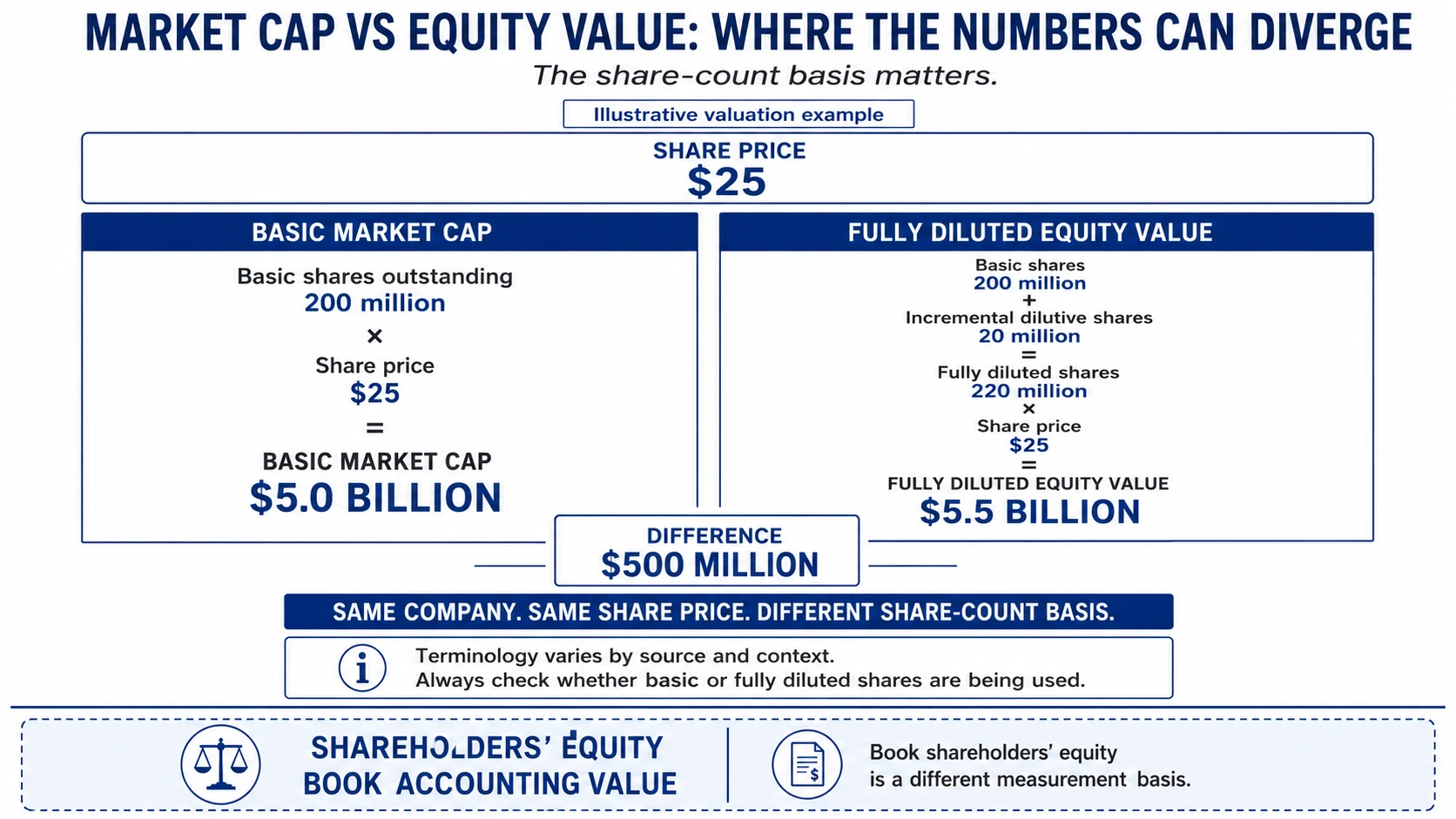
Dilution can also change the interpretation. A market cap based on basic shares outstanding may differ from an equity value per diluted share when options, restricted stock units, convertibles, or other potential shares are included in the analysis.
Limitation: equity value is not automatically intrinsic value, fair value, or a target price. It is a value attributable to common shareholders under a stated method or analytical setting.
Same-Company Example
A company trades at $25 per share and has 200 million basic shares outstanding. Its market cap is $5.0 billion.
| Question being asked | Relevant figure | Why the wording changes |
|---|---|---|
| What is the current public-market value of the common shares? | $5.0 billion market cap. | The answer comes directly from share price and basic shares outstanding. |
| What common-shareholder value results from a valuation or transaction method? | Equity value under the selected valuation or transaction method. | The answer may use enterprise value adjustments, diluted shares, or model assumptions. |
| What is the accounting value of shareholder claims on the balance sheet? | Shareholders’ equity, not market cap. | The answer comes from accounting book values rather than the stock market quote. |
Measurement takeaway: the same company can have one market cap, a valuation-derived equity value, and a separate book shareholders’ equity figure. Confusion starts when the same word “equity” is used without naming the measurement basis.
Common Confusion Trap
The most common mistake is treating every equity-related term as if it describes the same number. Market cap, market value of equity, shareholders’ equity, and enterprise value sit near each other, but they answer different questions.
| Term | What it usually means | Common mistake |
|---|---|---|
| Market cap | Market price of common shares multiplied by shares outstanding. | Treating it as a full-company value that includes debt and cash adjustments. |
| Market value of equity | Usually the market value of common equity. | Assuming it always includes every possible diluted ownership claim. |
| Equity value | Common-shareholder value under the stated analytical setting. | Using the phrase without specifying market, valuation, transaction, or diluted-share basis. |
| Shareholders’ equity | Book accounting value on the balance sheet. | Comparing it directly with market cap without recognizing book-versus-market differences. |
| Enterprise value | Value of the operating business before separating common equity from other capital claims. | Expanding a market cap comparison into a full capital-structure analysis too early. |
When Each Term Is More Useful
Market cap is more useful when the task is quick public-market comparison. It can help compare company size, listed equity value, and market-implied common-share value across public companies. It is less useful when the analysis needs to separate operating value from debt, cash, preferred claims, or dilution.
Equity value is more useful when the analysis asks what common shareholders own after the relevant valuation or transaction method is applied. It is the better term when the investor needs to reconcile valuation output, ownership dilution, or capital-structure adjustments with the common-shareholder claim.
Decision rule: use market cap when the answer comes from the current share price and shares outstanding. Use equity value when the answer depends on which common-shareholder claim is being measured and how that claim is calculated.
Enterprise Value Boundary
Enterprise value belongs in this comparison only as a boundary. Market cap looks at listed common equity, while enterprise value moves toward operating-business value by adjusting for capital-structure items such as debt and cash.
Equity value often appears after enterprise value has been adjusted back to the common-shareholder claim. That bridge matters, but the core distinction here remains simpler: market cap is a market quote for common equity, while equity value is a method-dependent common-shareholder value measure.
FAQ
Is market cap the same as equity value?
Market cap can be the same as equity value when equity value means the market value of common equity. The terms diverge when equity value is used in valuation, transaction, diluted-share, or accounting contexts.
Is market cap the same as market value of equity?
Market cap is commonly used as the market value of common equity for a public company. The wording can still depend on share-count assumptions and whether the analysis includes only listed common shares.
Is shareholders’ equity the same as market cap?
No. Shareholders’ equity is an accounting book value from the balance sheet. Market cap is based on the stock market price and shares outstanding.
Does equity value mean intrinsic value?
Not automatically. Equity value describes value attributable to common shareholders under a stated context. Intrinsic value is a valuation estimate based on assumptions about future cash flows, risk, growth, and required return.