
ETF tracking error measures how consistently an exchange-traded fund follows the returns of its benchmark. It is a diagnostic metric for benchmark-following behavior, not a return forecast, fund-quality proof, or complete investment decision.
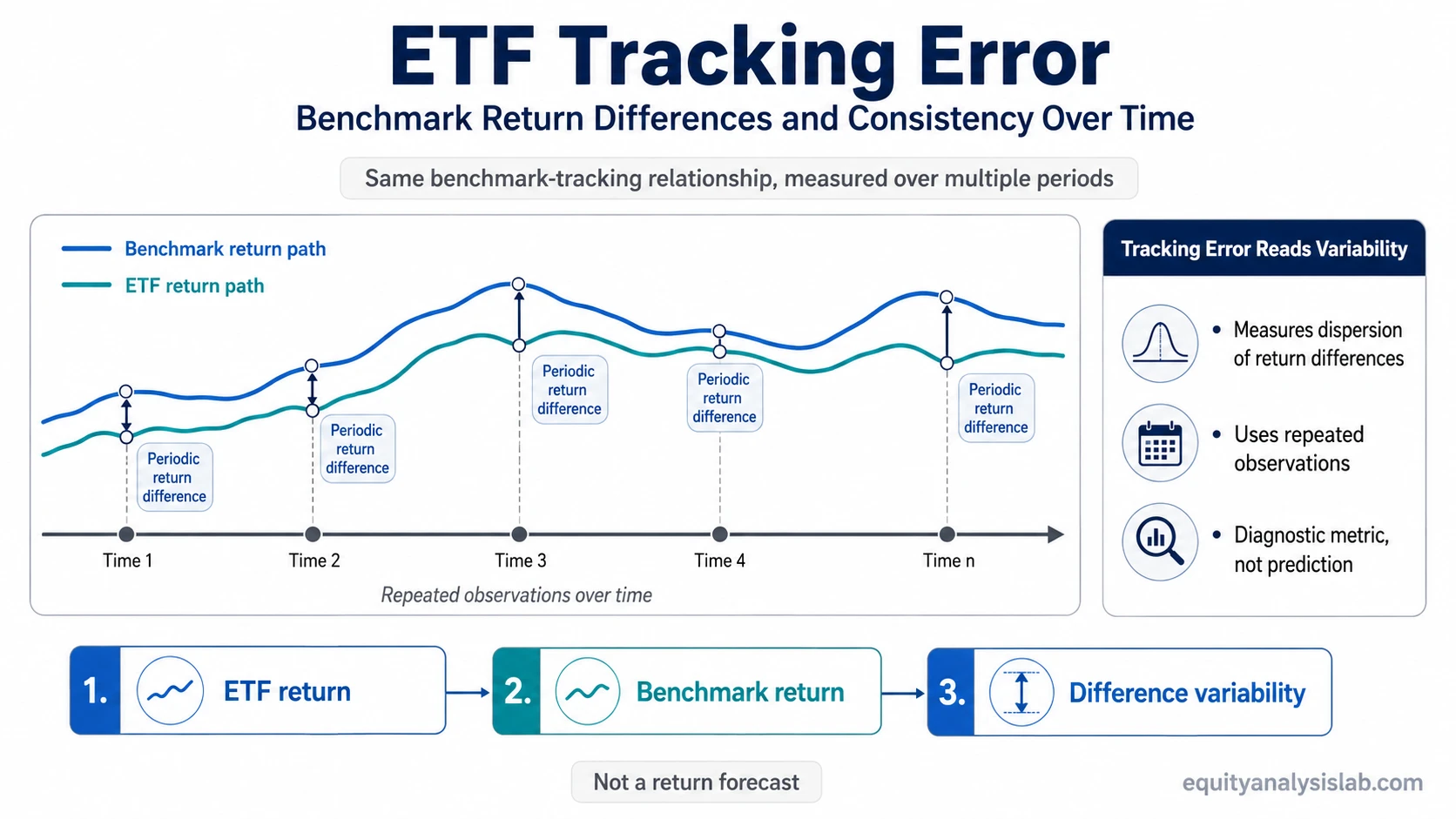
Definition: ETF tracking error is the variability of the difference between an ETF’s returns and the returns of the index or benchmark it is designed to track. A lower tracking error usually means the ETF’s return pattern stayed closer to the benchmark over the measured period, while a higher tracking error means the return differences were more variable.
Key Points
- ETF tracking error focuses on consistency versus a benchmark, not absolute performance.
- The metric is usually based on the standard deviation of periodic ETF return minus benchmark return differences.
- Fees, holdings, sampling, rebalancing, liquidity, distributions, taxes, and market-price frictions can all affect the result.
- Low tracking error does not automatically mean better investor fit, lower total cost, or stronger future returns.
What ETF Tracking Error Means
An ETF normally has a stated benchmark, such as an equity index, bond index, factor index, sector index, or commodity-linked reference. Tracking error asks whether the ETF’s returns moved closely with that benchmark over time.
The concept is most useful when the ETF is expected to replicate or closely follow an index. If the benchmark rises 1.0% during a period and the ETF rises 0.9%, the difference for that period is negative 0.1 percentage points. Tracking error does not stop at one difference. It looks at how those differences vary across many periods.
That makes ETF tracking error a consistency metric. A fund can have a small average gap from its benchmark but still show uneven differences across daily, weekly, or monthly observations. The unevenness is what tracking error is designed to capture.
ETF Tracking Error Formula and Inputs
The standard idea behind tracking error is simple: calculate the return difference between the ETF and its benchmark for each observation period, then measure the standard deviation of those differences.
Basic structure:
Tracking error = standard deviation of periodic (ETF return − benchmark return)
| Input | What it means | Why it matters |
|---|---|---|
| ETF return | The ETF’s return for each measurement period | Provides the fund-side return series |
| Benchmark return | The index or benchmark return for the same periods | Provides the reference return series |
| Return difference | ETF return minus benchmark return for each period | Creates the tracking deviation series |
| Measurement period | Daily, weekly, monthly, or another consistent interval | Changes how short-term variation is captured |
| Standard deviation | The dispersion of the return differences | Turns the differences into a tracking consistency metric |
Generic example: if an ETF’s daily return differences versus its benchmark are small and stable, tracking error will usually be lower. If those differences swing from slightly above the benchmark to meaningfully below it across the measured periods, tracking error will usually be higher. The example is illustrative only and does not describe any specific ETF.
Some presentations annualize tracking error after calculating periodic return differences. The measurement basis should be checked before comparing figures from different sources, because daily, monthly, and annualized tracking-error figures are not directly interchangeable.
Tracking Error vs Tracking Difference
Tracking error and tracking difference are related, but they answer different questions. The related concept of tracking difference focuses on the actual return gap between the ETF and benchmark over a period.
| Concept | Main question | Typical interpretation |
|---|---|---|
| Tracking error | How variable were the ETF’s return differences versus the benchmark? | Consistency of benchmark following |
| Tracking difference | How far did the ETF’s return end up from the benchmark over the period? | Realized performance gap versus the benchmark |
An ETF can have a small tracking difference over a full period but still show meaningful short-term tracking error inside that period. The reverse can also happen when short-term deviations offset each other by the end of the measurement window.
What Can Cause ETF Tracking Error
ETF tracking error can come from the way the ETF holds or samples benchmark exposure, the costs embedded in the fund structure, and the market conditions under which the ETF trades or rebalances.
| Driver | How it can affect tracking error |
|---|---|
| Holdings match | An ETF that does not hold every benchmark constituent may deviate from the benchmark return path. |
| Weighting differences | Small differences between ETF weights and benchmark weights can create return differences as constituents move. |
| Replication method | Full replication, sampling, and synthetic or derivative-based exposure can produce different tracking behavior. |
| Fees and fund expenses | Recurring fund costs can create a drag between ETF returns and benchmark returns. |
| Liquidity and trading spreads | Market-price frictions, including the bid-ask spread, can affect investor execution and market-price observations, even when the fund’s NAV-based tracking behavior is measured separately. |
| Rebalancing | Index changes, fund rebalancing, and timing differences can create temporary gaps versus the benchmark. |
| Distributions | Dividends, interest, withholding effects, and reinvestment timing can change fund-versus-index return alignment. |
| Taxes and local market structure | Tax treatment, settlement timing, and market access frictions can affect how cleanly benchmark exposure is delivered. |
| Cash drag and securities lending | Cash holdings, collateral, lending revenue, or lending constraints can alter fund return behavior versus the benchmark. |
The fund’s creation and redemption process can also matter because large-block share creation or redemption helps connect ETF share supply with the underlying basket or cash process.
When the market price of an ETF moves away from fund-value references, ETF arbitrage mechanics can help explain why those gaps may narrow or persist under different liquidity conditions.
How Investors Should Interpret ETF Tracking Error
ETF tracking error is best treated as one input in fund analysis. It can help compare how consistently different ETFs follow similar benchmarks, but it does not explain total cost, liquidity, tax treatment, exposure design, or portfolio fit by itself.
A lower tracking error can indicate tighter benchmark-following behavior, especially for index ETFs where close replication is expected. That does not automatically mean the ETF is the better choice. Expense ratio, tracking difference, tax treatment, liquidity, spread cost, exposure design, portfolio role, and investor time horizon can still change the interpretation.
Interpretation boundary: tracking error is a benchmark-consistency diagnostic. It is not a recommendation signal, a measure of future return, or proof that the ETF is suitable for a specific portfolio.
The metric is also more useful when the benchmark is clear and comparable. Tracking error is harder to interpret when funds use different benchmarks, different replication methods, different currency exposure, or different distribution treatment.
When Tracking Error Can Mislead
Tracking error can look reassuring when the ETF stays close to its benchmark, but that closeness may not solve the investor’s real question. A fund can track its benchmark closely while the benchmark itself is unsuitable for the intended exposure, too concentrated, too volatile, or too expensive to access efficiently.
Common misuse: low tracking error does not guarantee better returns, lower all-in costs, lower risk, stronger liquidity, or better portfolio fit.
Tracking error can also miss costs or frictions that appear outside the return series being measured. Execution spreads, tax impact, distribution timing, and the difference between net asset value behavior and market-price execution may still matter for the investor’s actual outcome.
For funds using sampling or less liquid holdings, tracking error may change across market regimes. Calm markets can make benchmark tracking look stable, while stressed markets can reveal liquidity, rebalancing, or pricing frictions that were less visible before.
Related ETF Concepts
Tracking error sits inside a wider ETF mechanics framework. The closest related concepts are tracking difference, bid-ask spread, creation and redemption, and arbitrage behavior between ETF shares and the underlying fund value.
| Concept | Why it matters beside tracking error |
|---|---|
| Tracking difference | Separates realized benchmark return gap from the variability of return differences. |
| Bid-ask spread | Connects benchmark-following analysis with the trading cost an investor may face when buying or selling ETF shares. |
| Creation and redemption | Explains how ETF share supply can adjust through large-block transactions involving the issuer and authorized participants. |
| ETF arbitrage | Clarifies how market-price deviations from fund-value references may be reduced or extended by market mechanics. |
FAQ
What is ETF tracking error?
ETF tracking error is the variability of the difference between an ETF’s returns and its benchmark returns over a defined period. It measures consistency of benchmark following rather than total return or fund quality.
How do you check the tracking error of an ETF?
Use the ETF return series and the matching benchmark return series for the same intervals, calculate the return difference for each interval, and measure the standard deviation of those differences. The source, time period, and annualization method should be consistent when comparing figures.
Is tracking error the same as tracking difference?
No. Tracking error measures the variability of return differences, while tracking difference measures the realized return gap between the ETF and its benchmark over a period.
Is lower ETF tracking error always better?
Not always. Lower tracking error can indicate closer benchmark-following consistency, but it does not guarantee better returns, lower total costs, stronger liquidity, tax efficiency, or suitability for a portfolio.