
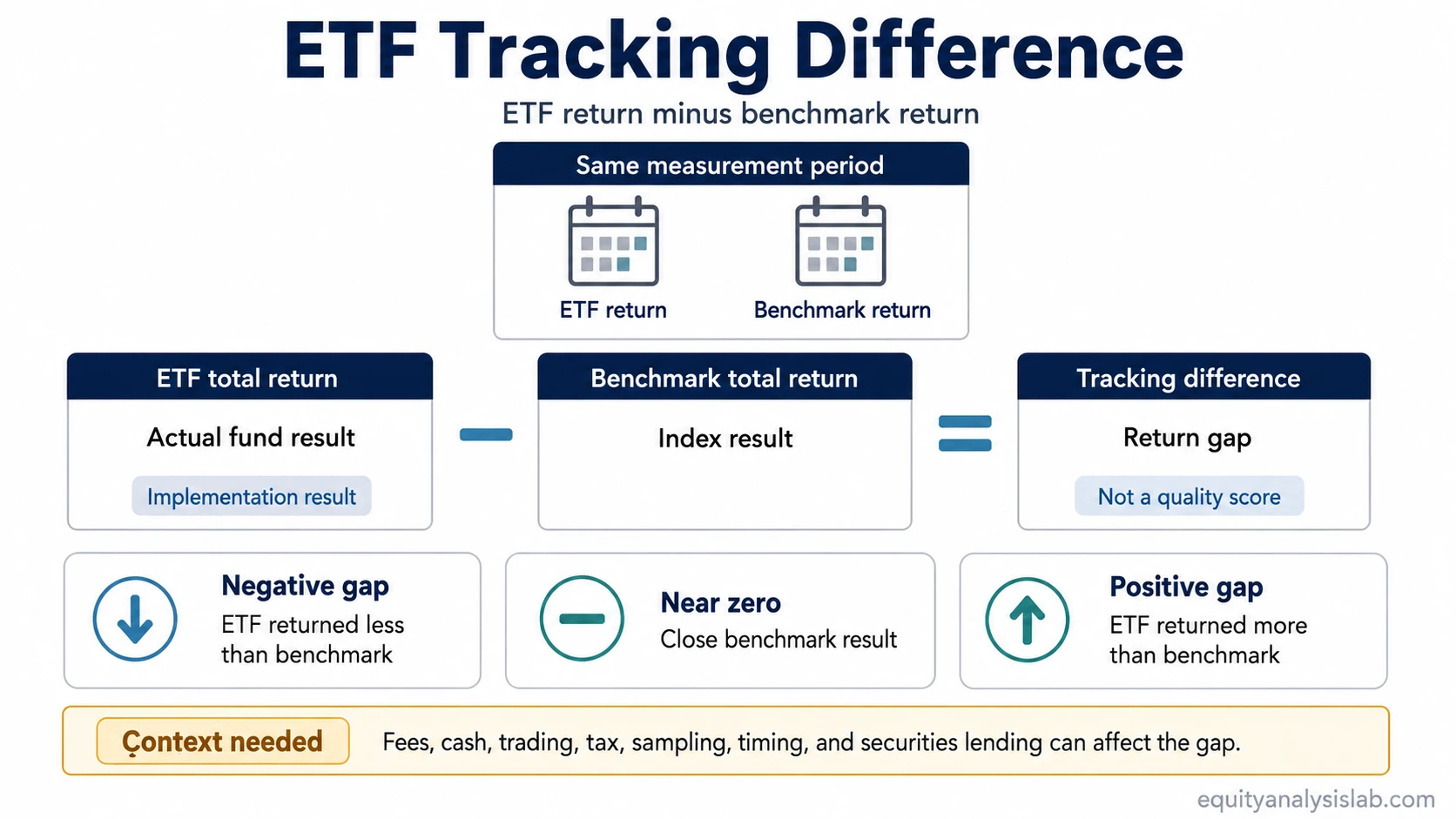
ETF tracking difference is the realized return gap between an ETF and the benchmark it is designed to track over a specific period. It is usually measured as ETF total return minus benchmark total return, so the sign and size of the gap show how closely the fund’s actual result matched the index after fees, cash, trading, tax, and implementation effects.
Definition: ETF tracking difference measures the difference between an ETF’s total return and its benchmark’s total return over the same period.
Basic formula: ETF total return − benchmark total return = tracking difference.
Key points
- Tracking difference measures the realized return gap between the ETF and its benchmark over a defined period.
- The usual formula is ETF total return minus benchmark total return.
- A negative tracking difference means the ETF returned less than the benchmark for that period, while a positive tracking difference means it returned more.
- Expense ratio is one possible cause of tracking difference, but fees do not explain every gap.
- The metric helps interpret fund implementation, but it should not be used as a standalone fund ranking.
What ETF tracking difference means
ETF tracking difference is a period-based measurement. It compares the ETF’s actual total return with the return of the index or benchmark the ETF is trying to follow.
If the ETF return is lower than the benchmark return, the tracking difference is negative. If the ETF return is higher than the benchmark return, the tracking difference is positive. The sign is useful, but it does not explain the cause by itself.
A tracking difference can reflect fund costs, cash held inside the portfolio, index rebalancing, replication choices, dividend timing, tax treatment, securities lending, or market timing effects. That is why the number should be read as an implementation result, not as an automatic judgment about fund quality.
How ETF tracking difference is calculated
The standard calculation compares the ETF’s total return with the benchmark’s total return over the same measurement period.
| Input | Example value | Role in the calculation |
|---|---|---|
| Benchmark total return | 10.0% | The return of the index or benchmark over the period. |
| ETF total return | 9.7% | The ETF’s actual total return over the same period. |
| Tracking difference | -0.3 percentage points | ETF total return minus benchmark total return. |
If a benchmark returns 10.0% over a year and the ETF returns 9.7% over the same period, the ETF’s tracking difference is -0.3 percentage points. That gap may reflect fees, cash drag, trading costs, tax treatment, replication choices, or timing effects rather than one single cause.
The period matters. A one-month tracking difference, one-year tracking difference, and three-year tracking difference can show different patterns because costs, distributions, index changes, and market conditions do not affect every period in the same way.
Real ETF example: IVV
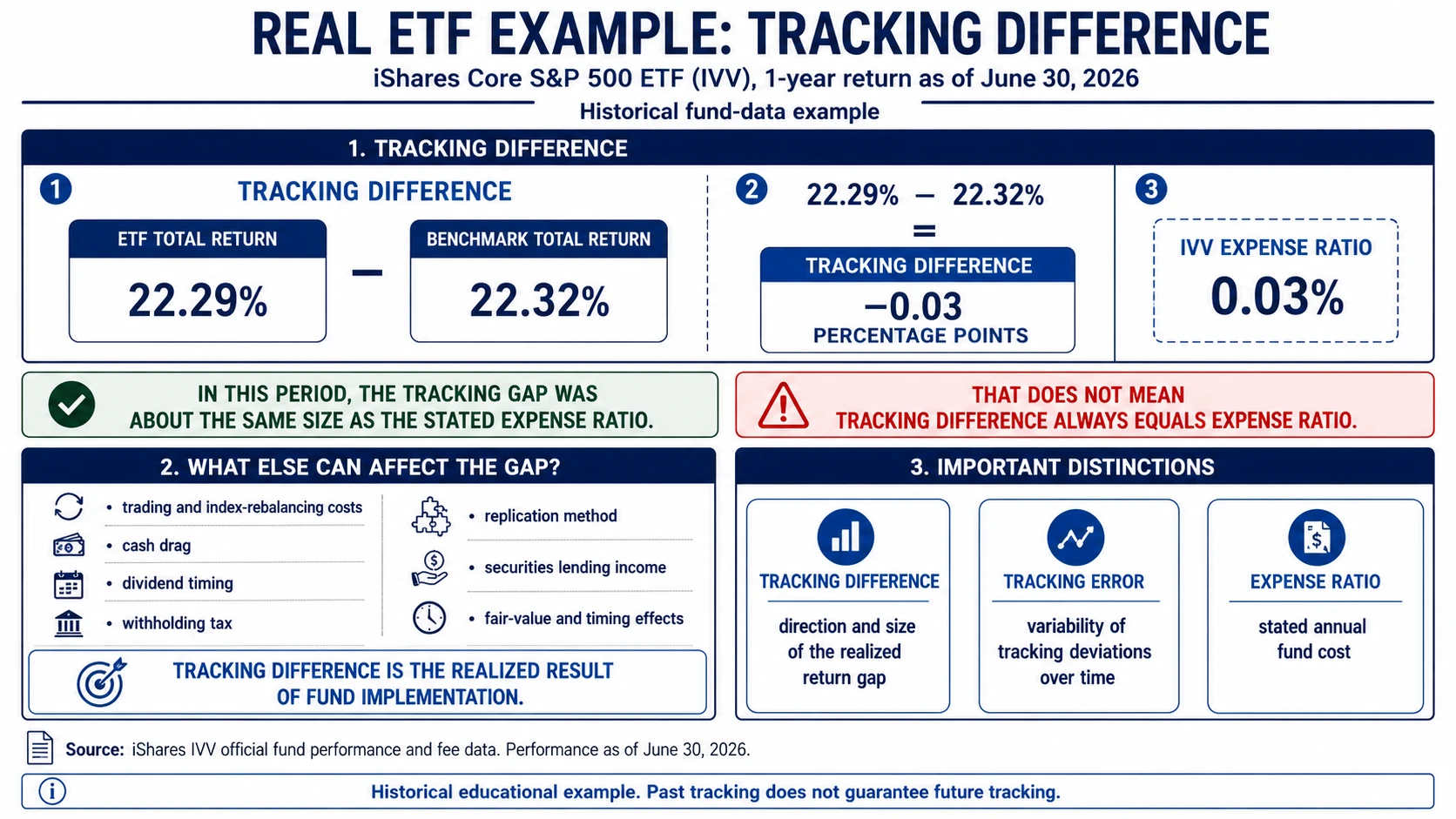
A real historical example makes the concept easier to interpret. For the one-year period ending June 30, 2026, iShares Core S&P 500 ETF, ticker IVV, reported a total return of 22.29%, while its benchmark, the S&P 500 Index, returned 22.32%.
Using the standard formula, the tracking difference for that period was:
22.29% − 22.32% = −0.03 percentage points
IVV also had a stated expense ratio of 0.03%. In that specific period, the realized tracking gap was about the same size as the stated fee, but that should not be turned into a rule. Tracking difference does not always equal the expense ratio, because the final gap can also reflect trading and rebalancing costs, cash drag, dividend timing, withholding tax, replication choices, securities lending, or fair-value and timing effects.
Practical takeaway: tracking difference is the realized result of fund implementation. Expense ratio is one input, not the full explanation.
Tracking difference vs tracking error vs expense ratio
Tracking difference, tracking error, and expense ratio are related, but they answer different questions. The cleanest way to separate them is to ask whether the metric measures a return gap, the variability of that gap, or a stated cost.
| Metric | What it measures | What it does not tell you by itself |
|---|---|---|
| Tracking difference | The realized return gap between the ETF and its benchmark over a period. | It does not identify the exact cause of the gap without more context. |
| Tracking error | How much the ETF’s return differences fluctuate around the benchmark over time. | It does not show whether the ETF finished above or below the benchmark over a specific period. |
| Expense ratio | The stated annual fund cost charged by the ETF provider. | It does not capture every source of tracking difference, such as tax, cash, trading, sampling, or securities lending effects. |
An ETF can have a low expense ratio and still show tracking difference if other implementation effects are material. It can also show a smaller gap than its expense ratio alone might imply if offsets, timing, or portfolio mechanics work in its favor during the measured period.
What causes ETF tracking difference
Tracking difference is usually a combination of several implementation effects. Some reduce ETF return relative to the benchmark, while others can partly offset costs in certain periods.
| Source of difference | Likely effect | What to check |
|---|---|---|
| Expense ratio | Usually reduces ETF return relative to the benchmark. | Check the stated annual expense ratio and whether the benchmark return is shown gross or net of certain costs. |
| Trading and rebalancing costs | Can reduce return when the fund trades to match index changes or cash flows. | Check turnover, index reconstitution frequency, and whether the ETF has to trade less liquid underlying assets. |
| Sampling or replication method | Can create a gap if the ETF holds a representative basket instead of every benchmark constituent. | Check whether the ETF uses full replication, sampling, optimization, or synthetic exposure. |
| Cash drag | Can reduce tracking when part of the portfolio is held in cash instead of benchmark assets. | Check cash balances, distribution timing, and how subscriptions or redemptions are handled. |
| Dividend timing and distribution policy | Can affect the measured return gap depending on when income is received, reinvested, or distributed. | Check the fund’s distribution policy and whether return comparisons are made on a total-return basis. |
| Withholding tax | Can reduce fund return relative to a benchmark that assumes a different tax treatment. | Check fund domicile, index methodology, and whether benchmark returns are gross, net, or tax-adjusted. |
| Securities lending | Can partly offset costs, but the effect is not guaranteed and depends on the fund’s program. | Check whether securities lending income is disclosed and how much of it is retained by the fund. |
| Fair-value and timing effects | Can create short-term gaps when ETF pricing, underlying markets, or index valuation times do not line up perfectly. | Check the measurement period and whether underlying markets were open, closed, or moving across different time zones. |
Trading costs can also show up through market execution. A wider bid-ask spread affects what investors pay or receive when they trade the ETF, while tracking difference focuses on the fund’s realized return versus the benchmark over the measured period.
How investors should interpret tracking difference
Tracking difference is most useful when it is read in context: same benchmark, same return period, same return basis, and comparable fund structure. Without those controls, the metric can look cleaner or worse than it really is.
A negative tracking difference does not automatically mean the ETF is poorly managed. It may simply reflect costs, taxes, cash, dividend timing, or benchmark assumptions. A positive tracking difference also should not be treated as proof of superior future tracking, because the cause may be temporary or period-specific.
Useful checks include the fund factsheet, ETF website, index methodology, replication method, distribution treatment, tax assumptions, and the time period used in the comparison. The goal is to understand why the ETF’s realized return differed from the benchmark, not to turn one number into a product ranking.
Common mistake: treating tracking difference as a quality score
Tracking difference is not a standalone quality score. A small gap is not automatically proof that one ETF will track better in the future, and a large gap may need explanation before it becomes a useful judgment.
The mistake is reading the number without checking the benchmark return basis, the fund’s costs, the replication method, distribution timing, tax treatment, and whether the period being measured is representative. The same tracking difference can have different meanings depending on fund structure and market conditions.
Related ETF concepts
Tracking difference is part of the broader ETF implementation picture. The closest related concept is tracking error, because it separates the realized gap from the variability of that gap. ETF trading costs and market structure can also matter, but they should not be merged into the tracking difference definition.
- Creation and redemption explains the primary-market mechanism that allows ETF shares to be created or redeemed around portfolio baskets.
- ETF arbitrage helps explain why ETF market prices can stay connected to underlying portfolio value, without turning tracking difference into a premium/discount concept.
FAQ
Can ETF tracking difference be positive?
Yes. A positive tracking difference means the ETF returned more than its benchmark over the measured period. That can happen because of securities lending income, timing effects, benchmark assumptions, tax treatment, or other fund-specific mechanics. It should not be treated as proof that the ETF will outperform in the future.
Does a negative tracking difference mean an ETF is bad?
No. A negative tracking difference means the ETF returned less than its benchmark over the measured period. The cause may be normal fund costs, cash drag, trading costs, withholding tax, sampling, or distribution timing. The number needs context before it becomes useful.
Is ETF tracking difference the same as expense ratio?
No. Expense ratio is the stated annual cost of the fund. Tracking difference is the realized return gap between the ETF and its benchmark. Expense ratio can contribute to tracking difference, but it is not the only cause.
What period should be used for tracking difference?
The period should match the comparison being made. One-year, three-year, and shorter-period tracking differences can all be useful, but they may show different results because costs, distributions, cash levels, market timing, and benchmark changes vary over time.