
ETF arbitrage is the mechanism that can help an ETF’s market price stay close to the value of its underlying holdings. When an ETF trades above or below NAV, authorized participants may use creation and redemption to adjust ETF share supply when the potential price gap is large enough relative to trading costs and risk.
The important boundary is who can use the mechanism directly. Ordinary investors usually trade ETF shares on the exchange, while authorized participants operate in the primary market with the ETF issuer. That makes ETF arbitrage a structural pricing mechanism inside the ETF structure, not a simple retail trading strategy.
Key Points About ETF Arbitrage
- ETF arbitrage links an ETF’s exchange price with the value of the underlying basket.
- Authorized participants can create or redeem ETF shares with the issuer, but they are not required to act whenever a price gap appears.
- A premium can strengthen the incentive to create ETF shares, while a discount can strengthen the incentive to redeem them.
- Small premiums or discounts may persist when they are smaller than the costs and risks of closing the gap.
- Apparent premiums or discounts can also reflect stale underlying prices, closed markets, illiquidity, or market stress.
What ETF Arbitrage Means
ETF arbitrage is the process by which institutional participants can help reduce the gap between an ETF’s market price and the value of the assets it represents. The gap usually appears as a premium, when the ETF trades above estimated NAV, or a discount, when it trades below estimated NAV.
The word arbitrage can sound like a guaranteed trade, but ETF arbitrage is better understood as an incentive mechanism. A price difference must be large enough to justify the transaction costs, hedging requirements, financing needs, settlement risk, and uncertainty involved in creating or redeeming ETF shares.
That means an efficiently functioning ETF does not have to trade at exactly NAV at every moment. Small differences can remain when the potential economic benefit of closing them is smaller than the friction involved.
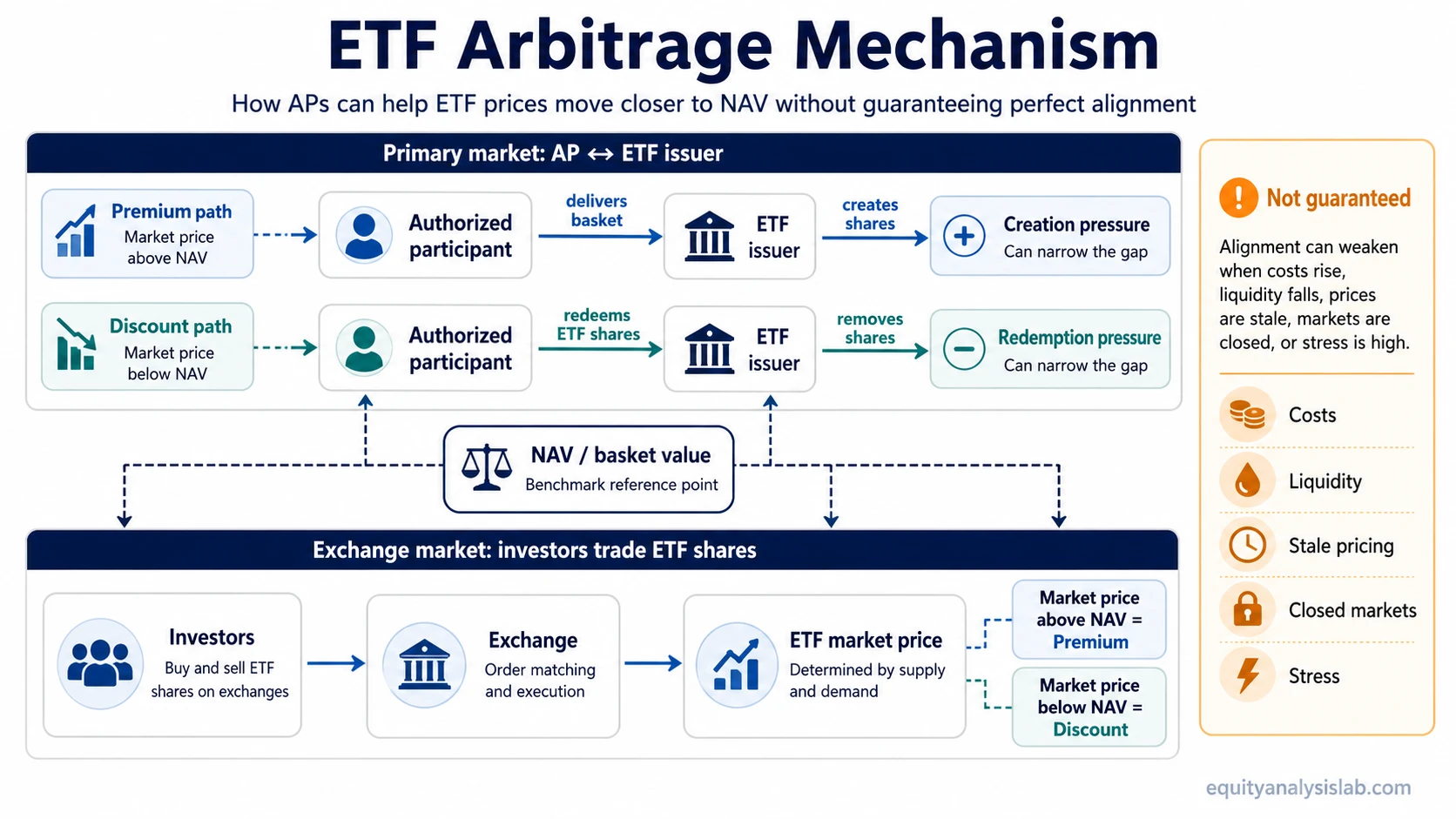
How Authorized Participants Create the Link
Authorized participants, often called APs, are institutions that have agreements allowing them to transact directly with the ETF issuer. They are different from ordinary investors, who normally buy and sell ETF shares in the secondary market through an exchange.
The AP connection links two markets. In the secondary market, ETF shares trade between investors. In the primary market, APs can exchange baskets of underlying securities or cash with the issuer through creation and redemption.
| Part of the Mechanism | What Happens | Why It Matters |
|---|---|---|
| Secondary market | Investors trade ETF shares with each other on an exchange. | This is where the ETF market price is formed. |
| Primary market | Authorized participants transact with the ETF issuer. | This is where ETF share supply can be created or reduced. |
| Underlying basket | The ETF portfolio or creation basket provides the economic reference for the ETF shares. | It helps determine whether a market-price gap may create an arbitrage incentive. |
| Arbitrage incentive | An AP may act when the expected benefit of the price gap exceeds relevant costs and risks. | Creation or redemption can pressure market price and underlying value back toward each other. |
Important boundary: APs can create or redeem ETF shares directly with the issuer, but the existence of that access does not require them to transact every time a premium or discount appears.
How Premium and Discount Arbitrage Works
A premium means the ETF trades above the estimated value of its underlying holdings. If the gap becomes economically attractive, an authorized participant may acquire or deliver the required basket, receive newly created ETF shares, and sell those shares into the secondary market. The additional ETF share supply can put downward pressure on the premium.
A discount means the ETF trades below the estimated value of its underlying holdings. An authorized participant may buy ETF shares in the market, redeem them with the issuer, and receive the underlying basket or cash value. Reducing the number of ETF shares available can help narrow the discount.
The important condition is economic incentive. A visible premium or discount does not automatically mean that an AP can earn a meaningful profit after execution costs, hedging, financing, settlement, and uncertainty in the basket value are considered.
Why ETF Price Does Not Have to Equal NAV Exactly
ETF arbitrage can create a range around estimated NAV where small price differences are not large enough to justify institutional arbitrage activity. The width of that range depends on the cost and risk of trading the ETF and its underlying assets.
Illustrative case 1: Estimated basket value is $100.00 per ETF share. Assume the combined trading, hedging, financing, and execution friction is approximately $0.30. If the ETF trades at $100.15, the visible premium is only $0.15.
In this simplified example, the price gap is smaller than the assumed friction. The ETF can therefore trade above estimated NAV without creating a strong economic reason for an arbitrage participant to close the gap.
Illustrative case 2: Keep the estimated basket value at $100.00 and the assumed friction at $0.30, but let the ETF trade at $100.70. The $0.70 premium is now much larger than the assumed costs, so the potential incentive for creation-based arbitrage is stronger.
Illustrative relationship: observed price gap greater than estimated trading and hedging frictions → stronger arbitrage incentive.
This is a conceptual break-even framework rather than a universal AP profit formula. Real transactions depend on the composition of the basket, execution prices, financing, hedging, taxes, settlement terms, market access, and other institutional costs.
A Premium or Discount Can Reflect Stale NAV
A price/NAV gap does not always mean the ETF market price is the stale or incorrect number. Sometimes the ETF continues to trade while part of the underlying portfolio is closed, thinly traded, or valued using prices that have not yet incorporated new information.
In that situation, the ETF market price can move first. The resulting premium or discount may partly reflect a timing difference between a continuously traded ETF and a slower-moving NAV reference.
| Situation | What May Be Happening | Interpretation |
|---|---|---|
| Underlying market actively trading | Both ETF price and underlying prices can incorporate current information. | A persistent gap may provide a more meaningful pricing signal. |
| Foreign market closed | The ETF continues trading while some underlying security prices remain unchanged. | An apparent premium or discount may partly reflect different market hours. |
| Thinly traded bonds | ETF shares trade continuously while some bond valuations update less frequently. | The ETF price may incorporate current market information faster than reported NAV. |
| Market stress | Both trading costs and uncertainty about underlying value increase. | A wider premium or discount may reflect liquidity and valuation uncertainty rather than a simple pricing error. |
Interpretation rule: before calling a premium or discount a mispricing, check whether the NAV reference is based on underlying assets that are actively and reliably priced at the same time as the ETF.
What Determines Whether ETF Arbitrage Works Well
The mechanism is generally easier to use when the ETF portfolio is transparent, underlying assets are liquid, prices are current, and institutional participants can trade and hedge the basket efficiently. Frictions become more important as those conditions weaken.
| Condition | Why It Matters | What an Investor May Observe |
|---|---|---|
| Transaction costs | Creation or redemption must be economically worthwhile after execution costs. | Small premiums or discounts may persist without triggering strong arbitrage activity. |
| Underlying liquidity | APs need to trade or hedge the underlying basket efficiently. | ETFs holding less-liquid securities can show wider or more persistent gaps. |
| Current underlying prices | Arbitrage requires a reasonably reliable estimate of basket value. | Stale prices can make the reported premium or discount less informative. |
| Aligned market hours | Simultaneous trading makes price comparison and hedging easier. | International ETFs can show larger apparent gaps when foreign markets are closed. |
| Market volatility | Rapid price changes increase hedging risk and execution uncertainty. | Premiums, discounts, and spreads can widen during volatile periods. |
| Arbitrage capacity | Institutional participants must be willing and able to commit balance-sheet capacity. | Gaps can persist longer when market makers or APs face higher funding or risk constraints. |
Limitation: ETF arbitrage is a price-alignment pressure mechanism, not a promise that every premium or discount will disappear immediately.
What Ordinary Investors Can Observe
Ordinary investors usually cannot observe every institutional arbitrage calculation, but they can review the market conditions that affect how a premium or discount should be interpreted.
| Observable | What It Can Show | Interpretation Limit |
|---|---|---|
| NAV or estimated intraday value | A reference point for comparing ETF price with the underlying portfolio. | The estimate becomes less reliable when underlying assets are stale, illiquid, or closed. |
| Premium or discount | The size and direction of the price gap relative to estimated NAV. | The gap can reflect normal trading frictions or valuation timing. |
| Bid-ask spread | The visible cost of immediately buying or selling ETF shares. | A small premium or discount can still exist alongside a wide bid-ask spread. |
| Trading volume and depth | How readily ETF shares appear to trade in the secondary market. | ETF volume alone does not fully describe the liquidity of the underlying basket. |
| Underlying market status | Whether the securities inside the ETF are actively trading at the same time. | Closed or slow-moving markets can make NAV comparisons less precise. |
Why Ordinary Investors Are Not Usually Doing ETF Arbitrage
Most investors trade ETF shares with other investors on an exchange. They do not normally assemble creation baskets, deliver them to the issuer, or redeem institutional creation units for underlying securities.
For a retail investor, the practical value of understanding arbitrage is therefore interpretation. A premium, discount, widening spread, or unusual price/NAV gap can signal that the investor should examine underlying liquidity, market hours, pricing quality, and market stress before placing a trade.
ETF arbitrage explains why the ETF wrapper can remain connected to the underlying portfolio. It does not turn every visible gap into a retail arbitrage opportunity.
How ETF Arbitrage Connects to ETF Liquidity
ETF arbitrage and ETF liquidity are related, but they describe different parts of the trading system. Liquidity describes the ability to transact in ETF shares and underlying securities. Arbitrage describes the incentive and primary-market mechanism that can connect ETF market price with portfolio value.
Liquid underlying holdings make creation, redemption, and hedging easier. Less-liquid holdings increase transaction costs and uncertainty, which can widen the range of price/NAV differences that institutional participants may tolerate before acting.
That is why ETF price interpretation should combine premiums and discounts with spreads, underlying-market liquidity, trading hours, and the reliability of the NAV reference.
Common Mistakes When Reading ETF Arbitrage
| Mistake | Why It Is Misleading | Better Interpretation |
|---|---|---|
| Assuming every premium or discount is an opportunity | The gap may be smaller than trading and hedging costs. | Compare the size of the gap with the likely frictions involved in closing it. |
| Assuming NAV is always the correct real-time price | Underlying prices can be stale, estimated, or based on a closed market. | Check whether the underlying basket is actively priced at the same time as the ETF. |
| Assuming APs must eliminate a gap | Authorized participants have access to creation and redemption but are not required to use it whenever a gap appears. | Treat arbitrage as an economic incentive that depends on costs, risk, and capacity. |
| Ignoring underlying liquidity | The ETF can trade actively while some holdings are expensive or difficult to transact. | Review ETF liquidity together with the liquidity of the underlying basket. |
| Confusing retail trading with primary-market activity | Ordinary investors normally trade ETF shares on the exchange rather than creating or redeeming institutional units. | Separate secondary-market trading from the AP and issuer mechanism. |
FAQ
Is ETF arbitrage a strategy for ordinary investors?
Usually no. ETF arbitrage primarily describes the institutional mechanism connecting ETF market prices with underlying portfolio value through authorized-participant creation and redemption. Ordinary investors usually access the ETF through secondary-market trading.
Does ETF arbitrage guarantee that an ETF trades at NAV?
No. Small price differences can remain because arbitrage involves costs and risk. Larger differences can also persist when the underlying market is illiquid, closed, difficult to value, or under stress.
Can the ETF price be more current than NAV?
Yes. When underlying securities are not actively trading or their reported values update slowly, the ETF market price can incorporate newer information before the published or estimated NAV fully reflects it.