
A portfolio review process is a diagnostic sequence used to determine whether a portfolio is still being judged against the right structure, measurement basis, and constraints before any maintenance decision is considered.
The process separates observation from interpretation. A portfolio may show different weights, more cash, higher concentration, or greater turnover than before, but those observations do not become useful findings until the reference mix, denominator, time basis, and reason for the review are clear.
Definition: A portfolio review process compares the portfolio’s current structure with the reference structure, assumptions, and constraints used to judge it. Its first job is diagnosis, not automatic rebalancing.
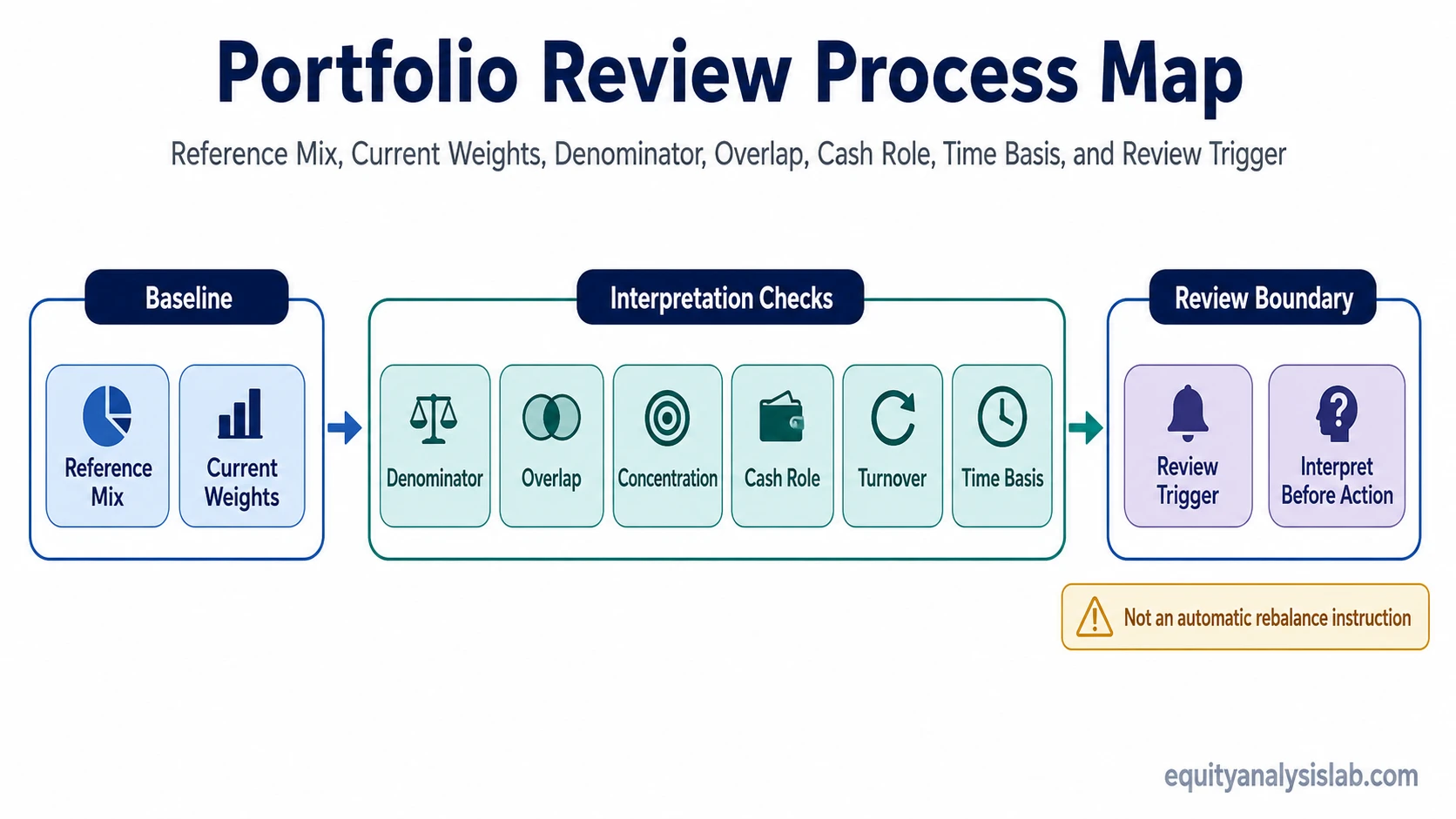
Key Points
- A portfolio review organizes evidence before action.
- The reference mix, denominator, cash role, and time basis should be established before current weights are interpreted.
- The same portfolio can produce different diagnostic conclusions when the measurement basis changes.
- Drift, concentration, cash, and turnover are diagnostic findings, not automatic instructions to trade.
- A valid review can conclude that no portfolio change is needed.
What a Portfolio Review Process Checks
A useful review does more than list holdings or compare today’s weights with an earlier snapshot. It first establishes what the portfolio is supposed to be compared with and how the measurements should be constructed.
That means identifying the intended reference mix, the denominator used for portfolio weights, the relevant time period, the role of cash, and the reason the review was triggered. Only after those inputs are clear does it make sense to interpret concentration, overlap, drift, or turnover.
Core principle: measurement basis first, portfolio diagnosis second, maintenance decision last.
Same Portfolio, Different Diagnostic Result
A portfolio can appear to have drifted even when its underlying invested allocation has not changed. The difference can come entirely from the denominator used in the review.
Illustrative portfolio:
Total account value: $100,000
Stocks: $54,000
Bonds: $36,000
Recent contribution held temporarily in cash: $10,000
Reference invested allocation: 60% stocks / 40% bonds
If every position is divided by the full $100,000 account value, the portfolio appears to contain:
| Position | Weight using total account value |
|---|---|
| Stocks | 54% |
| Bonds | 36% |
| Cash | 10% |
Compared mechanically with a 60/40 reference mix, that snapshot appears to show both stocks and bonds below target.
But assume the $10,000 cash balance is a recent contribution that has not yet entered the long-term allocation. The invested portfolio is therefore $90,000. Using invested assets as the denominator:
Stocks: $54,000 ÷ $90,000 = 60%
Bonds: $36,000 ÷ $90,000 = 40%
The underlying invested allocation still matches the 60/40 reference mix exactly. The apparent mismatch came from combining temporary contribution cash with the denominator used to judge the invested allocation.
Diagnostic lesson: the observation did not change. The portfolio still contained $54,000 of stocks, $36,000 of bonds, and $10,000 of cash. What changed was the question being asked and the denominator appropriate to that question.
This does not mean cash should always be excluded. If the reference portfolio explicitly includes a strategic cash allocation, total portfolio value may be the correct denominator. The review has to establish the role of the cash and the reference structure before choosing the calculation basis.
Portfolio Review Diagnostic Sequence
The order of the review matters because later findings depend on earlier measurement choices. Concentration, drift, and cash exposure can all look different when the reference mix or denominator is wrong.
| Diagnostic stage | What to establish | What it prevents |
|---|---|---|
| 1. Reference structure | The intended asset mix, portfolio buckets, position roles, or other structure being used for comparison. | Judging current weights against a target the portfolio was never designed to follow. |
| 2. Measurement basis | The denominator, review date, time period, and treatment of contributions, withdrawals, and temporary cash. | False drift, misleading concentration readings, and inconsistent comparisons. |
| 3. Exposure reconstruction | Current weights, overlapping holdings, sectors, factors, cash, and major business-driver exposures. | Assuming that holding count or account labels represent true diversification. |
| 4. Issue classification | Whether the evidence points to drift, concentration, a cash-role change, turnover, or another portfolio mismatch. | Combining unrelated portfolio observations into one generic problem. |
| 5. Decision gate | Whether the finding requires no action, further analysis, monitoring, or a later maintenance decision. | Turning every diagnostic observation into an automatic trade. |
Why Reference Mix, Denominator, and Time Basis Come First
These inputs determine what the later numbers actually mean.
The reference mix establishes what the portfolio is being compared with. Without it, a current weight is only a number. A 25% sector allocation cannot be called excessive, underweight, or normal until the portfolio’s intended structure and the role of that exposure are known.
The denominator establishes the base of the calculation. Total account value, invested assets, risk assets, and a specific portfolio sleeve can all be valid denominators for different questions. Problems arise when one denominator is used to answer a question that belongs to another.
The time basis establishes whether the observation is temporary or persistent. A recent contribution, withdrawal, price move, or portfolio transaction can distort a short snapshot without representing a lasting change in portfolio structure.
False diagnostic risk: precise calculations can still produce weak conclusions when the reference mix, denominator, or time basis does not match the question being reviewed.
Drift, Concentration, Cash, and Turnover Are Different Findings
Once the measurement basis is established, the review can classify what actually changed.
Current weights may reveal meaningful allocation drift, but drift requires a valid reference point. A higher weight caused by market appreciation is an observation first. Whether it represents an unwanted mismatch depends on the intended portfolio structure.
Concentration asks whether too much portfolio behavior depends on one company, sector, factor, theme, or underlying economic driver. Holding count alone may miss that exposure when different holdings overlap.
Cash is a role question before it becomes a performance question. A recent contribution, planned withdrawal reserve, pending allocation, and unintended idle balance may all appear as cash in the portfolio snapshot. The relevant first interpretation may therefore be the cash position rather than a portfolio problem.
Turnover is different again. It describes how much portfolio replacement or trading activity occurred. Higher turnover may deserve review, but it does not by itself prove that the underlying decisions were unnecessary or undisciplined.
Cash Balance Does Not Automatically Mean Cash Drag
Common mistake: seeing a visible cash balance and immediately classifying it as a performance problem.
Better sequence: identify why the cash exists, whether it belongs inside the reference allocation, how long it has remained there, and what exposure it replaced. Only then determine whether cash drag is the relevant diagnosis.
The worked example above shows why this matters. Temporary contribution cash changed the total account weights without changing the underlying 60/40 invested allocation. Treating the cash as immediate evidence of drift or drag would skip the measurement-basis step.
Portfolio Review vs Rebalancing Decision
A portfolio review can identify a mismatch without deciding what should happen next. This separation prevents a diagnostic process from turning into a mechanical trading rule.
Portfolio review: establishes the reference and measurement basis, reconstructs exposures, and identifies possible drift, concentration, cash, turnover, or other mismatches.
Rebalancing decision: evaluates whether a confirmed mismatch should be changed after considering objectives, constraints, taxes, transaction costs, risk capacity, and the investor’s maintenance rules.
A valid review can therefore produce several outcomes. The portfolio may still match its intended structure. A finding may require monitoring rather than action. A measurement issue may need to be corrected. Or a confirmed mismatch may move to a separate maintenance decision.
What a Portfolio Review Cannot Tell You
Limitations: A portfolio review cannot predict future returns, prove that a portfolio is safe, identify a universally correct allocation, or determine what an investor should buy or sell. Its role is to improve the quality of the evidence used before those separate decisions are considered.
The process also cannot remove investor-specific judgment. Two portfolios with similar holdings can require different interpretations because liquidity needs, risk capacity, taxes, time horizon, objectives, and reference allocations differ.
That is why a useful review is not defined by the longest checklist. It is defined by whether each calculation and observation answers the correct portfolio question.
Portfolio Review Framework Summary
A strong portfolio review follows a dependency order. Establish the reference structure first. Fix the denominator and time basis next. Reconstruct the actual exposures. Then classify any mismatch. Only after those steps should a finding move toward a possible maintenance decision.
The sequence matters because the same holdings can produce different diagnostic conclusions when the measurement basis changes. A portfolio review becomes useful when it explains why a number matters, not merely when it calculates the number correctly.
FAQ
Is a portfolio review process the same as rebalancing?
No. A portfolio review identifies and interprets portfolio evidence. Rebalancing is a separate maintenance decision that may or may not follow from the review.
Why does the denominator matter in a portfolio review?
The denominator determines what each portfolio weight represents. Total account value, invested assets, risk assets, and individual portfolio sleeves can answer different questions. Using the wrong denominator can create a misleading drift or concentration reading.
Can a portfolio review show that no action is needed?
Yes. A review may confirm that the portfolio still matches its intended structure, that a visible cash balance has a valid role, or that an apparent mismatch came from the measurement basis rather than from the portfolio itself.
What can trigger a portfolio review?
A review can be scheduled, threshold-based, event-driven, or triggered by a portfolio mismatch, contribution, withdrawal, major price move, thesis change, or another change in the investor’s circumstances.