SaaS Churn Rate

SaaS churn rate measures the percentage of customers or recurring revenue a SaaS company loses from an existing customer base over a measured period. Customer churn, also called logo churn, counts lost customers. Revenue churn measures lost recurring revenue, usually through lost accounts, cancellations, downgrades, or contraction.

For investors, the useful question is not only whether churn is high or low. The more important question is what type of churn is being measured, what revenue base is used, which customer cohort is included, and whether expansion from retained customers is masking weakness in the existing base.

Key Points

  • SaaS churn rate can be calculated by customer count or by recurring revenue.
  • Customer churn and revenue churn can move differently when customer sizes vary.
  • New customer revenue is excluded from churn calculations because churn measures losses from an existing base.
  • ARR or MRR context matters because the same churn percentage can have a different business impact depending on revenue concentration and contract structure.
  • A “good” SaaS churn rate is not universal. Peer group, customer segment, contract length, maturity, and disclosure quality all change the interpretation.

What Is SaaS Churn Rate?

SaaS churn rate is the rate at which a software-as-a-service company loses customers, subscriptions, or recurring revenue from an existing customer base during a specific period. It is usually measured monthly, quarterly, or annually.

The metric belongs to recurring-revenue analysis. A SaaS business can keep reporting growth while still losing part of its existing customer base if new sales are large enough to replace the lost revenue. That is why churn should be read alongside the calculation base, the period, and the customer segment being measured.

Definition: SaaS churn rate is the percentage of existing SaaS customers or recurring revenue lost during a measured period, before adding new customer revenue.

SaaS Churn Rate Formula

There is no single churn formula that answers every SaaS analysis question. Customer churn focuses on lost accounts or logos. Revenue churn focuses on lost recurring revenue. Both formulas require a clear beginning base and a consistent measurement period.

Formula type Basic formula What it answers
Customer churn rate Lost customers during period ÷ customers at beginning of period × 100 What percentage of the starting customer base left?
Revenue churn rate Lost recurring revenue during period ÷ recurring revenue at beginning of period × 100 What percentage of the starting recurring revenue base was lost?

The denominator needs to match the question being analyzed. If the analysis is based on MRR, the denominator is beginning monthly recurring revenue. If it is based on ARR, the denominator is beginning annual recurring revenue. Mixing monthly losses with annual bases, or using an average base without disclosure, can make churn rates harder to compare.

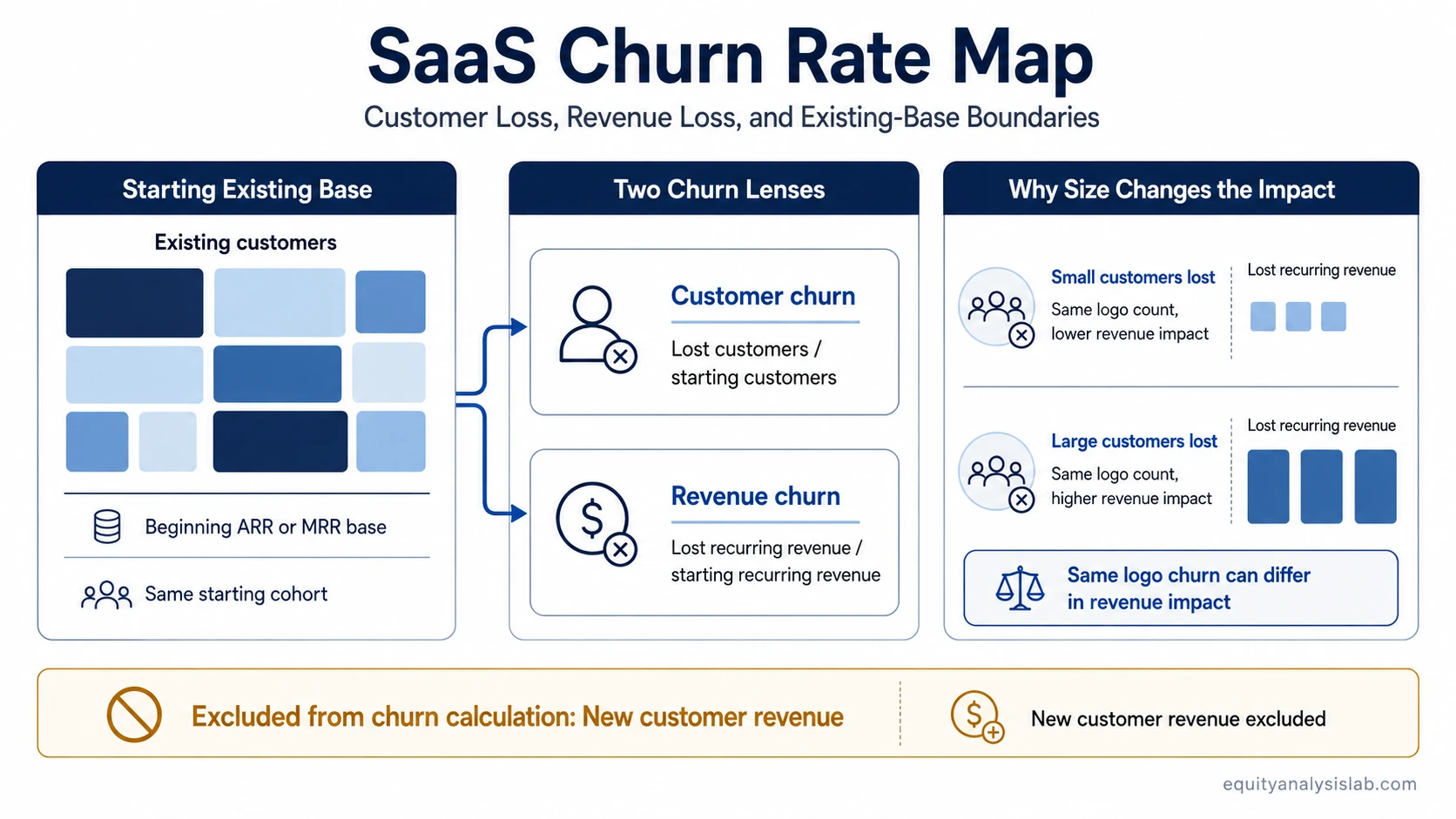
SaaS churn rate map comparing customer churn, revenue churn, excluded new customer revenue, and different revenue impact from the same lost customer count.
Customer churn counts lost customers, while revenue churn shows how much recurring revenue those losses remove from the existing base.

What Is Included and Excluded in SaaS Churn?

The cleanest churn reading starts with the existing customer cohort. It then measures what was lost from that cohort during the period. New customers are excluded because they belong to acquisition growth, not churn.

Item Treatment in churn analysis Reason
Cancelled customers Included in customer churn They reduce the starting customer base.
Lost recurring revenue from cancellations Included in revenue churn It reduces recurring revenue from existing customers.
Downgrades or contraction Usually included in revenue churn The customer may stay, but recurring revenue falls.
New customer revenue Excluded It reflects acquisition, not retention of the starting base.
Expansion from existing customers Excluded from gross churn, included in net retention metrics Expansion can offset losses, but it answers a different question.
Trials, pauses, reactivations, or freemium users Disclosure-dependent Definitions vary by company and reporting system.

This boundary matters because a company can show strong new bookings while existing customers are leaving. Churn analysis isolates the existing base so the reader can separate retention quality from new sales activity.

Customer Churn vs Revenue Churn

Customer churn and revenue churn are related, but they are not interchangeable. Customer churn counts lost customers. Revenue churn measures the recurring revenue lost from those customers or from contraction inside retained accounts.

Metric Focus Main use Main limitation
Customer churn / logo churn Number of customers lost Shows customer-base retention Does not show whether the lost customers were small or large
Revenue churn Recurring revenue lost Shows ARR or MRR impact Can hide how many customers left if losses are concentrated in smaller accounts

A company that loses many small customers may report higher logo churn but modest revenue churn. A company that loses one large enterprise customer may report lower logo churn but a much larger revenue impact. That difference is central to SaaS company analysis because the revenue base is often unevenly distributed.

Gross Churn, Net Retention, NRR, and GRR

Gross churn looks at losses before expansion offsets them. Net retention metrics can include expansion, upsells, cross-sells, or price increases from retained customers. That difference changes the interpretation.

Gross revenue retention, or GRR, focuses on how much recurring revenue remains from the existing base before expansion. Net revenue retention, or NRR, can rise above 100 percent when expansion from retained customers is larger than churn and contraction. Strong NRR can be useful, but it should not erase the need to understand gross churn.

Boundary: Churn measures loss from the existing base. Net retention measures what remains after losses and, depending on the formula, expansion from retained customers. A SaaS company can have attractive net retention while still carrying meaningful gross churn underneath.

Compact SaaS Churn Example

Consider a SaaS company that begins the month with 100 customers and $100,000 in MRR. During the month, it loses 5 customers.

Scenario Customers lost MRR lost Customer churn Revenue churn
Five small customers leave 5 $2,500 5.0% 2.5%
One large customer and four small customers leave 5 $15,000 5.0% 15.0%

The customer churn rate is the same in both scenarios because 5 of 100 customers left. The revenue churn rate is very different because the size of the lost customers changed. This is why logo churn is weaker when it is read without revenue context.

What Is a Good SaaS Churn Rate?

A good SaaS churn rate depends on the business model, customer segment, contract length, product category, and company maturity. A self-serve SaaS product selling to small businesses may naturally show different churn behavior than an enterprise SaaS company with annual contracts and large implementation costs.

Benchmark comparisons are useful only when the peer set is close enough. Segment, contract length, average contract value, pricing model, and measurement period all matter. A low churn rate is not automatically evidence of a strong investment, and a higher churn rate is not automatically disqualifying if the company has a different customer mix or lifecycle stage.

Limit: Churn benchmarks should not be read as universal SaaS quality thresholds. They are more useful when the comparison set has similar customer size, product category, contract duration, and disclosure definitions.

How Investors Can Interpret SaaS Churn Rate

For investors, SaaS churn rate is most useful when it is connected to revenue durability. High churn can force a company to spend more on new acquisition just to keep recurring revenue flat. Low churn can reduce the replacement burden, but it still needs to be read with growth, acquisition cost, pricing power, and product expansion.

Churn also affects the quality of reported SaaS growth. If a company adds new customers rapidly while existing customers leave at a high rate, growth may depend heavily on continued sales and marketing efficiency. If churn is low and expansion is strong, recurring revenue may be more durable, but valuation still depends on margins, cash flow, competitive position, and expectations.

Investor question Why churn matters
Is growth durable? High churn means more new revenue is needed to replace lost existing revenue.
Is the product sticky? Lower customer churn may indicate stronger retention, switching costs, or product fit.
Is revenue concentrated? Revenue churn can reveal whether lost large customers create outsized ARR or MRR pressure.
Are valuation multiples supported? Higher-quality recurring revenue may support stronger interpretation of SaaS valuation multiples, but churn alone is not enough.

Common SaaS Churn Rate Mistakes

The most common mistake is treating every churn figure as if it measures the same thing. One company may report logo churn, another may report gross revenue churn, and another may emphasize net retention. These are different lenses.

Mistake Why it weakens analysis
Comparing monthly churn with annual churn The periods are not equivalent unless converted carefully.
Mixing customer churn and revenue churn Customer count and recurring revenue can tell different stories.
Ignoring customer size Losing one large account can matter more than losing many small accounts.
Including new revenue in churn New revenue belongs to acquisition analysis, not churn analysis.
Reading NRR without gross churn Expansion can offset losses and make underlying churn less visible.

SaaS Churn Rate and Related Metrics

SaaS churn rate becomes more useful when it is read alongside acquisition cost, sales efficiency, and valuation context. A company with high churn may need stronger acquisition performance to maintain growth, so SaaS customer acquisition cost can help show how expensive replacement growth may be.

Sales efficiency metrics can add another layer. The SaaS magic number helps frame how efficiently sales and marketing spend turns into new recurring revenue. If churn is high and sales efficiency is weak, the company may face a harder path to durable growth.

Valuation also matters. Churn can affect how investors read SaaS valuation multiples, but it should not be isolated from gross margin, revenue growth, free cash flow, competitive position, and expected durability.

Disclosure Limits in Public SaaS Churn Data

Public companies do not always disclose churn in the same way. Some report net retention, some report gross retention, some disclose customer counts, and some provide limited churn commentary without a clean formula. Private SaaS operators may track churn in more detail internally than public filings show externally.

That disclosure gap means churn analysis often requires caution. If the exact formula, cohort, period, or revenue base is unclear, the metric should be treated as a partial signal rather than a complete retention diagnosis.

Related SaaS Metrics

SaaS churn rate becomes more useful when it is read with nearby recurring-revenue metrics rather than in isolation. ARR and MRR define the recurring revenue base. GRR and NRR show how much of that base remains after churn, contraction, and sometimes expansion. CAC and sales-efficiency metrics show how costly it may be to replace lost revenue.

The practical reading is sequential: first identify whether churn is customer-based or revenue-based, then check the recurring revenue base, then compare it with retention, acquisition cost, growth efficiency, and valuation context.

FAQ

Is SaaS churn rate the same as customer churn?

No. Customer churn is one version of SaaS churn rate. It measures lost customers or logos. SaaS churn can also be measured as revenue churn, which focuses on lost recurring revenue.

Should new customer revenue be included in SaaS churn rate?

No. New customer revenue is excluded from churn because churn measures losses from the existing customer base. New customer revenue belongs to acquisition and growth analysis.

Can a SaaS company have high customer churn but low revenue churn?

Yes. This can happen when many small customers leave but larger customers remain. It can also happen when expansion from retained customers offsets some revenue pressure in net retention metrics.

Why is there no universal good SaaS churn rate?

Customer segment, contract length, product category, ACV, company maturity, and disclosure method all affect churn interpretation. A churn rate that looks acceptable in one SaaS model may be weak in another.