
Price and value can refer to the same company, but they answer different investor questions: price shows what the market is quoting now, while value estimates what the business or security may be worth under a specific set of assumptions.
Price vs value, in investing, separates an observable market number from an estimated worth figure. Price is visible in a quote, transaction, or market capitalization figure. Value is judged through future cash flows, asset quality, risk, growth, competitive position, and the assumptions used to interpret those inputs.
The confusion comes from the fact that both terms can point to the same stock at the same moment. A share may trade at $40, while one investor estimates its value at $48 and another estimates it at $34. The price is shared by the market. The value estimate depends on the model, assumptions, and required margin for error.
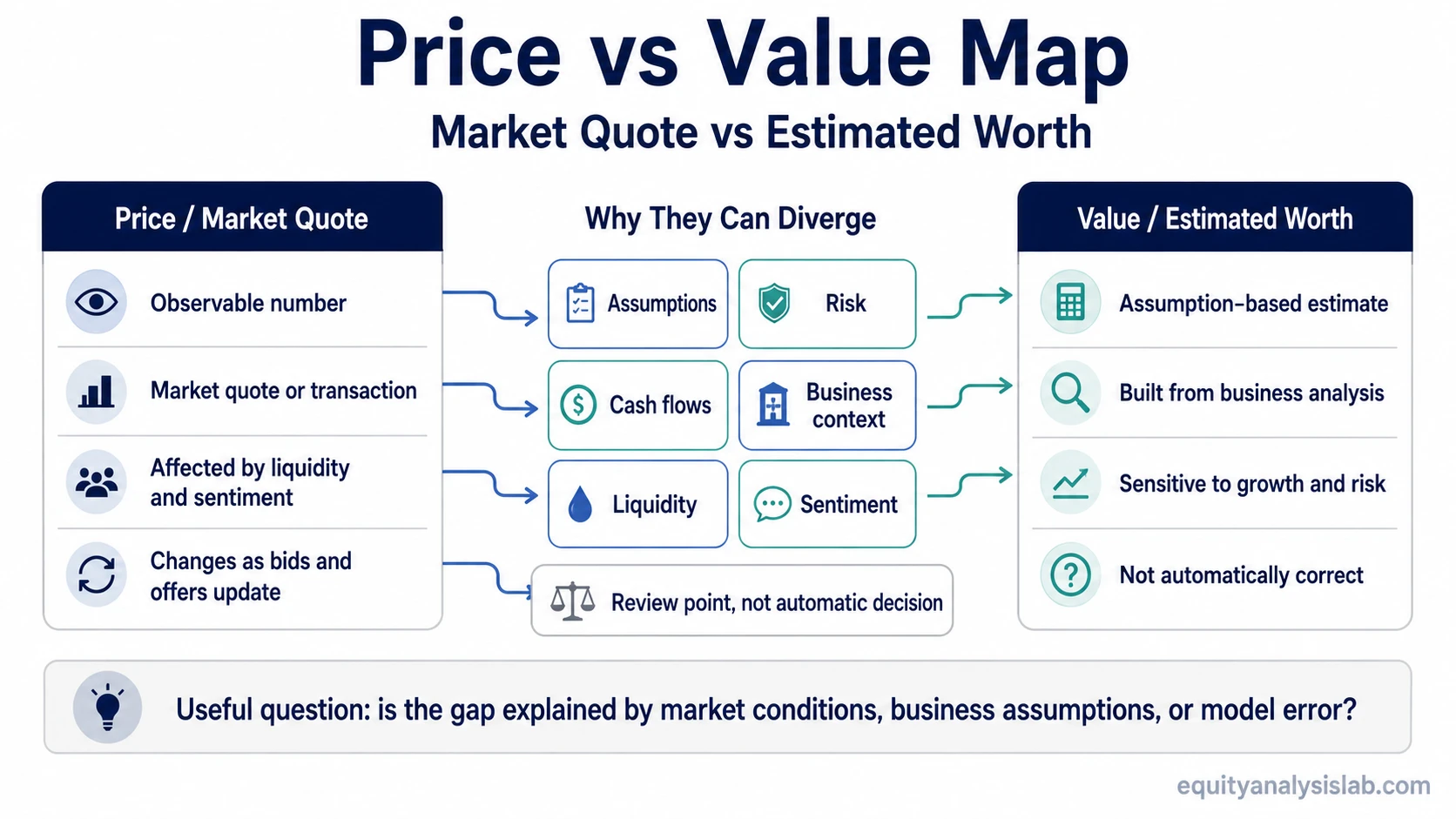
Price vs Value: Key Differences
The most useful distinction is not linguistic. Price and value sit on different measurement bases. Price is observed. Value is estimated.
| Criterion | Price | Value |
|---|---|---|
| Question answered | What is the market quoting or what was paid? | What may the asset be worth under a defined assumption set? |
| Main source | Market quote, trade, offer, or transaction data. | Valuation work, business analysis, future expectations, and risk judgment. |
| Timing | Current or transaction-specific. | Forward-looking and assumption-sensitive. |
| Inputs | Supply, demand, liquidity, sentiment, order flow, and transaction conditions. | Cash flow, earnings quality, growth, risk, capital structure, competitive position, and required return. |
| Sensitivity | Can change quickly as buyers and sellers update bids and offers. | Can change when the underlying assumptions or business outlook change. |
| Investor use | Shows the current market reference point for investor review. | Provides a reference point for judging whether the quote looks reasonable. |
| Common mistake | Assuming a lower price automatically means better opportunity. | Assuming a model estimate is automatically correct because it looks precise. |
Why Price and Value Diverge
Price and value diverge because markets and valuation models respond to different forces. The quoted price reflects the point where buyers and sellers are currently willing to transact. That point can be shaped by liquidity, sentiment, forced selling, short-term news, positioning, and the availability of comparable alternatives.
Value is slower and more assumption-driven. An investor estimating intrinsic value is asking what the company may be worth based on future benefits and risk, not only what the quote shows today.
This gap does not automatically mean the market is wrong. Sometimes price moves before the valuation case is visible in reported numbers. Sometimes a model lags reality because its assumptions are stale. The useful question is not whether price or value is always superior. The useful question is whether the difference is explained by a real assumption gap, a temporary market condition, or a weak valuation estimate.
How to Measure the Price-Value Gap
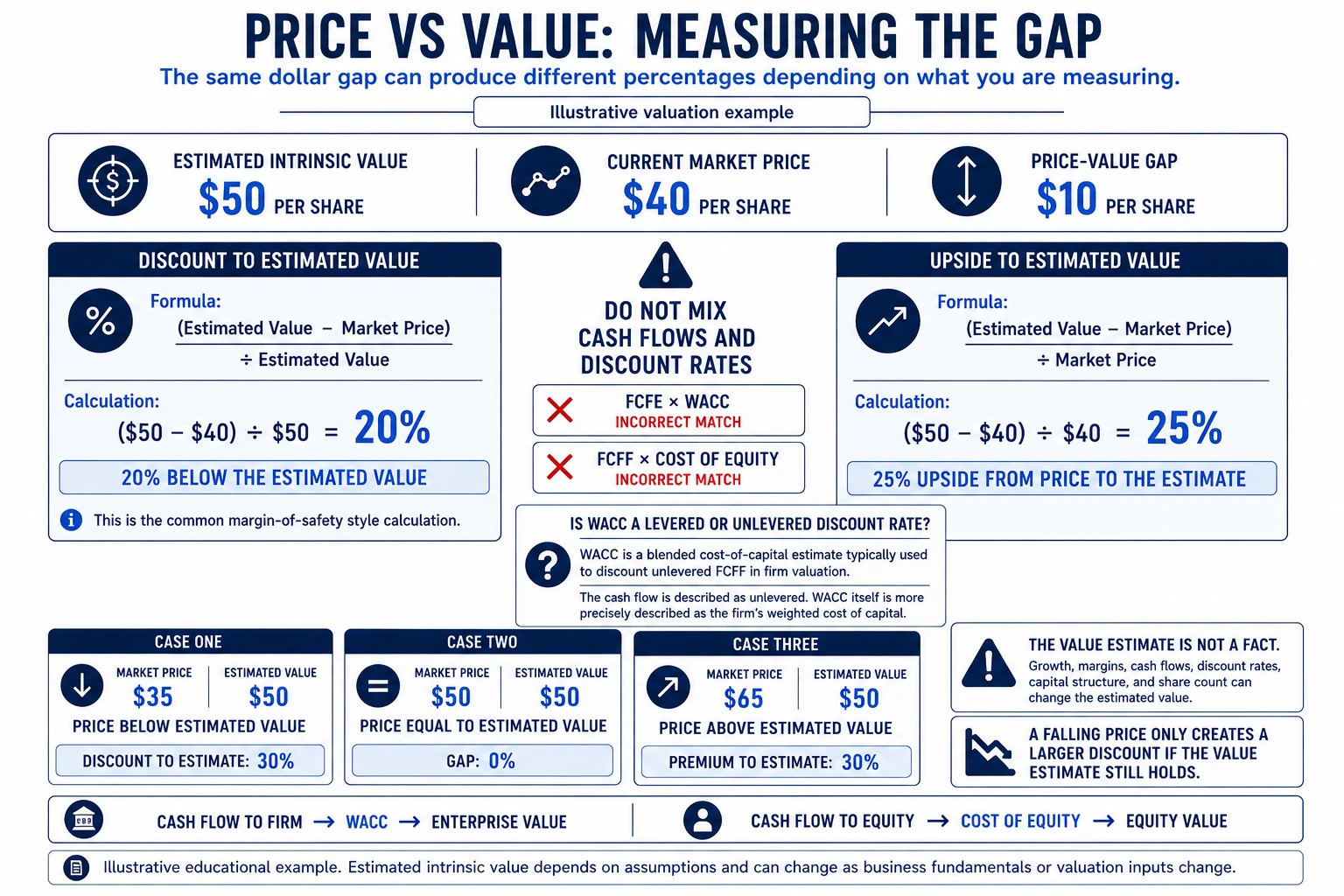
A clearer way to compare price and value is to measure the gap directly. Assume a stock trades at $40 and an investor estimates its intrinsic value at $50. The dollar gap is $10 per share, but the percentage gap depends on what is being measured.
If the investor measures discount to estimated value, the calculation is ($50 – $40) / $50 = 20%. This is the style of calculation often used in a margin of safety discussion.
If the investor measures upside from market price to the estimate, the calculation is ($50 – $40) / $40 = 25%. The dollar gap is the same, but the denominator is different, so the percentage is different as well.
Key point: a 20% discount to estimated value is not the same thing as 20% upside from the market price. The calculation method should be stated clearly.
The same framework also helps organize other valuation readings. If the stock traded at $35 against the same $50 estimate, it would trade at a 30% discount to the estimate. If it traded at $65, it would trade at a 30% premium to the estimate.
This still does not make the estimate a fact. The estimated value can change if growth, margins, capital intensity, capital structure, discount rate, or diluted share count assumptions change. A falling price only creates a larger discount if the value estimate still holds.
Common Confusion Trap
A lower price is not automatically better value. A stock can fall because the business outlook has deteriorated, because dilution risk has increased, because expected cash flows are weaker, or because the market is demanding a higher return for the same uncertainty.
The opposite trap is treating a model as truth. A valuation model can produce a clean-looking value estimate while relying on fragile inputs. Growth, margin, reinvestment, discount rate, debt, and diluted share count can all change the result. A weak model can be less useful than the market quote it tries to challenge.
The distinction also depends on the value basis being used. A discussion of the whole firm may use an enterprise value framework, while a common-share estimate focuses on what belongs to equity holders after the relevant claims and share-count assumptions are considered.
Market Price vs Fair Value
Market price is the number available now. Fair value, in this investor valuation context, means an estimate of what the security or business may be worth under a more balanced or internally consistent set of assumptions. It should not be treated as the same thing as a formal accounting fair value measurement unless that accounting context is explicitly being discussed.
For an investor, fair value is most useful when the assumptions are explicit. A fair value estimate without stated growth, cash-flow, risk, capital-structure, and share-count assumptions is difficult to test. A price without valuation context is also incomplete because it shows where the market is, not whether the quote is reasonable.
When the analysis is focused on common shareholders, the relevant estimate may be described as the value of equity or common equity value. That is a narrower question than the value of the entire operating business and should not be mixed casually with firm-level valuation measures.
Related Valuation Concepts
Price vs value is a starting distinction. The deeper work is deciding which value basis is being estimated and which assumptions control the estimate.
The clean measurement sequence often begins with share price, then extends into market capitalization when the quoted share price is multiplied across the public equity base.
From there, enterprise value helps frame the value of the operating business before the analysis narrows to debt, cash, and shareholder-level claims.
A shareholder-focused estimate may then move toward the value attributable to common equity, while intrinsic value focuses on estimated worth under business and risk assumptions.
These concepts should not be blended into one number. A cleaner comparison starts by naming the measurement basis, then asking whether the current quote is being compared with the right estimate.
FAQ
Is price the same as value?
No. Price is the observable quote or transaction number. Value is an estimate of worth based on assumptions about future benefits, risk, and context.
Can price and value be equal?
Yes. They can be close or even effectively equal if the market quote is consistent with a reasonable valuation estimate. The problem is that equality cannot be assumed without checking the assumptions behind the estimate.
Does a lower price always mean better value?
No. A lower price can reflect weaker fundamentals, higher risk, worse expectations, dilution, or changed market conditions. Price only becomes meaningful when compared with a defensible value estimate.
Why do investors compare price and value?
Investors compare price and value to judge whether the market quote appears reasonable relative to the estimated worth of the business or security. The comparison is not a prediction and does not remove uncertainty.
What is the difference between discount to value and upside to value?
Discount to value usually measures the gap relative to the estimated value. Upside to value usually measures the gap relative to the current market price. The dollar gap can be the same, but the percentage will differ because the denominator is different.