
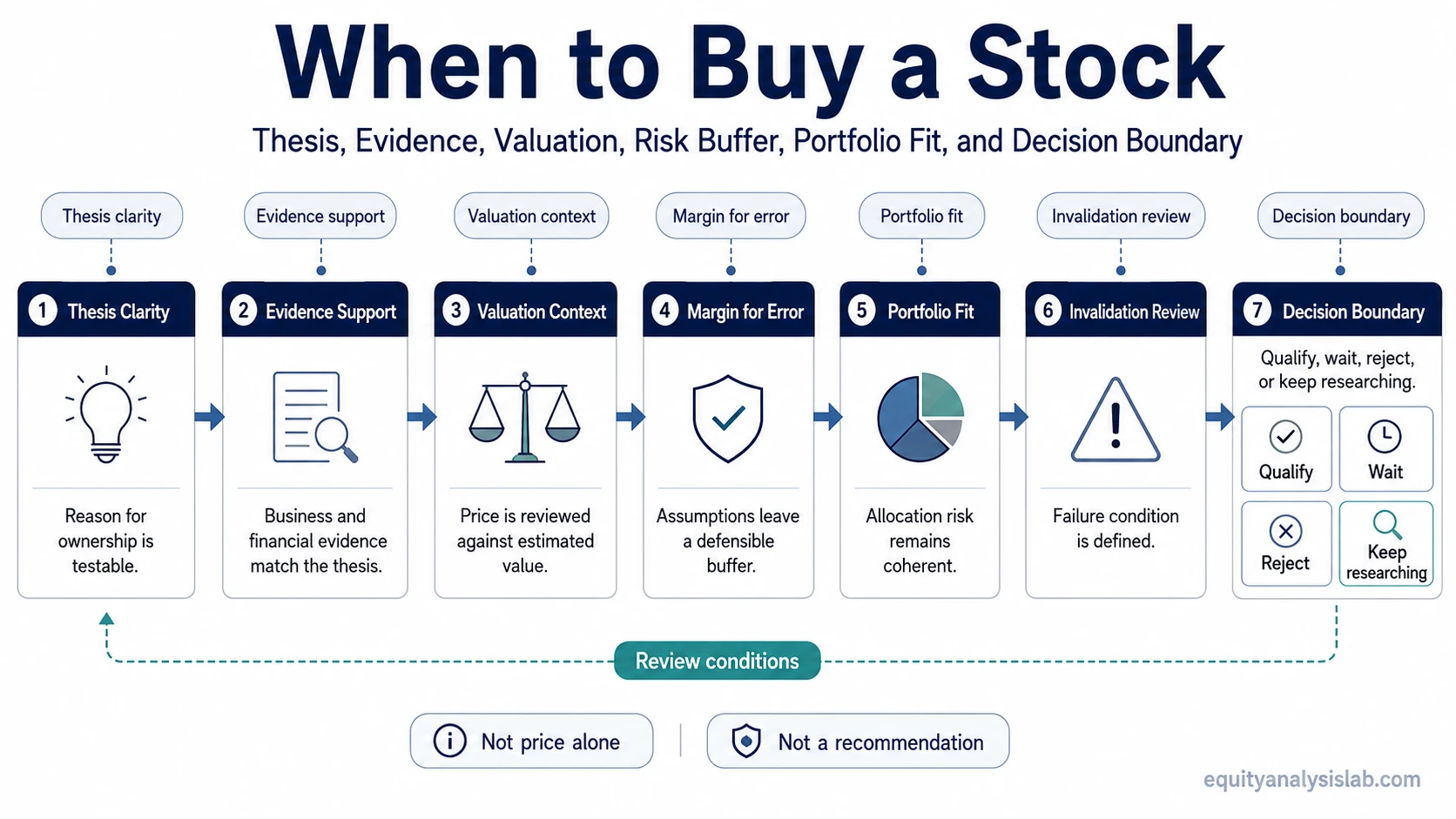
A stock becomes buy-review eligible when the investment thesis is clear, business evidence supports the case, valuation leaves a defensible margin for error, portfolio role is defined, and the investor can identify what would make the thesis wrong.
A lower price, a strong recent move, or a familiar company name does not answer the buy question by itself. The decision becomes stronger when business evidence, valuation context, risk buffer, portfolio fit, and invalidation point in a compatible direction.
The outcome does not have to be action. A disciplined review can lead to buying, waiting, rejecting the idea, or continuing research until the missing evidence becomes clearer.
Framework boundary: buying a stock is not a reaction to price alone. It is a conditional decision made after the thesis, evidence, valuation, risk, and portfolio role have been tested together.
Key Points
- A buy review is stronger when the business thesis, valuation, risk buffer, and portfolio role support the same conclusion.
- A falling price can improve potential value, but it can also reveal new business risk.
- Valuation is an estimate, not proof that a stock is safe or ready to buy.
- Portfolio fit matters because even a well-researched idea can create concentration or liquidity risk.
- Waiting can be the more disciplined outcome when evidence, valuation, or invalidation remains unclear.
What “When to Buy a Stock” Means for Investors
The buy decision starts with a testable claim about why the business may be worth owning at the current price. That claim should connect business quality, financial evidence, valuation assumptions, and risk. A clear investment thesis gives the review structure, but it does not automatically justify the purchase.
The important distinction is between interest and eligibility. A company can be interesting because its products, growth, balance sheet, or market position deserve research. It becomes buy-review eligible only when the evidence can support a defined decision boundary.
A stronger buy review is not created by one positive input. It appears when thesis, evidence, valuation, portfolio role, and invalidation point in a compatible direction. If one of those pieces is missing, waiting remains a valid result.
The Buy Decision Checklist and Its Limits
A checklist can organize the review, but it should not become a mechanical rule. Its job is to expose missing evidence, weak assumptions, and hidden risk before capital is committed.
| Framework component | Question to ask | Weak case |
|---|---|---|
| Thesis clarity | Can the reason for ownership be stated clearly? | The idea depends on vague optimism or headline appeal. |
| Evidence support | Do revenue quality, cash flow, balance sheet, or business signals support the thesis? | The story sounds attractive, but the financial evidence is thin or deteriorating. |
| Valuation context | Does price compare reasonably with estimated value under conservative assumptions? | The stock looks cheaper only because expectations or fundamentals have worsened. |
| Margin for error | Is there a defensible buffer if assumptions are imperfect? | The estimate leaves little room for disappointment. |
| Portfolio fit | Would the position fit the portfolio without creating excessive concentration? | The idea may be sound, but the allocation would dominate risk. |
| Invalidation condition | What evidence would prove the thesis wrong or materially weaker? | The review has no clear failure boundary. |
The checklist works best as a pressure test. It should make the decision harder when evidence is weak, not easier because several boxes can be filled with optimistic assumptions.
Evidence That Can Support a Buy Review
Evidence should connect the thesis to observable business performance. Depending on the company, that may include revenue durability, cash generation, margins, debt capacity, capital allocation, customer concentration, or balance-sheet resilience.
One strong metric is rarely enough. A company with improving revenue but weak cash conversion may still require caution. A company with attractive margins but rising debt or refinancing pressure may not support the same conclusion. Balance-sheet risk, cash flow quality, and financing needs act as review gates rather than blind mechanical filters.
The buy review becomes more credible when the evidence supports the reason for ownership and also identifies what could break it. Without that failure boundary, the thesis can turn into a story that absorbs every new fact instead of being tested by it.
Valuation Context Before Buying
Valuation does not answer the buy question alone, but it defines the relationship between price and estimated business value. A lower stock price can make a review more interesting only if the estimate of intrinsic value remains supported by the business evidence.
Conservative assumptions matter because valuation is sensitive to growth, margins, reinvestment needs, discount rates, and terminal expectations. A valuation gap is less useful if it depends on aggressive recovery assumptions or ignores new financial stress.
The review should also ask whether there is a buffer between price and value. That buffer can help frame risk, but it is not a guaranteed floor and cannot replace business analysis.
Limitation: margin of safety is an analytical buffer, not protection against loss. It can shrink or disappear if the business weakens, estimates were too optimistic, or new risks change the valuation range.
Portfolio Fit and Position Size Boundary
A stock can pass the business and valuation review but still fail the portfolio review. The decision has to account for concentration, correlation with existing holdings, liquidity needs, time horizon, and the investor’s ability to absorb being wrong.
The portfolio-fit check does not require a fixed formula inside the buy framework. It asks whether the proposed allocation would remain coherent if the thesis takes longer to play out, weakens, or needs to be exited later. Position sizing turns the idea into a risk allocation decision rather than a pure opinion about the company.
The framework is stronger when the investor can separate three questions: whether the business is attractive, whether the price is reasonable, and whether the portfolio can carry the risk. A yes on the first two does not automatically create a yes on the third.
When the Framework Says Not to Buy
The same framework should also create rejection points. A stock may be worth watching, but not worth buying, when the evidence remains incomplete or the risk boundary is unclear.
| Trigger | Why it weakens the review | Disciplined result |
|---|---|---|
| Price decline alone | The lower price may reflect real business damage. | Recheck thesis evidence before treating valuation as improved. |
| Hype or popularity | Attention does not prove durable earnings power or valuation support. | Separate narrative from cash flow and business quality. |
| One attractive ratio | A single multiple can hide debt, cyclicality, dilution, or falling quality. | Compare the ratio with the full business and financial context. |
| Unclear thesis | The decision lacks a testable reason for ownership. | Continue research or reject the idea until the claim is clear. |
| Portfolio concentration | The stock may add more risk than the portfolio can justify. | Review allocation risk before considering action. |
| No invalidation condition | The investor cannot tell the difference between patience and denial. | Define what would make the thesis wrong before acting. |
Not buying is not a failed decision. It can be the correct result when the evidence is not strong enough, the valuation gap is too thin, or the portfolio impact is poorly defined.
Simple When to Buy a Stock Example
A stock falls after a broad market selloff or company-specific concern, and the valuation appears more attractive. The lower price does not settle the decision. The review first asks whether the business thesis is still intact, whether cash flow and business quality still support the estimate, and whether new risk explains part of the decline.
The case becomes more defensible if the company’s financial evidence remains stable, the valuation range still leaves room for error, and the position would fit the portfolio even if the thesis takes longer to develop. The case weakens if the lower price reflects deteriorating cash flow, rising financing pressure, or a thesis that no longer has a clear failure boundary.
The diagnostic conclusion is not that a decline creates an opportunity. The useful distinction is whether the decline improves the price-to-value relationship while the evidence still supports the thesis.
Decision Boundary: Buy, Wait, Reject, or Keep Researching
The framework separates evidence from action. A buy review can end in several ways: the idea qualifies for purchase, the investor waits for stronger evidence, the thesis is rejected, or the research remains incomplete.
A buy outcome is more defensible when the thesis is clear, the evidence is current, valuation is reasonable under conservative assumptions, the margin for error is visible, portfolio fit is acceptable, and invalidation is defined.
A wait outcome is more defensible when the company is attractive but valuation is thin, the evidence is promising but incomplete, or the portfolio already has enough similar exposure. A reject outcome is more defensible when the thesis breaks, the valuation case depends on unrealistic assumptions, or the risk cannot be bounded.
FAQ
Is a lower stock price enough reason to buy?
No. A lower price can improve valuation, but it can also reflect weaker fundamentals, higher risk, or reduced expectations. The thesis and evidence need to be reviewed again.
How do investors know when a stock is buy-review eligible?
A stock is buy-review eligible when the thesis is clear, evidence supports the business case, valuation is reasonable under conservative assumptions, portfolio fit is defined, and invalidation risk is visible.
Can valuation alone justify buying a stock?
Valuation alone is not enough. The estimate needs support from business quality, cash flow, balance-sheet condition, and realistic assumptions.
What if the framework does not give a clear answer?
Waiting or continuing research can be the disciplined result. A forced decision is weaker when the thesis, valuation, portfolio fit, or invalidation condition remains unclear.