
A condor separates the short strikes to create a wider acceptable price range, while a butterfly centers the structure around one middle strike and creates a narrower payoff zone. Both structures can have defined expiration boundaries, but the comparison changes once premium, breakevens, outside wings, and short-leg assignment or exercise review are included.
Key Points
- A condor is built around a wider range between two short strikes.
- A butterfly is built around a tighter center, usually near a middle strike.
- The structures can look similar because both may use four legs and outside wings.
- The risk review is not only the payoff diagram; short legs, breakevens, liquidity, and closing costs also matter.
Condor vs butterfly: the practical split
The useful distinction is range width. A condor is designed so the underlying can finish inside a broader middle zone. A butterfly is more dependent on the underlying finishing near a central strike. That difference comes from where the short strikes are placed.
In a common iron condor, the structure has two separate short strikes: one below the current price area and one above it. Those short strikes create a central range between them. In a butterfly spread, the structure is centered more tightly around the body of the spread, so the payoff is more concentrated around the middle.
Core distinction: A condor is range-centered; a butterfly is strike-centered. The condor gives the structure more room between short strikes, while the butterfly concentrates the outcome around a narrower center.
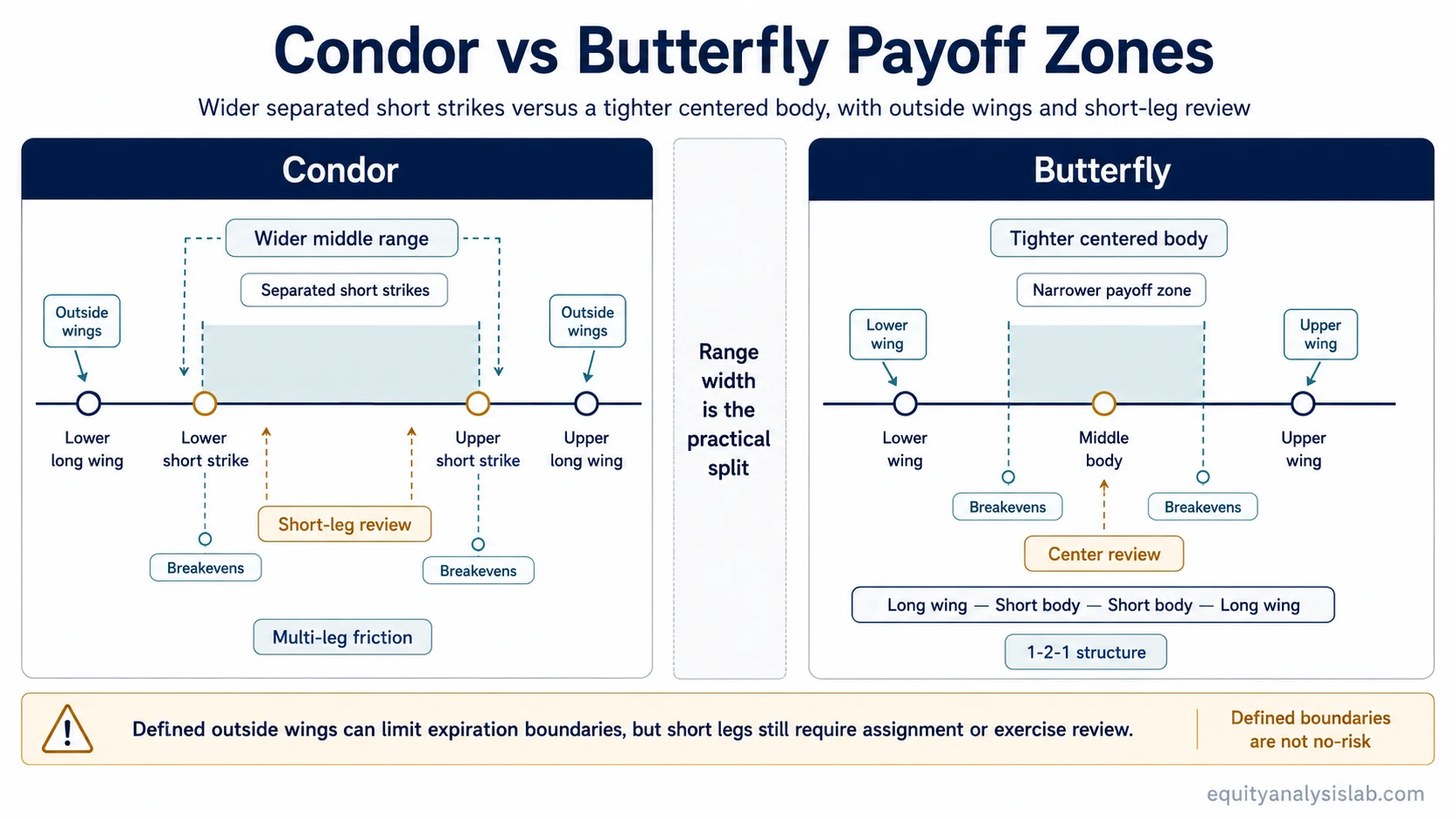
Condor vs butterfly comparison table
| Comparison point | Condor | Butterfly |
|---|---|---|
| Basic shape | Four-leg spread with separated short strikes and outside wings. | Four-leg spread centered around a middle body strike or tight central zone. |
| Short strike placement | Short strikes are apart, creating a wider middle range. | Short exposure is concentrated around the center of the structure. |
| Long wings | Long wings define the outer boundaries of the spread. | Long wings define the outside limits around the center. |
| Payoff zone | Usually wider, because the structure allows more room between the short strikes. | Usually narrower, because the structure is more dependent on the underlying finishing near the center. |
| Premium profile | Often collects less concentrated premium than a tighter centered structure, depending on strikes, width, and volatility. | Can concentrate more premium around the center, but the acceptable zone is usually tighter. |
| Breakevens | Breakevens usually sit around the wider central range and depend on the net premium and wing width. | Breakevens usually sit closer to the central body and depend on the net premium and strike spacing. |
| Main trade-off | More room for the underlying to move, with a more spread-out payoff profile. | More concentrated payoff around the center, with less room for price drift. |
| Risk review | Defined outer wings can limit expiration exposure, but short options still require assignment or exercise review. | Defined outer wings can limit expiration exposure, but the short center can still create assignment or exercise considerations. |
Why the two structures are easy to confuse
Condors and butterflies are often confused because both can use four legs, outside wings, and a defined expiration payoff diagram. The diagram may make both structures look like range strategies, but the range is not built the same way.
Common mistake: Treating the payoff shape as the whole comparison. The more important question is whether the structure is built around a wider middle range or a tighter center.
A condor spreads the short strikes apart. A butterfly pulls the body toward the center. That single structural difference affects the premium profile, breakeven distance, and how much price movement the structure can absorb before the payoff profile changes materially.
Same-scenario example
Assume two same-expiration structures are built around the same underlying price area. The condor places one short strike below the current price area and another short strike above it, with long wings farther outside. The butterfly places the body around one middle strike, with long wings on either side.
| Scenario question | Condor interpretation | Butterfly interpretation |
|---|---|---|
| Where is the desired expiration area? | Inside a broader middle range between the short strikes. | Near the central body strike. |
| What happens if price drifts modestly? | The structure may still remain inside the central range. | The structure can become less aligned with the centered payoff area. |
| What is the payoff concentration? | More spread across the central range. | More concentrated around the center. |
| What needs extra review? | Short-leg assignment risk, fills, wing width, and closing cost. | Short-center assignment or exercise risk, fills, wing width, and closing cost. |
The example does not make one structure better. It shows that the same underlying price area can be expressed as a wider range structure or as a tighter centered structure.
Premium, breakevens, and payoff boundaries
The payoff diagram is only a starting point. A condor may give more room between short strikes, but that wider zone is not free. The premium received or paid, the width of the wings, volatility, liquidity, and transaction costs all affect the actual breakevens.
A butterfly may show a more attractive peak around the center, but that peak is concentrated. If the underlying finishes away from the center, the payoff profile can change quickly. The tighter the centered structure, the more important strike selection and realistic closing cost become.
Boundary check: Defined wings can limit expiration exposure before costs, but they do not remove execution friction, early assignment risk on short American-style options, exercise considerations, or the need to review the spread before expiration.
When a condor comparison is more useful
A condor comparison is most useful when the main question is how much room exists between two short strikes. The structure is built around a central range rather than one exact center. That makes the range width, breakevens, and outside-wing distance the main review points.
The risk is oversimplifying the condor as safer because the payoff zone is wider. A wider middle range can still involve short options, gap risk, poor fills, early assignment risk, and closing-cost friction. The wider range changes the structure; it does not eliminate risk.
When a butterfly comparison is more useful
A butterfly comparison is most useful when the main question is how concentrated the payoff is around the middle strike. The structure is centered more tightly, so the body of the spread matters more than the width of a broad middle zone.
The risk is treating the higher centered payoff potential as the whole story. The payoff can be more sensitive to where the underlying finishes, and the short center still needs assignment or exercise review when applicable.
How to read the comparison without turning it into a recommendation
The cleanest way to compare the two structures is to separate the payoff shape from the strategy label. The names matter less than the structure: where the short strikes sit, how far the wings are placed, how much premium is involved, and how much room the underlying has before the breakevens are challenged.
| Question | Structure that usually answers it more directly | Reason |
|---|---|---|
| Is the focus a wider acceptable range? | Condor | The separated short strikes create more room in the middle. |
| Is the focus a tighter center? | Butterfly | The body of the structure concentrates the payoff around the middle. |
| Is the diagram hiding short-leg risk? | Both | Both structures can include short options that require assignment or exercise review. |
| Is the apparent payoff sensitive to fills and closing cost? | Both | Both are multi-leg spreads, so execution quality can affect the real result. |
Related concepts
Butterfly mechanics: Review the butterfly spread to separate the body-and-wings structure from the broader comparison.
Condor mechanics: Review the iron condor to understand the separated short strikes and outside-wing structure in more detail.