
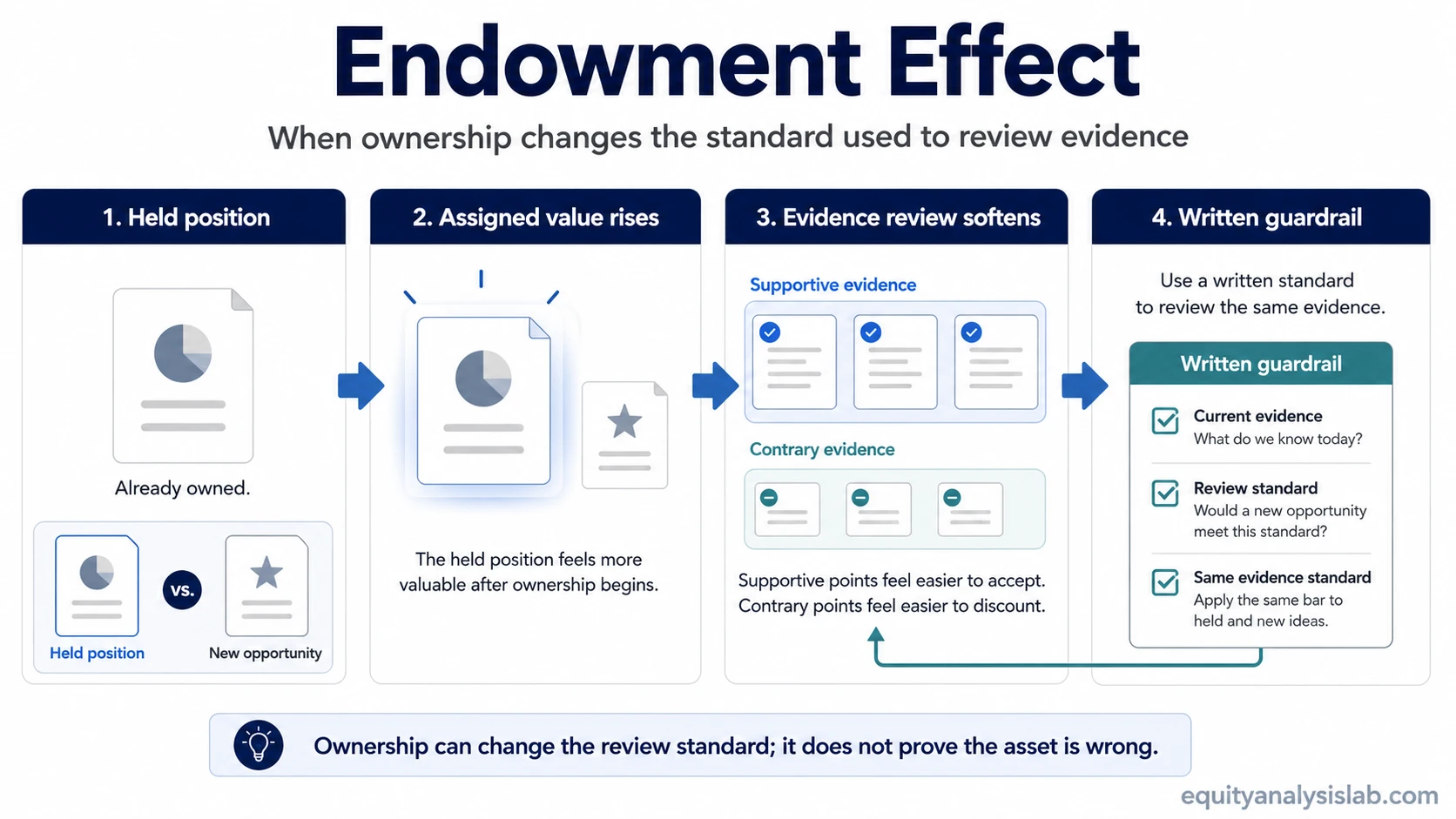
The endowment effect is an ownership bias where an asset can feel more valuable after it is owned than it would have felt as a new opportunity. In investing, the risk is not simply attachment to a holding; the risk is that ownership can change how evidence is weighted during review.
Definition: The endowment effect is an ownership-based overvaluation bias that can make a held position, asset, or opportunity feel harder to reassess objectively. A held investment may receive a softer evidence standard than a similar investment the investor does not already own.
For an investor, the endowment effect can appear when a holding becomes part of a portfolio story, a personal decision, a legacy position, or a concentrated exposure. The position may still deserve serious consideration, but ownership can make negative evidence feel less important and supportive evidence feel more persuasive.
Key Points
- The endowment effect is driven by ownership-based attachment, not by the objective quality of the asset alone.
- It can create a gap between the value an investor assigns to a held position and the value the same investor might assign before owning it.
- Psychological ownership, loss aversion, and selective evidence weighting can all contribute to the bias.
- The endowment effect does not prove that a holding is wrong; it shows that the evidence standard may need stronger guardrails.
- It differs from related biases such as disposition effect, anchoring bias, and availability bias.
How Ownership Changes Valuation Judgment
Ownership can change the reference point for judgment. Before buying an investment, the investor may compare expected return, business quality, valuation, risk, and opportunity cost with a relatively open mind. After ownership begins, the same evidence may be filtered through the existing position.
A common way to explain the endowment effect is the gap between willingness to pay and willingness to accept. In investor terms, the amount required to feel comfortable parting with a position may become higher than the amount the investor would willingly pay to buy the same exposure from scratch.
That gap can come from several overlapping forces. Psychological ownership can make the position feel personally connected to the investor’s judgment. Loss aversion can make giving up the position feel more painful than missing a new opportunity. Biased information processing can then make supportive facts easier to accept and conflicting facts easier to explain away.
The bias becomes more relevant when the standard changes after ownership begins. A valuation concern that would block a new purchase may be tolerated in an existing holding. A deteriorating business signal may be treated as temporary without enough evidence. A position-size concern may be postponed because reducing exposure feels like admitting the original decision was incomplete.
Investor Evidence-Review Components
The endowment effect is most useful as a review-risk lens. It helps identify where ownership may be affecting the way a holding is evaluated, especially when new evidence would be judged more strictly for an investment that is not already in the portfolio.
| Ownership trigger | Evidence that may be discounted | Decision risk | Review guardrail |
|---|---|---|---|
| A long-held position has become familiar. | Weakening fundamentals, margin pressure, or lower earnings quality may be treated as temporary too quickly. | The holding receives more patience than a new candidate with the same evidence would receive. | Ask whether the same evidence would still justify interest if the position were not already owned. |
| An inherited or legacy holding carries personal meaning. | Concentration risk, business-model change, or opportunity cost may receive less attention. | The position stays in the portfolio because it feels difficult to reassess, not because the current case is strong. | Separate the history of ownership from the present evidence for quality, valuation, and role in the portfolio. |
| A position has appreciated and feels like a successful decision. | Valuation stretch, slower growth, or weaker forward expectations may be minimized. | Past success becomes part of the current justification even when the evidence set has changed. | Review the current thesis without relying on the emotional weight of the original decision. |
| A position has declined and selling would confirm discomfort. | New negative evidence may be reframed as noise, while small positive updates receive more weight. | The holding review becomes defensive rather than evidence-led. | Write the current thesis, contrary evidence, and required improvement conditions before judging the holding. |
| The holding is large enough to influence portfolio identity. | Position-size pressure, diversification limits, and downside exposure may be postponed. | The investor protects the story around the position instead of reviewing the position’s role. | Evaluate the holding’s role, size, and risk separately from the original reason for owning it. |
Endowment Effect Example in Investor Review
A portfolio contains a company that has been held for several years. The original thesis was based on durable growth, strong margins, and a reasonable valuation. Over time, growth slows, margins become less stable, and the valuation no longer looks as attractive compared with similar companies.
The same evidence might make a new purchase candidate look less compelling. Yet the existing holding still feels easier to defend because it has history inside the portfolio. The investor remembers the original research, the earlier gains, and the time spent following the business. Ownership makes the position feel more valuable than the current evidence alone may justify.
A cleaner review writes down the current business quality, valuation, portfolio role, and contrary evidence before judging the holding. The weaker pattern is more defensive: the decision to keep the asset comes first, and the evidence is filtered afterward to make that decision feel comfortable.
Where the Endowment Effect Can Be Misused
Limitation: The endowment effect is not proof that a held investment is wrong, overvalued, or unsuitable. A position can be owned for a long time and still have a strong evidence base. The bias matters when ownership changes the standard of review.
The danger is overdiagnosis. Not every reluctance to change a holding is irrational. Transaction costs, taxes, portfolio role, liquidity needs, time horizon, and updated business evidence may all justify patience for reasons separate from ownership attachment.
A cleaner reassessment asks whether the current case can stand without the comfort of ownership. If the argument depends mainly on familiarity, past effort, emotional attachment, or the wish to avoid regret, the decision review may be carrying more ownership bias than the investor realizes.
Endowment Effect vs Related Biases
The endowment effect overlaps with other behavioral biases, but the trigger is specific: ownership makes the asset feel more valuable or harder to reassess. Nearby biases can appear in the same portfolio review, yet they describe different mechanisms.
| Bias | Main trigger | How it differs from endowment effect |
|---|---|---|
| Disposition effect | Realized and unrealized gain-loss framing | The disposition effect focuses on selling or holding behavior around winners and losers, while the endowment effect focuses on ownership-based attachment and valuation judgment. |
| anchoring bias | An initial price, valuation, forecast, or thesis reference point | Anchoring bias comes from over-weighting an early reference point, while the endowment effect comes from the psychological weight of ownership itself. |
| Availability bias | Information that is vivid, recent, familiar, or easy to recall | Availability bias affects evidence weighting through memory and salience, while the endowment effect affects evidence weighting through possession and attachment. |
| Confirmation bias | A preference for evidence that supports an existing belief | Confirmation bias can reinforce the endowment effect when the investor searches for reasons to defend a holding instead of testing the full evidence set. |
How to Recognize Ownership Bias in a Review
The endowment effect becomes easier to notice when the investor compares two standards: the standard used for a current holding and the standard used for a new opportunity. A gap between those standards is often more revealing than the investor’s stated opinion about the holding.
| Review question | What it tests |
|---|---|
| Would the same evidence justify a new position today? | Whether ownership is making the current holding easier to defend than a comparable new opportunity. |
| Which facts would challenge the current thesis most directly? | Whether contrary evidence is being identified clearly or softened before reassessment begins. |
| Has the reason for owning the asset changed since the original decision? | Whether the investor is relying on an old thesis after the evidence set has moved. |
| Is the position size still justified by current evidence and portfolio role? | Whether attachment is weakening risk review around concentration or exposure. |
These questions do not force an action. They make the evidence standard visible. The endowment effect is most damaging when the investor never notices that the standard has changed.
FAQ
What is the endowment effect in investing?
The endowment effect in investing is an ownership bias where a held asset can feel more valuable or more defensible simply because it is already owned. It can affect how an investor reviews evidence, valuation, risk, and opportunity cost.
Does the endowment effect mean a holding is a bad investment?
No. The endowment effect does not prove that a holding is bad or should be changed. It only warns that ownership can distort the review process if the investor applies a softer standard to an existing position than to a new opportunity.
How is the endowment effect different from loss aversion?
Loss aversion describes the tendency for losses to feel more painful than equivalent gains feel rewarding. The endowment effect is broader ownership attachment, although loss aversion can help explain why parting with a held asset may feel difficult.