
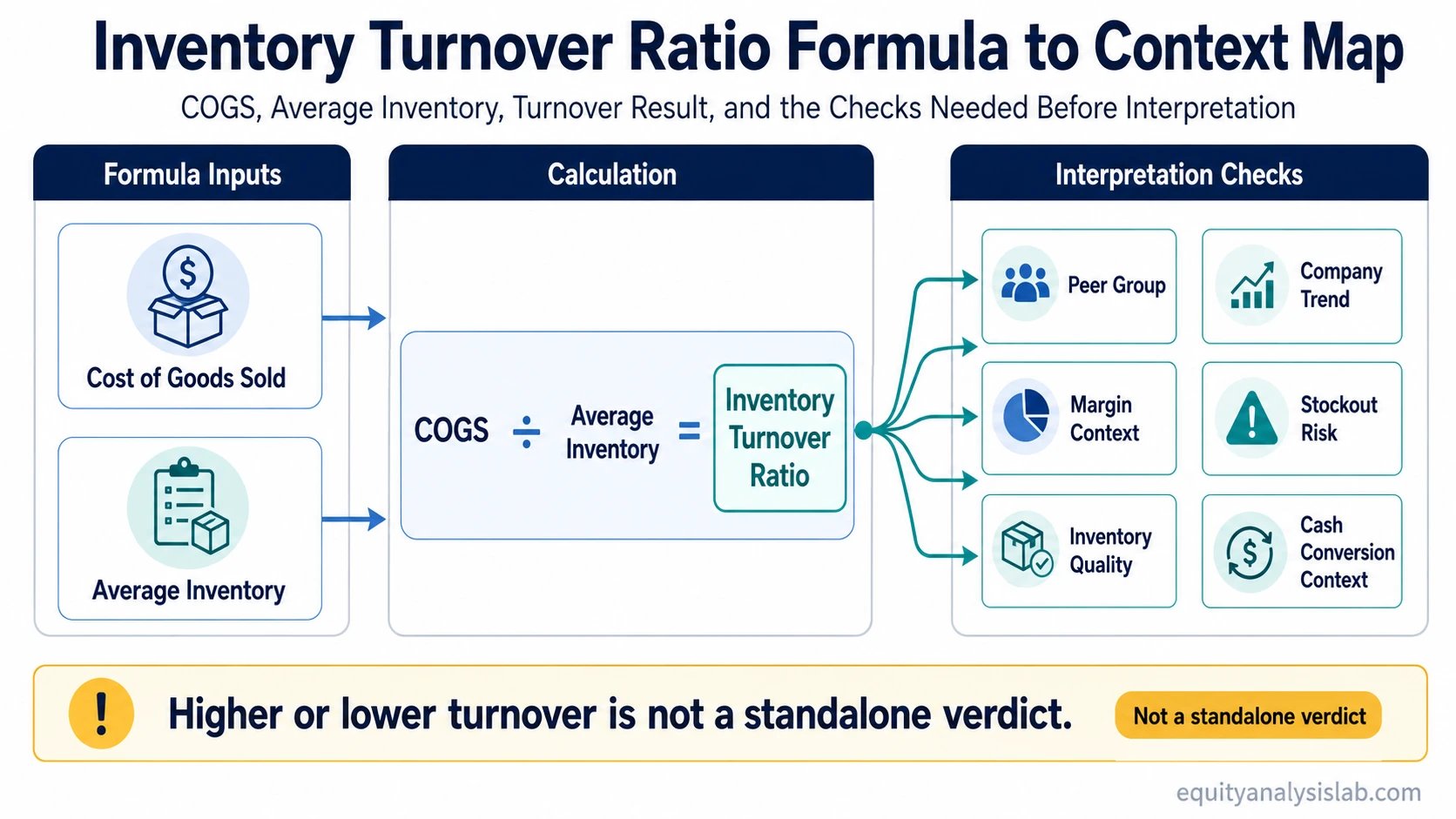
Inventory turnover ratio is an operating-efficiency ratio that compares cost of goods sold with average inventory to estimate how often a company sells and replaces inventory during a period. The ratio is useful, but it is not a standalone verdict. Investors still need peer context, company trend, margin behavior, inventory risk, and cash-conversion support.
Definition: Inventory turnover ratio measures how many times average inventory is sold and replaced during a reporting period, using cost of goods sold as the numerator and average inventory as the denominator.
Key Points
- Inventory turnover ratio is usually calculated as cost of goods sold divided by average inventory.
- Average inventory is commonly estimated as beginning inventory plus ending inventory, divided by two.
- A higher turnover ratio can reflect stronger inventory movement, but it can also come from a smaller inventory base rather than stronger product throughput.
- A lower turnover ratio can reflect slower-moving inventory, but interpretation depends on industry model, seasonality, product cycle, and company strategy.
- The ratio is strongest when compared with peer companies, the company’s own trend, margins, inventory quality, and cash-conversion context.
What Is the Inventory Turnover Ratio?
Inventory turnover ratio shows how quickly a company moves inventory relative to the inventory base it holds. It is most relevant for businesses where inventory is a meaningful balance-sheet item, such as retailers, manufacturers, distributors, and many consumer product companies.
The ratio uses cost of goods sold, often shortened to COGS, rather than revenue. That is important because inventory is carried at cost, not at its final sales price. Using COGS creates a cleaner match between the inventory balance and the cost that moved through the income statement.
For investor analysis, inventory turnover is a diagnostic metric. It helps frame questions about inventory productivity, product availability, stockout risk, inventory build-up, and whether working-capital behavior supports the income-statement trend.
Inventory Turnover Ratio Formula
The standard formula is:
Inventory turnover ratio = Cost of goods sold / Average inventory
Average inventory is commonly estimated as:
Average inventory = (Beginning inventory + Ending inventory) / 2
If beginning inventory is $180 million and ending inventory is $220 million, average inventory is $200 million. If cost of goods sold is $800 million, the inventory turnover ratio is 4.0 times.
Example calculation: $800 million COGS / $200 million average inventory = 4.0 times inventory turnover.
That means the company sold and replaced average inventory about four times during the period measured by the inputs. More detailed analysis may use monthly or quarterly averages when inventory swings materially during the year.
| Formula input | What it represents | Typical statement source |
|---|---|---|
| Cost of goods sold | The cost base tied to goods sold during the period | Income statement |
| Beginning inventory | Inventory reported at the start of the period | Balance sheet or prior-period balance sheet |
| Ending inventory | Inventory reported at the end of the period | Balance sheet |
| Average inventory | A period estimate of inventory held during the period | Calculated from inventory balances |
| Period length | The reporting period being analyzed, such as a quarter or fiscal year | Financial statement period |
The Same Turnover Change Can Come From Different Causes
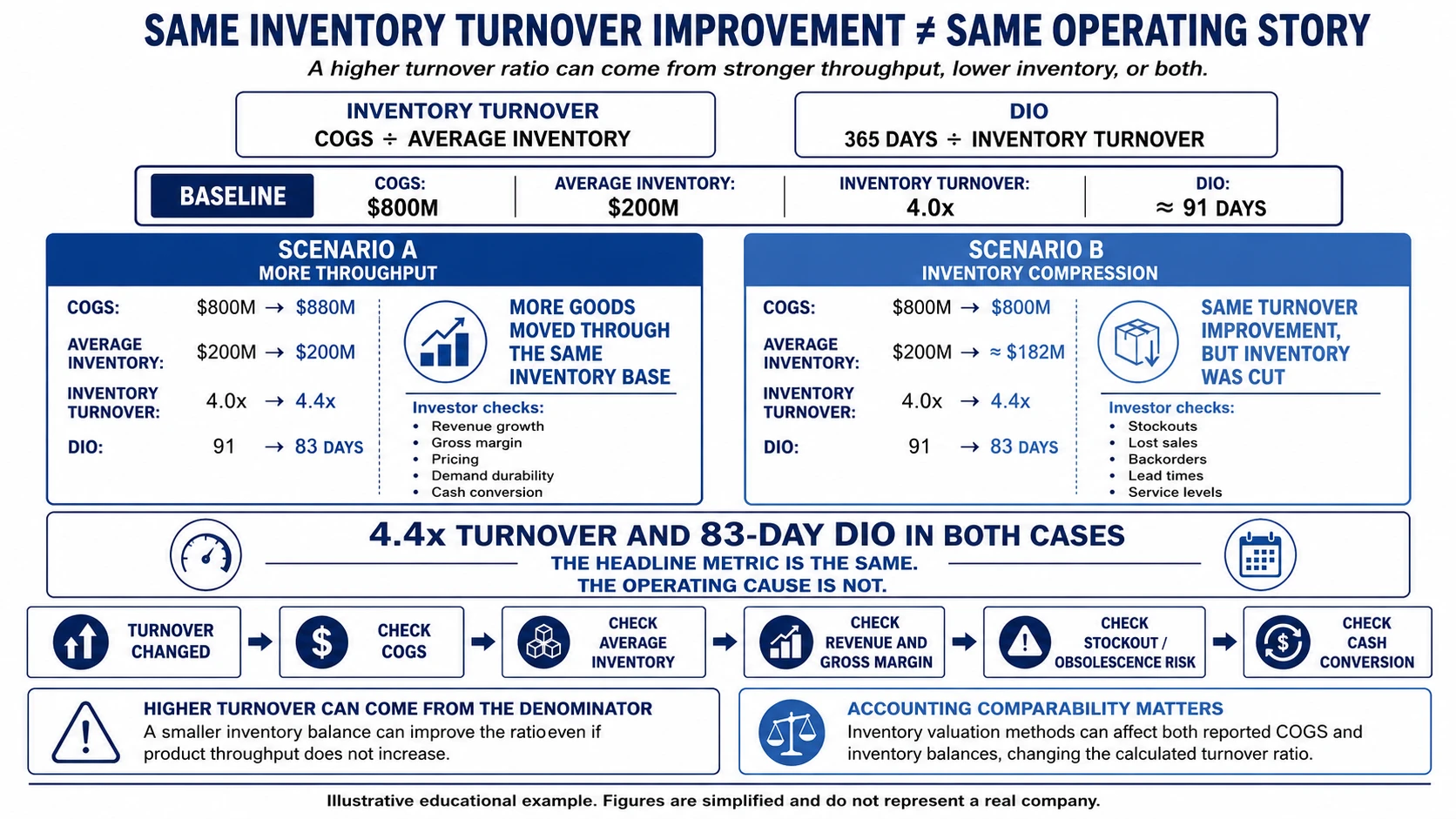
One of the most useful investor checks is to separate the headline ratio change from the operating cause. A higher turnover ratio can come from stronger product movement, tighter inventory management, or a reduction in the inventory base. Those are not always the same operating story.
Assume a company starts with:
Baseline: COGS = $800 million, average inventory = $200 million, inventory turnover = 4.0 times.
Now consider two different ways the ratio could improve to 4.4 times.
| Scenario | COGS | Average inventory | Inventory turnover | What may be happening |
|---|---|---|---|---|
| Scenario A, more throughput | $880 million | $200 million | 4.4 times | More goods moved through the same inventory base. |
| Scenario B, inventory compression | $800 million | About $182 million | 4.4 times | The same turnover improvement came from holding less inventory. |
The ratio improves by the same amount in both cases, but the interpretation is different. In the first scenario, stronger throughput may support the improvement. In the second, leaner inventory may reflect better discipline, but it may also increase stockout risk or reduce the company’s ability to meet demand.
Investor rule: When inventory turnover changes, check what happened to both COGS and average inventory before concluding that inventory productivity improved.
Inventory Turnover, DIO, and Cash Conversion Context
Inventory turnover ratio measures frequency. Days inventory outstanding, often shortened to DIO, translates the same inventory movement into an estimated number of days inventory is held.
DIO = Days in period / Inventory turnover ratio
If inventory turnover is 4.0 times, DIO is about 91 days using a 365-day year. If inventory turnover improves to 4.4 times, DIO falls to about 83 days.
The two metrics are mathematically linked, but they frame the same issue differently. Turnover highlights how often inventory turns. DIO highlights how long inventory remains in the system. Both still need operating context.
Cash-conversion analysis is broader. Inventory movement is only one part of the working-capital cycle. Customer collection timing and supplier-payment timing can change the cash-flow interpretation even when inventory turnover looks stable or improves.
Practical read: Better inventory turnover and lower DIO are more useful when margins remain healthy, inventory quality stays sound, and the wider cash-conversion picture also supports the improvement.
How to Interpret High and Low Inventory Turnover
High and low inventory turnover are always context-dependent. The same number can mean very different things in grocery retail, industrial equipment, apparel, luxury goods, or specialty manufacturing.
| Observed pattern | Possible interpretation | Next check |
|---|---|---|
| High inventory turnover | Inventory may be moving quickly relative to the inventory base held. | Review demand strength, margin stability, and product availability. |
| Very high inventory turnover | The company may be carrying very lean inventory. | Check for stockouts, lost sales, service pressure, or discounting behavior. |
| Low inventory turnover | Inventory may be moving slowly or building faster than demand. | Review seasonality, product cycle, demand change, and write-down risk. |
| Improving turnover | Inventory productivity may be improving. | Check whether the improvement came from stronger throughput or a smaller inventory base. |
| Deteriorating turnover | Inventory may be becoming less productive. | Review sales trend, gross margin, inventory build-up, and inventory quality. |
A higher inventory turnover ratio is not automatically better. It can reflect efficient movement of goods, but it can also reflect understocking or operating pressure. A lower ratio is not automatically worse either. Some business models naturally hold more inventory because products are expensive, seasonal, slow-cycle, customized, or strategically stocked.
Accounting Method Can Change the Ratio
Inventory turnover ratio is influenced not only by operations, but also by accounting inputs. Inventory valuation methods can affect both reported inventory and reported cost of goods sold.
That means two companies with broadly similar physical inventory movement may still report somewhat different turnover ratios if their inventory accounting differs. This issue matters most when investors compare companies across jurisdictions, industries, or accounting policies.
Accounting caution: A ratio difference does not always mean an operational difference of the same size. Investors should confirm whether accounting treatment or inventory valuation policy is affecting comparability.
Why Peer Group and Company Trend Matter
Inventory turnover ratio is strongest when it is compared in two directions: against similar companies and against the same company’s own history. Cross-industry comparisons are often weak because inventory economics differ widely across business models.
A retailer with fast-moving consumable goods may normally show much higher turnover than a manufacturer of specialized equipment. That does not automatically make the retailer a better business. It means the inventory model is different.
Context checklist: Compare the ratio with the company’s peer group, prior periods, revenue trend, gross margin, inventory balance, working-capital movement, and cash-flow support.
Trend analysis often reveals more than a single-period number. If turnover improves while revenue grows and margins remain stable, the signal may be stronger. If turnover improves because inventory was cut too aggressively, the headline ratio may look better before the operating consequences appear.
Limitations and Common Mistakes
Inventory turnover ratio is useful, but it compresses several operational and accounting realities into one number.
Main limitation: A single turnover result does not show whether inventory is fresh or obsolete, whether margins are protected, whether stockouts are limiting sales, or whether working capital is being managed sustainably.
| Risk or limitation | Why it matters | How to check it |
|---|---|---|
| Seasonality | Inventory can rise before peak selling periods and fall afterward. | Compare the same quarter across years, not only sequential periods. |
| Inventory write-downs | Write-downs can change inventory balances and signal weaker inventory quality. | Review gross margin movement and inventory-related disclosures when available. |
| Stockout risk | Lean inventory can make turnover look high while limiting future sales. | Check revenue growth, availability, backlog, and service-level commentary. |
| Accounting comparability | Input definitions and inventory valuation methods can differ. | Compare companies with similar business models and reporting structures. |
| Cash-conversion mismatch | Inventory movement is only one part of working-capital timing. | Compare turnover with receivables, payables, and operating cash-flow trends. |
Common mistake: Treating a higher inventory turnover ratio as automatically better can hide inventory shortages, margin pressure, or a smaller inventory base that improved the denominator without improving the underlying operating story.
Related Operating Efficiency Ratios
Inventory turnover ratio focuses on inventory movement, but operating-efficiency analysis usually needs nearby ratios to separate inventory, customer collection, supplier-payment timing, and broader working-capital productivity.
| Related ratio | What it focuses on | How it differs from inventory turnover |
|---|---|---|
| accounts receivable turnover | Customer collection efficiency | It focuses on receivables and collections, not inventory sold and replaced. |
| accounts payable turnover ratio | Supplier-payment timing | It focuses on how quickly a company pays suppliers, not how quickly inventory moves. |
| working-capital productivity | Revenue relative to working capital | It uses a broader working-capital base rather than isolating inventory. |
These ratios should not be collapsed into one score. Inventory, receivables, payables, and working capital each reveal a different part of the operating cycle.
FAQ
What is inventory turnover ratio?
Inventory turnover ratio is an operating-efficiency ratio that compares cost of goods sold with average inventory to estimate how often inventory is sold and replaced during a period.
What is the inventory turnover ratio formula?
The standard formula is cost of goods sold divided by average inventory. Average inventory is commonly calculated as beginning inventory plus ending inventory, divided by two.
Is a high inventory turnover ratio always good?
No. A high ratio can indicate fast inventory movement, but it can also reflect very lean inventory, stockout risk, or a smaller inventory base rather than stronger demand.
How is inventory turnover related to DIO?
Inventory turnover measures how often inventory turns during a period. DIO converts that same inventory movement into an estimated number of days inventory is held. The two metrics are mathematically linked but frame the same issue differently.
Why should inventory turnover be compared within the same industry?
Industry comparison matters because inventory economics differ across business models. A grocery retailer, luxury goods company, industrial manufacturer, and equipment distributor can have very different normal turnover levels.