
ARR and MRR describe recurring subscription revenue at different time scales. MRR is the normalized monthly view. ARR expresses the recurring base on an annualized basis, often as MRR multiplied by 12 when the same definition is used.
The arithmetic is closely related, but the reporting use differs. MRR makes recent changes easier to see, while ARR makes the current recurring base easier to express on an annualized basis. Cash collected, billings, and recognized revenue remain separate measures.
Normalizes active recurring subscription revenue to a monthly amount and makes changes in the recurring base easier to track over time.
Expresses recurring revenue at annual scale. When ARR is calculated from the same monthly recurring base, the common relationship is ARR = MRR × 12.
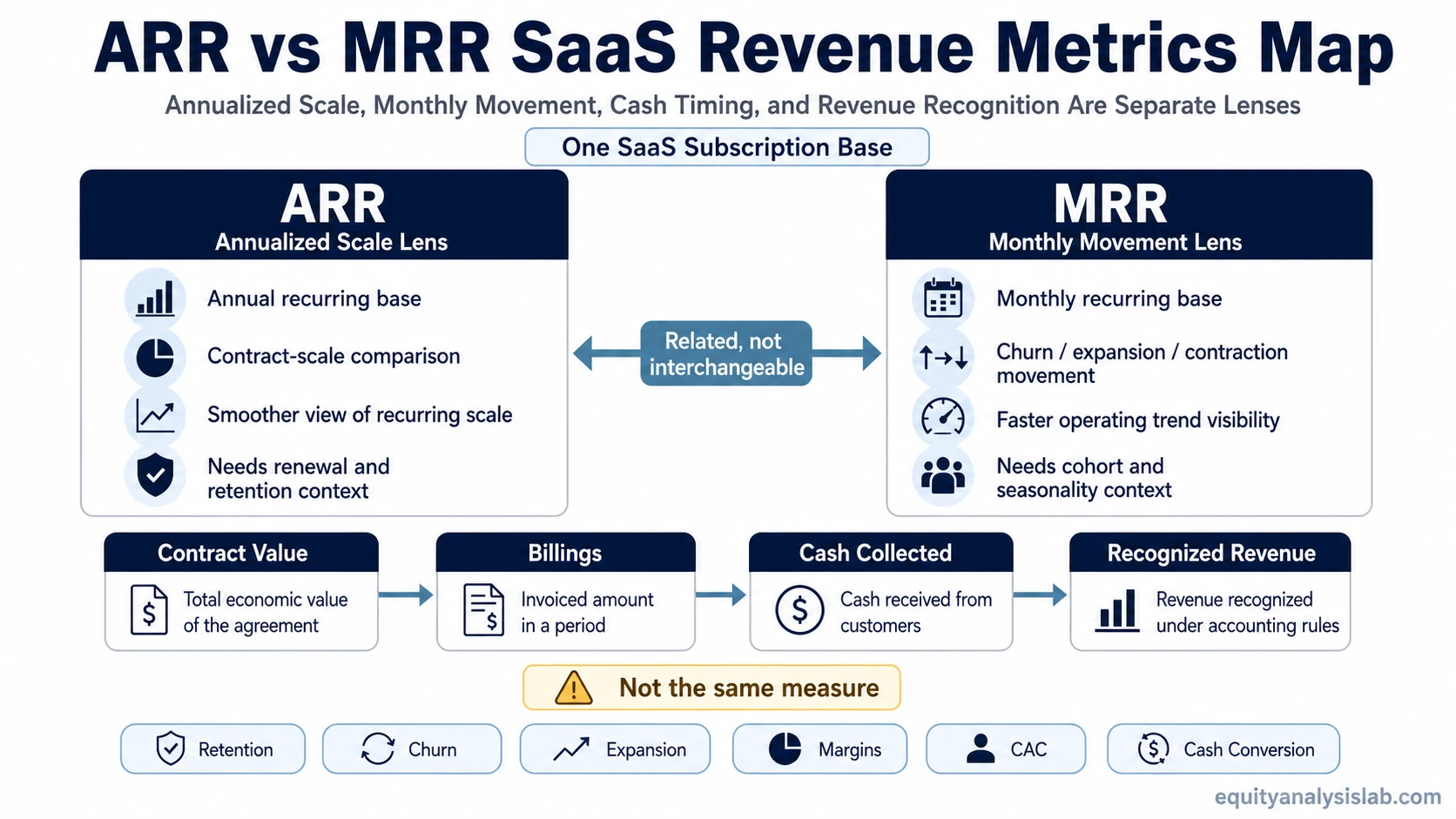
ARR vs MRR Comparison Table
| Comparison point | ARR | MRR | Investor interpretation |
|---|---|---|---|
| Time base | Annualized recurring revenue | Monthly recurring revenue | They describe the recurring base at different time scales. |
| Common relationship | Often calculated as MRR × 12 when the same recurring-revenue definition is used | Built from normalized monthly recurring subscription amounts | Converting between them changes the time scale, not the underlying economics. |
| Analytical use | Useful for expressing recurring revenue scale on an annualized basis | Useful for examining changes in the recurring base at monthly granularity | The better presentation depends on the question being asked. |
| Change visibility | Presents the current recurring base at annual scale | Makes monthly additions, expansion, contraction, and churn easier to observe | MRR usually provides more granular movement data. |
| Definition risk | Company definitions can differ, especially around what qualifies as recurring revenue | Normalization rules can differ across billing intervals, discounts, and subscription structures | Peer comparisons need consistent definitions. |
| What it does not establish | Revenue quality, profitability, cash collection, or renewal durability | Revenue quality, profitability, cash collection, or renewal durability | Retention, margins, acquisition economics, and cash conversion need separate analysis. |
One Contract, Four Different Revenue Lenses
A recurring subscription can affect ARR, MRR, cash, and recognized revenue at the same time. Those numbers can be related without being interchangeable.
Illustrative scenario: A company sells a one-year subscription for $12,000. Normalized MRR is $1,000 and the annualized recurring revenue view is $12,000. If the customer pays the full contract upfront, cash collected may also be $12,000 at the start. In a simple ratable service arrangement, accounting revenue would be recognized over the service period rather than treated as $12,000 of first-month revenue.
The ARR and MRR figures describe the recurring run rate at different time scales. Cash collection describes payment timing. Recognized revenue follows the applicable accounting treatment. Combining those four readings into one number can distort the analysis.
What ARR and MRR Can Hide
ARR and MRR show the size and movement of the recurring revenue base. They do not show whether that revenue is renewing efficiently, producing attractive margins, converting to cash, or depending heavily on a small number of customers.
| Issue | Why the headline recurring-revenue number can mislead | What to check |
|---|---|---|
| Churn and retention | A large or growing recurring base can coexist with customers leaving or reducing spend. | Customer churn, revenue churn, gross retention, and net retention. |
| Expansion quality | Expansion can increase recurring revenue without showing whether the additional revenue is profitable or durable. | Expansion sources, discounts, gross margin, and retention by cohort. |
| Customer concentration | A strong recurring-revenue figure can depend heavily on a small number of large customers. | Customer concentration and renewal exposure. |
| Cash conversion | ARR and MRR do not automatically equal cash collected in the same period. | Billing terms, collections, operating cash flow, and deferred revenue where relevant. |
| Margins and acquisition cost | Recurring revenue can grow while unit economics remain weak. | Gross margin, customer acquisition cost, payback period, and operating efficiency. |
| Metric definition | Two companies can use similar ARR or MRR labels while applying different inclusion or normalization rules. | The company’s disclosed definition and reporting consistency across periods. |
Common ARR vs MRR Mistakes
| Common mistake | Why it causes a bad reading | What to check instead |
|---|---|---|
| Treating ARR and MRR as independent growth signals | When ARR is calculated as MRR × 12, conversion changes the time scale rather than creating new economic information. | Check whether ARR and MRR use the same recurring-revenue definition and reporting basis. |
| Mixing upfront cash with recurring revenue | Payment timing can differ from the recurring run rate and from accounting revenue recognition. | Separate ARR and MRR from billings, cash collected, and recognized revenue. |
| Including non-recurring items | Setup fees, implementation work, or other one-time charges can inflate the apparent recurring base. | Check which revenue components the company includes in ARR or MRR. |
| Comparing companies without checking definitions | Similar metric labels can use different inclusion, exclusion, and normalization rules. | Read each company’s disclosed definition and check whether the comparison basis is consistent. |
| Reading recurring-revenue growth as business quality | A growing recurring base can coexist with weak retention, poor margins, expensive acquisition, customer concentration, or weak cash conversion. | Check retention, unit economics, customer concentration, margins, and cash conversion separately. |
For company analysis, confirm how the recurring-revenue metric is defined first. Then use the surrounding operating evidence to judge the quality of that revenue.