
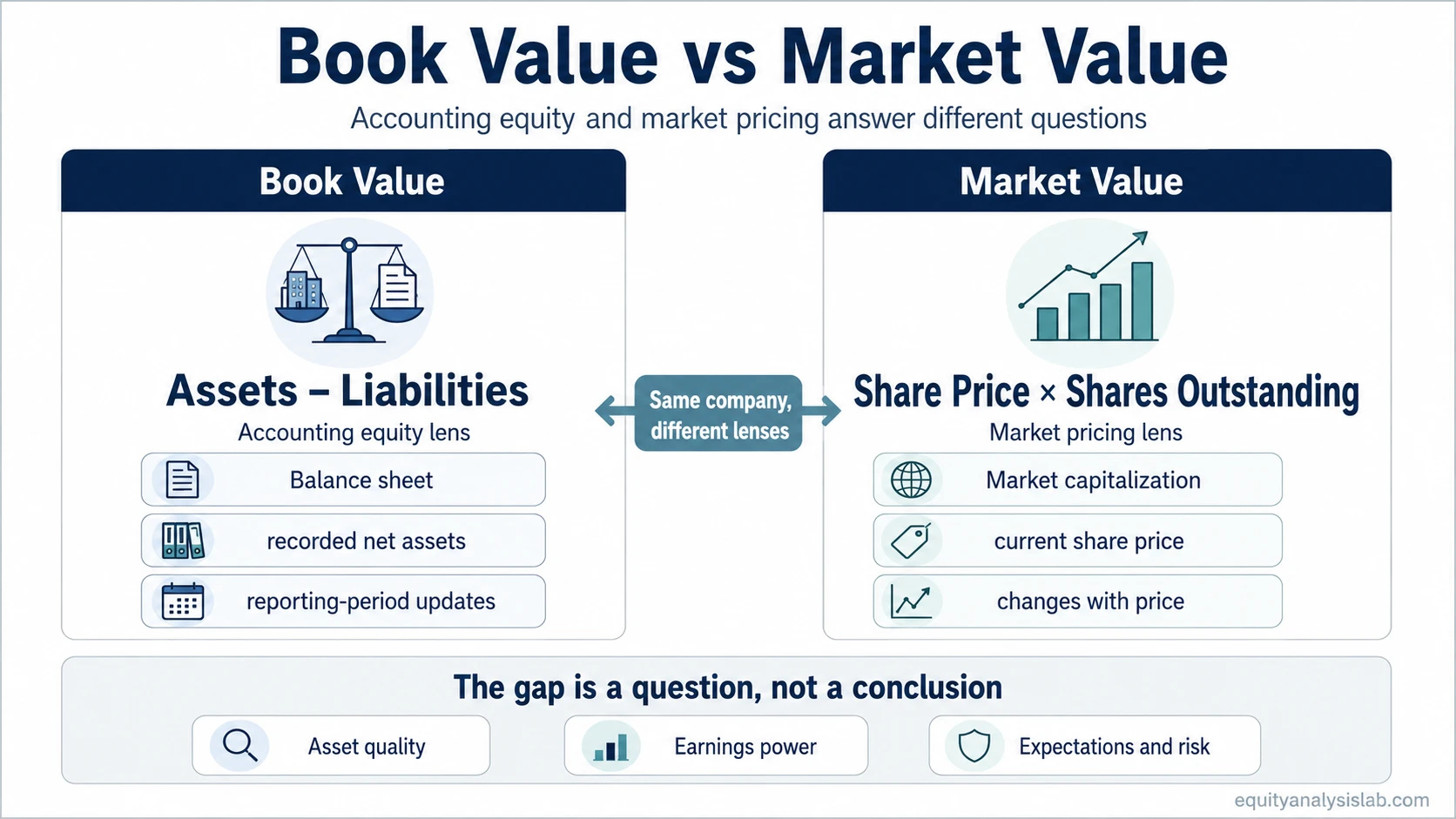
Book value vs market value separates two different lenses on a company: book value comes from accounting equity on the balance sheet, while market value comes from current market pricing of the company’s equity.
Core distinction: book value is an accounting net-asset measure. Market value is the equity value investors assign through the public market. The two numbers answer different questions and should not be treated as interchangeable.
Book value asks what remains for common equity holders under accounting rules after liabilities are subtracted from assets. Market value asks what the market currently prices the company’s equity at based on share price, share count, expectations, risk, profitability, and sentiment.
Key Points
- Book value comes from the balance sheet and is tied to shareholders’ equity.
- Market value comes from market pricing and usually aligns with market capitalization for public companies.
- The gap between the two numbers is an interpretation starting point, not a conclusion.
- Neither number is automatically better, more accurate, or more useful without business context.
What Book Value Measures
Book value measures a company through an accounting-equity lens. At the company level, it is commonly understood as assets minus liabilities, which connects it directly to shareholders’ equity on the balance sheet.
| Book value lens | Meaning for company analysis |
|---|---|
| Source | Balance sheet and accounting records |
| Basic formula | Total assets minus total liabilities |
| Core question | What accounting equity remains after liabilities? |
| Main strength | Gives an accounting anchor for the company’s net asset position |
| Main weakness | May lag economic reality when assets, intangibles, impairments, or business quality are not captured cleanly |
Book value is especially relevant when balance-sheet strength, asset backing, accumulated losses, retained earnings, or equity dilution matter to the investment question. It becomes less complete when the most important value drivers are not well represented on the balance sheet.
What Market Value Measures
Market value measures what investors currently assign to the company’s equity in the market. For a public company, the usual company-level version is market capitalization, calculated as share price multiplied by shares outstanding.
| Market value lens | Meaning for company analysis |
|---|---|
| Source | Current share price and current share count |
| Basic formula | Share price × shares outstanding |
| Core question | What value does the market currently assign to the company’s equity? |
| Main strength | Reflects current expectations, risk perception, and investor demand |
| Main weakness | Can move faster than fundamentals and may reflect optimism, pessimism, liquidity, or sentiment |
Market value is not the same as intrinsic value. It is a market-priced equity value that changes as share price changes, even when the latest balance sheet has not changed.
Book Value vs Market Value Comparison Table
| Comparison point | Book value | Market value |
|---|---|---|
| Primary lens | Accounting equity | Market pricing |
| Typical source | Balance sheet | Share price and shares outstanding |
| Company-level formula | Total assets minus total liabilities | Share price multiplied by shares outstanding |
| Update speed | Usually updates with financial reporting and accounting changes | Changes whenever the market price changes |
| What it reflects | Recorded net assets and accumulated equity history | Current investor expectations, risk appetite, and pricing |
| Where it helps | Asset backing, balance-sheet analysis, equity mechanics, capital structure context | Company size, public equity valuation, market expectations, relative valuation context |
| Where it can mislead | Can understate or overstate economic value when accounting values differ from business reality | Can overreact or underreact when expectations, sentiment, or risk perception shift quickly |
Why Book Value and Market Value Can Diverge
Book value and market value diverge because accounting records and market pricing do not measure the same thing. A balance sheet records assets, liabilities, and equity under accounting rules. The market prices the company’s future prospects, business quality, risk, capital structure, and available alternatives.
| Divergence driver | Why the gap can appear |
|---|---|
| Profitability expectations | A company expected to earn high returns may trade above accounting book value. |
| Asset quality | Recorded assets may not reflect current recoverable value or future earning power. |
| Intangible value | Brands, software, customer relationships, network effects, and know-how may not be fully captured as book equity. |
| Balance-sheet risk | Debt, impairments, weak liquidity, or operating losses can make book value less reassuring. |
| Market expectations | Market value can rise or fall as investors revise expectations before accounting equity changes. |
| Sentiment and liquidity | Market price can move because of risk appetite, flows, or short-term pressure, not only business value. |
A large gap does not prove mispricing by itself. It raises a question: whether the accounting equity, the market pricing, or both need deeper interpretation.
Same-Company Example
The useful test is not which number is right, but why the same company produces one accounting equity value and a different market-priced equity value.
Illustrative example: A company reports $500 million of assets and $300 million of liabilities. Its book value is $200 million. If the company has 20 million shares outstanding and the stock trades at $18, its market value is $360 million.
| Measure | Calculation | Result | Interpretation |
|---|---|---|---|
| Book value | $500 million assets − $300 million liabilities | $200 million | Accounting equity recorded on the balance sheet |
| Market value | $18 share price × 20 million shares | $360 million | Market-priced equity value based on current share price |
| Gap | $360 million − $200 million | $160 million above book value | The market is pricing more than recorded accounting equity |
The gap could reflect strong expected profitability, valuable intangible assets, a high-quality business model, or optimistic market pricing. The same gap could also be too generous if future earnings disappoint. The number alone does not settle the valuation question.
Common Confusion: The Gap Is Not a Conclusion
Common mistake: Treating book value and market value as two versions of the same answer creates false precision. Book value is an accounting anchor. Market value is a market-pricing lens. The difference between them needs interpretation, not an automatic label.
Market value below book value can point to distress, weak profitability, asset concerns, dilution risk, or pessimistic expectations. It can also point to a possible valuation mismatch, but only after the business, asset quality, earnings power, and balance-sheet risk are examined.
Market value above book value can reflect high returns on equity, durable earnings power, intangible assets, strong reinvestment economics, or optimistic expectations. It does not automatically mean the company is overvalued.
When Book Value and Market Value Are Useful Together
Book value gives investors an accounting reference point. Market value gives investors the current equity price assigned by the market. Used together, the two numbers help frame a better question: why is the market pricing the company above, near, or below its accounting equity?
| Investor question | Book value contribution | Market value contribution |
|---|---|---|
| Is the balance sheet important to the thesis? | Shows recorded equity and net asset backing | Shows how much value the market assigns to that equity |
| Is the company asset-heavy or intangible-heavy? | Helps identify what is captured on the balance sheet | May price assets, intangibles, and future returns differently |
| Does the valuation need a per-share lens? | Can be translated into book value per share | Can be compared with share price or market capitalization |
| Is the gap meaningful? | Provides the accounting baseline | Shows the market’s current premium or discount to that baseline |
The price-to-book ratio is a compact bridge between the two lenses because it compares market value with book value. That ratio can be useful, but it should not replace the underlying analysis of business quality, asset quality, profitability, and risk.
Limitations of Book Value and Market Value
Book value limitation: Accounting equity can be useful, but it may not fully capture economic value. Some assets may be carried at values that differ from current economics, and some important sources of value may not appear cleanly as book equity.
Market value limitation: Market pricing can change quickly. It may reflect better forward information than the latest balance sheet, but it can also reflect excessive optimism, pessimism, liquidity pressure, or short-term flows.
Asset-heavy companies, financial companies, and businesses with large intangible assets often require extra care. When intangible assets make the accounting base harder to interpret, tangible book value can help isolate the portion of equity tied more closely to tangible net assets.
The safest interpretation keeps the two measures separate: book value anchors the accounting side, while market value captures the market’s current equity pricing. The investment question begins with the difference between them, but it is answered through business quality, earnings power, asset quality, and risk.
FAQ
Is book value the same as market value?
No. Book value comes from accounting equity on the balance sheet, while market value comes from current market pricing of the company’s equity.
Can market value be lower than book value?
Yes. Market value can be lower than book value when investors price in weak profitability, balance-sheet risk, asset-quality concerns, dilution risk, or pessimistic expectations. That condition is not automatically a bargain.
Why is market value often higher than book value?
Market value can be higher than book value when investors expect strong earnings, high returns on equity, durable growth, valuable intangible assets, or better future economics than the balance sheet alone shows.
Is book value useful for every company?
Book value is more useful for some companies than others. It tends to matter more when asset backing and balance-sheet strength are central to the analysis, and less when the company’s value depends mainly on intangible assets or future earnings power.