
Tangible book value shows how much balance-sheet equity remains after removing goodwill and other intangible assets. It is used when investors want a stricter accounting view of equity that focuses more on assets with physical or directly measurable financial substance.
The concept matters most when a company carries material goodwill, acquired intangibles, or other non-tangible balance-sheet items. In those cases, ordinary book value and tangible book value can differ meaningfully, and that difference can affect how investors read capital strength, asset backing, and per-share accounting value.
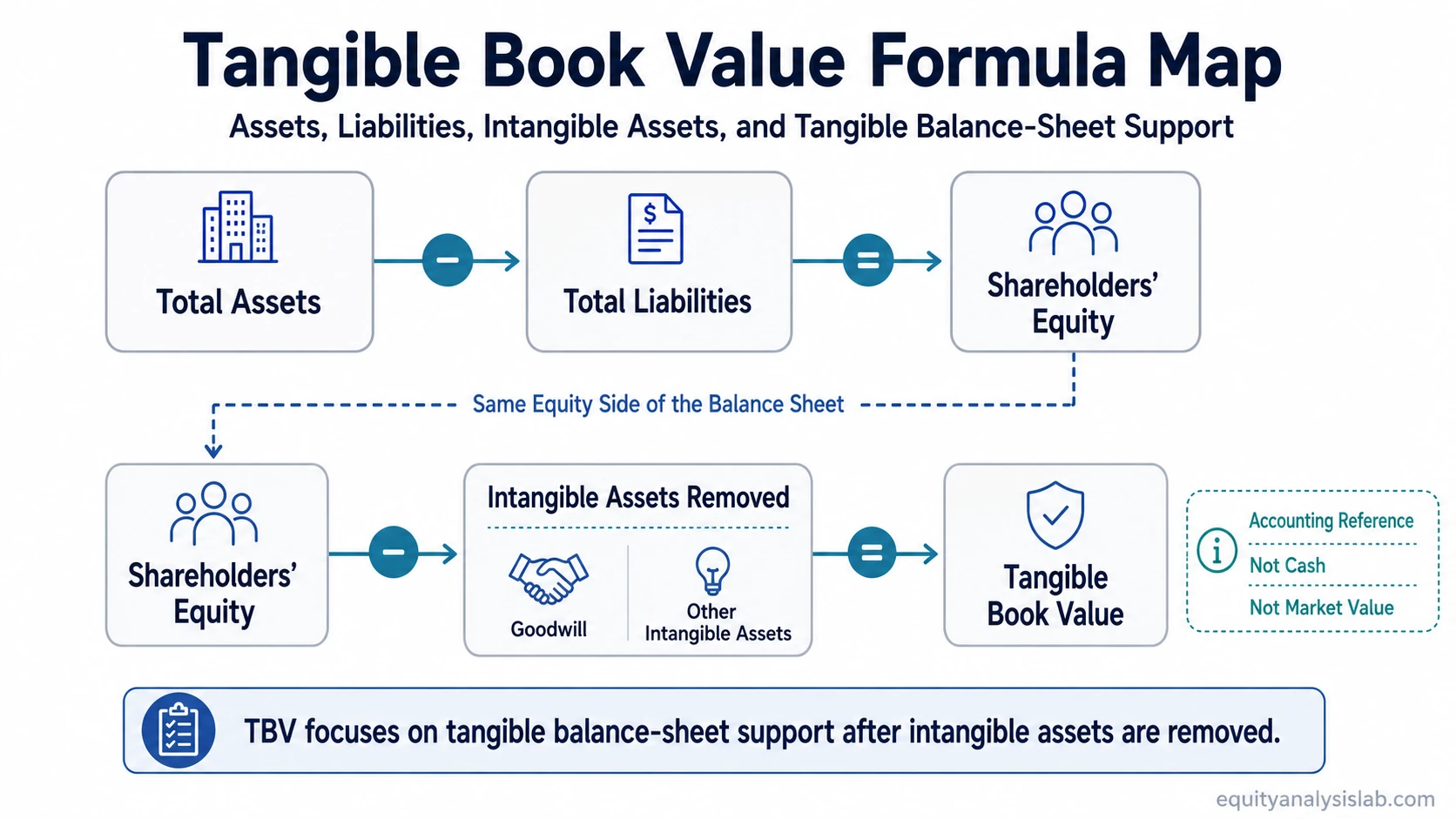
Definition: Tangible book value is shareholders’ equity after subtracting goodwill and other intangible assets, with any additional company-specific reconciliation adjustments considered where relevant.
Key Points
- Tangible book value begins with shareholders’ equity.
- It removes goodwill and other intangible assets from that equity base.
- The measure is often used in financials, industrials, and other balance-sheet-heavy sectors.
- Tangible book value can be expressed as a total amount or on a per-share basis.
- It is an accounting measure, not the same as market value, liquidation value, or intrinsic value.
What Tangible Book Value Means
Tangible book value is a narrower version of book equity. It keeps the balance-sheet focus, but removes items that do not represent tangible assets in the usual accounting sense.
That is why the metric is often used when investors want to know how much of the reported equity base remains after excluding goodwill from acquisitions and other recorded intangible assets. In practice, it is a way to look at the accounting equity cushion from a more conservative angle.
The measure still depends on accounting values, so it should not be treated as a direct measure of business worth. It is most helpful when used as part of a broader balance-sheet and valuation review.
Basic Tangible Book Value Formula
Tangible Book Value = Shareholders’ Equity − Goodwill − Other Intangible Assets
This is the standard teaching formula. In many companies, it gives a good first approximation of the tangible equity base. It also explains why tangible book value is usually lower than ordinary book value whenever goodwill or intangible assets are material.
In real filings, the reconciliation can sometimes include extra adjustments. That does not change the idea of the metric, but it does mean investors should check the company’s own presentation when using a reported tangible common equity figure.
How Tangible Book Value Connects to Equity
Tangible book value comes from the broader equity section of the balance sheet. That means the result still reflects the company’s accumulated capital history, including issued capital, retained results, and other equity components.
For example, items such as retained earnings or accumulated deficit help shape the reported equity base before goodwill and intangible assets are removed. Tangible book value therefore does not stand apart from the rest of the equity statement. It is derived from it.
That connection matters because a low or high tangible book value may reflect more than one thing at the same time: the asset mix, acquisition history, accumulated profits or losses, and other equity movements.
Real Company Example: JPMorgan Chase
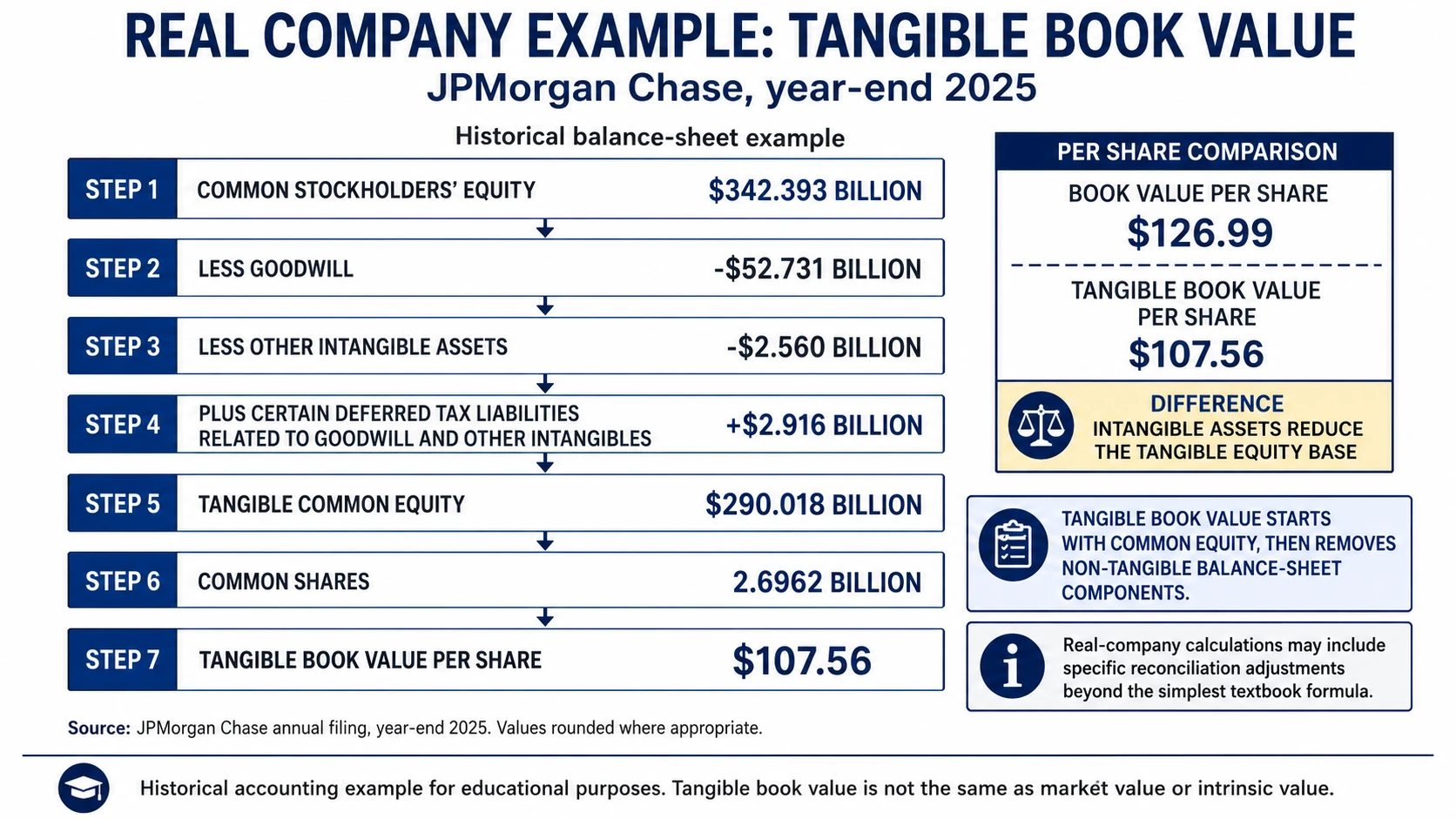
A real company example makes the concept much easier to understand. In its year-end 2025 reporting, JPMorgan Chase showed $342.393 billion of common stockholders’ equity. The company then adjusted that figure by subtracting $52.731 billion of goodwill and $2.560 billion of other intangible assets, while adding back $2.916 billion of certain deferred tax liabilities related to goodwill and other intangibles.
After those adjustments, JPMorgan reported $290.018 billion of tangible common equity. Using 2.6962 billion common shares, the company reported $107.56 of tangible book value per share, compared with $126.99 of book value per share. Source: JPMorgan Chase annual filing, year-end 2025.
Why this example matters: the basic textbook formula explains the concept, but real filings can contain additional reconciliation details. Investors should therefore check the company’s own tangible equity bridge instead of assuming every case follows the simplest version of the formula.
Tangible Book Value Per Share
After calculating total tangible book value, investors often convert it into a per-share measure.
Tangible Book Value Per Share = Tangible Book Value ÷ Common Shares Outstanding
This makes it easier to compare the accounting value base with the stock price. It also connects naturally with discussions around book value per share.
When doing the per-share step, the share-count basis matters. If preferred equity or other shareholder-claim distinctions are important, the analyst should make sure the common-equity base and the share count are aligned.
Why Investors Use Tangible Book Value
Investors use tangible book value when they want a more asset-focused reading of equity. This is especially common in sectors where the balance sheet plays an important role in the investment case.
| Use case | Why TBV can help | Main caution |
|---|---|---|
| Balance-sheet review | Shows how much reported equity remains after removing goodwill and intangibles. | Accounting values may still differ from economic or market values. |
| Bank and financial analysis | Tangible common equity is often used in capital-strength discussions. | Sector-specific definitions and adjustments may apply. |
| Per-share comparison | TBV per share helps compare accounting backing with the current share price. | A low or high price relative to TBV does not by itself decide valuation attractiveness. |
| Acquisition-heavy companies | Helps show how much of book equity depends on acquired intangibles and goodwill. | Removing intangibles does not automatically make the result more economically correct. |
What Tangible Book Value Does Not Tell You
Tangible book value is useful, but it should not be treated as a complete measure of value. It does not tell investors what a company is worth in the market, what the business may be worth on a discounted cash flow basis, or what the assets would actually realize in a liquidation.
It also does not say whether the intangible assets being removed are economically unimportant. Some businesses derive a large part of their strength from intangible advantages, brand power, customer relationships, software, or other non-physical assets. Removing those items may be useful for one analytical purpose while becoming too narrow for another.
Limitations of Tangible Book Value
- It is accounting-based: the number comes from reported balance-sheet values, not from a market or intrinsic value estimate.
- It can understate intangible-heavy businesses: companies built on software, brand, or other non-physical advantages may look weaker on a TBV basis than their business economics suggest.
- Sector relevance varies: the metric is often more useful in financials and asset-heavy sectors than in businesses where intellectual capital dominates.
- Definitions can vary: some companies publish their own tangible common equity reconciliation with additional adjustments.
How to Read Tangible Book Value More Carefully
A good reading of tangible book value starts with context. Investors should ask how large goodwill and other intangibles are, whether acquisition history explains the difference between book value and tangible book value, and whether the sector makes TBV especially relevant or only moderately helpful.
From there, it helps to compare total TBV, tangible book value per share, the direction of the metric over time, and the relationship between TBV and the company’s broader earnings, capital, and valuation picture.
Used that way, tangible book value becomes a useful balance-sheet lens rather than a standalone conclusion.
FAQ
What is tangible book value in simple terms?
Tangible book value is shareholders’ equity after removing goodwill and other intangible assets. It is meant to show a more tangible accounting equity base.
Is tangible book value the same as book value?
No. Ordinary book value uses the reported equity base. Tangible book value reduces that base by removing goodwill and other intangible assets.
What is tangible book value per share?
Tangible book value per share is total tangible book value divided by common shares outstanding. It converts the accounting amount into a per-share figure.
Does a low price-to-tangible-book ratio mean a stock is cheap?
Not by itself. It may be a useful starting signal, but investors still need to examine asset quality, profitability, capital strength, sector context, and the broader valuation picture.