
For investors, accumulated deficit matters because it shows when retained earnings have fallen below zero inside shareholders’ equity. Accumulated deficit is negative retained earnings, usually caused when cumulative losses, distributions, or other retained earnings reductions exceed cumulative retained profits.
The useful question is not only whether the label is negative. The more important question is why the deficit exists, how it developed over time, and whether it affects book equity mechanics without becoming a standalone verdict on business quality, valuation, solvency, or future returns.
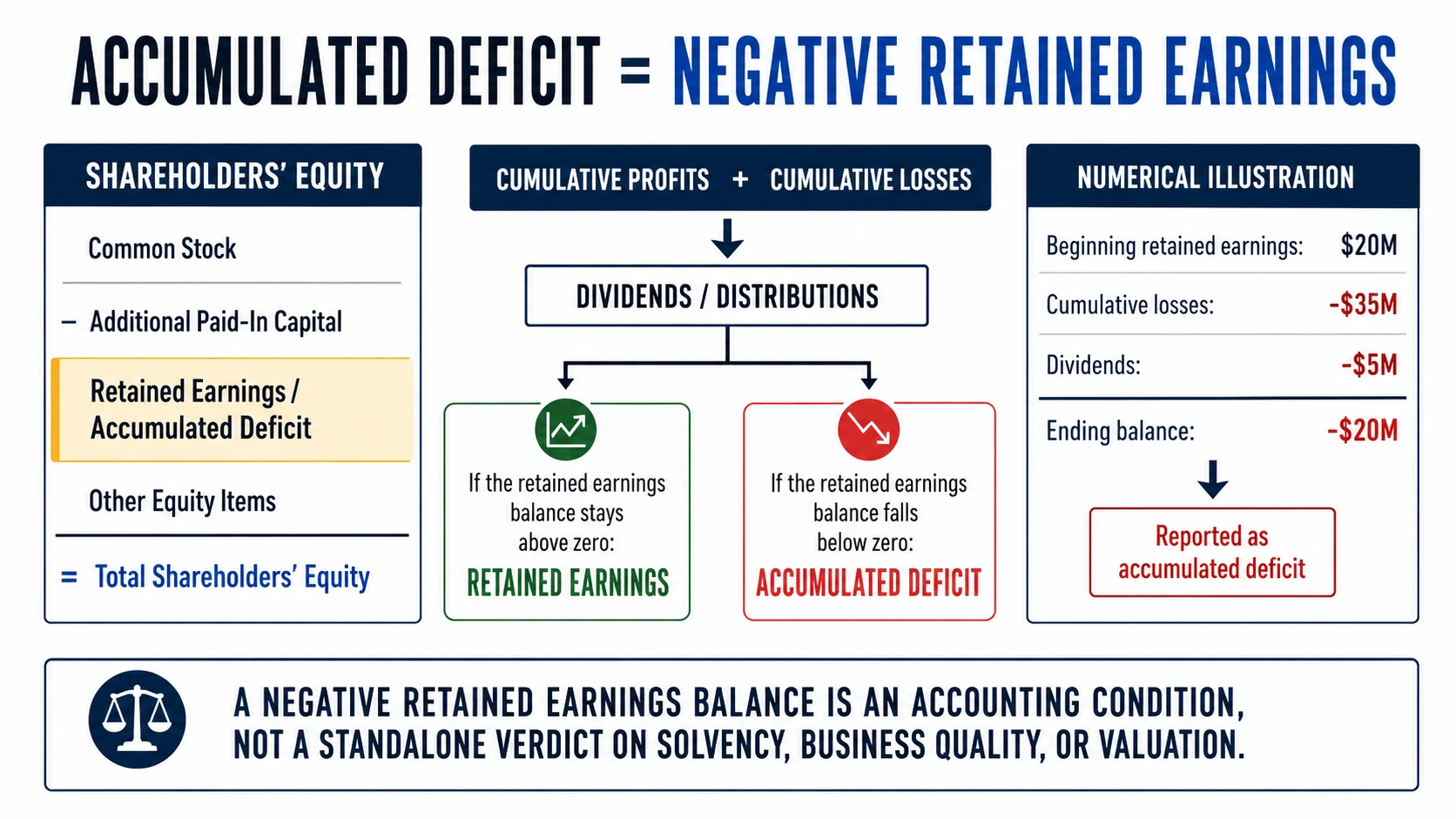
Key Points
- Accumulated deficit means retained earnings are negative.
- It usually appears within the shareholders’ equity section of the balance sheet or the statement of shareholders’ equity.
- It can result from cumulative net losses, dividends or distributions, company lifecycle history, capital structure history, or accounting effects.
- It can reduce reported book equity, but it does not by itself prove weak business quality, bankruptcy risk, cheap valuation, or poor future returns.
What Accumulated Deficit Means
Accumulated deficit is the negative balance of retained earnings. It means cumulative reductions to retained earnings have exceeded cumulative additions from retained profit over the company’s reporting history.
Retained earnings normally represent cumulative profits kept in the business after dividends and other distributions. When that cumulative balance falls below zero, the same line may be reported as accumulated deficit, accumulated losses, or negative retained earnings, depending on the company’s reporting language.
The label is accounting-specific. It identifies the condition of retained earnings, but it does not automatically explain the cause. A young company with cumulative start-up losses, a mature company with a complex capital history, a firm that has paid distributions, and a business that has suffered repeated losses can all show negative retained earnings for different reasons.
Where Accumulated Deficit Appears in Shareholders’ Equity
Accumulated deficit is usually presented inside the equity section of the balance sheet or in the statement of shareholders’ equity. It sits alongside other equity components such as common stock, additional paid-in capital, treasury stock, accumulated other comprehensive income, and retained earnings or accumulated deficit.
Because it is part of the equity section, accumulated deficit can affect reported book equity. A larger negative retained earnings balance can reduce total shareholders’ equity, all else equal, although other equity accounts may partly or fully offset it.
Where to verify it: Investors normally verify the line item in the balance sheet, the statement of shareholders’ equity, the annual report, or the company’s 10-K. The exact label may vary across filings.
How Accumulated Deficit Builds Over Time
The retained earnings bridge is the simplest way to understand how accumulated deficit develops. A generic retained earnings relationship is:
Ending retained earnings = Beginning retained earnings + net income – dividends and distributions
If net losses occur, they reduce retained earnings rather than increasing them. Dividends and distributions also reduce retained earnings. Net income increases retained earnings, but only if later profits are large enough to offset earlier reductions.
This is why accumulated deficit is cumulative rather than period-specific. A company can report profit in a recent year and still show accumulated deficit if past losses or distributions have not yet been fully offset.
Real Company Example: Lyft
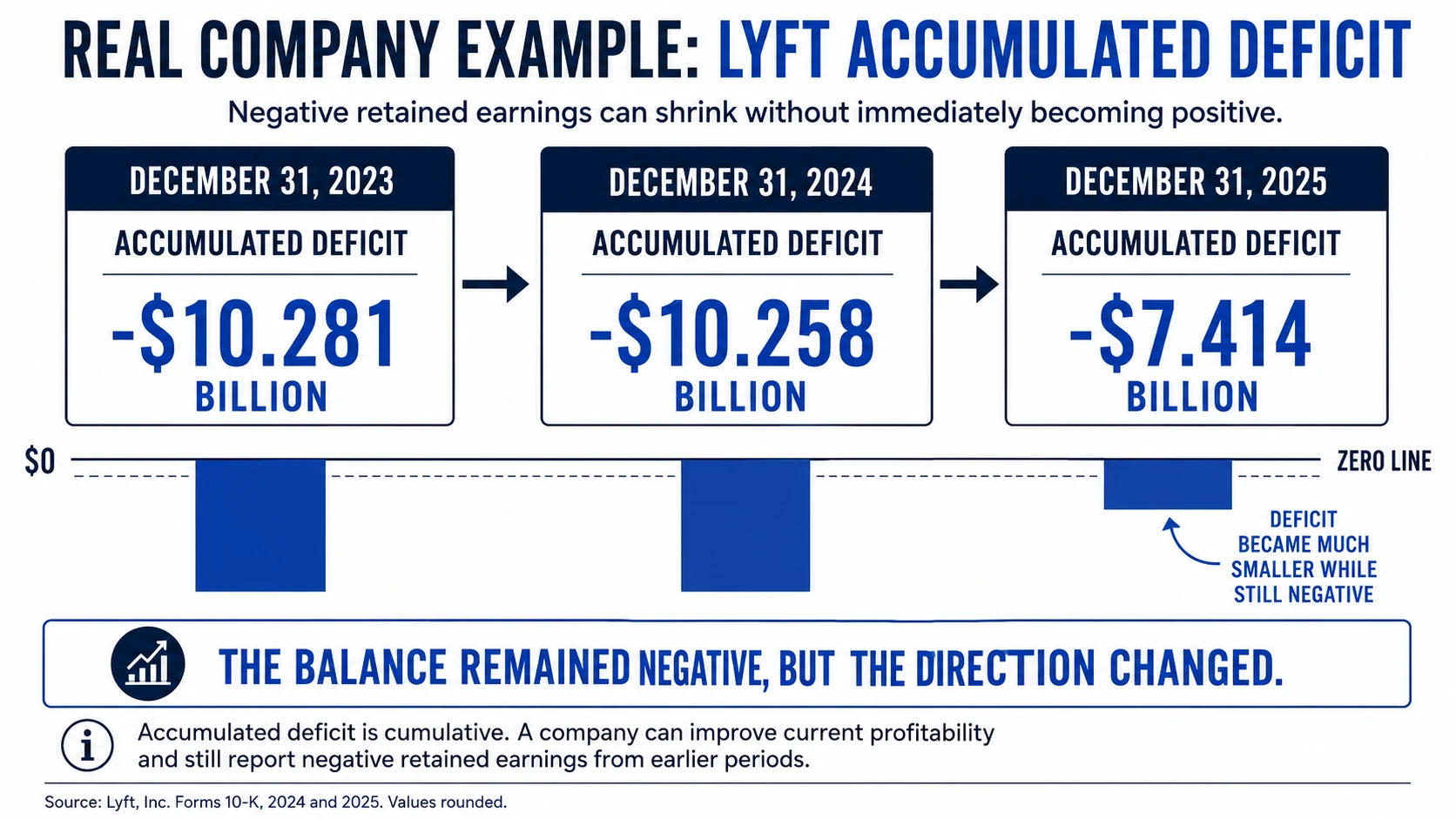
A real company example helps show why accumulated deficit should be read as a cumulative accounting balance rather than as a one-period verdict. Lyft reported accumulated deficit of approximately negative $10.281 billion at December 31, 2023, negative $10.258 billion at December 31, 2024, and negative $7.414 billion at December 31, 2025.
The balance remained negative in all three periods, but the direction changed meaningfully by the end of 2025. That matters because it shows that a company can improve current profitability and still report negative retained earnings from earlier periods. In other words, accumulated deficit can shrink without immediately becoming positive.
Why this matters: The analytical question is not simply whether retained earnings are below zero. Investors should also ask whether the balance is getting worse, stabilizing, or improving, and what operating and capital-history forces are driving that change.
What Accumulated Deficit Can and Cannot Tell Investors
Accumulated deficit can help investors understand part of a company’s retained capital history. It may indicate that cumulative losses, distributions, or other retained earnings reductions have exceeded cumulative retained profit. That can be relevant when reviewing book equity, capital structure, and the path from past profitability to current balance-sheet equity.
It can also matter for book value per share because book value per share depends on total common equity and the share-count denominator. A negative retained earnings balance can reduce common equity, but the final effect depends on the full equity section rather than the accumulated deficit line alone.
The strongest interpretation comes from cause analysis. Investors need to separate accumulated deficit caused by repeated operating losses from accumulated deficit shaped by company age, restructuring, distributions, accounting history, or capital transactions.
| Question | What accumulated deficit can show | What it does not prove |
|---|---|---|
| Retained earnings history | Retained earnings are negative at the reporting date. | It does not prove that current earnings are negative. |
| Business quality | Past retained profits have not exceeded past reductions. | It does not prove that the business is low quality. |
| Solvency | Reported equity may be lower because retained earnings are negative. | It does not prove bankruptcy risk without liquidity, debt, cash flow, and obligation analysis. |
| Valuation | Book equity mechanics may be affected. | It does not prove that the stock is cheap, expensive, attractive, or unattractive. |
| Future returns | The company has a cumulative accounting deficit in retained earnings. | It does not predict future stock performance. |
Limitation: The Label Is Not the Conclusion
A common mistake is treating accumulated deficit as the final investment conclusion. The line item is an accounting condition, not a complete diagnosis. A negative retained earnings balance may deserve attention, but the interpretation depends on profitability trends, cash flow, leverage, capital needs, dividend history, issuance history, industry economics, and company lifecycle.
The same label can carry different meanings across companies. A growth company with cumulative early losses, a cyclical company recovering from a downturn, and a mature company with unusual historical distributions should not be analyzed through the same shortcut.
How Investors Should Read Accumulated Deficit
A useful review starts with three questions. First, did the accumulated deficit come mainly from operating losses, distributions, accounting adjustments, or capital history? Second, is the deficit growing, shrinking, or stable across reporting periods? Third, how does the line interact with cash flow, debt, book equity, and future capital needs?
Those questions keep the analysis tied to financial statement mechanics. Accumulated deficit can raise a useful flag, but it should be interpreted with the full balance sheet, income statement, cash flow statement, and equity statement rather than as an isolated score.
FAQ
Is accumulated deficit the same as negative retained earnings?
Yes. Accumulated deficit generally means retained earnings are negative. The exact reporting label may vary, but the idea is that cumulative retained earnings have fallen below zero.
Does accumulated deficit always mean a company is losing money now?
No. Accumulated deficit is cumulative. A company can be profitable in the current period and still have negative retained earnings if earlier losses or distributions have not yet been offset.
Can a company with accumulated deficit still improve financially?
Yes. A company can improve earnings, cash flow, and balance-sheet quality while still reporting accumulated deficit. The key is whether the negative retained earnings balance is worsening, stabilizing, or beginning to shrink over time.