
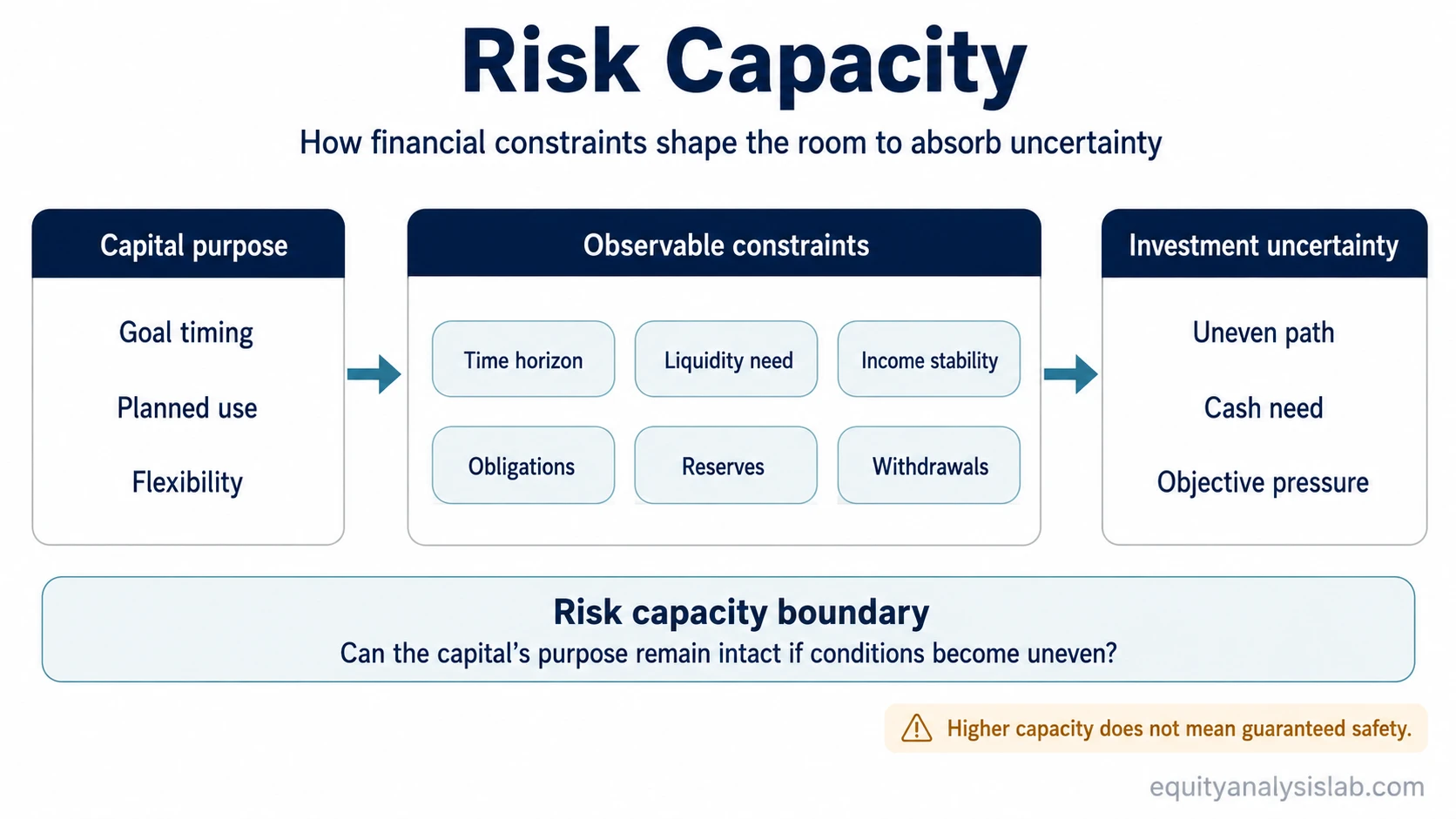
Risk capacity is the amount of investment risk an investor’s financial situation can absorb before the purpose of the capital comes under pressure. It is shaped by observable constraints such as time horizon, liquidity needs, income stability, obligations, assets, liabilities, planned withdrawals, and goal timing.
Definition: Risk capacity is an investor’s objective ability to take investment risk without putting the capital’s intended purpose at risk. It is different from risk tolerance, which describes willingness or comfort with uncertainty.
- Risk capacity depends on financial flexibility and future cash needs.
- A market decline can create very different consequences for investors with different obligations and liquid reserves.
- Capacity can change even when the portfolio itself has not changed.
- Higher capacity provides more flexibility, but it does not make an investment safe or predict future returns.
What Determines Risk Capacity?
Risk capacity depends on how much financial flexibility remains if an investment follows an unfavorable path. A temporary decline may be manageable when the investor has stable income, liquid reserves, and no near-term withdrawals. The same decline can create pressure when the capital is needed soon or when other resources are limited.
| Input | How It Affects Risk Capacity |
|---|---|
| Time horizon | A longer time horizon can provide more flexibility. A near-term goal reduces the time available to manage an unfavorable investment path. |
| Liquidity need | Capital that may be required soon has less capacity for large or prolonged declines. |
| Income stability | Stable external income can reduce dependence on investment assets for near-term spending. |
| Assets and reserves | Liquid reserves can fund obligations without requiring investment assets to be sold during weak markets. |
| Debt and liabilities | Required payments reduce flexibility because those cash outflows continue regardless of investment performance. |
| Planned withdrawals | Regular or scheduled withdrawals increase dependence on portfolio value at specific points in time. |
| Dependents and obligations | Family, business, tax, education, and other commitments can make future cash requirements less flexible. |
| Goal timing | A fixed goal date generally creates less flexibility than a goal that can be delayed or adjusted. |
Risk Capacity as a Funding-Gap Problem
One way to understand risk capacity is to examine what would happen if a financial need arrived during an unfavorable market period. The key issue is whether the investor can fund the obligation without being forced to sell a large portion of a depressed portfolio.
Illustrative example:
Investment portfolio: $100,000
Cash required within 12 months: $30,000
Liquid reserves outside the portfolio: $5,000
The portion of the cash need that still depends on the investment portfolio is:
Near-term funding gap = required cash need – liquid resources available outside the risky portfolio
$30,000 – $5,000 = $25,000
Now assume the portfolio declines by 25% before the cash is needed. The $100,000 portfolio becomes $75,000.
$100,000 × 0.75 = $75,000
Funding the remaining $25,000 need would require withdrawing:
$25,000 ÷ $75,000 = 33.3%
of the reduced portfolio.
The financial pressure comes from the interaction between the drawdown and the fixed cash need. If the investor cannot delay the obligation or fund it elsewhere, part of the market decline may have to be converted into a realized reduction in portfolio capital.
Boundary: This is an illustrative stress test, not a formula for determining a correct asset allocation or a universal level of acceptable risk. Its purpose is to show how liquidity needs and portfolio losses can interact.
Same Portfolio Loss, Different Risk Capacity
The same percentage decline can create very different financial consequences. Consider two investors who each begin with a $100,000 portfolio and experience the same 25% decline.
| Comparison | Investor A | Investor B |
|---|---|---|
| Portfolio after 25% decline | $75,000 | $75,000 |
| Cash needed within 12 months | $30,000 | $0 |
| Liquid reserves outside portfolio | $5,000 | $30,000 |
| Portfolio funding gap | $25,000 | $0 |
| Pressure to sell investments for the stated need | High | Low |
Both investors experienced the same market loss. Investor A has much less flexibility because a near-term cash obligation still depends on the reduced portfolio. Investor B has no stated portfolio funding gap in this example because the required liquidity is already available outside the investment account.
Interpretation: Risk capacity is shaped by what an unfavorable investment path could force the investor to do with the capital.
Risk Capacity vs Risk Tolerance
Risk capacity measures financial ability to absorb an unfavorable investment path. Risk tolerance measures willingness to experience uncertainty, volatility, or temporary loss.
| Concept | Main Question | Primary Inputs |
|---|---|---|
| Risk capacity | Can the financial situation handle the risk without impairing the objective? | Time horizon, liquidity, income, obligations, reserves, liabilities, and withdrawals. |
| Risk tolerance | How willing is the investor to experience uncertainty or temporary loss? | Temperament, experience, emotional response, confidence, and behavioral discipline. |
The two measures can point in different directions. An investor may be comfortable with volatility while having limited capacity because the capital is needed soon. Another investor may have substantial financial flexibility while remaining uncomfortable with market uncertainty.
How Risk Capacity Changes an Investment Plan
Risk capacity changes how the same investment uncertainty affects a financial objective. A volatile return path may be easier to absorb when the capital has a long horizon, external cash-flow support, and no fixed withdrawals. The same path becomes more consequential when the portfolio must fund a near-term obligation.
This connects risk capacity directly to investment objectives. The objective defines what the capital is meant to accomplish. Risk capacity tests how much financial flexibility exists if the investment path becomes unfavorable before that objective is reached.
Important boundary: Risk capacity does not determine which security is suitable, which allocation is correct, or which market outcome will occur. It identifies financial constraints that can limit how much uncertainty the capital can absorb.
Risk Capacity Can Change Without the Portfolio Changing
Risk capacity is not fixed. It can rise or fall because circumstances outside the portfolio change even when the investments, market prices, and asset allocation remain exactly the same.
| Change Outside the Portfolio | Possible Effect on Risk Capacity |
|---|---|
| Job loss or less stable income | Reduces external cash-flow support and can increase dependence on invested assets. |
| New debt payment or fixed obligation | Creates additional non-negotiable cash outflows. |
| Goal moves from seven years away to two years away | Shortens the period available to absorb an unfavorable market path. |
| Liquid reserve increases | Can reduce dependence on the investment portfolio for unexpected or scheduled cash needs. |
| Planned portfolio withdrawal is removed | Reduces the risk that assets must be sold at an unfavorable time. |
This is why a capacity review should be repeated when major financial circumstances change. A portfolio that matched the investor’s constraints several years ago may interact differently with a new income structure, liability, withdrawal schedule, or goal date.
Common Mistakes When Using Risk Capacity
Treating confidence as financial capacity. Confidence can change with market conditions, while cash needs, liabilities, and time constraints remain real financial obligations.
Treating higher capacity as protection from loss. Greater flexibility can reduce pressure to sell during an unfavorable period, but it does not make the investment itself safer.
Assuming capacity is permanent. Changes in income, reserves, liabilities, withdrawals, dependents, or goal timing can materially change the investor’s financial flexibility.
Reducing capacity to a questionnaire score. A questionnaire can organize information, but the important evidence is the financial situation behind the answers.
How to Think About Risk Capacity Before Setting Goals
Risk capacity becomes easier to evaluate when purpose, timing, and constraints are separated. The purpose identifies what the capital must accomplish. Timing identifies when the capital may be needed. Financial constraints determine how much flexibility exists if the investment path becomes unfavorable before that date.
For investors still organizing those inputs, the process usually begins with how to set investment goals. A defined objective and time frame make liquidity requirements and financial constraints easier to evaluate.
Risk capacity also differs from the circle of competence. Risk capacity concerns the financial ability to absorb an unfavorable investment path. Circle of competence concerns the investor’s ability to understand, evaluate, and monitor the investment itself.
FAQ
Is risk capacity the same as risk tolerance?
No. Risk capacity concerns the financial ability to absorb investment risk without impairing an objective. Risk tolerance concerns the investor’s willingness or comfort when facing uncertainty and temporary losses.
Can risk capacity change over time?
Yes. Changes in income, liabilities, liquid reserves, withdrawal needs, dependents, or goal timing can change risk capacity even when the investment portfolio itself has not changed.
Does high risk capacity mean an investor should take more risk?
No. Higher risk capacity indicates greater financial flexibility under an unfavorable investment path. It does not determine the correct allocation, make a risky investment attractive, or predict future returns.