
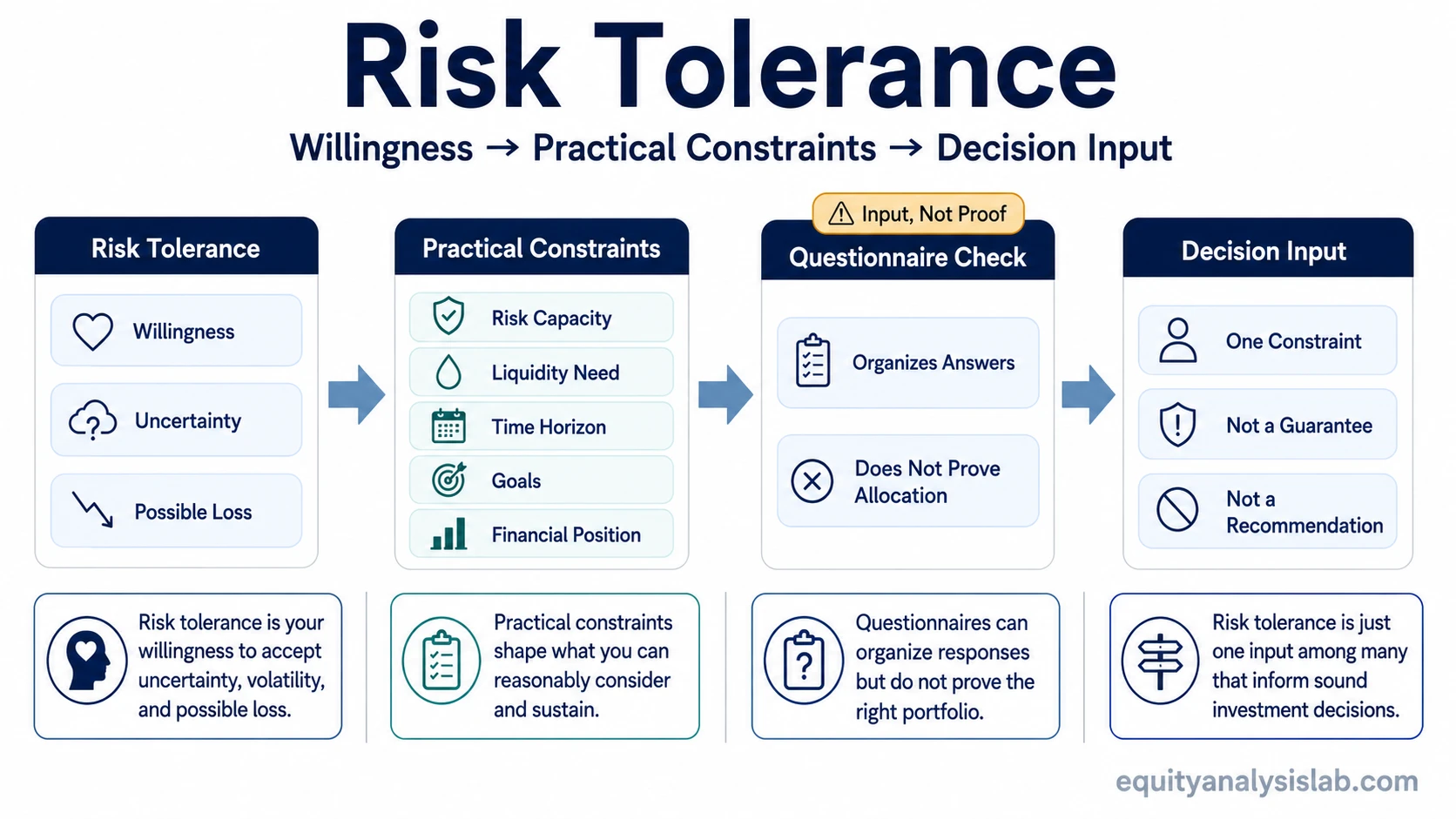
Risk tolerance describes an investor’s willingness to accept investment uncertainty and possible loss. In this sense, it is an attitudinal input: how much risk the investor is willing to take while pursuing an investment objective.
That willingness matters because an investment process can become difficult to follow when actual losses or uncertainty exceed what the investor expected to tolerate. Financial ability to absorb those losses is a separate question and should be evaluated independently.
How Risk Tolerance Is Defined
CFA Institute describes a practitioner definition centered on willingness to take perceived investment risk. FINRA and Investor.gov use a broader formulation that includes both willingness and ability to accept loss. In the discussion below, risk tolerance refers to willingness, while financial ability is treated separately as risk capacity.
What Can Inform a Risk-Tolerance Assessment
Risk tolerance cannot be observed directly. It is inferred from stated preferences, responses to risk trade-offs, questionnaire answers, and behavior when investment outcomes become uncomfortable or uncertain.
| Evidence | What it can reveal | Boundary |
|---|---|---|
| Questionnaire responses | How the investor describes willingness to accept losses, volatility, and uncertain outcomes. | The answers are hypothetical and depend on the questions, scoring method, and assumptions used. |
| Risk-return trade-offs | How much perceived risk the investor is willing to accept in exchange for greater potential return. | The response depends partly on how the investor understands the risks and possible outcomes. |
| Past behavior under market stress | How the investor actually responded when losses or uncertainty became visible. | Observed behavior may also reflect changing liquidity needs, financial circumstances, or other constraints. |
| Consistency across time | Whether stated willingness remains reasonably consistent rather than changing with every short-term market move. | A change in circumstances or risk perception does not automatically prove that underlying tolerance changed by the same amount. |
Risk Tolerance and Financial Capacity Are Separate Inputs
Time horizon, liquidity needs, income stability, debt obligations, cash reserves, and the purpose of the capital can change how much investment loss an investor can financially withstand. Under the willingness-focused definition used here, those conditions belong closer to the ability to absorb financial loss than to risk tolerance itself.
This separation matters when the two inputs disagree. An investor can be comfortable with market volatility while having little financial room for a loss, or have substantial financial capacity while remaining unwilling to accept a high level of uncertainty.
What a Risk-Tolerance Questionnaire Can and Cannot Show
A questionnaire can make stated preferences easier to compare and can expose contradictions between different answers. It can also give the investor a structured way to think about losses, volatility, and uncertainty.
The result still depends on the questionnaire’s assumptions and cannot establish the full investment decision by itself. Vanguard, for example, describes the allocation produced by its investor questionnaire as a general guideline rather than a sole or primary basis for investment decisions.
Same Financial Capacity, Different Willingness
Consider two investors with similar financial resources, the same long-term objective, and no immediate need to withdraw the capital. Both experience the same portfolio decline.
One investor remains comfortable with the uncertainty and continues to follow the existing process. The other finds the loss difficult to tolerate and feels pressure to reduce risk even though the financial constraints are similar.
The difference in this example is willingness. Keeping financial capacity broadly comparable makes the risk-tolerance distinction easier to see.
How Risk Tolerance Fits the Investor Decision
Setting investment goals clarifies what the capital is intended to accomplish and when that purpose may require the money.
Formal objective framing then provides a standard against which the investment approach can be evaluated.
Risk tolerance still does not establish whether the investor understands the investment itself. That analytical boundary belongs to the circle of competence.
Limits of Risk Tolerance
Greater willingness to accept uncertainty does not establish financial capacity, suitability, investment quality, expected return, or the correct portfolio allocation. Risk tolerance is one investor-level input and should not substitute for the other constraints and evidence required by the decision.