
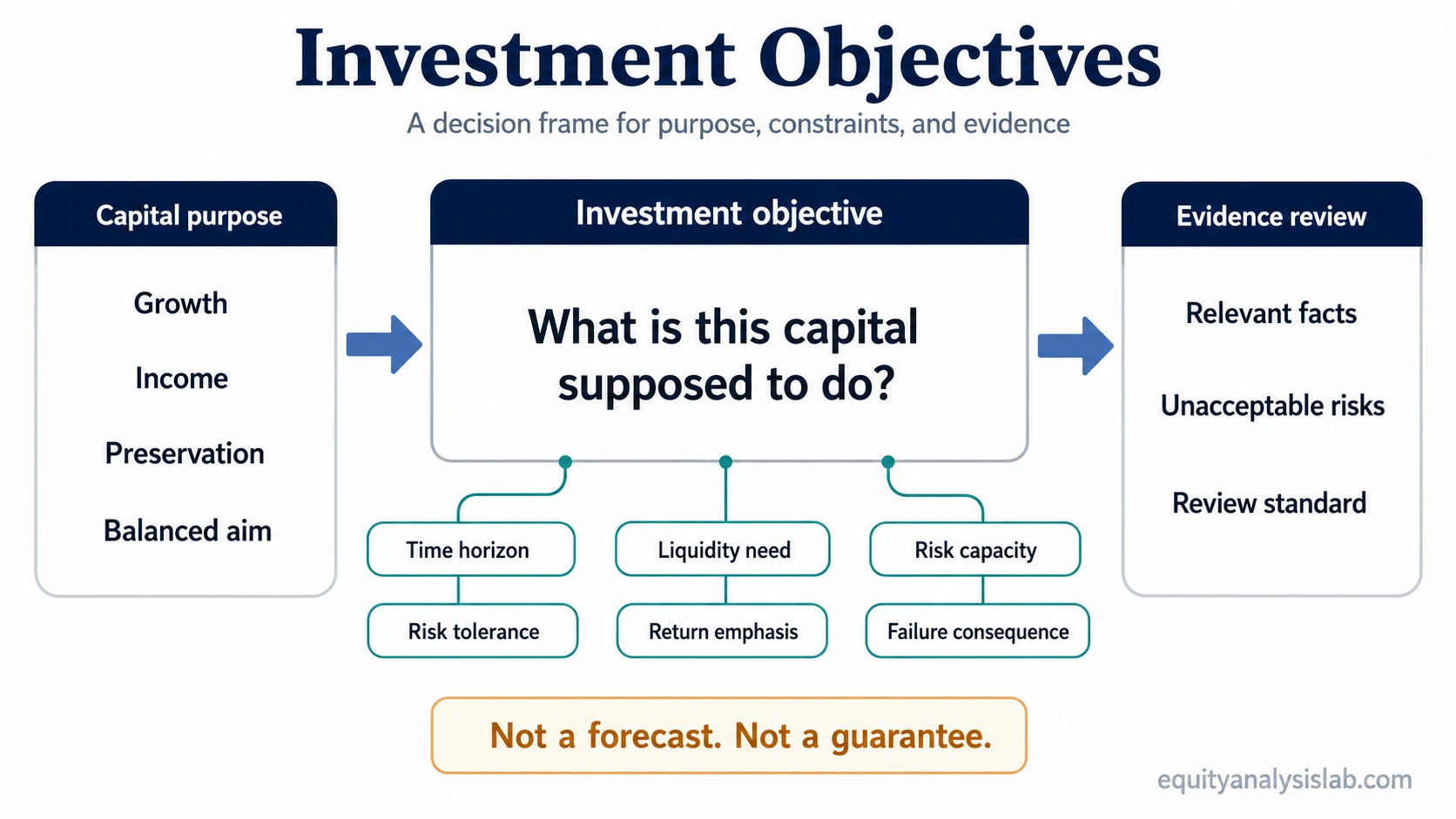
Investment objectives define what invested capital is meant to accomplish and provide a standard for judging whether an investment approach fits that purpose. Common objectives include growth, income, capital preservation, or a combination, but the objective has to be read together with the investor’s time horizon, liquidity needs, and ability and willingness to take risk.
The objective narrows the decision before a stock, fund, portfolio, or strategy is evaluated. It helps determine which evidence deserves more weight and which outcomes would conflict with the purpose of the capital.
Investor Objective vs Fund Objective
Defines what the investor needs the capital to accomplish and the risk-and-return requirements the broader investment process must satisfy.
Describes what a particular fund is designed to pursue, such as capital appreciation, income, or a combination, as stated in its prospectus.
CFA Institute discusses client objectives within portfolio planning, while Investor.gov uses investment objective in the separate context of a fund prospectus. This page uses the investor-level meaning unless stated otherwise.
Objective, Goal, Strategy, and Policy
| Concept | Main question | Decision role |
|---|---|---|
| Investment objective | What should this capital accomplish? | Defines the standard the investment approach has to satisfy. |
| Investment goal | What financial outcome or future need is the investor trying to reach? | Provides the practical target or purpose behind the capital. |
| Investment strategy | How will the investor pursue the objective? | Describes the implementation approach rather than the purpose itself. |
| Investment policy statement | How will objectives, constraints, rules, and review standards be documented? | Turns the broader investor framework into a repeatable process. |
Inputs That Determine Whether an Objective Is Feasible
An objective cannot be evaluated in isolation from the conditions under which the capital has to work. Portfolio-planning frameworks commonly separate the objective from constraints such as liquidity and time horizon, while risk willingness and financial ability affect how much uncertainty the investor can reasonably accept.
| Input | Question to resolve | Why it changes the decision |
|---|---|---|
| Time horizon | When may the capital be needed? | A shorter window leaves less time for an adverse price path or delayed thesis to recover before the money is required. |
| Liquidity need | Could the investor need access to cash before the intended holding period ends? | A forced sale can make an otherwise reasonable long-term thesis unsuitable for the actual capital need. |
| Risk capacity | How much loss or delay can the investor absorb financially? | Financial obligations can limit how much downside or illiquidity the objective can tolerate. |
| Risk tolerance | How much uncertainty can the investor tolerate behaviorally? | A financially workable plan can still fail if the investor is unlikely to remain with it during stress. |
| Failure consequence | What happens if the objective is not met when the capital is needed? | The consequence helps determine how much uncertainty is acceptable before the investment approach conflicts with the purpose of the money. |
Common Investment Objective Types
Labels vary across institutions and account frameworks, so the categories are best treated as common objective emphases rather than a universal taxonomy.
| Objective emphasis | Investor question | Evidence focus | Main boundary |
|---|---|---|---|
| Growth / capital appreciation | Can the capital accept uncertainty while pursuing longer-term value growth? | Business quality, reinvestment potential, valuation, and durability of earnings or cash flow. | A growth objective does not establish that a growth investment is fairly priced or high quality. |
| Income | Does the capital need recurring cash flow rather than relying mainly on price appreciation? | Distribution quality, coverage, cash-flow durability, and balance-sheet strength. | A high quoted yield does not establish that the underlying income is durable. |
| Preservation / stability | How much capital uncertainty can be accepted before the purpose of the money is impaired? | Liquidity, downside exposure, and the consequences of loss when the capital is needed. | Preservation reduces the acceptable risk budget but cannot eliminate investment risk. |
| Balanced growth and income | How should current cash flow be weighed against future appreciation? | Income quality, growth potential, valuation, and the investor’s risk capacity. | The label alone does not establish diversification or suitability. |
| Speculative / high-risk | What level of loss or thesis failure would make the position unacceptable? | Downside tolerance, liquidity, thesis fragility, and the role of the position in the broader portfolio. | A high-risk objective does not remove the need to define loss limits and failure conditions. |
Same Investment, Different Objective
Consider an investment with uncertain near-term price movement, a plausible long-term growth case, and limited current income.
An investor focused on long-term growth may concentrate on whether the business evidence and valuation support waiting through uncertainty. An investor who needs current income may place more weight on recurring cash generation. An investor focused on preservation may reject the same idea if a significant decline would interfere with the purpose of the capital.
The evidence is being judged against different requirements. That change in objective can alter which facts matter most without changing the underlying security.
From Objective to Investment Process
Investment goals make the intended outcome more concrete. An investment policy statement can then document the objective, constraints, and review rules used to apply it.
The circle of competence adds another boundary: even when an investment fits the objective financially, the investor still needs enough understanding to evaluate the business, industry, accounting, and evidence independently.
Limits of an Investment Objective
The objective does not forecast returns, establish valuation, guarantee safety, or prove that a security, fund, or portfolio is suitable. Those conclusions still depend on the underlying evidence, the investor’s constraints, and the quality of the investment analysis.