
An investment policy statement is a written investing framework that records the investor’s objectives, constraints, risk boundaries, liquidity needs, and review rules before individual investment decisions are made.
Its role is to turn a broad intention into a decision reference. A useful IPS can help an investor check whether a portfolio decision still fits the stated purpose of the capital, but it cannot select securities automatically, forecast returns, prove suitability, or guarantee better outcomes.
Key Points
- An investment policy statement is a written framework for objectives, constraints, risk boundaries, liquidity needs, and review rules.
- Its core components usually include the purpose of the capital, time horizon, risk boundary, liquidity needs, constraints, investment guidelines, and review process.
- It narrows the decision environment, but it does not choose securities, prove suitability, forecast returns, or make judgment unnecessary.
- Review triggers should be based on material changes in goals, time horizon, liquidity needs, constraints, portfolio drift, or scheduled review rules.
What Is an Investment Policy Statement?
An investment policy statement, often shortened to IPS, is a policy document for investing decisions. It usually describes what the money is meant to do, what constraints apply, how much uncertainty the investor is prepared or able to accept, and when the plan should be reviewed.
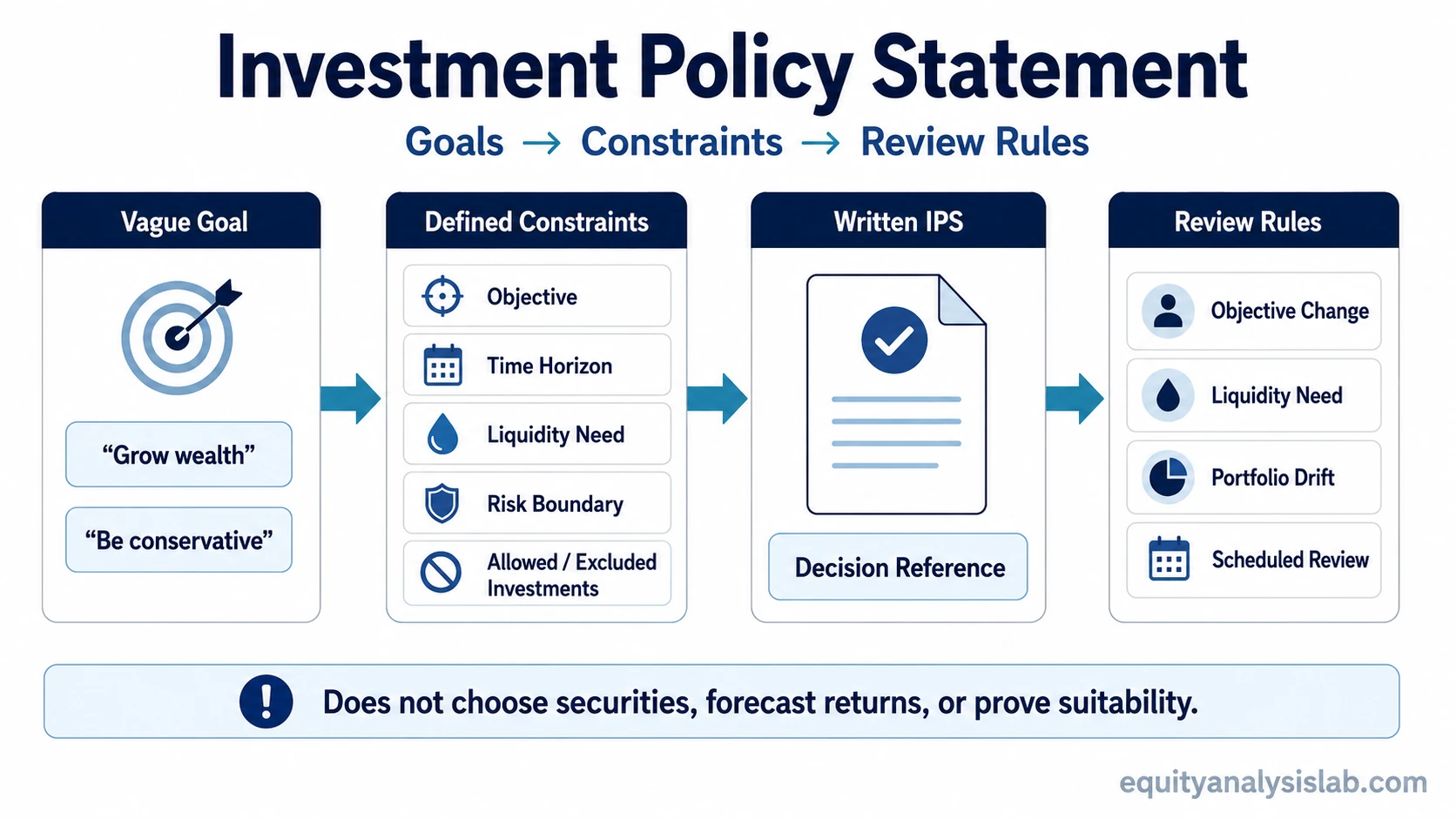
The important boundary is that an IPS is not the investment itself. It is the written standard used to judge whether later choices remain consistent with the investor’s stated framework. Before the IPS can be useful, the investor still needs clear specific objectives rather than a vague preference such as “grow wealth” or “be conservative.”
What an Investment Policy Statement Includes
A complete IPS does not need to be complicated, but it should be specific enough to guide decisions when market conditions, personal circumstances, or portfolio results change.
A practical IPS usually starts with the objective, time horizon, liquidity need, risk boundary, allowed or excluded investments, and the conditions that trigger review.
| IPS element | What it defines | What it does not prove |
|---|---|---|
| Objectives | The purpose of the capital and the outcome the investor is trying to support. | That the objective is realistic or that any specific investment will meet it. |
| Time horizon | The period over which the capital may be invested before it is needed. | That short-term volatility can be ignored or that long-term returns are guaranteed. |
| Risk boundary | The level of uncertainty, drawdown, illiquidity, or portfolio variation the framework is meant to tolerate. | That the chosen investments are automatically suitable or safe. |
| Liquidity needs | How much access to cash may be needed for spending, reserves, taxes, or future obligations. | That the portfolio will always provide liquidity under stress. |
| Constraints | Limits such as eligible instruments, concentration rules, tax considerations, ethical screens, or prohibited exposures. | That every allowed investment is attractive or every excluded investment is poor. |
| Review rules | When the IPS should be revisited and what changes justify an update. | That frequent changes improve the plan or that no judgment is required. |
How an IPS Turns Goals Into Decision Constraints
The practical value of an IPS is translation. It takes broad investor intentions and converts them into written constraints that can be checked later. That process usually starts with setting investment goals clearly enough that time horizon, liquidity, and risk boundaries can be written down.
For example, an individual investor with a vague goal of “investing for the future” has not created much decision guidance. If that same investor defines the purpose of the capital, the approximate time horizon, the need for emergency liquidity, the types of investments that are allowed, and the conditions that would trigger a review, the goal becomes easier to evaluate against future choices.
This does not make the future predictable. It only creates a written reference point so that later portfolio decisions can be compared with the investor’s own constraints rather than with market noise, recent performance, or a new product idea.
What an Investment Policy Statement Does Not Decide
An IPS can narrow the decision environment, but it should not be treated as a security-selection tool. It may describe eligible asset classes, prohibited exposures, portfolio policy boundaries, review rules, or risk limits, but it cannot show whether a specific stock, fund, ETF, bond, or strategy is appropriate at a particular price.
It also does not replace analysis. An IPS may say that the investor only wants to own investments they understand, but the investor still needs a circle of competence boundary to decide which companies, sectors, instruments, or strategies can be analyzed with enough confidence.
Limitation: An IPS is useful only inside the correct investor context. If the objective is unclear, the risk boundary is unrealistic, or liquidity needs are understated, writing the policy does not fix the underlying problem.
IPS vs Investment Objectives, Risk Capacity, and Risk Tolerance
An IPS often mentions several related concepts, but they are not the same thing. Keeping the distinctions clear prevents the document from becoming a loose planning template.
| Concept | Main question | How it relates to the IPS |
|---|---|---|
| Investment objectives | What is the capital meant to accomplish? | The IPS records the objective and uses it as the anchor for later policy choices. |
| Risk capacity | How much loss, delay, or illiquidity can the investor actually absorb? | The IPS should respect how much loss or illiquidity the investor can actually absorb, not only how much volatility the investor says they can tolerate. |
| Risk tolerance | How much uncertainty is the investor emotionally willing to accept? | The IPS can document tolerance, but tolerance should not override capacity, liquidity needs, or objective constraints. |
| Goal setting | How should a broad desire become a usable target? | The IPS depends on goal clarity; it should not be the first place where vague goals are invented. |
When an Investment Policy Statement Should Be Reviewed
An IPS is not meant to change every time markets move. Review rules are useful because they separate ordinary portfolio movement from a real change in the investor’s situation, mandate, or constraints.
Common review triggers include a major change in the investor’s objective, a shorter or longer time horizon, a material liquidity need, a change in income or spending requirements, a portfolio drift outside stated policy boundaries, a new legal or tax constraint, or a scheduled periodic review.
The review should ask whether the policy still matches the investor’s real situation. It should not be used as a way to justify every recent preference, chase performance, or rewrite the plan after normal volatility.
Common Misuse of an IPS
The most common misuse is treating the IPS as a form that creates discipline by itself. A document can record discipline, but it cannot enforce good judgment if the inputs are weak or ignored.
Another misuse is treating a sample or template as the answer. A sample investment policy statement can show possible headings, but the useful work is not copying the format. The useful work is defining the investor’s own objective, constraints, risks, liquidity needs, and review process in a way that can be applied consistently.
FAQ
What is an investment policy statement in simple terms?
An investment policy statement is a written framework that describes the investor’s objectives, constraints, risk boundaries, liquidity needs, and review rules. It helps guide later investing decisions, but it does not choose investments or guarantee results.
Is an investment policy statement the same as investment objectives?
No. Investment objectives describe what the capital is meant to accomplish. The IPS records those objectives and connects them with constraints, risk boundaries, liquidity needs, investment guidelines, and review rules.
Does an IPS tell an investor what to buy?
No. An IPS may define eligible investment types or prohibited exposures, but it does not determine whether a specific security, fund, or strategy is attractive, suitable, or correctly priced.
Can an individual investor use an investment policy statement?
Yes. An IPS can be useful for an individual investor when it stays practical and context-specific. It should focus on the investor’s purpose, constraints, risk boundary, liquidity needs, and review discipline rather than copying an institutional template.
How often should an investment policy statement be reviewed?
It can be reviewed on a scheduled basis and whenever the investor’s objectives, time horizon, liquidity needs, constraints, or portfolio policy boundaries materially change. It should not be rewritten only because markets have moved.