
P/E vs PEG compares a basic earnings multiple with the same multiple after expected earnings growth is added to the analysis. P/E shows how much investors are paying for each unit of earnings. PEG asks how that P/E changes when it is divided by an earnings-growth assumption.
The extra growth input can materially change the relative valuation reading. It also makes PEG more sensitive to forecasts, growth horizons, and the consistency of the inputs used in the calculation.
Core distinction: P/E compares price with earnings. PEG compares the P/E ratio with an earnings-growth rate. PEG can add growth context, but the result still depends on the growth assumption used.
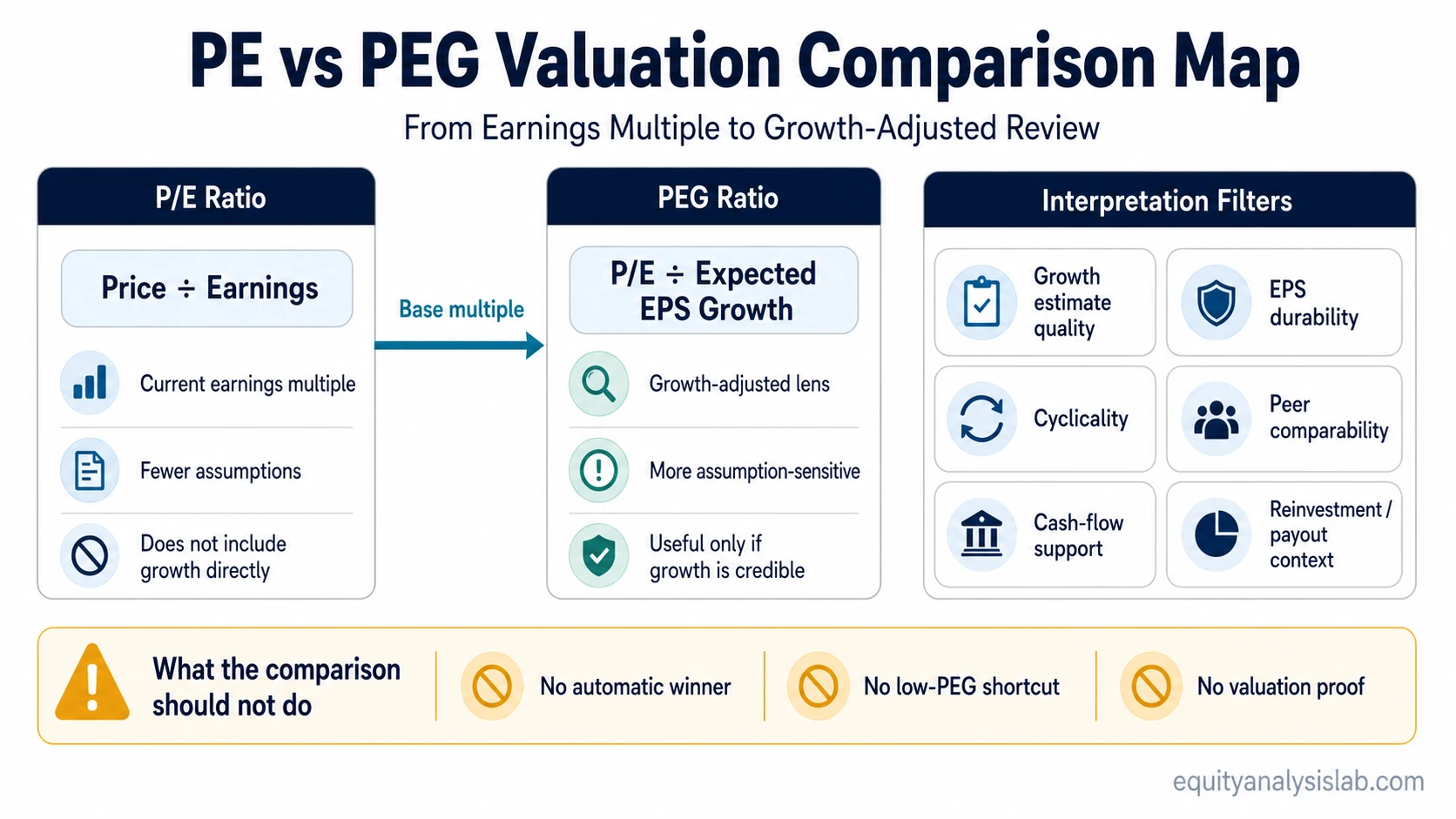
Key Points
- P/E measures price relative to earnings, while PEG adjusts that multiple for an earnings-growth rate.
- A lower P/E can produce a higher PEG if expected growth is much slower.
- The same P/E can produce very different PEG ratios when the growth assumption changes.
- The same PEG can come from different combinations of P/E and growth.
- PEG comparisons are more useful when the P/E basis, growth horizon, and earnings definitions are consistent.
What P/E and PEG Compare
The price-to-earnings ratio compares a company’s share price with earnings per share. It provides a direct reading of how much the market is paying for the earnings base used in the calculation.
The PEG ratio adds an earnings-growth rate:
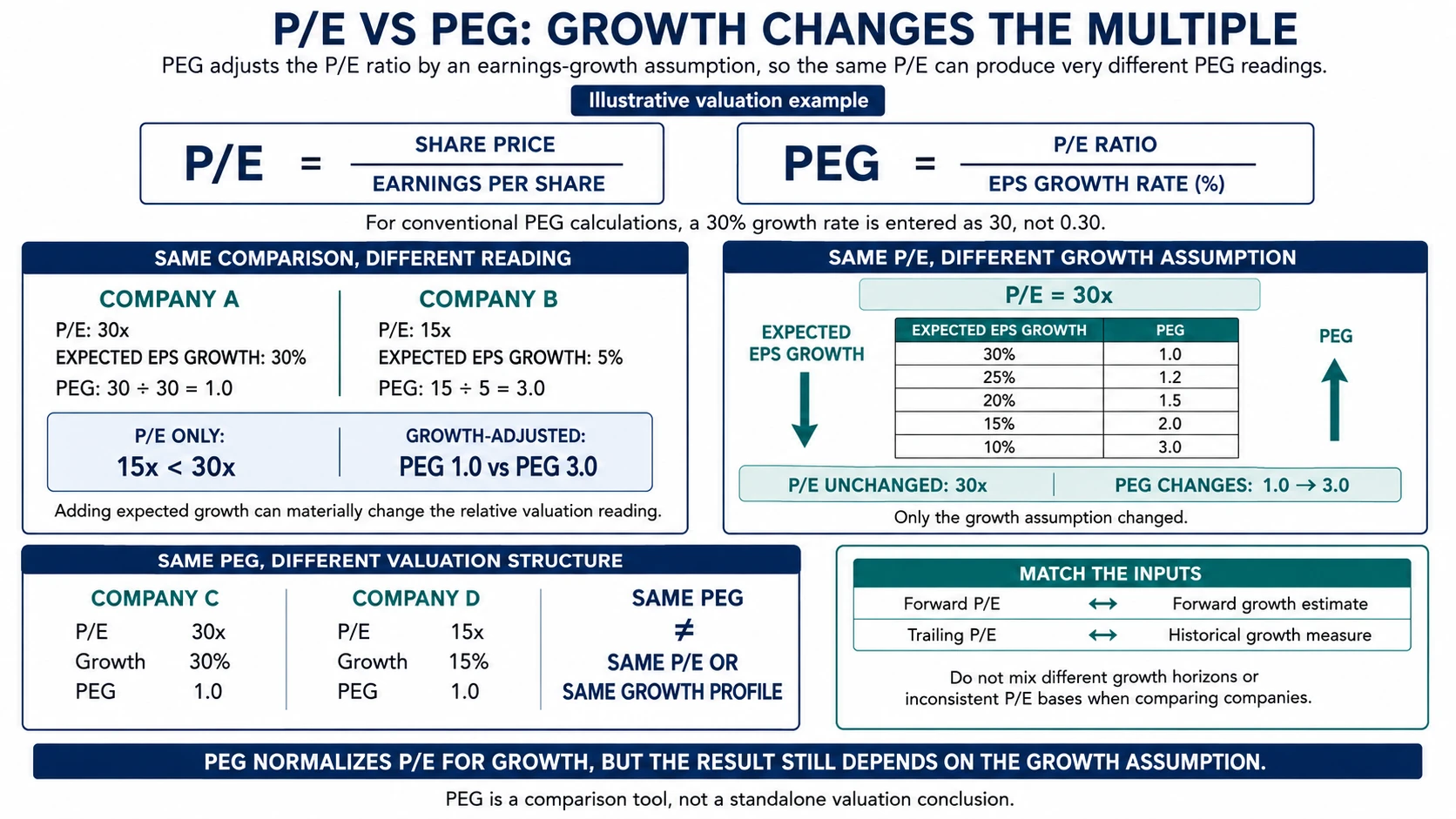
PEG Ratio = P/E Ratio ÷ EPS Growth Rate (%)
Under the conventional presentation, a 30% growth rate is entered as 30 rather than 0.30. The PEG calculation therefore changes the P/E reading according to the growth rate placed in the denominator.
P/E vs PEG: Calculate the Difference
Consider two hypothetical companies with different earnings multiples and different expected EPS growth rates.
| Comparison | Company A | Company B |
|---|---|---|
| P/E ratio | 30x | 15x |
| Expected EPS growth | 30% | 5% |
| PEG calculation | 30 ÷ 30 | 15 ÷ 5 |
| PEG ratio | 1.0 | 3.0 |
On P/E alone, Company B has the lower multiple at 15x versus 30x. Once expected growth is included, Company A has a PEG of 1.0 while Company B has a PEG of 3.0. The growth adjustment changes the relative reading even though Company A still has the higher absolute earnings multiple.
Interpretation: PEG can change how two P/E ratios are compared, but it does not remove the underlying P/E or prove that the lower PEG represents the better investment.
Same P/E, Different Growth Assumption
PEG becomes more assumption-sensitive because the growth rate sits directly in the denominator. Hold the P/E constant at 30x and change only the expected EPS growth rate:
| Expected EPS Growth | P/E | PEG |
|---|---|---|
| 30% | 30x | 1.0 |
| 25% | 30x | 1.2 |
| 20% | 30x | 1.5 |
| 15% | 30x | 2.0 |
| 10% | 30x | 3.0 |
The P/E remains 30x throughout the example, while PEG moves from 1.0 to 3.0 as the growth assumption falls from 30% to 10%. Nothing about the share price or the earnings multiple changed. Only the assumed growth rate changed.
This is the central sensitivity in PEG analysis. A revision to expected growth can materially change the ratio even before the stock price or current earnings base changes.
Same PEG, Different Valuation Structure
An identical PEG ratio can also come from very different combinations of P/E and growth.
| Comparison | Company C | Company D |
|---|---|---|
| P/E ratio | 30x | 15x |
| EPS growth rate | 30% | 15% |
| PEG ratio | 1.0 | 1.0 |
Both companies have a PEG of 1.0, but Company C carries twice the P/E and twice the assumed growth rate. PEG compresses both inputs into a single ratio, so the underlying multiple and growth assumption should still be reviewed separately.
Key distinction: An equal PEG ratio does not mean two companies have the same valuation structure or growth profile.
Why PEG Is More Assumption-Sensitive
P/E depends on the earnings figure selected for the denominator. PEG adds another variable by introducing an earnings-growth rate. If that growth estimate changes, the PEG ratio changes even when the P/E remains constant.
Forecast uncertainty becomes especially important for businesses with cyclical profits, sharp margin changes, temporary earnings rebounds, early-stage growth, or large differences between reported EPS growth and underlying cash generation.
Main limitation: PEG can only be as informative as the growth assumption used in the calculation. A precise ratio produced from an unstable forecast can create more apparent precision without adding better valuation evidence.
Match the P/E and Growth Inputs
A PEG comparison is more meaningful when the earnings multiple and growth rate refer to compatible periods. Mixing different time bases can create ratios that look comparable mathematically while measuring different economic periods.
| P/E Basis | Growth Input to Review |
|---|---|
| Forward P/E | Forward-looking earnings-growth estimate over a comparable horizon |
| Trailing P/E | Historical earnings-growth measure over a defined historical period |
The comparison also becomes weaker when one company uses a one-year growth estimate and another uses a multi-year CAGR, or when different earnings definitions are used. Before comparing PEG ratios, check that the P/E basis, EPS definition, growth horizon, and forecast source are reasonably consistent.
When P/E and PEG Give Different Signals
P/E can be useful when the main question concerns the earnings multiple itself. PEG becomes useful when the analyst wants to test whether materially different growth rates change that reading.
Different signals are most informative when the analyst can explain why they differ. A high P/E combined with a lower PEG usually reflects a relatively high growth assumption. A low P/E combined with a high PEG usually reflects a slower growth assumption. The next analytical step is therefore to test whether those growth expectations are supported by the business.
What to Check Before Comparing PEG Ratios
| Check | Why It Matters |
|---|---|
| Growth horizon | One-year growth and multi-year growth rates can produce different PEG readings. |
| P/E basis | Trailing and forward earnings multiples measure different earnings periods. |
| EPS durability | A growth estimate is less useful if the earnings base is temporarily depressed, unusually elevated, or dependent on one-time items. |
| Cyclicality | Peak or trough earnings can distort both the P/E and the growth rate used in PEG. |
| Cash-flow support | EPS growth deserves a different interpretation when it is supported by operating cash generation. |
| Peer comparability | PEG comparisons are easier to interpret when companies have reasonably similar business economics and accounting treatment. |
Limits of P/E vs PEG Comparisons
Neither ratio captures the entire valuation problem. P/E does not directly incorporate growth, while PEG reduces a complex growth outlook to one denominator. Neither ratio directly measures reinvestment returns, balance-sheet risk, competitive position, capital intensity, or the cash required to produce future earnings.
A low PEG can result from an aggressive growth forecast. A high PEG can result from a conservative forecast or from a business whose current earnings already reflect a mature growth profile. The ratio is most useful when the analyst can trace the calculation back to the actual P/E basis and growth assumption.
FAQ
What is the main difference between P/E and PEG?
P/E compares price with earnings. PEG divides the P/E ratio by an earnings-growth rate, adding growth as another input to the valuation comparison.
Why can a higher P/E stock have a lower PEG?
A company with a higher P/E can have a lower PEG when its assumed earnings-growth rate is sufficiently higher. For example, a 30x P/E with 30% growth produces a PEG of 1.0, while a 15x P/E with 5% growth produces a PEG of 3.0.
Can PEG change if the P/E ratio stays the same?
Yes. If the growth assumption changes while P/E remains constant, PEG changes because the growth rate is the denominator. A 30x P/E produces a PEG of 1.0 at 30% growth and 3.0 at 10% growth.
Does the same PEG mean two companies have the same valuation?
No. A 30x P/E with 30% growth and a 15x P/E with 15% growth both produce a PEG of 1.0, even though the underlying earnings multiples and growth assumptions are very different.