
Portfolio concentration risk is the risk that a portfolio depends too heavily on one holding, issuer, sector, geography, asset class, fund, currency, factor, or overlapping exposure group. The useful question is not only how concentrated the portfolio looks, but how strongly that concentration could affect total portfolio results if the shared exposure moves against the investor.
A concentration reading is not a standalone verdict. It does not prove that a holding is low quality, that future returns will be poor, or that immediate action is required. It identifies where portfolio dependence may be larger than the holding count or the largest visible line item suggests.
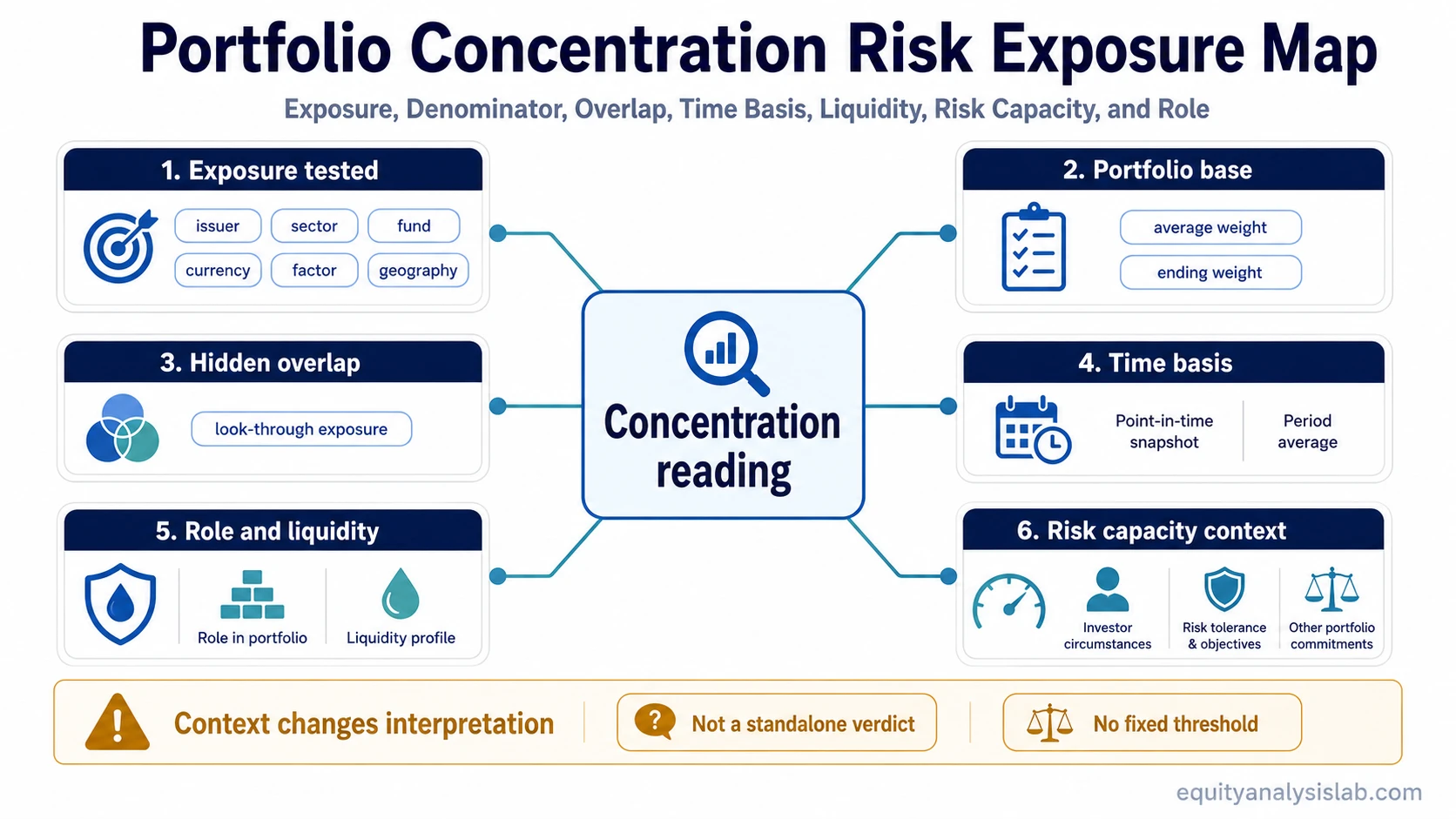
Definition: Portfolio concentration risk is a diagnostic exposure reading that compares a defined exposure group with the portfolio base used to measure it, then asks how strongly that exposure could affect total portfolio results. The reading becomes useful only when the numerator, denominator, overlap, time period, liquidity, and portfolio role are understood together.
Key Points
- Portfolio concentration risk measures exposure dependence, not investment quality by itself.
- Concentration weight and portfolio risk impact are related, but they are not the same thing.
- The largest visible holding can understate the real concentration risk if several positions share the same underlying driver.
- Measurement basis matters because numerator, denominator, look-through exposure, and time basis can all change the reading.
- A concentration reading is a diagnostic result, not an automatic instruction to trade.
What Portfolio Concentration Risk Measures
Portfolio concentration risk measures how much of the portfolio’s outcome may depend on a defined exposure. That exposure may be a single stock, an employer stock position, a sector, a country, a currency, a commodity-linked group, a fund, or a broader economic driver such as interest-rate sensitivity, credit sensitivity, or growth-factor dependence.
The broader concept of portfolio concentration describes the condition itself. Portfolio concentration risk focuses on the consequence question: how much portfolio dependence exists, where it comes from, and how strongly that dependence could affect the whole portfolio if the exposure moves unfavorably.
A portfolio can therefore look diversified by holding count while still carrying meaningful concentration risk. Several different tickers or funds may still depend on the same revenue driver, same valuation factor, same geography, same currency, or the same small group of underlying issuers.
Concentration Weight Is Not the Same as Portfolio Risk Impact
A useful simplified framework is:
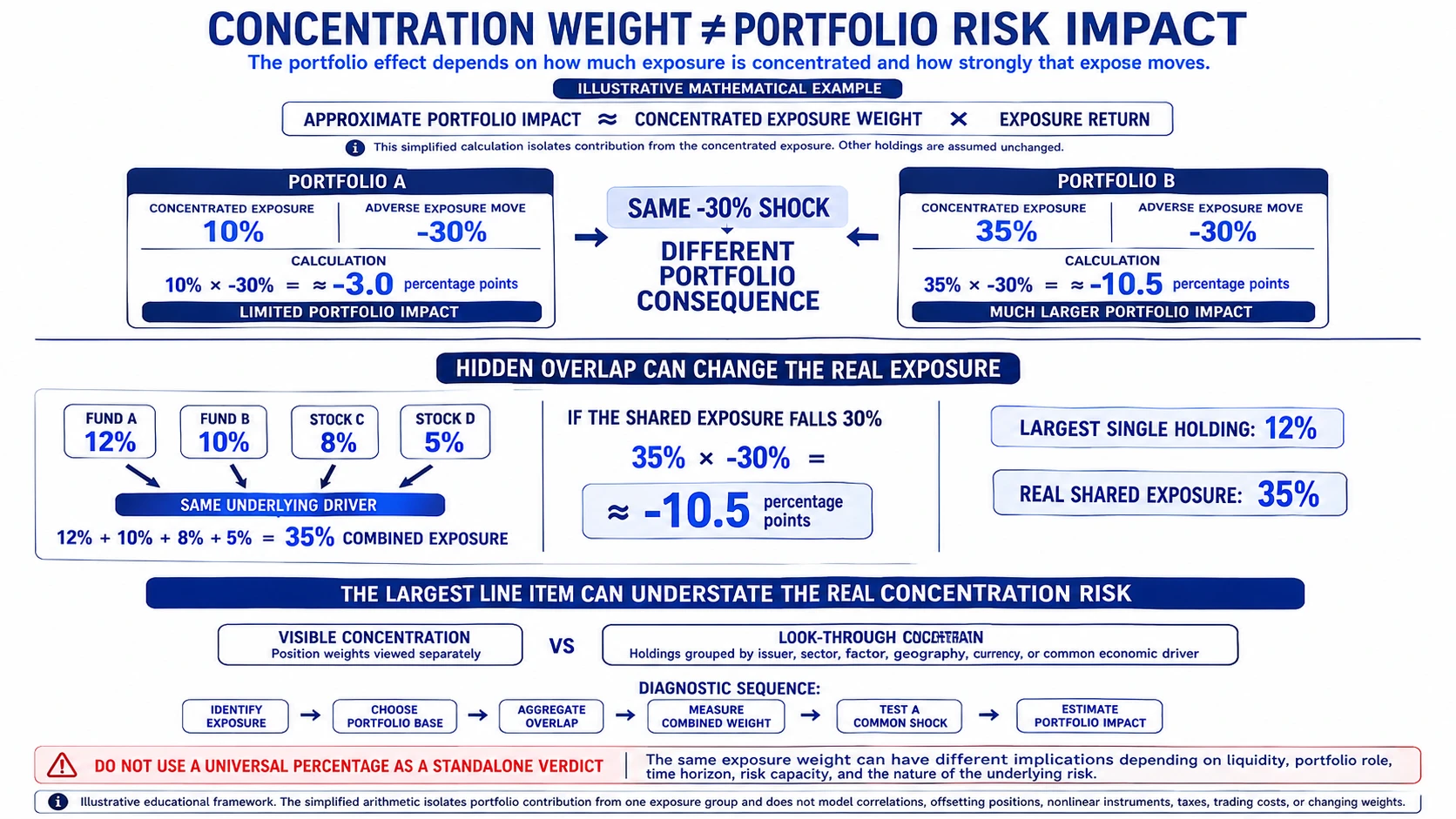
Approximate portfolio impact ≈ concentrated exposure weight × exposure return
This does not capture every portfolio interaction, but it shows the central idea. A concentration reading only becomes economically meaningful when it is connected to potential portfolio-level impact.
Illustrative example: If a concentrated exposure is 10% of the portfolio and that exposure falls 30%, the approximate portfolio contribution from that shock is 10% × -30% = about -3.0 percentage points.
If the concentrated exposure is 35% and the same shock occurs, the approximate contribution becomes 35% × -30% = about -10.5 percentage points.
The shock did not change. What changed was the size of the portfolio’s dependence on that exposure. That is why concentration weight and risk impact should not be treated as interchangeable ideas. One describes how much exposure is concentrated. The other describes how strongly that concentration can affect the full portfolio.
Core insight: the same adverse move can create very different portfolio consequences because concentration risk depends on both the size of the exposure and the size of the shock to that exposure.
Why the Largest Position Can Understate Concentration Risk
One of the most common mistakes is to look only at the largest single holding. That can understate the real concentration risk when several holdings share the same underlying driver.
Look-through example: A portfolio contains Fund A at 12%, Fund B at 10%, Stock C at 8%, and Stock D at 5%. The largest visible line item is only 12%. But if all four positions depend on the same underlying driver, the combined exposure is 35%.
If that shared exposure group falls 30%, the approximate portfolio effect is again 35% × -30% = about -10.5 percentage points. The more useful risk reading is therefore not the 12% largest single position. It is the 35% combined dependence on the same driver.
Hidden overlap is why holding count can create false comfort. Several funds, sector exposures, and individual stocks may look separate while still leaning on the same mega-cap issuers, same valuation factor, same economic cycle, or same region. The practical question is not only “how many holdings are there?” but “which risks are repeated?”
This is also where exposure spread becomes more important than label count. A portfolio can contain many tickers and still lack meaningful diversified exposure if those holdings move for similar reasons.
How the Measurement Works
The basic reading starts with a numerator and a denominator. The numerator is the exposure being tested. The denominator is the portfolio base used for comparison. A single-position reading may compare one holding’s market value with total portfolio value. A broader reading may group several holdings that share the same sector, country, factor, currency, issuer overlap, or economic driver.
The same number can mean different things if the denominator changes. A position may be 12% of an equity sleeve, 8% of the full investment portfolio, and 5% of total liquid assets. None of those readings is automatically wrong, but each answers a different question.
| Measurement input | Question it answers | Why it changes interpretation |
|---|---|---|
| Single holding weight | How much depends on one issuer? | A large position can dominate results even if the rest of the portfolio is broadly spread. |
| Sector or industry weight | How much depends on one business cycle? | Several separate holdings can still react to the same earnings cycle, regulation, commodity price, or valuation pressure. |
| Fund look-through exposure | What exposures exist inside pooled vehicles? | Different funds may still lean on the same issuers, sectors, countries, or factors. |
| Geography or currency exposure | How much depends on one region or currency regime? | Revenue source, listing location, and reporting currency may not tell the same story. |
| Average versus ending weight | Was the exposure persistent or temporary? | A year-end weight can miss a large exposure carried during most of the period, while an average can smooth a recent drift. |
| Portfolio sleeve versus total assets | Which portfolio base is being tested? | An exposure can look large inside one sleeve but smaller across the full portfolio, or the reverse if the sleeve carries most of the relevant risk. |
Why the Same Concentration Reading Can Mean Different Things
A concentration reading needs context before it becomes useful. A large exposure that is liquid, intentionally sized, well understood, and matched to the portfolio’s time horizon is different from a large exposure that grew by drift, became hard to sell, or duplicates risks already present elsewhere.
The role of the position matters. A core holding, a satellite holding, an inherited position, an employer-linked position, and a temporary cash substitute do not carry the same interpretation. The number may look similar, but the reason for the exposure and the consequence of being wrong can differ sharply.
Liquidity changes the reading as well. Concentration in an easily traded large-cap instrument is not the same as concentration in an illiquid security, private investment, thinly traded fund, or restricted position. Liquidity does not remove concentration risk, but it changes how flexible the portfolio may be if circumstances change.
Broader asset allocation context matters too. A position can look large in isolation but still fit a deliberate portfolio sleeve, while a smaller-looking exposure can be more dangerous if it silently duplicates risks already present across funds, sectors, or correlated assets.
Common Mistake: Treating Concentration as a Standalone Verdict
Not this: A high concentration reading automatically means the portfolio is poorly built, too risky, or in immediate need of action.
Instead: A concentration reading identifies where portfolio dependence is located. The next question is whether that dependence is intentional, understood, liquid enough, aligned with the investor’s time horizon, and consistent with the rest of the portfolio structure.
The opposite mistake is also common. A low single-position weight does not automatically mean the portfolio is well diversified. If many holdings depend on the same sector, same issuer cluster, same country, same currency, same factor, or same economic driver, the portfolio can still carry meaningful concentration risk beneath the surface.
Concentration risk is therefore a diagnostic, not a command. It is most useful when it identifies exposure dependence clearly without pretending to answer what the investor should do next.
How Measurement Basis Can Distort the Reading
Portfolio concentration risk can be overstated or understated when the measurement basis is unclear. A point-in-time reading may capture the portfolio only on one date. An average reading may better describe the exposure carried across a period, but it can smooth a recent change. A look-through reading may be more useful for funds, but it depends on having enough transparency into the underlying holdings.
Peer comparison can also mislead. A concentrated portfolio, a broad index portfolio, a thematic fund, a family portfolio, and a retirement account may have different constraints and purposes. A concentration number from one structure should not be treated as a universal benchmark for another.
Time horizon matters because exposure dependence is not experienced the same way over every holding period. A portfolio built around a long-term thesis may tolerate a different kind of exposure than a portfolio intended to fund near-term cash needs. That does not make concentration harmless. It means the interpretation has to connect the number with the role of the portfolio and the investor’s risk capacity.
How to Read Portfolio Concentration Risk Without Overreacting
A useful reading follows a simple sequence. First, name the exposure being measured. Second, define the portfolio base being used as the denominator. Third, check whether overlap is visible or hidden. Fourth, estimate how strongly a common shock could affect the portfolio. Fifth, decide whether the reading identifies an intentional concentration, an accidental overlap, a liquidity problem, or simply a portfolio characteristic that needs monitoring.
Diagnostic sequence: identify the exposure → choose the portfolio base → aggregate overlap → measure combined weight → test a common shock → estimate portfolio impact → interpret within liquidity, role, and time-horizon context.
The most useful result is usually a precise statement, not a vague label. “The portfolio has 35% combined exposure to one growth-stock driver through four overlapping holdings” is much more useful than “the portfolio seems concentrated.”
FAQ
Is portfolio concentration risk always bad?
No. Portfolio concentration risk identifies exposure dependence. The same reading can be intentional, accidental, liquid, illiquid, temporary, persistent, understood, or misunderstood. The number needs context before it can be interpreted.
Can a portfolio with many holdings still have concentration risk?
Yes. Many holdings can still share the same sector, issuer overlap, country, currency, factor, or business driver. Holding count alone does not prove that exposure is spread across different sources of risk.
Why can the largest holding understate real concentration risk?
The largest visible holding can look modest while several other holdings still depend on the same underlying driver. In that case, the real concentration risk comes from the combined look-through exposure, not from the largest single line item alone.
What makes a concentration-risk reading more useful?
The reading becomes more useful when it states the exposure being measured, the denominator used, the time period, whether the value is average or ending weight, whether hidden overlap is included, and how a common shock could affect the total portfolio.