
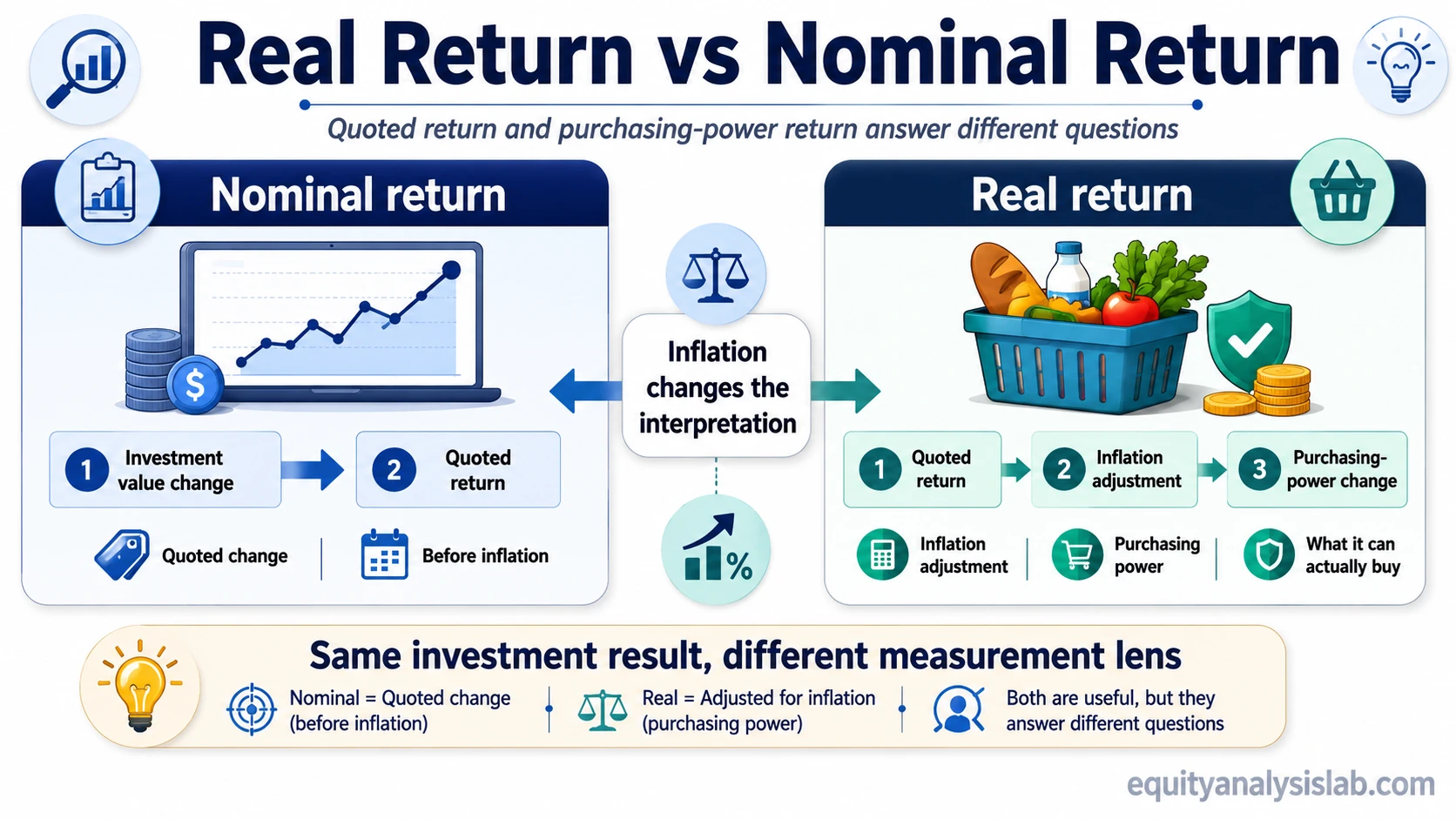
Nominal return measures an investment result before inflation adjustment. Real return translates that result into purchasing-power terms by accounting for inflation.
The two measures can point in different directions. An investment may rise in nominal terms while purchasing power falls if inflation exceeds the investment return.
The Core Difference
Measures the percentage gain or loss before adjusting for inflation. It answers how the investment value changed in current currency terms.
Adjusts the investment result for inflation. It answers how purchasing power changed over the same measurement period.
Real Return vs Nominal Return Comparison
| Criterion | Nominal return | Real return |
|---|---|---|
| What it measures | The quoted percentage change in investment value. | The change in purchasing power after inflation adjustment. |
| Inflation treatment | No inflation adjustment. | Inflation is incorporated into the calculation. |
| Investor question | How much did the investment value change? | Did the result increase or reduce purchasing power? |
| Calculation role | Provides the starting investment return. | Combines the nominal return with inflation over the same period. |
| Typical use | Reading reported performance, quoted yields, and account results. | Evaluating the economic result after changes in the price level. |
How to Calculate Real Return
A quick approximation subtracts inflation from the nominal return:
Approximate real return = nominal return − inflation
The exact calculation compares the two growth rates:
Real return = ((1 + nominal return) / (1 + inflation rate)) − 1
The return and inflation figures should cover the same measurement period. The subtraction shortcut is useful for a quick estimate, while the exact formula preserves the compounding relationship between the two rates.
What Counts as a Real Return?
On this page, real return means the inflation-adjusted investment return before investor-specific taxes and fees unless stated otherwise. Investor.gov uses a broader definition that accounts for taxes and inflation, so the convention matters when different sources are compared.
The inflation measure also affects the interpretation. The U.S. Bureau of Labor Statistics describes CPI as an average measure of price change for urban consumers and notes that an individual household’s inflation experience can differ from that average.
Same Nominal Return, Different Real Result
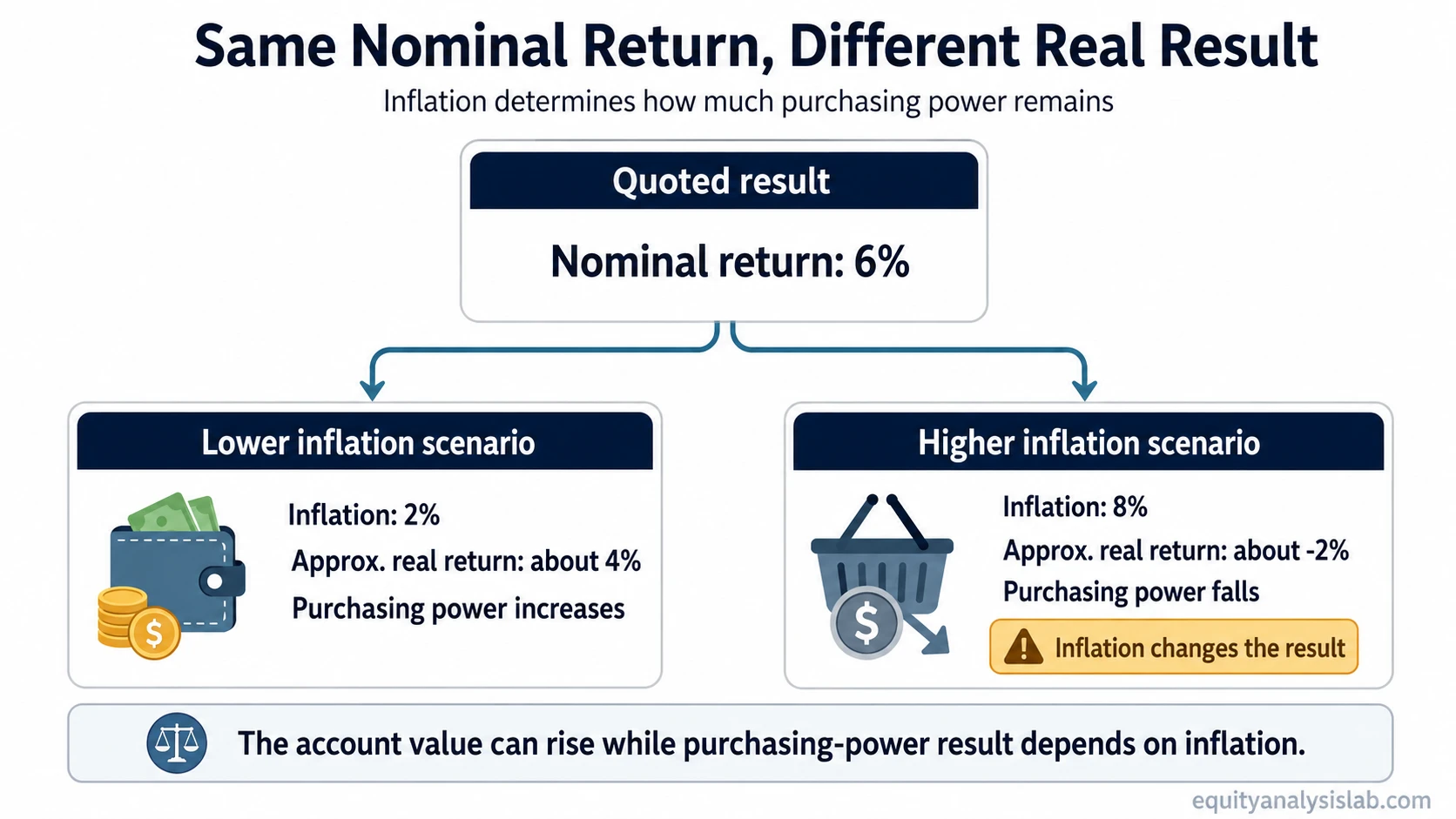
Assume a portfolio earns a 6% nominal return.
With 2% inflation, the subtraction shortcut gives an approximate real return of 4%. The exact calculation is about 3.92%.
With 8% inflation, the shortcut gives an approximate real return of -2%. The exact calculation is about -1.85%.
The portfolio gained 6% in nominal terms in both cases. The purchasing-power result changed because inflation was different.
When Each Measure Is Useful
| Investor question | More relevant measure | Reason |
|---|---|---|
| What return was quoted or reported? | Nominal return | The quoted figure normally describes the investment result before a separate inflation adjustment. |
| Did purchasing power increase? | Real return | The inflation adjustment shows whether the investment outpaced the selected price benchmark. |
| How should a future return assumption be interpreted? | Both | An expected return assumption should identify whether it is expressed in nominal or inflation-adjusted terms. |
| How should a valuation yield be read? | Usually nominal first, then inflation context | A metric such as earnings yield can be quoted in nominal terms while inflation remains part of the investor’s broader required-return framework. |
| Was the investment attractive for the risk taken? | Neither measure alone | The return figure still belongs inside a broader risk and return analysis. |
Interpretation Limits
The result still depends on the risk taken, the measurement period, taxes and fees when relevant, liquidity needs, valuation context, and the inflation benchmark used. A negative real return also identifies an outcome rather than its full cause.