
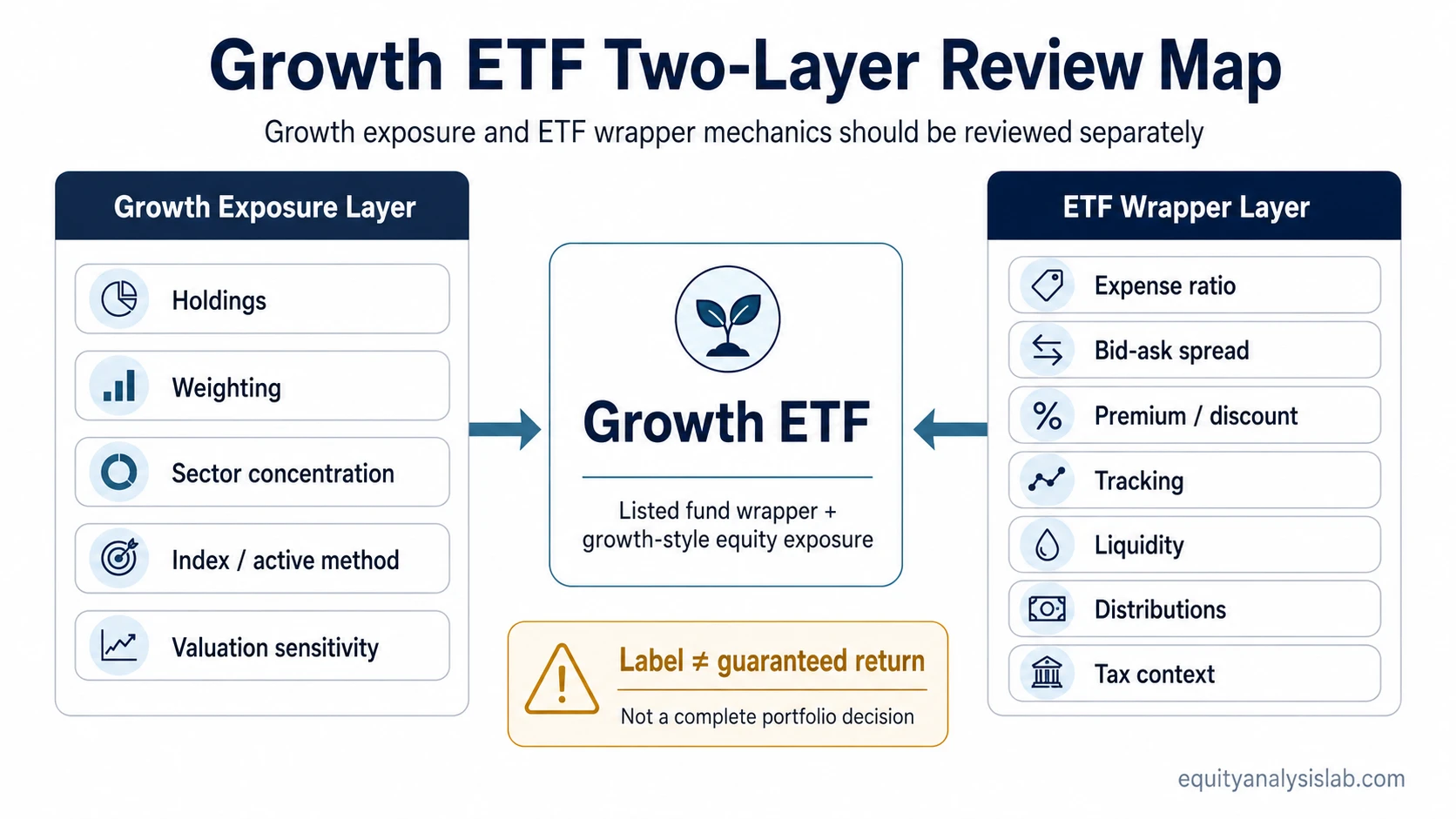
A growth ETF is an exchange-traded fund that gives investors exposure to growth-style stocks or a growth-oriented investment strategy. A useful review separates the growth exposure layer from the ETF wrapper layer. Holdings, weighting method, cost, tracking, liquidity, distributions, and tax context can make two growth ETFs behave very differently.
Definition: A growth ETF holds, tracks, or actively selects stocks expected to grow revenue, earnings, cash flow, or market value faster than a broader benchmark or value-oriented peer group. The ETF wrapper allows shares to trade on an exchange, while the growth exposure defines the style of companies or strategy inside the fund.
A growth ETF should not be read as a guaranteed return vehicle, a quality screen, or a complete portfolio decision. It identifies an investment style, but the actual portfolio behavior depends on what the fund owns and how the ETF structure handles trading, costs, tracking, liquidity, and distributions.
Key Points
- A growth ETF combines two layers: growth-style equity exposure and an ETF wrapper.
- The exposure may come from a rules-based index or an active manager’s stock-selection process.
- Holdings, sector weight, concentration, and weighting method determine what the growth category actually represents.
- Expense ratio, bid-ask spread, tracking behavior, liquidity, distributions, and tax context affect the investor experience.
- A growth ETF is not automatically diversified, lower risk, tax-free, or likely to outperform other equity funds.
What a Growth ETF Owns
The growth exposure layer is the stock portfolio or strategy inside the ETF. It usually focuses on companies with above-average growth expectations, stronger reinvestment potential, faster earnings or revenue expansion, or market characteristics associated with growth-style investing.
Large-cap growth stocks are common in many growth ETFs, but the category is not limited to one company size. Some funds may focus on large companies, while others may include mid-cap, small-cap, international, thematic, or actively selected holdings. The same category name can therefore hide very different sector weights, concentration levels, valuation profiles, and business-model exposures.
The first review point is the source of the exposure: the index rules, the active selection process, the holdings list, the weighting method, and the concentration of the largest positions.
The ETF Wrapper Layer
The ETF wrapper controls how fund shares trade and how investors experience the fund outside the stock portfolio itself. A growth ETF has a net asset value based on the underlying holdings, but investors buy and sell ETF shares on an exchange at a market price that can move slightly above or below that value.
Wrapper-level review points include the expense ratio, bid-ask spread, secondary-market trading volume, premium or discount to net asset value, tracking difference, tracking error, distribution pattern, turnover, and tax context. These factors do not change the growth style of the holdings, but they can change the cost, execution quality, and after-tax experience of owning the ETF.
The growth exposure layer answers “what stocks or strategy does the fund represent?” The ETF wrapper layer answers “how does the fund trade, track, distribute, and behave as a listed vehicle?” Both layers matter before comparing one growth ETF with another.
Growth ETF Label vs What to Verify
A growth ETF label can summarize the category, but it cannot replace a review of the underlying portfolio and wrapper mechanics.
A clean review sequence starts with the exposure source, then checks holdings and concentration, then moves to wrapper costs, liquidity, tracking behavior, distributions, and tax context.
| What the label suggests | What to verify | Why it matters |
|---|---|---|
| Growth-style stock exposure | Holdings, sector weights, market-cap range, and top-position concentration | Two funds can share the same label while owning meaningfully different portfolios. |
| Rules-based or manager-led growth selection | Index methodology, active mandate, rebalancing rules, and turnover pattern | The source of the exposure affects how the fund changes over time. |
| Low-cost ETF access | Expense ratio, trading spread, and any other fund-level costs disclosed by the provider | Ownership cost is more than the headline category label. |
| ETF liquidity | Bid-ask spread, trading volume, underlying holdings liquidity, and premium or discount behavior | Liquidity depends on both the ETF shares and the securities inside the fund. |
| Index or strategy exposure | Tracking difference, tracking error, benchmark fit, and active-position differences | A fund may not behave exactly like the broad growth category investors expect. |
| Growth-oriented return profile | Valuation exposure, concentration risk, sector tilt, and market-cycle sensitivity | Growth exposure can come with periods of higher volatility or sharper drawdowns. |
| Potential distributions | Dividend policy, capital gains distributions, turnover, fund domicile, and investor tax context | Distribution and tax outcomes depend on fund mechanics and the investor’s situation. |
Active vs Index Growth ETFs
An index growth ETF follows a rules-based benchmark that defines which stocks qualify as growth holdings. The rules may consider factors such as earnings growth, sales growth, momentum, valuation characteristics, or other style-screen inputs depending on the index provider.
An active growth ETF relies on a manager or investment team to select holdings within a growth-oriented mandate. The manager may own companies that differ from a standard growth index, adjust weights more selectively, or hold a portfolio with higher turnover. An actively managed ETF adds manager discretion to the ETF wrapper, so its portfolio may diverge more from a benchmark than a purely index-tracking growth ETF.
The active-versus-index distinction matters because two growth ETFs can have the same broad style label while using different methods to select, weight, and update their holdings.
Simple Growth ETF Example
One growth ETF may follow a concentrated large-cap growth index where a small group of dominant companies represents a large share of assets. Another growth ETF may use an active strategy with more holdings, different sector exposure, higher turnover, and a different distribution pattern.
Both funds can reasonably carry the growth ETF label, but they may not create the same portfolio exposure. One review focuses on what each fund owns and how the positions are weighted. Another review focuses on the wrapper: expenses, trading spread, tracking behavior, liquidity, and distribution mechanics.
Common Misunderstandings About Growth ETFs
| Misunderstanding | Safer interpretation |
|---|---|
| A growth ETF guarantees higher returns. | Growth exposure can perform well in some environments and struggle in others, especially when valuation, interest-rate sensitivity, concentration, or earnings expectations become unfavorable. |
| A growth ETF is automatically a quality screen. | A growth label may reflect style characteristics, index rules, or manager judgment, but it does not prove that every holding has durable earnings quality, strong cash flow, or a resilient business model. |
| A growth ETF is a complete portfolio decision. | The fund still has to fit an investor’s objectives, time horizon, risk capacity, diversification needs, tax context, and broader portfolio structure. |
| A growth ETF is the same as a full growth investing strategy. | The ETF is a vehicle and exposure type. A full strategy also considers position size, portfolio role, valuation context, rebalancing discipline, and how the exposure interacts with the rest of the portfolio. |
Limitations and Portfolio-Fit Boundaries
A growth ETF can simplify access to growth-style equities, but the label cannot answer whether the fund is suitable for a specific investor. Fund facts can change, including holdings, weights, fees, spreads, yields, distributions, and tax characteristics. Current provider documents should be checked before relying on product-level details.
Tax treatment also depends on the fund structure, investor account type, investor jurisdiction, holding period, and distribution profile. General ETF tax-efficiency mechanics do not mean that a growth ETF creates a tax-free outcome.
Growth ETFs also remain equity funds. They can lose value, become concentrated, trade at wider spreads during stressed conditions, or lag other styles when the market environment favors value, income, defensive sectors, or lower-valuation companies.
Related ETF Types
Growth exposure is only one equity-style category. A fixed-income allocation uses a different exposure layer, so a bond ETF should be reviewed through interest-rate risk, credit risk, duration, yield, and bond-market liquidity rather than growth-stock characteristics.
Commodity exposure also follows a different structure. A commodity ETF structure may depend on physical holdings, futures contracts, roll mechanics, collateral, or commodity-linked strategies instead of company-level growth characteristics.
The useful boundary is simple: a growth ETF is an ETF wrapper around growth-style equity exposure, while other ETF types use the same listed-fund wrapper for different underlying exposure layers.
FAQ
What is a growth ETF?
A growth ETF is an exchange-traded fund that gives exposure to growth-style stocks or a growth-oriented strategy. The fund may follow an index or use an active process, but the key idea is equity exposure focused on growth characteristics.
Are growth ETFs always actively managed?
No. Some growth ETFs track rules-based indexes, while others use active management. The fund documents should show whether the portfolio follows an index methodology or relies on manager discretion.
Do growth ETFs pay dividends?
Some growth ETFs may pay distributions, but income is usually not the main reason investors study the category. Distribution behavior depends on the holdings, fund policy, turnover, and tax structure.
Are growth ETFs risky?
Growth ETFs carry equity risk and may also carry concentration, valuation, sector, liquidity, and tracking risks. The risk profile depends on the holdings, weighting method, strategy, and ETF wrapper mechanics.