
An ETF expense ratio is the annual operating cost of an exchange-traded fund, expressed as a percentage of the fund’s assets.
The cost is generally reflected inside the fund rather than billed as a separate invoice. It is different from trading commissions, the bid-ask spread, market price premiums or discounts, tax effects, liquidity conditions, and tracking results.
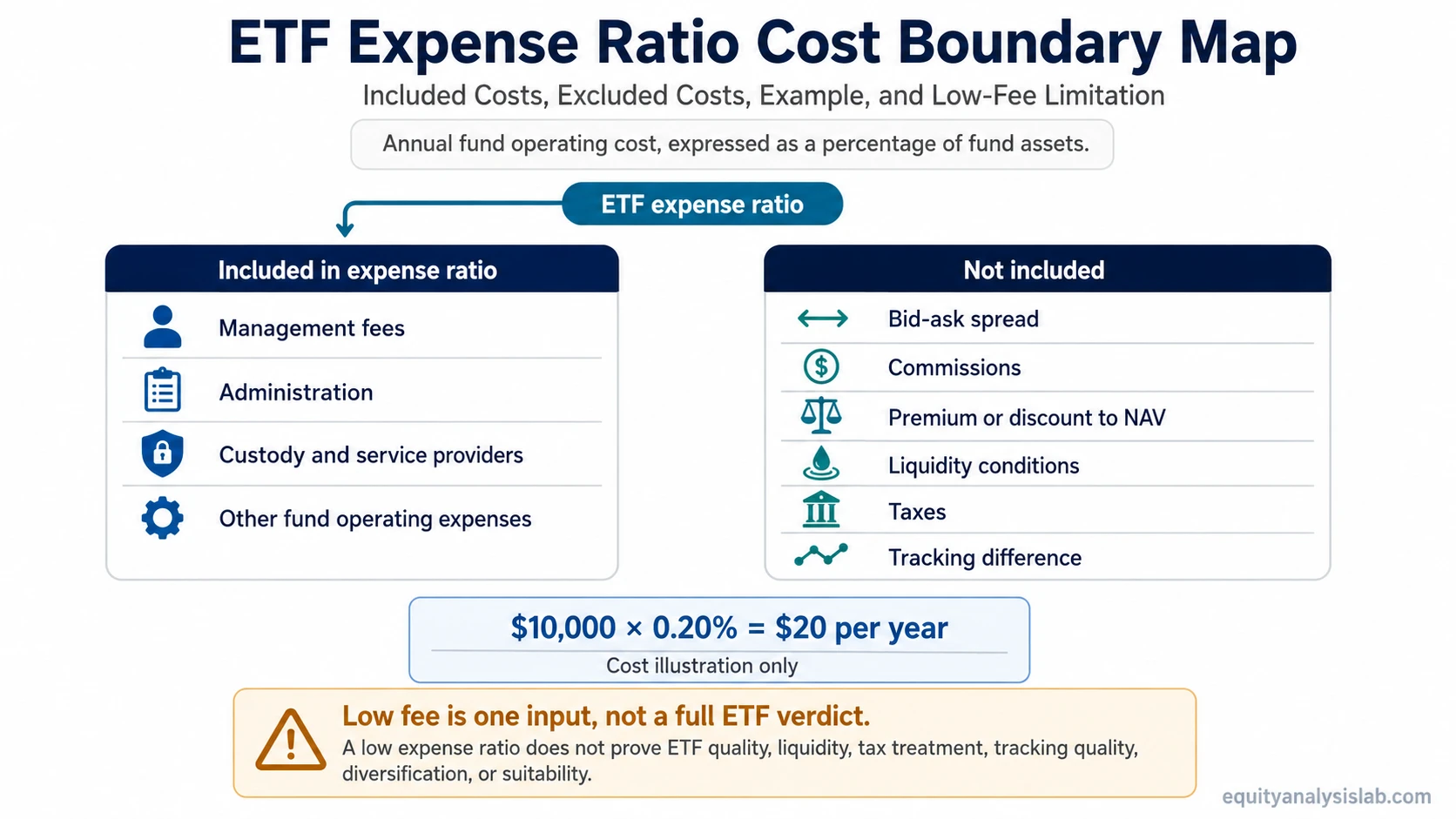
Definition: An ETF expense ratio measures the recurring fund-level operating cost that reduces the fund’s assets over time. A 0.20% expense ratio means about $20 per year for every $10,000 invested before market movement and before other ownership or transaction costs.
Key Points
- An ETF expense ratio is a recurring operating-cost percentage, not a one-time trading fee.
- It can include management, administration, custody, accounting, legal, and other operating expenses.
- It does not include spread costs, commissions, premium/discount movement, taxes, liquidity effects, or tracking outcomes.
- A lower expense ratio can reduce one cost drag, but it does not prove that an ETF has better exposure, liquidity, tax treatment, diversification, tracking, or suitability.
What an ETF Expense Ratio Means
The expense ratio is the fund’s annual operating cost divided by fund assets. ETF providers usually state it as a percentage, such as 0.05%, 0.20%, or 0.75% per year.
The percentage format makes funds easier to compare, but it can also hide the dollar effect. A small percentage becomes more meaningful as position size, holding period, or category comparisons grow.
The ratio belongs to the fund structure. It does not describe whether the ETF’s exposure is useful, whether the fund trades efficiently, or whether the market price stays close to its underlying value.
What an ETF Expense Ratio Includes
The expense ratio usually covers ordinary costs required to operate the fund. The exact categories can vary by fund, provider, and prospectus language, but the main idea is that these are recurring fund-level expenses.
| Included cost category | What it generally relates to |
|---|---|
| Management fees | Compensation for managing, administering, or overseeing the ETF’s portfolio process. |
| Administration and operations | Fund accounting, recordkeeping, reporting, and day-to-day fund administration. |
| Custody and service providers | Costs connected with custody, transfer, audit, legal, compliance, or other provider services. |
| Other fund expenses | Additional operating expenses disclosed by the fund, subject to the provider’s expense structure. |
The fund prospectus, provider page, factsheet, or ETF database usually shows the stated expense ratio. For a precise figure, the fund’s own disclosure should be treated as the controlling source.
Where to find it: The stated expense ratio is usually listed in the fund prospectus, provider factsheet, ETF profile page, or fund database entry. The fund’s own disclosure should control when figures differ across sources.
What an ETF Expense Ratio Does Not Include
The expense ratio is not the same as total ETF ownership cost. It covers recurring fund operating expenses, but several other costs and frictions can still affect an investor’s realized result.
| Not included | Why it is separate |
|---|---|
| Bid-ask spread | The spread is the difference between the quoted buying and selling prices when ETF shares trade. |
| Trading commissions | Commissions, when charged, are brokerage transaction costs rather than fund operating expenses. |
| Premium or discount to NAV | The ETF market price can trade above or below the value of the underlying portfolio. |
| Liquidity conditions | Secondary-market depth, volume, and underlying basket liquidity are separate from the stated operating fee. |
| Taxes | Tax outcomes depend on structure, holdings, distributions, turnover, jurisdiction, and investor circumstances. |
| Tracking difference or tracking error | Fund performance can differ from the reference index or strategy for reasons beyond the expense ratio. |
Premiums and discounts are connected to ETF market structure. The creation and redemption process helps explain how ETF share supply can adjust around portfolio value.
Related arbitrage mechanisms can help explain why ETF market prices may move around portfolio value, but those mechanics are separate from the stated expense ratio.
Simple ETF Expense Ratio Example
A $10,000 ETF position with a 0.20% expense ratio represents about $20 per year in fund operating cost before other costs and before market movement.
Example: $10,000 × 0.20% = $20. The investor usually does not receive a separate $20 bill. The cost is reflected through the fund’s ongoing operation and net asset value mechanics over time.
The example is only a cost illustration. It does not estimate return, tax impact, tracking difference, trading spread, or whether the ETF fits a research objective.
Gross vs Net Expense Ratio
A gross expense ratio shows fund expenses before any applicable fee waiver or reimbursement. A net expense ratio reflects the cost after those waivers or reimbursements are applied.
The net figure can be lower than the gross figure when the provider temporarily limits expenses. That distinction matters because waivers can expire, change, or depend on fund terms. A current net ratio should not be treated as permanent unless the fund documents support that conclusion.
When comparing ETFs, the gross and net figures should be read together with the fund’s disclosure, category, exposure, structure, and holding-period context.
What Is a Good ETF Expense Ratio?
A good ETF expense ratio depends on the ETF category, exposure, strategy, issuer structure, and comparable alternatives. A broad index ETF may have a very low stated fee, while a specialized, actively managed, leveraged, thematic, or less common exposure can carry a higher fee.
The useful question is not whether the ratio is low in isolation. The better comparison is whether the fee is reasonable for the exposure, implementation, liquidity, tracking behavior, and comparison purpose being analyzed.
That comparison should stay category-aware. Comparing a broad equity index ETF with a niche strategy ETF only by expense ratio can produce a misleading conclusion.
Expense Ratio vs Other ETF Cost and Structure Checks
Expense ratio is one cost input. ETF research usually also needs separate checks for market-price trading conditions, liquidity, underlying holdings, distribution policy, tracking behavior, and premium or discount behavior.
An ETF with a low expense ratio can still have wider trading costs if secondary-market conditions are thin. The depth and tradability of an ETF depend on more than the stated fee, so visible and structural ETF liquidity conditions should be checked separately.
Expense ratio also does not explain whether the ETF holds the exposure an investor expects. Two ETFs can have similar fees but different indexes, weighting rules, holdings, turnover, concentration, distribution policy, or tracking behavior.
Common Mistake: Treating Low Fees as a Complete Verdict
Common mistake: Comparing ETFs only by expense ratio can miss spread cost, liquidity, premium or discount behavior, tracking results, tax consequences, and exposure differences.
Limitation: A lower expense ratio can reduce one recurring cost drag, but it does not prove ETF quality, diversification, liquidity, tax efficiency, tracking quality, or research fit.
The cleaner test is to separate the stated operating fee from the other moving parts that affect ETF ownership. Expense ratio belongs in the review, but it should not replace checks on exposure, trading conditions, structure, tracking, and tax context.
FAQ
How is an ETF expense ratio charged?
It is generally reflected through the fund’s ongoing expenses and net asset value mechanics rather than charged as a separate invoice to the investor.
Does an ETF expense ratio include the bid-ask spread?
No. The expense ratio covers recurring fund operating costs. The bid-ask spread is a separate transaction cost that appears when ETF shares trade in the market.
What is the difference between gross and net expense ratio?
Gross expense ratio shows expenses before fee waivers or reimbursements. Net expense ratio reflects the cost after those waivers or reimbursements are applied.
Is the lowest expense ratio always best?
No. A lower ratio can reduce one cost drag, but exposure, liquidity, spread, tracking behavior, tax effects, and research purpose still need separate review.