
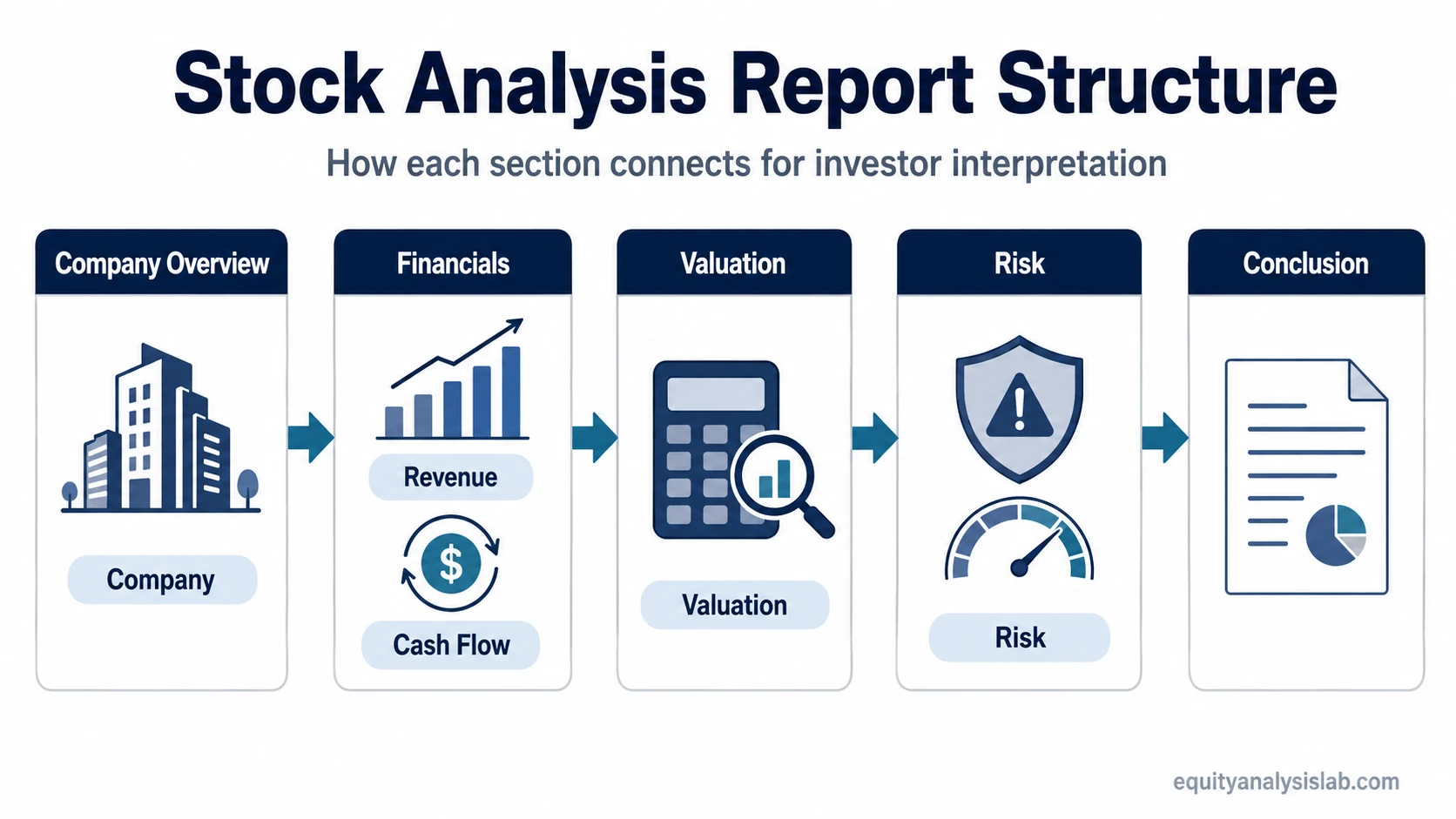
A stock analysis report example shows how company background, financial statements, valuation, risk review, and conclusion work together inside an investor research document.
Use the example to see what each section is supposed to test: what the business does, whether the numbers support the story, how valuation assumptions affect the estimate, and what could make the conclusion wrong. A rating or final opinion only becomes useful when that reasoning is visible.
Key Points
- A stock analysis report example should show the logic behind the conclusion, not only the conclusion itself.
- The core sections usually include company overview, business quality, financials, valuation, risks, and interpretation.
- Financial analysis should connect revenue, margins, earnings, cash flow, and balance-sheet risk instead of treating each metric separately.
- Valuation should be read as a range or scenario exercise because assumptions can change the result materially.
- A good example separates evidence, assumptions, interpretation, and uncertainty before any final view appears.
What a Stock Analysis Report Example Should Include
A stock analysis report example should make the research process visible. It should show how an analyst moves from business description to financial evidence, from financial evidence to valuation, and from valuation to a cautious interpretation of risk and reward.
The strongest examples do not treat the final conclusion as the main lesson. A conclusion such as positive, neutral, cautious, undervalued, or overvalued only becomes useful when the reader can see which assumptions support it and which risks could weaken it.
For an investor, the report format is a checklist for reasoning. Each section should answer one clear question and expose one possible source of error.
Sample Stock Analysis Report Format
A practical report format separates what each section says from what that section is testing.
| Report section | Example wording | What the section tests |
|---|---|---|
| Company snapshot | The company earns revenue from recurring subscriptions and professional services. The report should separate recurring revenue from one-time implementation revenue because the two streams may deserve different interpretation. | Whether the business model is durable, understandable, and tied to repeatable demand. |
| Business quality | The company may have customer stickiness, but the report should test whether that stickiness comes from real switching costs, product depth, brand strength, or simple customer inertia. | Whether the company has a defensible advantage or only a strong narrative. |
| Revenue review | Revenue growth appears positive, but the report should ask whether growth came from pricing, volume, acquisitions, or temporary demand. | Whether growth quality is strong enough to support the thesis. |
| Margin review | Margins may compress even while revenue grows. That can signal reinvestment, cost pressure, weak pricing power, or operating inefficiency depending on the context. | Whether profitability supports or contradicts the growth story. |
| Cash flow review | Free cash flow should be compared with reported earnings. If earnings rise while cash flow lags, the report should examine working capital, capital expenditure, and revenue recognition. | Whether reported profit is supported by cash generation. |
| Balance-sheet review | Debt, cash, maturity schedule, and interest burden should be reviewed before treating valuation upside as attractive. | Whether financial risk could limit flexibility or weaken the thesis. |
| Valuation method | The report may use DCF, peer multiples, or both. The method should match the business profile and the quality of available assumptions. | Whether the valuation approach is suitable for the company being analyzed. |
| Risk factors | The report should explain which events would weaken the thesis, such as slower growth, margin pressure, dilution, debt stress, or competitive loss. | Whether the conclusion has clear boundaries and uncertainty is visible. |
| Interpretation | The final view should connect evidence, assumptions, and risks. A single valuation estimate should not be presented as proof. | Whether the conclusion follows from the analysis instead of sounding detached from it. |
Main Sections of a Stock Analysis Report
Each section of a stock analysis report should do a specific job. If the report only describes the company, it is not yet analysis. If it only calculates valuation, it may miss business quality. If it only lists risks, it may fail to explain which risks matter most.
| Section | Investor question | Common mistake | Deeper concept |
|---|---|---|---|
| Company overview | What does the business do, who pays it, and why does demand exist? | Treating a strong story as proof of a strong business. | economic moat |
| Income statement | Are revenue, margins, and earnings moving in a way that supports the thesis? | Reading revenue growth as automatically positive. | income statement |
| Cash flow | Do reported earnings convert into cash? | Ignoring working capital, reinvestment needs, or weak cash conversion. | free cash flow |
| Balance sheet | Does leverage, liquidity, or dilution change the risk profile? | Looking at upside without checking financial flexibility. | balance sheet |
| Valuation | What assumptions are required for the estimated value to make sense? | Presenting one valuation number as if it were precise. | discounted cash flow |
| Value interpretation | How should the estimate be interpreted relative to uncertainty? | Confusing valuation output with an investment recommendation. | intrinsic value |
| Risk and conclusion | What could make the thesis wrong? | Listing generic risks without connecting them to assumptions. | investment research process |
Real-World Stock Analysis Example: Lyft
Lyft is a useful stock analysis example because the business shows several different trends at the same time. Demand and gross bookings are growing, adjusted profitability has improved, free cash flow is positive, and the company has been repurchasing shares. At the same time, normal operating profitability remains thin, reported net income has been affected by a large tax benefit, and part of the cash-flow improvement is connected to the timing of insurance and other liabilities.
The example shows why a stock analysis should not stop after one attractive number. Revenue growth, adjusted EBITDA, GAAP operating results, free cash flow, balance-sheet obligations, and per-share changes answer different questions.
The figures below use Lyft’s full-year 2025 results and the first quarter of 2026. Dollar amounts are shown in millions unless otherwise stated. Primary sources: Lyft 2025 Form 10-K and Lyft Q1 2026 Form 10-Q.
| Analysis area | Observed evidence | Investor interpretation |
|---|---|---|
| Business model | Lyft operates a transportation marketplace, with ridesharing generating at least 85% of revenue. The platform depends on attracting riders, maintaining driver availability, and balancing price, incentives, service quality, and marketplace liquidity. | The company has an established operating platform, but its economics depend on maintaining both sides of the marketplace in a highly competitive industry. |
| 2025 operating scale | Revenue reached $6,316.3 million and gross bookings reached $18,507.0 million. Revenue increased 9% from the previous year. | The business continued to expand, so the fundamental question is no longer whether Lyft can generate demand. The more important question is how much durable profit and cash the growing platform can retain. |
| Q1 2026 momentum | Active Riders increased 17% to 28.3 million, Rides increased 8% to 236.9 million, Gross Bookings increased 19% to $4,946.0 million, and revenue increased 14% to $1,650.5 million. | The operating platform was still growing. Gross bookings and revenue grew faster than ride volume, but the mix, acquisitions, pricing, and incentive spending still need to be separated before treating the difference as pure organic improvement. |
| GAAP profitability | Lyft reported a 2025 operating loss of $188.4 million and a pre-tax loss of $53.2 million. Reported net income was $2,844.0 million because the income statement included a $2,897.3 million tax benefit. In Q1 2026, the operating loss narrowed to $5.3 million and net income was $14.2 million. | The headline 2025 net income does not represent normal annual earning power. The operating result shows substantial improvement from earlier years, but the company had not yet demonstrated a wide and stable GAAP operating margin. |
| Adjusted profitability | Adjusted EBITDA was $528.8 million in 2025, equal to 2.9% of gross bookings. Q1 2026 Adjusted EBITDA was $132.8 million, with a 2.7% margin. | Adjusted operating performance improved, but the reconciliation matters. The 2025 calculation excluded $322.3 million of stock-based compensation and $211.6 million related to changes in legal, tax, and regulatory reserves, along with other adjustments. |
| Free cash flow | Lyft reported $1,115.6 million of free cash flow in 2025 and $287.3 million in Q1 2026. Changes in working capital contributed $829.0 million in 2025 and $176.4 million in Q1 2026, primarily reflecting insurance reserves and related accruals. | The cash generation is real for the reported periods, but not all of it should automatically be treated as recurring discretionary cash. Some cash remains inside the business until insurance claims and other accrued obligations are paid. |
| Balance sheet and claims | At March 31, 2026, Lyft had approximately $1.7 billion of unrestricted cash and short-term investments, $986.6 million of long-term debt, $2,245.0 million of insurance reserves, and $913.0 million of insurance-related accruals. | Liquidity appears adequate, but the insurance balances are economically important. Restricted insurance assets should not be treated as ordinary excess cash, and reserve adequacy remains a major source of estimation risk. |
| Share count and capital allocation | Lyft repurchased approximately 21.3 million shares for $300 million during Q1 2026. Stock-based compensation expense was approximately $86.9 million in the quarter. | The buyback reduced the share count, but buyback analysis should still be paired with stock-based compensation, acquisition spending, liquidity needs, and the price paid for the shares. |
- The clearest improvement is in operating scale. Active users, ride volume, gross bookings, and revenue continued to grow, while Lyft moved much closer to GAAP operating break-even than it had been several years earlier. Adjusted EBITDA and reported free cash flow also became meaningfully positive.
- The balance sheet gives the company room to continue investing, integrate acquired operations, fund insurance requirements, and repurchase shares. The Q1 2026 buyback also indicates that capital allocation has begun to shift from survival and restructuring toward per-share value considerations.
- The main analytical problem is the distance between reported net income, Adjusted EBITDA, operating income, and free cash flow. The 2025 net income figure was dominated by a non-cash tax benefit. Adjusted EBITDA excludes large recurring stock-based compensation and reserve-related expenses. Free cash flow benefited from the growth of liabilities that may require cash settlement in later periods.
- Each measure still answers a narrower question. Adjusted EBITDA can help track operating direction, while GAAP operating income shows how close the company is to normal accounting profitability. Free cash flow shows current cash generation, while reserve and accrual movements help test how much of that cash may be available after future obligations are paid.
What Could Weaken the Lyft Thesis
- Insurance reserve risk: actual claim costs could exceed current estimates, requiring additional expenses or cash payments.
- Growth-cost risk: sales and marketing expense increased approximately 50% year over year in Q1 2026, while ride volume increased about 8%. The spending may support future growth, but the relationship between growth and customer incentives requires continued review.
- Adjusted-to-GAAP gap: the investment case becomes weaker if Adjusted EBITDA rises without corresponding improvement in operating income and normalized cash generation.
- Competitive pressure: pricing, driver supply, rider promotions, service levels, and competitor actions can affect both growth and margin durability.
- Acquisition and integration risk: international expansion can increase scale, but it can also introduce integration costs, regulatory differences, and businesses with different underlying economics.
- Capital-allocation risk: buybacks create less value if they mainly offset recurring dilution, reduce needed liquidity, or are executed before future insurance and legal obligations become clearer.
Transferable Investor Lesson
The Lyft example shows why a company should not be classified as strong, weak, cheap, or expensive from one reported figure. The business can be improving while the quality of earnings remains mixed. Free cash flow can be positive while future liabilities still matter. A low valuation can reflect an opportunity, but it can also compensate investors for uncertainty around normal profitability, reserve adequacy, competition, and execution.
A more complete conclusion is that Lyft’s operating direction has improved materially, but the durability of GAAP profitability and normalized free cash flow still requires evidence across additional reporting periods. That conclusion is more useful than treating growth, Adjusted EBITDA, net income, or free cash flow as a standalone answer.
How the Financial Section Works
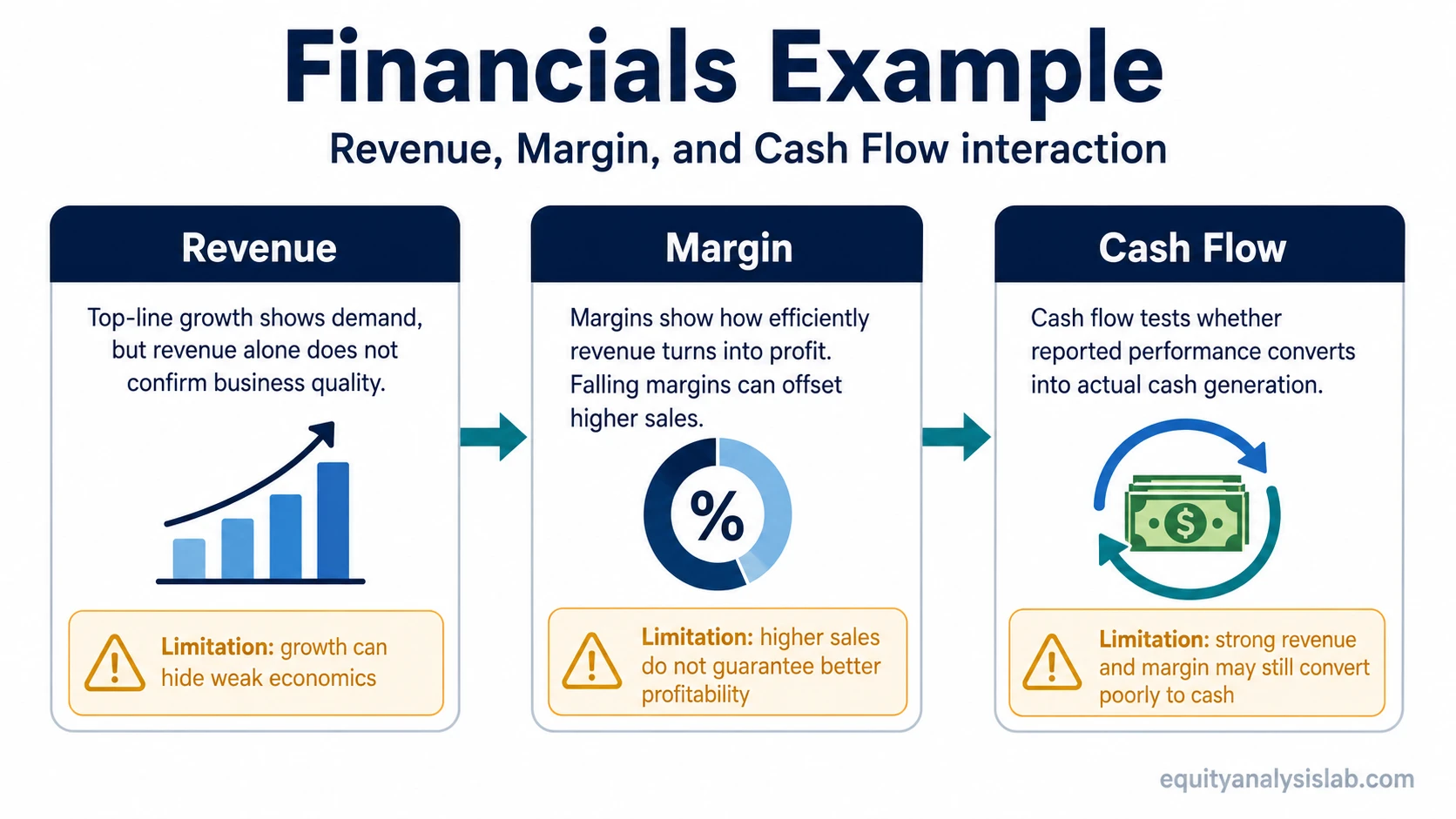
The financial section is where the report checks whether the business story appears in the numbers. Revenue, margin, earnings, cash flow, and debt should be read together because each metric can change the meaning of the others.
Revenue growth is more useful when it is supported by pricing power, customer retention, or expanding demand. It becomes less convincing when growth depends on heavy discounting, acquisitions, temporary demand, or dilution that weakens per-share economics.
Margins show whether growth is translating into profitability. A margin decline may be acceptable if it reflects productive reinvestment, but it becomes a warning sign if the company is losing pricing power or needs more spending simply to maintain growth.
Comparing the two can expose the difference between accounting performance and economic cash generation. If profit rises but free cash flow does not follow, the report should slow down and explain why.
Shows accounting performance.
Shows current cash generation.
How the Valuation Section Works
The valuation section translates business assumptions into an estimated value range. It should not make the report look more certain than the evidence allows.
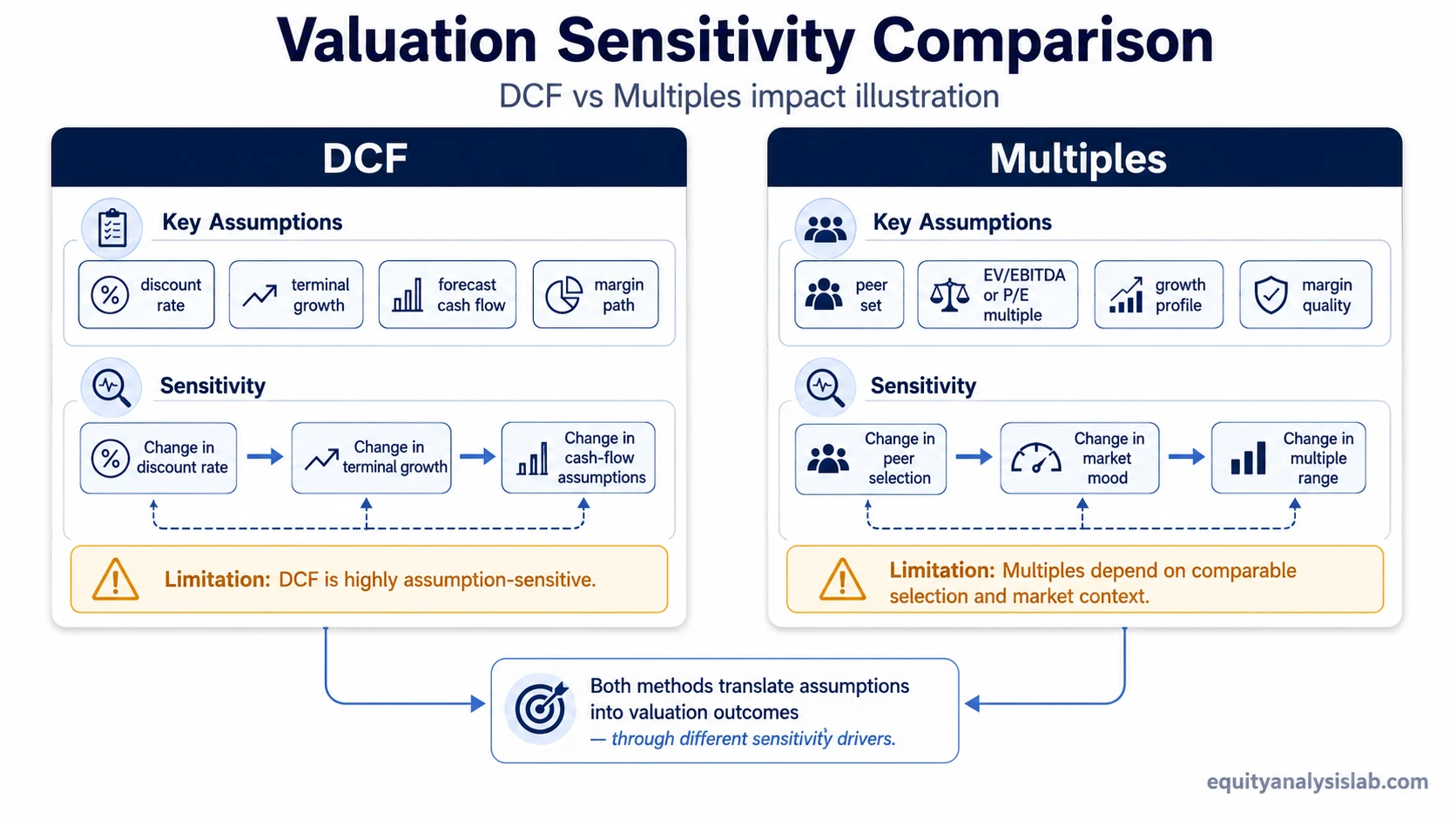
A discounted cash flow model depends on assumptions about revenue growth, operating margins, reinvestment, discount rate, and terminal value. A relative valuation depends on peer selection, multiple quality, and whether the company deserves a premium, discount, or market-level multiple.
If small changes in margin, growth, discount rate, or terminal value produce a large change in estimated value, the report should make that uncertainty visible instead of presenting one number as precise.
DCF vs Multiples in a Stock Analysis Report
A stock analysis report may use more than one valuation method because each method answers a different question. DCF focuses on long-term cash-flow assumptions. Multiples compare the company with similar businesses or market expectations.
| Valuation method | What it is useful for | Main weakness | How to interpret it |
|---|---|---|---|
| DCF | Connecting company-specific forecasts to estimated intrinsic value. | Highly sensitive to long-term assumptions and discount rate. | Best read as a scenario range, not a single precise answer. |
| Peer multiples | Comparing market pricing across similar companies. | Can be misleading if peers differ in growth, margins, risk, or accounting quality. | Best used as a market-context check, not as proof of value. |
| Enterprise value | Comparing business value while considering debt and cash. | Can still miss differences in asset quality, cyclicality, and reinvestment needs. | Useful when capital structure changes the equity-level picture. |
Common Mistakes in Stock Analysis Report Examples
- Copying the conclusion: A sample report is useful for structure, not for copying a rating or opinion.
- Ignoring assumptions: Valuation outputs depend on growth, margin, discount-rate, and terminal assumptions.
- Treating revenue growth as enough: Growth matters more when it converts into durable margin and cash flow.
- Skipping balance-sheet risk: Debt, dilution, and liquidity can change the interpretation of valuation upside.
- Reading risks as boilerplate: Risk factors should connect directly to the thesis and valuation assumptions.
- Confusing report format with investment advice: The structure helps organize analysis; it does not decide what an investor should do.
How to Read the Conclusion Without Copying It
The conclusion of a stock analysis report should be read as the output of a reasoning process. It may summarize whether the business appears strong, whether valuation seems demanding or reasonable, and which risks matter most.
The conclusion should not be separated from the assumptions that produced it. A report can sound confident while depending on aggressive growth, margin recovery, multiple expansion, or unusually favorable cash-flow assumptions.
What must be true for this view to work?
What evidence would weaken it?
How much does the valuation change when the assumptions move?
Stock Analysis Report Example FAQ
What is the purpose of a stock analysis report example?
A stock analysis report example helps readers understand how a report is organized. It shows how company overview, financials, valuation, risks, and conclusion connect inside an investor research process.
Should a stock analysis report example include a recommendation?
Professional reports may include a rating or recommendation, but an educational example does not need one. The more useful part is the evidence, assumptions, valuation sensitivity, and risk logic behind any conclusion.
What is the most important section of a stock analysis report?
No single section is enough on its own. The strongest reports connect business quality, financial performance, cash flow, valuation, and risk so that the conclusion follows from the evidence.
Why can valuation differ between reports?
Valuation can differ because analysts use different growth assumptions, margin forecasts, discount rates, peer groups, terminal values, and risk adjustments. That is why valuation is better read as a range or scenario analysis.
How should beginners use a stock analysis report example?
Beginners should use the example as a structure for learning. The goal is to understand what each section is trying to test before relying on any final opinion or valuation estimate.