
Options position management begins by identifying which risk question is active in an open option position: payoff shape, volatility exposure, expiration and assignment mechanics, or a change in contract terms.
A single option position can raise several different questions at once. The useful first step is not to treat every change as an adjustment problem. It is to separate the source of risk before moving into the specific concept that explains it.
What Options Position Management Covers
Options position management is the process of reading an open option position through its contract terms, payoff boundary, time remaining, volatility exposure, and possible exercise or assignment path. The topic works best as a learning path, not as a rulebook for what to do with a position.
The main distinction is simple: expiration payoff, pre-expiration option value, assignment risk, pin risk, and rolling mechanics are related, but they are not the same question. A payoff chart can show the simplified expiration shape, while the live position can still be affected by implied volatility, time decay, liquidity, early exercise considerations, and changes in the underlying security.
Start With the Risk Question
The fastest way to use this topic is to match the active question to the right risk area. That prevents a payoff question from being confused with a volatility question, or a rolling question from being treated as if it automatically removes assignment risk.
| If the active question is… | Main risk area | What to understand first | Topic to read next |
|---|---|---|---|
| What can this position gain or lose at expiration? | Payoff shape and net premium | How strike price, premium paid or received, and expiration value define the simplified payoff boundary. | Payoff and spread mechanics where relevant |
| Why is the option value changing before expiration? | Volatility, Greeks, and time decay | Why option value can change even when the expiration payoff boundary has not changed. | Options pricing, volatility, and Greeks topics |
| What happens if the underlying price is near the strike at expiration? | Pin risk and exercise uncertainty | Why near-strike expiration outcomes can be ambiguous and may create stock exposure uncertainty. | pin risk |
| Could this option position create stock exposure? | Assignment and exercise mechanics | How short options, exercise rights, expiration, and account treatment can affect resulting exposure. | assignment risk |
| What changes when expiration or strike is changed? | Rolling mechanics | Why replacing one option contract with another changes terms without automatically improving the position. | rolling an option |
| What changes in a covered-call roll? | Upside cap, premium, and assignment boundary | How a new short call changes expiration, strike, premium, and the cap on stock upside. | rolling covered calls |
| What changes when put exposure is rolled? | Put strike, premium, expiration, and assignment path | How the replacement put changes the risk boundary and time path without removing the underlying exposure question. | rolling puts |
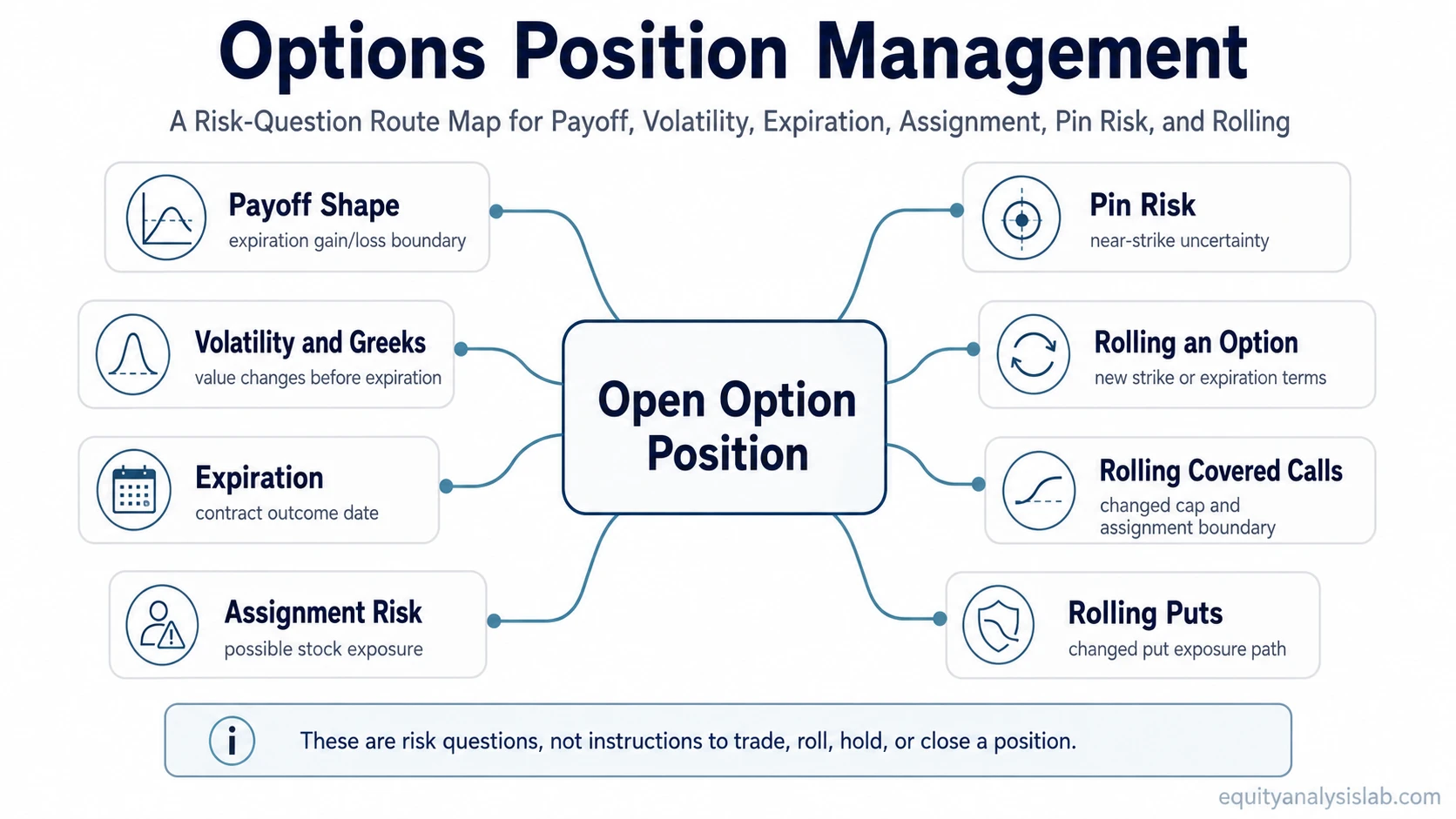
Payoff, Premium, and Expiration Are Not the Same Question
A payoff boundary describes the simplified result at expiration. It depends on the option type, strike price, net premium, and the underlying price at expiration. That is useful, but it does not explain every change in the position before expiration.
Before expiration, option value can move because implied volatility changes, time passes, the underlying price moves closer to or farther from the strike, or liquidity changes. A position can look clear on an expiration payoff map while still being difficult to interpret during the holding period.
Important limitation: A payoff chart is a simplified expiration model. It does not fully account for path dependence, implied volatility changes, early exercise or assignment conditions, bid-ask spreads, liquidity, margin treatment, tax context, or account-specific rules.
Expiration, Assignment, and Pin Risk Need Separate Treatment
Expiration creates a different risk environment because the option is approaching its final exercise decision point. A small move near the strike can matter more than it would earlier in the option’s life, especially when the final in-the-money or out-of-the-money status is uncertain.
Pin risk is the near-strike uncertainty problem. Assignment risk is the possibility that an option obligation results in stock exposure or another account consequence. They can overlap near expiration, but they are not identical. The cleaner reading is to identify whether the concern is price finishing near the strike, assignment mechanics, or the resulting exposure after exercise or assignment.
Rolling Changes Contract Terms, Not the Whole Risk Problem
Rolling an option means replacing an existing option position with another option position, usually with a different expiration, strike, or premium profile. The roll changes the contract terms. It does not erase the original market exposure or prove that the position has improved.
The same principle applies to covered calls and puts. A covered-call roll can change the upside cap, premium collected, expiration date, and assignment boundary. A put roll can change the strike, premium, expiration, and possible assignment path. The useful question is what changed in the contract and what risk remains after the replacement position exists.
What Options Position Management Does Not Decide
Options position management is educational risk interpretation. It does not decide whether a specific position should be opened, closed, rolled, held, exercised, or assigned. Those decisions depend on the exact contract, the underlying security, liquidity, account permissions, margin treatment, tax context, and the investor’s broader portfolio constraints.
A clearer educational sequence is to separate the risk question first. Payoff shape, volatility exposure, expiration uncertainty, assignment mechanics, and rolling mechanics each need their own explanation before any position-specific decision can be evaluated.
Options Position Management Map
Options position management is narrower than a full options strategy library. Start with the active risk question, then use the matching concept to understand what is changing.
| Risk question | Matching concept | Why this route fits |
|---|---|---|
| Near-strike uncertainty at expiration | Pin risk | Explains why the final outcome can remain unclear when the underlying price is close to the strike. |
| Changing strike, expiration, or premium terms | Rolling an option | Explains what a roll changes and why it should not be treated as automatic risk removal. |
| Possible stock exposure from option obligations | Assignment risk | Explains the narrow assignment and exercise mechanics that can affect exposure. |
| Covered call replacement terms | Rolling covered calls | Explains how the new call changes premium, expiration, strike, assignment boundary, and upside cap. |
| Put replacement terms | Rolling puts | Explains how the new put changes the risk boundary, premium profile, and assignment path. |