
Pin risk options refers to expiration uncertainty when the underlying price is very close to an option strike, making exercise, assignment, and possible stock exposure harder to know with certainty before the position fully settles.
The main limitation is that pin risk is not captured by a simple payoff diagram alone. A payoff diagram can show what an option position looks like at expiration under clean assumptions, but pin risk appears when the final exposure is uncertain because the underlying price is near the strike and small price changes can affect whether an option finishes in the money or out of the money.
For an investor or options learner, the concept matters because the option contract may not be the only exposure left to consider. Near expiration, a position can move from option exposure into stock exposure if exercise and assignment outcomes create shares after the option leg is resolved.
Key Points About Pin Risk Options
- Pin risk is most relevant when the underlying price is close to the strike near expiration.
- The uncertainty is about final exposure, not a forecast of market direction.
- Exercise and assignment outcomes can create stock exposure after the option expires.
- After-hours or weekend movement can make the final exposure different from what the closing price suggested.
- A payoff chart helps describe the option structure, but it does not remove assignment, exercise, or settlement uncertainty.
What Pin Risk Options Means
Pin risk is the risk that an option position’s final exposure is uncertain when the underlying trades close to the strike price near expiration. The uncertainty comes from the boundary between in-the-money and out-of-the-money status, plus the practical timing of exercise and assignment decisions.
The word “pin” refers to the underlying price staying near, or appearing pinned around, a strike as expiration approaches. The important point is not that the price must finish exactly at the strike. The risk can exist whenever the underlying is close enough that small moves, late trading, or after-hours changes may alter the final option outcome.
Pin risk can affect both the economic reading of a position and the operational reading of what exposure remains. The option may appear marginally in the money, marginally out of the money, or close enough that the final exercise and assignment result is not obvious at the decision point.
How Pin Risk Forms Near Expiration
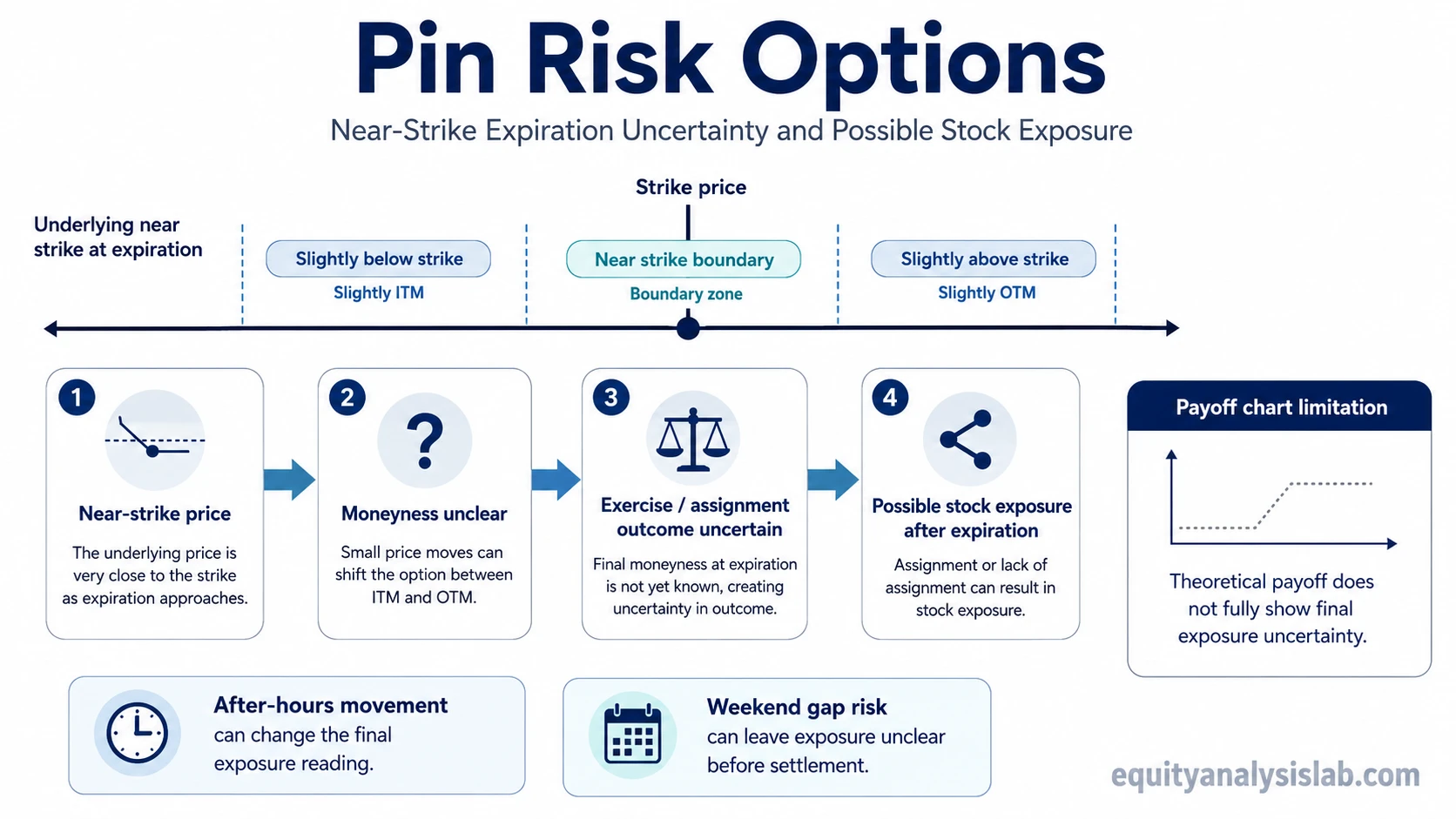
Pin risk forms through a sequence rather than through one isolated event. The underlying price is close to a strike. The option is near expiration. A small price change can alter moneyness. Exercise outcomes can depend on the closing price, holder instructions, broker cutoffs, and whether the option is treated as in the money under the applicable exercise process. Assignment may then create a stock position that did not feel certain when the market was still open.
Risk path: underlying near strike → option near expiration → in-the-money status becomes marginal → exercise decision becomes uncertain → assignment outcome may be unclear → stock exposure may appear after expiration → payoff chart alone does not define the final risk boundary.
This is why pin risk is different from simply saying that an option is profitable or unprofitable at expiration. The unresolved question is what exposure exists after the option process is complete. A position that appears small in option-premium terms can still create a larger stock-position question if assignment occurs.
After-hours and weekend movement can add another layer. An option may appear close to the strike at the regular market close, but later price movement or exercise behavior can change how the final exposure is interpreted. The exact mechanics depend on the contract, broker process, clearing process, and market circumstances, so the page should not treat one simplified example as a universal rule.
Why a Payoff Chart Does Not Remove Pin Risk
A payoff chart shows the theoretical value of an option position at expiration across different underlying prices. That is useful, but it is not the same as knowing the final delivered exposure. Pin risk sits at the boundary between the modeled payoff and the practical settlement result.
Payoff boundary limitation: a payoff diagram can show where gains and losses change, but it does not fully answer whether an option will be exercised, whether assignment will occur, or whether the account will hold stock after expiration.
The distinction is important for multi-leg positions as well as single-option positions. A payoff diagram may make the position look defined at a certain price, while the actual expiration process can leave uncertainty about which legs are exercised, assigned, or converted into stock exposure.
Pin Risk vs Assignment Risk and Gamma Risk
Pin risk overlaps with nearby options concepts, but it should not replace them. The cleanest way to understand it is to separate the uncertainty trigger from the related risk category.
| Concept | Main focus | How it differs from pin risk |
|---|---|---|
| Pin risk | Near-strike expiration uncertainty | Focuses on uncertainty when the underlying is close to the strike and final exposure is unclear. |
| Assignment risk | The possibility of being assigned on a short option | Assignment risk can exist outside a pin-risk situation, while pin risk is specifically tied to near-strike expiration uncertainty. |
| Gamma risk | Rapid option sensitivity changes as the underlying moves | Gamma risk describes sensitivity to price movement, while pin risk describes uncertainty around final expiration exposure near the strike. |
| Ordinary expiration risk | The general risk of option value changing into expiration | Ordinary expiration risk is broader. Pin risk is narrower and appears most clearly around the strike boundary. |
| Rolling an option | Changing an existing option position into a later or different contract | Rolling is a position-management concept. Pin risk is the condition that may make final exposure uncertain near expiration. |
What to Check When an Option Is Near the Strike
The useful question is not “what action should be taken?” The useful question is what variables define the uncertainty. Pin risk becomes easier to understand when the position is broken into observable inputs.
| Input | Why it matters |
|---|---|
| Underlying price vs strike | The closer the underlying is to the strike, the less certain the final in-the-money or out-of-the-money status may feel before settlement. |
| Time to expiration | Pin risk is most concentrated when little time remains and small price changes can alter the expiration outcome. |
| Option moneyness | A marginally in-the-money or marginally out-of-the-money option can create more ambiguity than a contract far from the strike. |
| Bid/ask spread and liquidity | Thin liquidity can make near-expiration interpretation and valuation less clean, especially close to the strike. |
| Implied volatility and gamma sensitivity | Volatility and option sensitivity can make the near-strike area change quickly, but they do not turn pin risk into a directional forecast. |
| Exercise and assignment rules | The final exposure depends on how exercise and assignment are processed, not only on the visible option price. |
| After-hours or weekend movement | Price movement after the regular session can affect how the final exposure is experienced once the option has expired. |
Short Example of Pin Risk in Options
Assume a stock is trading around $50 near expiration, and an option position uses the $50 strike. If the stock closes very close to $50, a small late move can affect whether the option is in the money or out of the money. The final result may not be clear at the moment the regular session ends because exercise and assignment outcomes can still determine whether stock exposure appears after expiration.
This example is about uncertainty only. It does not say that the position is good or bad. It also does not create a universal rule about closing, holding, rolling, or adjusting the position. The purpose is to show why a near-strike expiration can leave the final exposure less certain than the payoff line suggests.
Investor Interpretation of Pin Risk
For investor-oriented options education, pin risk is best understood as a boundary problem. Premium paid or collected is not the only relevant issue. The more important question is whether the expiration process can leave the account with stock exposure that was not certain before expiration.
Pin risk also separates option modeling from position reality. The model can describe the option payoff. The expiration process determines whether the investor is left with no shares, long shares, short shares, or another exposure created by assignment and exercise outcomes.
Interpretation note: pin risk is not a directional forecast, not a signal, and not a measure of position quality. It is a description of uncertainty around final exposure when an option is near the strike at expiration.
Common Misunderstandings About Pin Risk
- It is not just “the stock closed near the strike.” The issue is the exposure uncertainty created by that near-strike condition.
- It is not the same as assignment risk. Assignment risk is broader, while pin risk is tied to near-strike expiration ambiguity.
- It is not solved by looking at premium alone. Premium shows option value, but the final stock exposure may be a separate question.
- It is not a trading instruction. Understanding pin risk does not create a universal close, roll, hold, or adjustment rule.
Related Concepts
Pin risk is closest to assignment mechanics, but the concepts are not identical. Assignment risk describes the possibility of being assigned on a short option, while pin risk describes the uncertainty created when the underlying is close to the strike near expiration.
Rolling is related only because expiration uncertainty can appear while an option position is still open. Rolling an option changes the contract exposure, while pin risk describes the near-strike uncertainty that exists before the final exercise and assignment outcome is known.
FAQ
What is pin risk in options?
Pin risk in options is the uncertainty that appears when the underlying price is close to the strike near expiration, making exercise, assignment, and possible stock exposure harder to know before final settlement.
Does pin risk only affect short options?
Pin risk is most often discussed around short-option assignment uncertainty, but the broader issue is final exposure near expiration. Multi-leg positions can also be affected when one or more legs finish close to the strike.
Is pin risk the same as assignment risk?
No. Assignment risk is the possibility of being assigned on a short option. Pin risk is narrower: it describes uncertainty when the underlying is close to the strike near expiration.
Does a payoff chart show pin risk?
A payoff chart can show theoretical expiration outcomes, but it does not fully show exercise discretion, assignment uncertainty, after-hours movement, or the exact stock exposure that may remain after expiration.