
Representativeness bias is a mental shortcut where a situation is judged by how much it resembles a familiar pattern, prototype, or story. In investing, it can make a company, sector, or thesis feel more probable because it looks like a past success before the broader evidence has been tested.
Definition: Representativeness bias occurs when resemblance is given too much weight in judgment. An investor may see a company that looks like a past winner, a sector story that feels familiar, or a turnaround that resembles a successful recovery, and then treat that similarity as stronger evidence than the wider reference class supports.
Key Points
- Representativeness bias can make similarity to a familiar winner feel more predictive than it really is.
- The central error is often using one memorable prototype instead of a broader reference class.
- Base-rate information helps show how reasonably similar situations produced different outcomes.
- The bias can affect business-quality judgments, valuation work, turnaround analysis, sector narratives, and position sizing.
- Pattern recognition can start research, but it should not replace company-specific evidence.
What Representativeness Bias Means for Investors
For investors, representativeness bias means an idea can feel more believable because it fits a familiar category. A fast-growing company may resemble an earlier compounder. A turnaround may resemble a past recovery. A sector may appear to be repeating a familiar cycle.
The comparison can be useful as a hypothesis, but the current company may have different margins, capital needs, dilution risk, competitive pressure, balance-sheet constraints, or valuation. The story can look similar while the economic setup is materially different.
Investor test: If the thesis becomes much weaker when the familiar comparison is removed, resemblance may be carrying more of the argument than the underlying evidence.
The Core Error: Similarity Can Replace the Reference Class
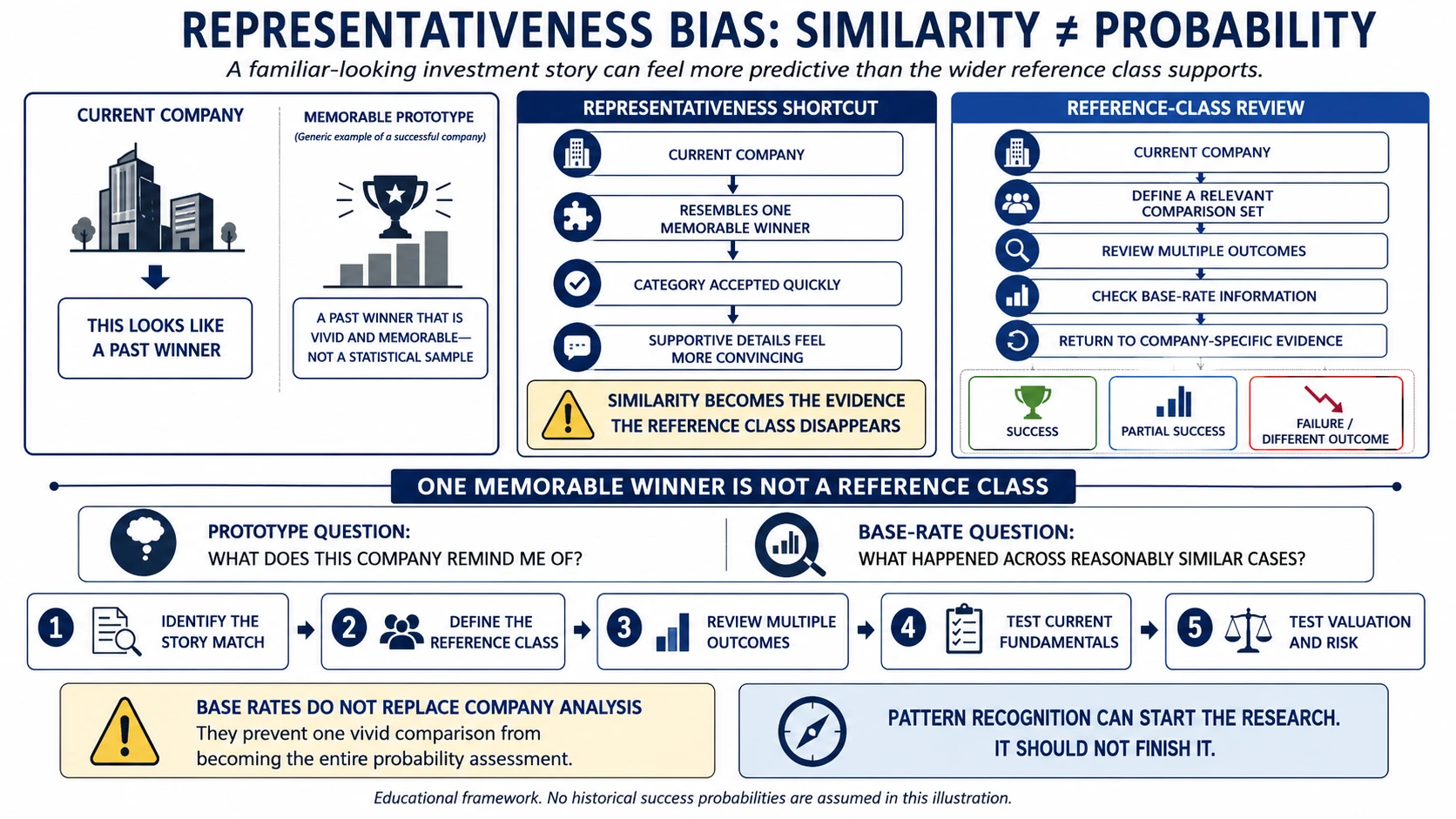
The most important distinction is between a prototype and a reference class.
A prototype is the memorable example that comes to mind. It might be a famous compounder, successful turnaround, dominant platform, or past sector winner. A reference class is the broader set of reasonably comparable situations that includes successes, partial successes, disappointments, and failures.
Representativeness bias appears when the prototype dominates the probability judgment. Instead of asking how similar companies generally performed under comparable conditions, the investor asks whether the current company looks enough like the memorable winner.
Weak comparison: “This company looks like a previous winner.”
Stronger comparison: “What happened across companies with reasonably similar growth, margins, capital needs, competition, and valuation at a comparable stage?”
This is where base rates become useful. They widen the comparison set. They do not tell the investor what the current company must do, but they reduce the risk that one vivid success story becomes the entire probability assessment.
Reference-class reset: identify the story match, define a broader comparison set, review multiple outcomes, and then return to the current company’s fundamentals, valuation, and risk.
How Representativeness Bias Enters the Investment Process
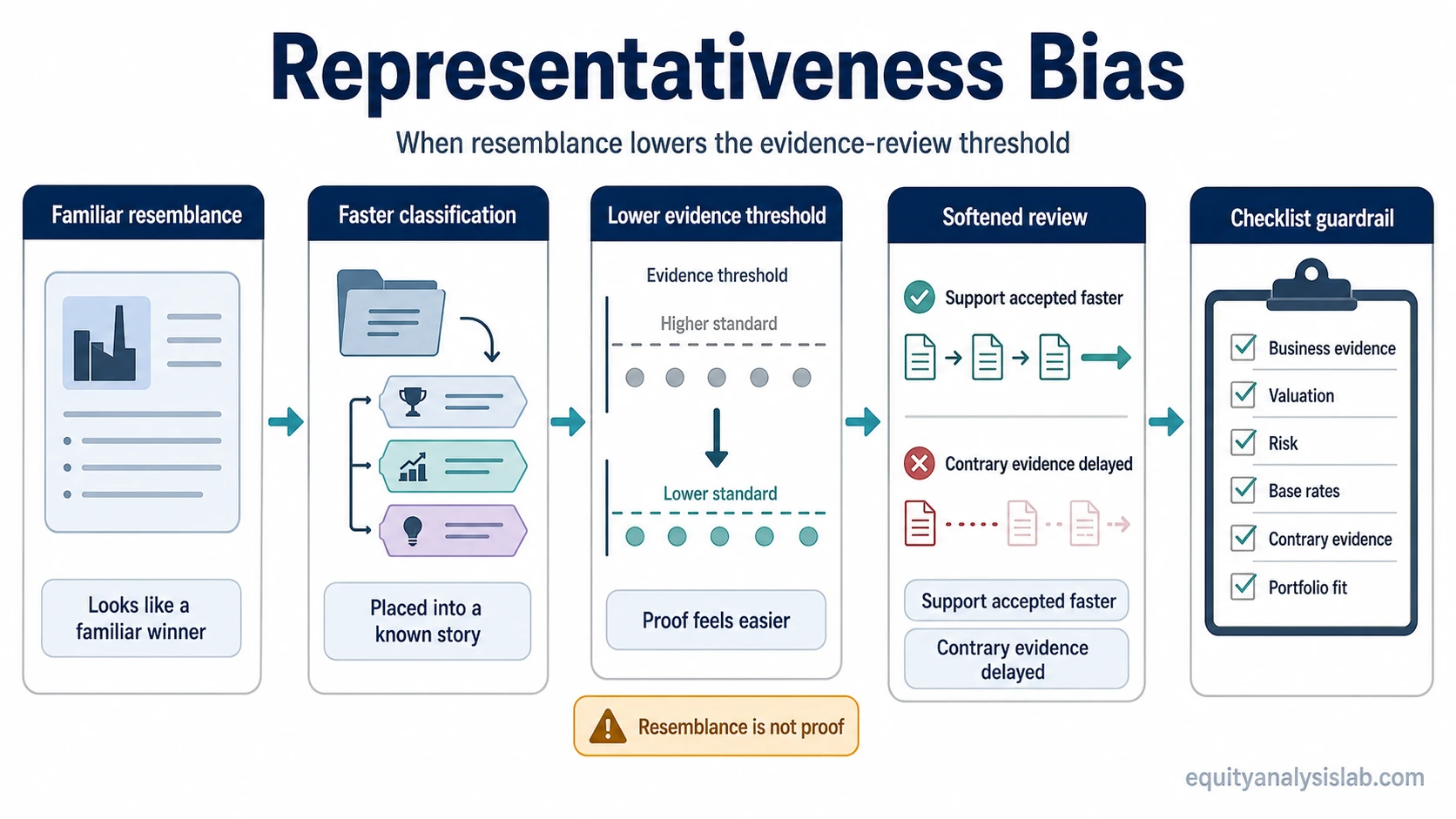
The bias often develops through a predictable sequence. A familiar story is recognized, the company is classified quickly, and the amount of evidence required to accept the thesis begins to fall.
| Decision trigger | Prototype match | Evidence at risk | Better review question |
|---|---|---|---|
| Fast-growing company | “This resembles a past compounder.” | Margins, cash conversion, dilution, reinvestment needs, valuation | How did a broader set of similarly positioned growth companies perform? |
| Turnaround story | “This looks like a successful recovery.” | Debt, execution risk, customer retention, margin durability | What separated successful recoveries from failed or incomplete ones? |
| Sector narrative | “I have seen this cycle before.” | Cycle maturity, balance-sheet risk, current demand, cost pressure | Which prior episodes are genuinely comparable, and how did outcomes differ? |
| Quality-company label | “This fits the profile of a great business.” | Forward growth, competition, reinvestment returns, valuation compression | Does the current investment case still work without relying on the quality label? |
Why Base Rates Matter
Base rates help counter representativeness bias because they force the investor to look beyond one memorable comparison. The goal is not to find a perfect statistical twin. It is to ask whether the conclusion changes when the current company is compared with a broader set of reasonably similar outcomes.
For example, instead of asking whether a company resembles one famous compounder, the investor can examine how companies with similar growth rates, margins, reinvestment requirements, competitive conditions, and valuation starting points performed over time.
The same logic applies to turnarounds and sector cycles. A memorable success is one observation. The relevant reference class includes the situations that looked similar at first but produced weaker, slower, or completely different results.
Important limit: base rates do not replace company analysis. They prevent the investor from treating one vivid example as sufficient evidence about the current company.
Representativeness Bias vs Nearby Biases
Representativeness bias often overlaps with other behavioral biases, but the trigger is specific: the idea feels convincing because it resembles a familiar category. The distinction matters because each bias requires a different review question.
| Bias | Main trigger | Investor review question |
|---|---|---|
| Availability bias | The information is easy to recall | Am I overweighting this because it is recent, vivid, or easy to remember? |
| Confirmation bias | The information supports an existing belief | Am I looking for evidence that supports the thesis more than evidence that could weaken it? |
| Overconfidence bias | Confidence rises faster than evidence quality | Has my conviction increased without a matching increase in tested evidence? |
| Recency bias | Recent information receives too much weight | Am I treating the latest pattern as more durable than the evidence supports? |
| Anchoring bias | An initial number, price, estimate, or reference point shapes later judgment | Am I still relying on the first reference point after new evidence has appeared? |
The shortest distinction is this: representativeness bias asks whether the investment was classified too quickly because it looked like a familiar type. Availability bias asks whether an example received too much weight because it was easy to recall. Confirmation bias asks whether the investor selectively searched for support after already leaning toward a conclusion.
How Investors Can Reduce Representativeness Bias
The objective is not to eliminate pattern recognition. The objective is to prevent the first pattern match from becoming the final probability judgment.
1. Identify the prototype: Write down the company, sector, or historical case that the current idea resembles.
2. Define the reference class: Expand the comparison beyond the memorable winner to a broader group of reasonably similar situations.
3. Review multiple outcomes: Include failures, slower-growth cases, partial successes, and examples where the original resemblance later broke down.
4. Return to current evidence: Test business quality, margins, cash flow, capital requirements, competitive position, and balance-sheet risk independently.
5. Separate valuation from resemblance: A company can genuinely resemble a successful business while still being priced for assumptions that leave little room for error.
6. Review position sizing: Check whether the familiar comparison is increasing confidence faster than the evidence justifies.
A useful final question is: “What evidence supports this thesis if I remove the company or historical example that it reminds me of?” If the remaining case is thin, representativeness may be doing too much of the analytical work.
What Representativeness Bias Does Not Mean
Recognizing a pattern is not automatically a mistake. Similar business models, sector structures, or historical setups can provide useful hypotheses. The problem starts when resemblance is treated as sufficient evidence about probability or investment quality.
A familiar-looking investment can also turn out to be an excellent investment. The presence of representativeness bias concerns the reasoning process, not whether the eventual market outcome happens to be positive or negative.
FAQ
What is representativeness bias in investing?
Representativeness bias occurs when an investor gives too much weight to how closely a company, sector, or thesis resembles a familiar pattern or successful example, while giving too little weight to the wider reference class and base-rate evidence.
How is representativeness bias different from availability bias?
Representativeness bias is driven by resemblance to a familiar pattern or prototype. Availability bias is driven by information that receives extra weight because it is recent, vivid, or easy to recall.
Why are base rates useful for investors?
Base rates broaden the comparison beyond one memorable example. They help investors review how a wider set of reasonably similar situations produced different outcomes before returning to the current company’s specific evidence.
How can investors reduce representativeness bias?
A practical method is to identify the prototype, define a broader reference class, review multiple outcomes, and then test the current company’s fundamentals, valuation, risks, and portfolio role independently.