
Bottom-up investing is a company-first research lens. It starts with the individual business – its financial statements, cash flow, earnings quality, balance sheet, business model, competitive position, management quality, and valuation context – before using sector or macro conditions as secondary context.
The core idea is sequence. A bottom-up investor begins with evidence from the business itself, then asks whether the wider industry, economic setting, and portfolio role change the interpretation. Bottom-up investing is a research lens, not a recommendation, suitability test, or return forecast.
What bottom-up investing means
Bottom-up investing treats the company as the first unit of analysis. Instead of starting with a macro view, sector forecast, or market cycle call, the research begins with the business: how it earns money, how durable those earnings may be, how much cash the business produces, how the balance sheet is financed, and whether the valuation leaves enough room for uncertainty.
The approach does not require macro or sector context to be ignored. It keeps company evidence in the foreground and uses broader conditions as a check rather than as the starting point.
Key points
- Bottom-up investing starts with company-level evidence before broader market context.
- The main inputs are financial statements, cash flow, earnings quality, balance-sheet strength, business model durability, competitive position, management quality, and valuation.
- The approach can be used with different investment styles, including value, growth, quality, and GARP, but it is not the same as any one of them.
- A company-first process can still be incomplete if valuation, cyclicality, sector economics, financing conditions, or portfolio concentration are ignored.
How the bottom-up research sequence works
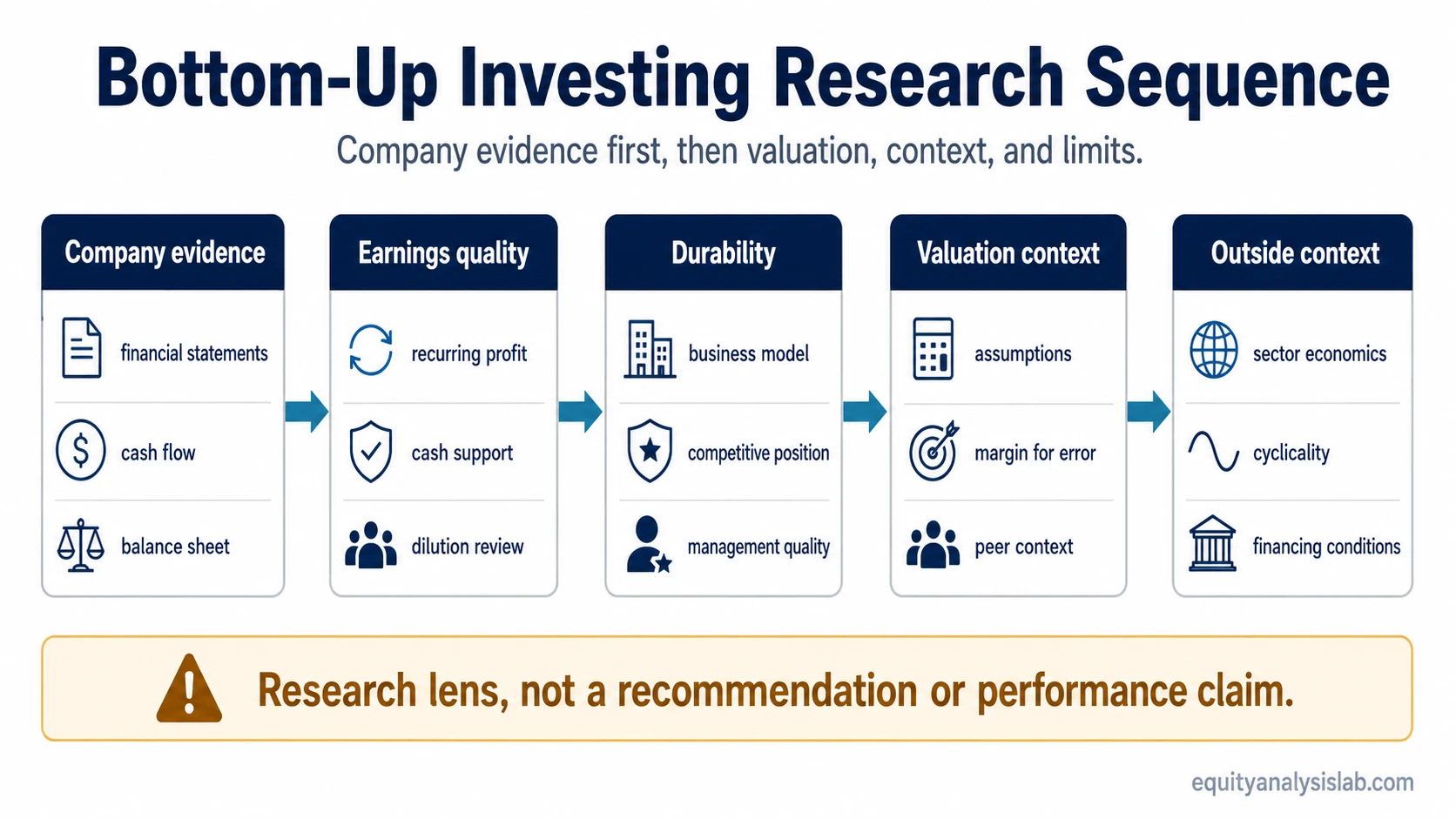
A bottom-up process usually moves from business evidence to interpretation, then from interpretation to context. The order matters because the investor is trying to understand the company before letting broad market narratives dominate the conclusion.
- Start with the business: Review revenue sources, margins, cash generation, balance-sheet structure, capital needs, and the economics of the business model.
- Test earnings quality: Separate accounting profit from cash-supported performance, recurring profitability, one-time effects, and dilution or financing changes.
- Assess durability: Look at competitive position, customer dependence, pricing power, reinvestment needs, and management’s capital allocation record.
- Add valuation context: Compare the business evidence with the price being paid, the assumptions required, and the margin for error.
- Check the outside context: Sector economics, cyclicality, interest rates, financing conditions, and market regime can still change how the company evidence should be interpreted.
Observable inputs in bottom-up investing
| Evidence input | What the investor reviews | What it can clarify | What it cannot prove alone |
|---|---|---|---|
| Financial statements | Income statement, balance sheet, and cash-flow statement trends | Revenue quality, margin structure, leverage, reinvestment needs, and cash conversion | Whether the stock is attractive at the current valuation |
| Cash flow | Operating cash flow, free cash flow, working capital movement, and capital expenditure needs | Whether reported earnings are supported by actual cash generation | Whether future cash flow will stay durable under different conditions |
| Earnings quality | Recurring profit, one-time gains, accounting adjustments, dilution, and expense timing | Whether per-share performance reflects durable business improvement | Whether the market will reward the earnings profile |
| Balance sheet | Debt load, interest coverage, liquidity, maturities, and financial flexibility | How much financial risk sits behind the business thesis | Whether the company can avoid stress in every macro or credit environment |
| Business model | Revenue drivers, cost structure, customer behavior, pricing power, and reinvestment needs | How the company creates value and where the economics may be fragile | Whether competitors, regulation, or demand shifts will remain favorable |
| Competitive position | Market share, switching costs, brand strength, network effects, scale, and cost advantages | Whether returns may be defendable over time | Whether the current advantage will survive disruption or poor execution |
| Management quality | Capital allocation, debt use, buybacks, acquisitions, reinvestment, and shareholder dilution | Whether management decisions reinforce or weaken the business economics | Whether future decisions will be equally disciplined |
| Valuation context | Multiples, intrinsic-value assumptions, normalized earnings, cash-flow expectations, and peer context | Whether expectations appear demanding, reasonable, or conservative relative to the evidence | Whether the valuation estimate is a floor, a target, or a guaranteed outcome |
Bottom-up investing versus top-down investing
The difference is the starting point. Bottom-up investing begins with the company. Top-down investing begins with the broader environment, such as macro conditions, sectors, themes, interest rates, or market cycles.
A bottom-up investor can still care about economic conditions. The distinction is that macro and sector evidence usually enters after the company has been reviewed, not before. A full side-by-side distinction belongs in top-down vs bottom-up investing.
Illustrative scenario
A business may show strong margins, consistent cash flow, and a conservative balance sheet. That can make the company interesting from a bottom-up perspective, but the analysis is still incomplete if the valuation already assumes perfect execution, the industry is highly cyclical, management has a weak capital-allocation record, or the position would create too much portfolio exposure to one type of risk.
The company-first evidence creates the starting case. Valuation, cyclicality, management quality, sector economics, and portfolio role decide whether that case is strong enough to survive a wider review.
Common misuse of bottom-up investing
A common mistake is treating bottom-up investing as a reason to ignore everything outside the company. Strong company evidence can still be offset by an overextended valuation, deteriorating industry economics, fragile financing conditions, or concentrated portfolio exposure.
Another mistake is using bottom-up language as a shortcut for conviction. Company-level research can clarify the thesis, but it does not remove uncertainty. Financial statements can be backward-looking, management commentary can be optimistic, and valuation assumptions can be wrong.
How bottom-up investing relates to other investment styles
Bottom-up investing describes where research begins. Other investment-style labels describe what kind of company evidence receives the most attention.
- Value investing emphasizes the relationship between price, intrinsic value, and margin for error.
- Growth investing emphasizes revenue expansion, earnings growth, reinvestment opportunity, and future scale.
- Quality investing emphasizes durability, margins, balance-sheet strength, competitive advantage, and cash generation.
- GARP investing combines growth analysis with valuation discipline.
A bottom-up process can be used inside any of those lenses. The investor still begins with the company, but the evidence that matters most changes with the style being applied.
FAQ
Is bottom-up investing the same as value investing?
No. Bottom-up investing is a research sequence that starts with the company. Value investing is a style that focuses on price versus estimated value. A bottom-up investor may use a value lens, but bottom-up research can also support growth, quality, or GARP analysis.
Does bottom-up investing ignore macro conditions?
No. It starts with company-level evidence, then uses macro and sector conditions as context. Ignoring financing conditions, cyclicality, or industry structure can make the analysis incomplete.
Is bottom-up investing a recommendation method?
No. It is an analytical lens, not a recommendation by itself. It organizes research around the individual business, but it does not prove that a stock is suitable, undervalued, or likely to perform well.