
Investment styles organize stock research by changing the question an investor asks first. Value, growth, quality, and GARP emphasize different evidence about the company and the price paid, while top-down and bottom-up investing change the order in which the research begins.
Choosing the right lens depends on the problem being analyzed. A valuation question points toward value investing, a durability question toward quality investing, and a research-sequence question toward top-down or bottom-up investing.
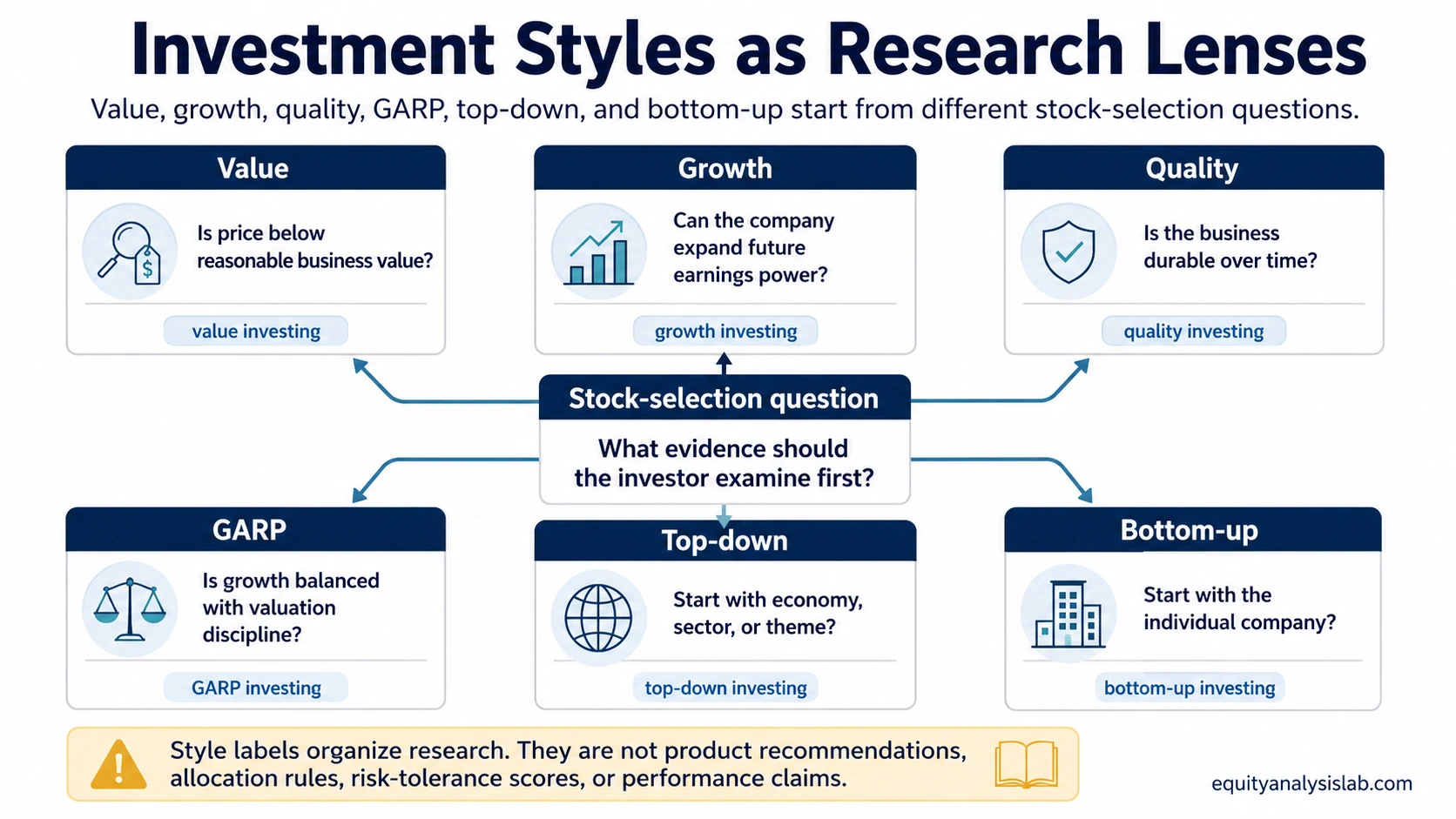
Value, growth, quality, and GARP change which evidence receives the most weight. Top-down and bottom-up investing change where the analysis starts.
Value, growth, quality, and GARP organize the analysis around valuation, expansion, business durability, or a combination of growth and price discipline.
Top-down investing starts with broader market or industry context. Bottom-up investing starts with the individual company.
Main Investment Style Routes
| Starting question | Primary lens | What it emphasizes | Start here |
|---|---|---|---|
| Is the stock priced below a reasonable estimate of business value? | Value | Valuation discipline, business value, fundamentals, and the risk that a low valuation reflects real deterioration. | Value investing |
| Can the company expand its economics at an attractive rate? | Growth | Revenue, earnings, cash flow, reinvestment, future earnings power, and the expectations already reflected in the price. | Growth investing |
| Is the business durable enough to compound value through different conditions? | Quality | Profitability, cash generation, balance-sheet strength, capital efficiency, and business durability. | Quality investing |
| Does the company combine attractive growth with a reasonable valuation? | GARP | Growth quality, valuation discipline, earnings durability, and the risk of overpaying for expansion. | GARP investing |
| Should the research begin with the economy, sector, industry, or theme? | Top-down | Macro conditions, sector structure, industry trends, and broad opportunity filters before company selection. | Top-down investing |
| Should the research begin with the individual company? | Bottom-up | Business model, financial statements, cash flow, valuation, and company-specific evidence before broader classification. | Bottom-up investing |
Investment Style Comparisons
| Research problem | Comparison | Analytical distinction |
|---|---|---|
| Valuation-first research versus expansion-first research | Value investing vs growth investing | Price discipline and growth expectations lead to different starting questions. |
| Price discipline versus business-quality discipline | Value investing vs quality investing | Business quality and valuation are separate analytical dimensions. |
| Market-context-first research versus company-first research | Top-down vs bottom-up investing | The difference is where the research sequence begins and when broader context enters the analysis. |
| Value, growth, quality, GARP, top-down, and bottom-up in one framework | Investing styles explained | The major style families can be compared before moving into a dedicated lens or comparison. |
Style Labels Depend on the Framework
Morningstar’s Style Box methodology measures value and growth separately and notes that a weak value orientation does not automatically make a stock growth-oriented. Different research frameworks can therefore describe the same company through more than one lens.
Limits of Investment Style Labels
Valuation, cash flow, balance-sheet risk, business quality, time horizon, portfolio role, and investor constraints still need separate review. A style can clarify which evidence deserves attention first without proving that a stock is attractive or suitable for a portfolio.