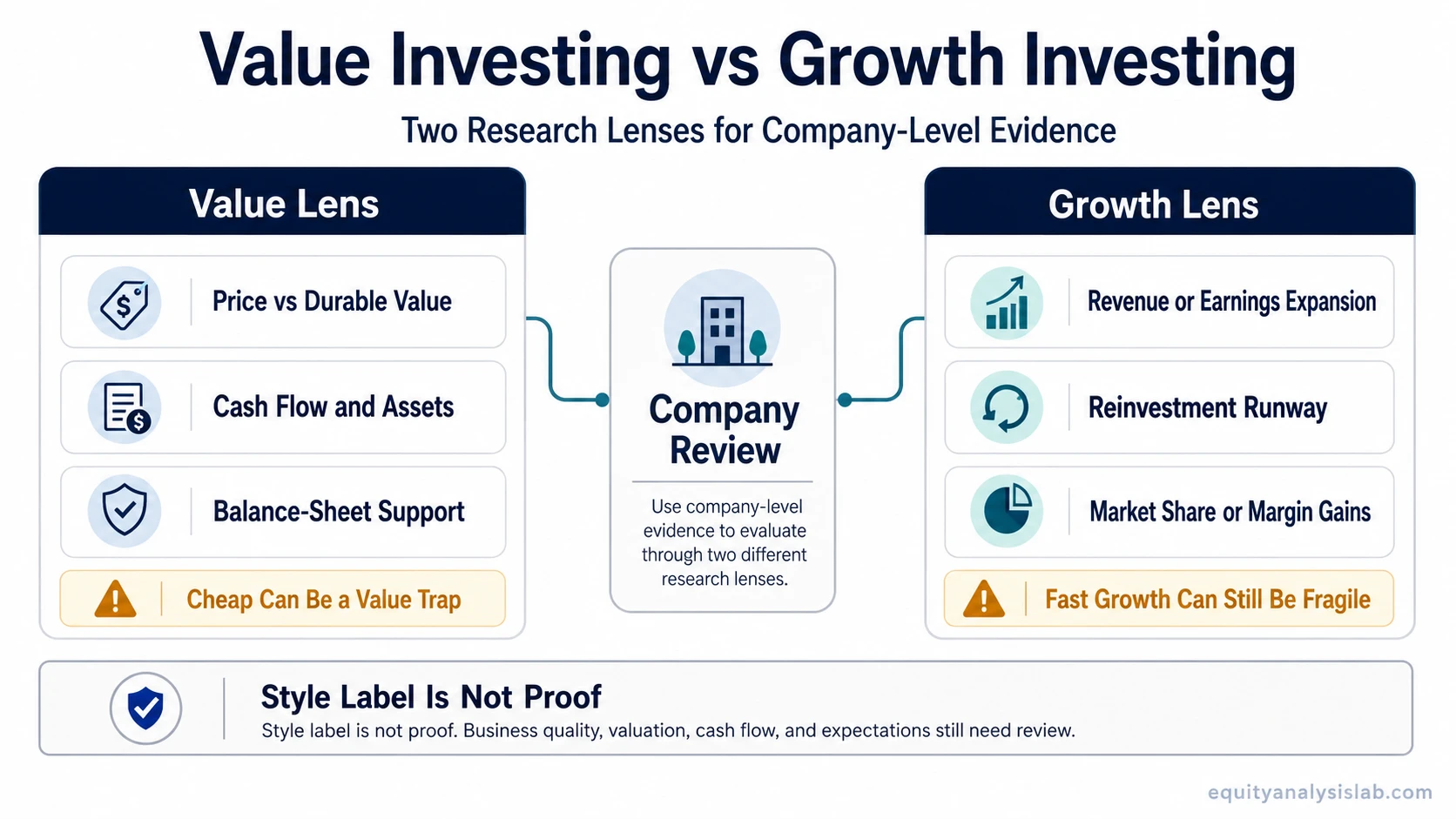
Value investing and growth investing are two major styles within investment styles, but they start from different analytical priorities. Value investing usually begins with the relationship between market price and estimated business worth, while growth investing gives more weight to the company’s ability to expand revenue, earnings, or economic relevance over time. The distinction becomes clearest when each style is viewed through what it treats as the main source of opportunity and the main source of risk.
Value investing vs growth investing at a high level
The clearest difference is where each style places its analytical center. Value investing is organized around the idea that a stock may trade below what the underlying business is worth. In that framework, price matters immediately because the investment case depends on a gap between quotation and estimated value.
Growth investing starts from a different premise. Its emphasis falls on the company’s capacity to become materially larger, more profitable, or more strategically important over time. The central issue is not mainly whether the stock looks discounted against present business conditions, but whether future business expansion can justify the valuation attached to it.
That creates a clean A versus B contrast. Value places more weight on current valuation relative to business worth. Growth places more weight on the scale, durability, and credibility of future expansion.
What each style is primarily looking for
Value investing is usually drawn to situations where the market appears restrained, skeptical, or disappointed. The stock price may imply pessimism about the business, the industry, or near-term conditions. In those cases, the analytical question is whether the market has become too negative relative to the company’s actual earning power, assets, cash generation, or resilience.
Growth investing looks for a different kind of setup. Instead of asking whether the market is too pessimistic about the present, it asks whether the market still understates the company’s future development. Revenue growth, reinvestment opportunities, competitive strength, and runway become more important because the business is being judged less as a static enterprise and more as an expanding one.
So the comparison is not merely cheap stocks versus expensive stocks. It is a contrast between one style that looks for undervaluation in relation to present business worth and another that looks for future business expansion strong enough to support or exceed current expectations.
How price and valuation are interpreted differently
In value investing, valuation usually sits at the front of the analysis. A low multiple, depressed share price, or weak sentiment alone is not enough, but those conditions often matter because they can signal a disconnect between price and business value. The style becomes compelling when the market price appears to assume a worse business reality than the evidence supports.
In growth investing, a high valuation is often interpreted in a different way. A richer multiple may reflect the market’s expectation that the company will expand meaningfully over time. That does not make the price automatically reasonable, but it does mean the valuation is tied more directly to future operating progress than to present-day cheapness.
This is why the same stock can look unattractive through one lens and understandable through the other. What appears expensive against current earnings in a value framework may look consistent with a much larger future earnings base in a growth framework. The disagreement is less about arithmetic alone and more about where the analytical weight should sit.
How expectation risk differs between value and growth
Both styles carry risk, but the structure of that risk is different. In value investing, disappointment often comes from the possibility that the apparent discount is misleading. A stock may look cheap because the business is weaker, less durable, or more structurally impaired than expected. In that case, the problem is not that the valuation failed to matter, but that the estimate of business worth was too optimistic.
In growth investing, disappointment usually comes from forward expectations failing to hold. The company may still be strong in absolute terms, yet if revenue growth slows, margins disappoint, or expansion proves less durable than the market expected, valuation can compress quickly. The damage often comes from the market revising its view of the future rather than from a collapse in the present business alone.
That difference matters because value is usually more exposed to error in judging cheapness and downside protection, while growth is more exposed to error in judging the sustainability of future business development. Both styles involve valuation judgment, but they locate their main vulnerability in different places.
What kinds of companies tend to fit each style
Value investing is often associated with more mature businesses whose economics are already visible. These companies may have established operations, clearer cash generation, and a commercial profile that can be judged more through present fundamentals than through aggressive future scaling. Their attraction comes from how current business reality compares with current market pricing.
Growth investing is more often drawn to businesses that are still expanding their market opportunity, reinvesting heavily, or deepening their competitive position. Current profits may matter less than the company’s ability to widen revenue, extend reach, and convert scale into stronger economics later. The business is interpreted more through trajectory than through present maturity.
Still, the categories are not permanent. A company can begin as a growth-style business and later be viewed through a value lens as expansion slows and current profitability becomes the dominant feature. The labels describe analytical emphasis, not fixed corporate identities.
How the mindset behind each style differs
Value investing tends to begin with doubt about the market’s current judgment. The investor asks whether the price has become too compressed relative to the underlying business. Patience matters because the thesis often depends on a gap between market opinion and business reality narrowing over time.
Growth investing tends to require conviction of a different kind. The investor is placing more confidence in the company’s ability to extend its economic relevance and compound its operating strength over time. The key question is whether the business can continue to develop in a way that justifies the expectations embedded in the stock.
That is why the comparison should not be reduced to a simple cheap-versus-expensive cliché. Value and growth represent different ways of organizing evidence, expectations, and risk. One starts with a possible mismatch between price and present worth. The other starts with the possibility that future business expansion will be more powerful or more durable than the market fully captures.
Where the comparison stops
The distinction remains clear only while the focus stays on the difference in analytical emphasis. Value investing gives priority to valuation relative to present business worth, while growth investing gives priority to future expansion and the credibility of that expansion. Once the discussion moves into the full internal logic of either style, the subject shifts from comparison to standalone treatment.
In practice, some companies show traits of both categories, and some investors blend elements from each. That overlap does not erase the distinction. The line between the two approaches remains most useful when the emphasis stays on direct differentiation rather than a full exploration of each style on its own.
FAQ
Is value investing always about low P/E stocks?
No. A low multiple can be part of a value case, but value investing is really about whether market price stands below a reasonable estimate of business worth. A stock can look statistically cheap without offering a true value opportunity if the business is weaker than it appears.
Does growth investing ignore valuation?
No. Growth investing still involves valuation judgment, but that judgment is tied more closely to future business expansion. The issue is not whether price matters, but whether future growth expectations are strong enough and durable enough to support the price being paid.
Can the same company be seen as both value and growth?
Yes. Some businesses sit between the two styles because they combine expansion potential with a valuation that some investors view as conservative. The labels are useful for comparison, but they do not always create rigid categories.
Which style carries more risk?
They usually carry different kinds of risk rather than one clearly higher level of risk in all cases. Value is often more exposed to misjudging the real quality or durability of a seemingly cheap business. Growth is often more exposed to disappointment in future expectations that were already built into the stock price.
How does direct comparison differ from standalone treatment of each style?
Direct comparison keeps the focus on the main difference in analytical emphasis between the two approaches. Standalone treatment goes further into the internal logic, methods, and implications of each style on its own terms.