Value Investing

Value investing is an investment style built around one central idea: a stock’s market price and a business’s underlying worth are not always the same thing. The style focuses on situations where an investor judges that the quoted price sits below a reasoned estimate of business value. Value investing is not simply about buying low-priced stocks. It is about interpreting whether the market’s current appraisal understates the economic substance of the company behind the share price.

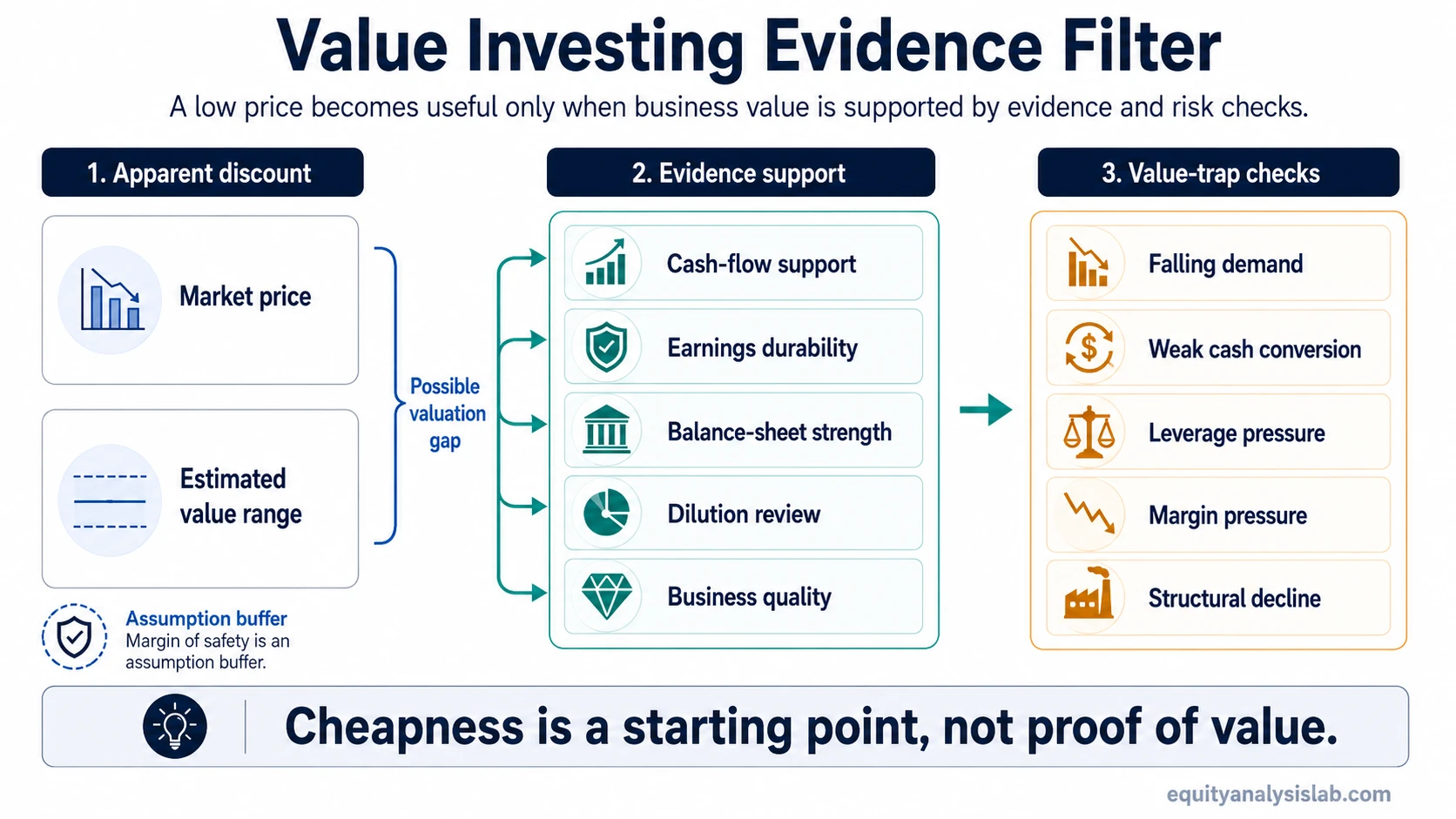
That distinction matters because “cheap” is not the same as “undervalued.” A stock can trade at a low multiple, a depressed price, or a discounted-looking level for reasons that are fully justified by weaker business economics. Value investing therefore belongs to the language of appraisal rather than bargain hunting. Its core question is whether price diverges from business worth, not whether a security merely looks inexpensive on the surface.

What value investing means

As an investment style, value investing treats a stock as a claim on an operating business. The emphasis falls on the relationship between quotation and appraisal. Market prices move continuously and are visible to everyone. Business value is slower, interpretive, and shaped by judgment about assets, earnings power, cash generation, competitive position, and financial structure. Value investing takes form in the gap between those two registers.

This gives the style a clear identity within the broader investment styles framework. It is defined by valuation asymmetry, not by trading activity, short-term signals, or a preference for fallen stocks. A price decline may create the appearance of value, but the style itself depends on a further claim: that the business is worth more than the market is currently recognizing.

Value investing is usually discussed in connection with intrinsic value and margin of safety. Intrinsic value provides the reference point outside the market quote. Margin of safety describes the gap that can exist between estimated worth and observed price. Together they help explain why value investing is more than simple price watching.

Core ideas that support the style

The style rests on the view that quoted prices and underlying business value can diverge for meaningful periods of time. This does not require markets to be irrational in a dramatic sense. It only requires that interpretation be uneven, information be absorbed imperfectly, and different market participants evaluate the same company through different time horizons or priorities.

Within that structure, business fundamentals become essential. Revenue durability, profit structure, balance-sheet condition, capital allocation, and cash-flow capacity matter because they shape the appraisal of the enterprise itself. Value investing does not rely on a stock’s price alone to establish opportunity. It relies on what the business is and on whether the market’s current price appears disconnected from that business reality.

This is also where error enters the picture. Appraisal is never exact, business conditions are never perfectly static, and market prices can remain detached from an analyst’s estimate longer than expected. For that reason, value investing is not a claim to certainty. It is a style organized around judgment under uncertainty, with valuation discipline acting as its central organizing principle.

Why low price alone does not define value

A low share price, a weak recent chart, or a compressed valuation multiple can attract attention, but none of those facts is sufficient on its own. A business may look cheap because its earning power has deteriorated, its capital structure has weakened, or its competitive position has eroded. In those cases, the lower price may reflect a lower underlying value rather than a genuine mispricing.

Value investing therefore separates undervaluation from surface discount. The style is not built on the idea that whatever has fallen is attractive. It is built on the idea that market price can at times fail to capture the business as an economic object. That difference keeps the concept anchored to business analysis instead of drifting into vague shopping analogies about buying things on sale.

Seen this way, value investing requires an analytical contrast between price and worth. Price is immediate and public. Worth is interpretive and slower-moving. The style becomes meaningful only when both are present and clearly distinguished.

How value investing is classified within investment styles

Value investing is best understood as a style family rather than a single rigid formula. What unifies the family is a shared emphasis on undervaluation relative to a reasoned estimate of worth. What varies is how that worth is framed and where the investor believes the market’s underappraisal resides.

Some value approaches place heavier emphasis on obvious discounts, asset backing, or deep dislocation. Others allow more room for durable franchises, resilient earnings, or underappreciated business quality, so long as valuation remains the anchor of the classification. That internal variation does not erase the style’s identity. It simply shows that value investing can take more than one structural form while still being defined by the same governing lens.

This is one reason the style can sometimes overlap with quality investing. A high-quality company may still fall inside a value framework if the investor’s primary claim is that the market price understates the worth of that business. The overlap is real, but the classification remains distinct because value investing still begins with the price-versus-worth relationship.

How value investing differs from adjacent styles

A nearby style is growth investing. Growth investing places more explanatory weight on future expansion and business acceleration. Value investing can include growth, but growth does not define the style. It is considered inside valuation rather than treated as the primary identity marker.

The boundary with quality-focused approaches is subtler. Quality investing centers more directly on the durability and excellence of the business itself, including returns on capital, resilience, and competitive strength. Value investing can care deeply about those same features, but it does not become a quality style merely by recognizing them. What preserves its identity is that price discipline remains central.

A blended framework such as GARP investing softens that distinction by balancing valuation and growth requirements together. That creates genuine overlap, but the conceptual center still differs. In value investing, undervaluation is the defining frame. In GARP, valuation is important but moderated by an explicit demand for growth characteristics at the same time.

Research direction should also be kept separate from style identity. Top-down and bottom-up describe how analysis is organized, not what style is being practiced. An investor can work through macro conditions or company-level evidence and still remain inside value investing if the final classification depends on the gap between market price and business worth.

Why the style assumes opportunities can exist

Value investing assumes that opportunities can exist because markets do not always translate business reality into price in a perfectly clean or immediate way. Uncertainty, neglect, complexity, cyclical disappointment, and different time horizons can all contribute to a quoted price that reflects something narrower than a fuller appraisal of the enterprise.

That does not mean every unpopular or discounted stock represents value. It means the market environment can create situations in which price and appraisal are not synchronized. The style is built around the possibility of that divergence, not around the guarantee that it is easy to identify or that it resolves quickly.

For the same reason, value investing should not be confused with simple contrarianism. Buying what others dislike is a posture toward consensus. Value investing is a classification built around valuation asymmetry. The two may overlap in practice, but they are not interchangeable concepts.

What belongs inside the concept of value investing

Value investing refers to a particular way of interpreting investment opportunity: judging the market price of a security against an estimate of the underlying business’s worth. That makes valuation central, but as part of the relationship between quoted price and business value rather than as a mechanical screen.

The concept excludes a ready-made buy process, a timing method, and a portfolio construction rule. Those are separate analytical questions. Value investing remains distinct when it is used to describe a valuation-based style rather than a generic synonym for discipline, patience, or seriousness.

When the term is used carefully, value investing remains a coherent category. It refers to a family of investment approaches organized around the belief that market price can diverge from underlying business worth, and that this divergence can matter for how a stock is understood. That is the core of the style, and it is what makes value investing a durable part of the stock-selection vocabulary.

FAQ

Is value investing the same as buying cheap stocks?

No. Value investing is not defined by low price alone. A stock may look cheap while accurately reflecting weaker business economics. The style depends on the belief that market price is below a reasoned estimate of business worth.

Does value investing ignore growth?

No. Growth can still matter inside a value framework, but it is treated as part of the appraisal of the business rather than as the main style identity. The defining feature remains the relationship between price and estimated worth.

Can a high-quality company still be a value investment?

Yes. A company can be high quality and still belong to a value framework if the investor believes the market is underestimating what that business is worth. Business quality does not remove the possibility of undervaluation.

Is value investing the same as being contrarian?

No. Contrarianism describes a stance against prevailing sentiment, while value investing describes a valuation-based style. They can overlap, but they are not the same concept.

Does value investing guarantee that the market will correct a mispricing quickly?

No. The style assumes that price and business value can diverge, but it does not guarantee timing. Apparent undervaluation can persist, and an appraisal can also turn out to be wrong.