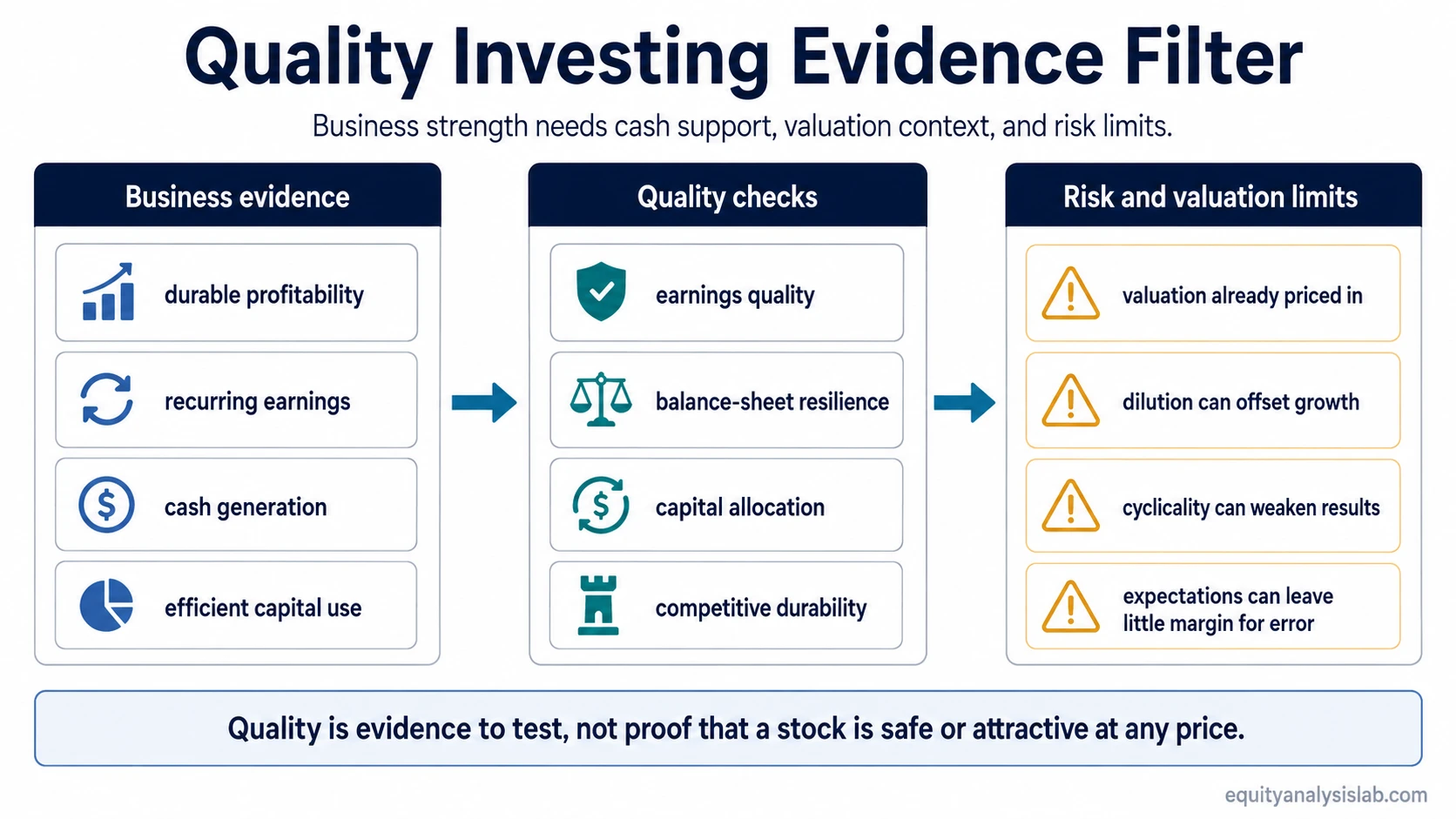
Quality investing is an investment style that classifies companies by the strength and durability of the underlying business rather than by short-term market behavior. The style centers on enterprises that combine resilient economics, strong returns on capital, financial strength, and disciplined capital deployment over time. Within the broader Investment Styles framework, quality investing is defined by business character as the primary organizing lens, not by timing, screening workflow, or portfolio construction rules.
What quality investing means
Quality investing refers to a stock selection style built around the operating and financial character of a company. Its core interest is whether a business can sustain favorable economics through time without relying on unusually supportive conditions, aggressive financing, or fragile narratives. The style focuses on durability, profitability, resilience, and discipline rather than on short-term market action.
This makes quality investing more specific than a general preference for well-known or successful companies. It is a structured way of classifying businesses according to recurring traits such as stable returns on capital, reliable cash generation, prudent balance sheet management, and thoughtful use of retained earnings. The emphasis stays on the business as an enduring economic structure, not on the stock as a near-term instrument.
Quality investing does not describe how to screen for stocks, how to build a portfolio, or when to buy shares. Those questions belong to implementation, portfolio design, and decision-making processes rather than to the definition of the style itself. As an investment style, quality investing centers on business durability and capital quality as the primary basis for classification.
Core traits associated with quality investing
Quality investing is usually associated with businesses whose economics remain sound across different environments. These companies often show resilient margins, repeatable demand, strong cash conversion, and returns on capital that reflect an underlying business advantage rather than a temporary cycle. The style is less about speed and more about structural strength.
Operating quality and financial quality both matter, but they are not identical. Operating quality concerns the business engine itself, including customer retention, pricing resilience, cost discipline, and competitive stability. Financial quality concerns funding structure, leverage, liquidity, and the degree to which the balance sheet can absorb pressure without changing the character of the business.
Capital allocation is part of the same picture. Quality weakens when strong economics are paired with poor reinvestment choices, acquisitive overreach, or routine dilution. A company may look impressive on the surface and still fall short of the style if capital is repeatedly directed toward low-return uses. In that sense, quality investing is not based on one isolated metric. It reflects the interaction among business durability, financial prudence, and managerial discipline.
How quality investing differs from other investment styles
Quality investing sits alongside other styles in the same subhub, but it remains distinct because the primary classificatory anchor is different. In value investing, the central question is the relationship between price and assessed worth. In quality investing, the central question is the character of the business itself.
The distinction from growth investing is also clear. Growth-led analysis begins with the pace and scope of expansion in revenue, earnings, or market opportunity. Quality investing does not begin there. Growth may be present, but it is secondary to the durability of the business model, the consistency of returns, and the resilience of the underlying economics.
Quality investing can also overlap conceptually with GARP investing, since both may involve businesses with solid economics. Even so, the styles are not identical. GARP holds growth and valuation in a combined frame, while quality investing remains centered on business strength and persistence as the primary basis for classification.
What quality investing usually pays attention to
Quality investing often relies on adjacent analytical concepts, but it is not reducible to any one of them. Competitive advantages matter because they help explain why attractive returns may persist. Financial strength matters because resilience under stress reinforces the idea that the business is structurally sound. Capital allocation matters because durable economics can still be diluted by weak managerial choices.
Concepts such as pricing resilience, recurring demand, margin stability, and the character of earnings are frequently discussed in connection with this style because they help distinguish durable business quality from temporary strength. A firm may show impressive recent results, but quality investing is more concerned with whether those results arise from a repeatable business structure than from favorable conditions that can reverse quickly.
That is why the style usually treats quality as a composite judgment rather than a single-variable conclusion. No one trait fully settles the question. Strong returns on capital, conservative financing, durable demand, and disciplined reinvestment matter together because they describe different sides of the same inquiry: whether the enterprise has an enduring economic foundation.
The role of valuation in quality investing
Valuation remains relevant to quality investing, but it does not define the style. Business quality answers one question, while valuation answers another. The first concerns the nature of the company and the durability of its economics. The second concerns the price attached to that business in the market. Keeping those questions separate helps preserve the identity of the style.
This is why quality investing should not be confused with indifference to price. A superior business does not cease to be superior when its shares trade at a demanding valuation, but the meaning of owning that business still depends in part on the terms of ownership. In quality investing, valuation acts as a contextual constraint rather than the defining lens of the style.
Once the discussion turns into intrinsic value estimates, multiple selection, discounted cash flow assumptions, or buy-price logic, the focus has shifted away from defining quality investing and toward valuation method or strategy. Valuation remains relevant as a boundary condition, but it does not turn the style itself into a pricing formula or implementation framework.
What quality investing does not include
Quality investing does not include screening rules, checklist design, ranking models, or portfolio construction architecture. Those are downstream applications of an investing style, not part of the style’s definition. The style is defined by what quality investing is, where its conceptual boundaries sit, and how it differs from nearby categories.
It also does not mean simply buying companies with strong reputations or admired brands. Reputation belongs to public narrative, while quality investing belongs to analytical classification. A famous business may be described as high quality, but recognition alone does not define the style or explain its structural logic.
For the same reason, quality investing should not be treated as a catch-all label for every activity related to owning strong businesses. It is not a thesis template, not a portfolio framework, and not a guide to implementation. It is a distinct investment style organized around the durability and character of the enterprise itself.
Why quality investing has a separate place in the taxonomy
Quality investing has its own place within stock selection frameworks because it organizes attention around a business’s internal strength rather than around price discrepancy, growth pace, or research direction. That gives it a stable identity inside the taxonomy even when real-world analysis moves across several lenses at once.
A company may be discussed as high quality, undervalued, or fast growing at the same time, but those labels describe different analytical centers. The taxonomy remains coherent when each page keeps its own center of gravity. Quality investing preserves that coherence by focusing on durable economics, financial resilience, and disciplined capital use as the features that define the style.
FAQ
Is quality investing the same as buying great companies?
No. Quality investing is narrower than a general preference for strong businesses. It refers to a style classification based on durable economics, resilient financial structure, and disciplined capital allocation.
Can a quality company also be a growth company?
Yes. A business can fit more than one analytical lens at the same time. The difference is that quality investing classifies the company by business durability, while growth investing classifies it by the nature of expansion.
Does quality investing ignore valuation?
No. Valuation still matters, but it is not the defining feature of the style. It functions as a contextual boundary rather than the main classificatory framework.
Is quality investing a portfolio strategy?
No. It is an investment style, not a portfolio construction method. Questions about position sizing, diversification, or implementation belong to other page types.
Does quality investing rely on one metric?
No. The style is usually associated with a combination of traits such as durable returns on capital, stable cash generation, balance sheet resilience, and disciplined reinvestment.