
Top-down investing starts with the broader environment, then narrows toward sectors and individual companies. Bottom-up investing starts with company evidence, then tests how industry and macro conditions affect the case. Both can use macro, sector, and company evidence; they prioritize those layers in a different order.
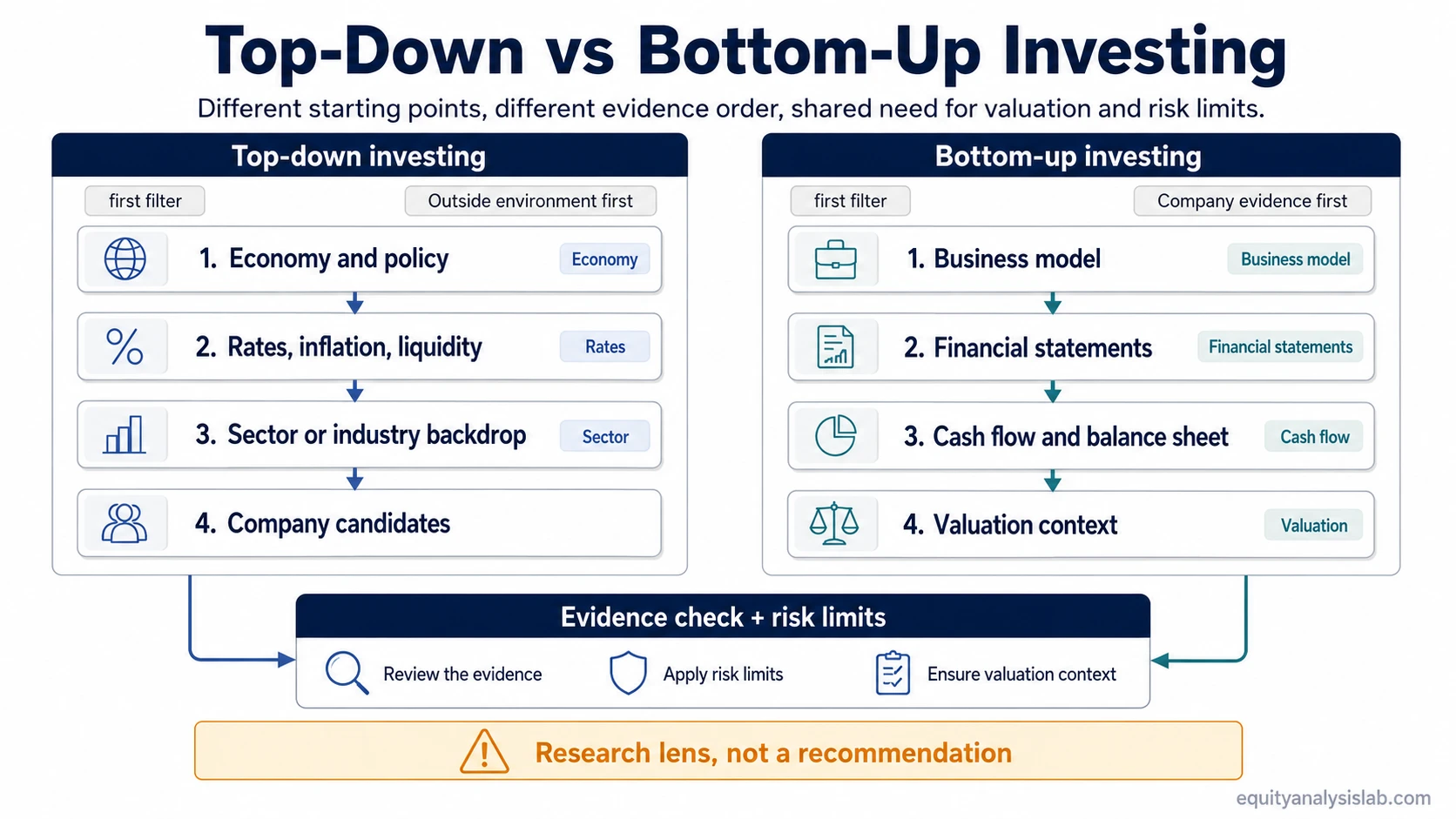
Top-Down vs Bottom-Up Investing Compared
| Comparison point | Top-down investing | Bottom-up investing |
|---|---|---|
| Starting point | Economy, policy, rates, inflation, liquidity, sector conditions, or industry trends. | Business model, financial statements, cash flow, margins, balance sheet, management, and valuation. |
| Typical sequence | Broader environment, then sector or industry, then company candidates. | Company evidence, then valuation and industry context, then broader macro checks. |
| Primary strength | Reduces the opportunity set before security selection when broad conditions matter. | Keeps company-specific economics and valuation at the center of the initial research. |
| Typical blind spot | A favorable theme or sector can hide weak company fundamentals or poor valuation. | A strong company can still face sector pressure, financing stress, valuation compression, or a hostile macro backdrop. |
| Company selection | Usually follows a prior view on the market, region, sector, industry, or theme. | Usually begins with the company and only later gives more weight to the external backdrop. |
| Use of the other layer | Can still use detailed company analysis before a security is selected. | Can still use macro, sector, and financing evidence before the thesis is finalized. |
For the standalone methods, see top-down investing and bottom-up investing.
The Difference Is the Starting Point
CFA Institute’s 2026 active equity reading describes bottom-up strategies as beginning at the company level, while top-down strategies focus first on the macroeconomic environment, demographic trends, and government policy. Its portfolio-construction reading similarly describes top-down managers as starting with the overall market environment before projecting that view toward countries, asset classes, sectors, and securities.
Same Company, Different Starting Point
Consider a software company with strong recurring revenue, healthy margins, positive cash generation, and a demanding valuation.
A top-down analyst may begin with interest rates, liquidity, sector valuations, and the broader appetite for long-duration growth assets. Those conditions determine how much attention the company receives before its individual fundamentals are examined in detail.
A bottom-up analyst may begin with retention, pricing power, margins, cash flow, balance-sheet strength, and dilution. The broader environment is then used to test whether the valuation and earnings assumptions still make sense.
The company is the same. The evidence enters the process in a different order.
Can Top-Down and Bottom-Up Analysis Be Combined?
Yes. A research process can begin with a top-down filter and then use bottom-up analysis to separate stronger companies from weaker ones inside the selected area. It can also begin with a company discovered through bottom-up research and then test whether sector, financing, or macro conditions weaken the thesis.
Combining the approaches still requires separate checks at each layer. A favorable sector does not establish company quality, while strong company evidence does not remove financing, demand, or valuation exposure.
Limits of the Comparison
Top-down analysis can identify a favorable backdrop without proving that a specific company has durable earnings, strong cash conversion, or an attractive valuation. Bottom-up analysis can identify a strong business without removing exposure to sector conditions, financing pressure, macro changes, or valuation risk. Both approaches still depend on the quality of the evidence and the assumptions used after the first filter.