
Active vs passive investing compares how portfolio decisions are made. Active investing uses discretionary research, selection, or manager judgment. Passive investing follows a predefined index or rules-based exposure with less security-by-security discretion.
The choice changes costs, turnover, flexibility, monitoring, and the evidence needed to justify the process. Management style is separate from holding period, contribution timing, and whether the investment is held through a stock, fund, or ETF.
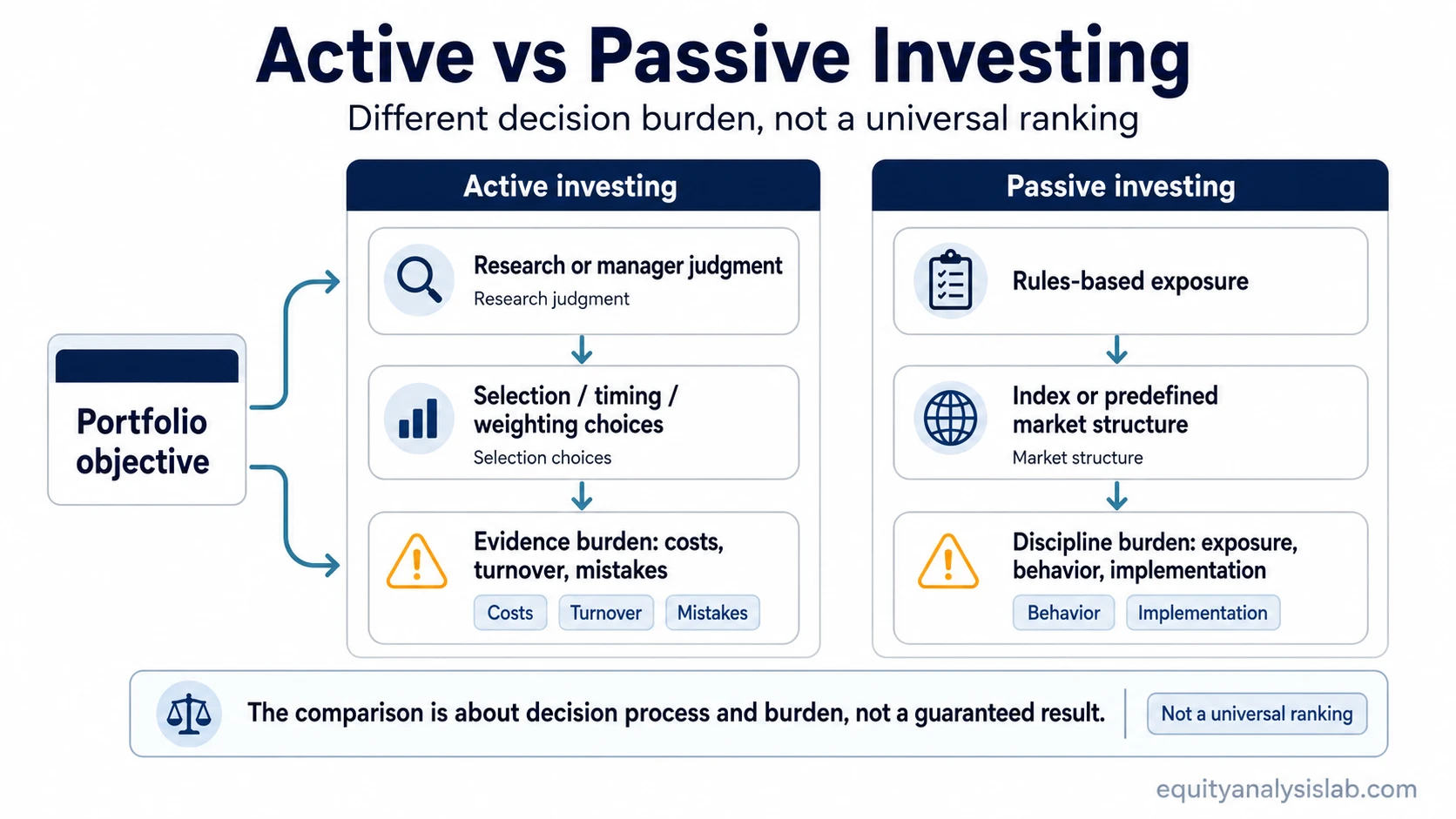
Active and Passive Investing: The Core Difference
A person, portfolio manager, or discretionary process decides which securities to own, how much to allocate, and when the portfolio should differ from a benchmark or broad market exposure.
Holdings and weights are driven mainly by an index, benchmark, or predefined rule set. The investor selects the exposure and implementation rather than repeatedly selecting each underlying security.
Both approaches still require decisions. The difference is where discretion sits and what has to be evaluated afterward.
Active vs Passive Investing Comparison
| Criterion | Active investing | Passive investing |
|---|---|---|
| Decision process | Research and judgment determine portfolio choices. | Index methodology or predefined rules determine most portfolio choices. |
| Performance objective | May seek to outperform a benchmark, manage risk differently, or express a specific research view. | Usually seeks to deliver the chosen index or rules-based exposure, less implementation costs. |
| Evidence burden | The decision process needs a reason to differ from broad exposure and a way to evaluate whether those differences remain justified. | The investor needs to understand whether the selected benchmark, holdings, weights, and implementation match the intended exposure. |
| Cost profile | Research, management fees, trading activity, spreads, and turnover can increase costs depending on the implementation. | Often involves lower management and transaction costs, although the specific product still has to be checked. |
| Turnover | Can rise when research conclusions, valuations, risk views, or portfolio weights change. | Portfolio changes usually follow index reconstitution, rebalancing, or other predefined rules. |
| Flexibility | Can change exposure when the process identifies a reason to do so. | Usually stays closer to the defined exposure even when individual holdings or sectors look unattractive. |
| Main added risk | Selection risk, manager risk, timing errors, and the possibility that discretionary decisions fail to improve the result. | Market, benchmark, concentration, tracking, and product-structure risks remain even without repeated discretionary selection. |
| Common implementation | Actively managed funds, discretionary stock portfolios, or research-driven strategies. | Index funds, broad market funds, and an index ETF are common implementations. |
Management Style Is a Separate Decision Layer
Active versus passive describes how portfolio choices are made. It does not by itself determine how long an investment is held, how often money is contributed, or whether the exposure sits inside a stock, mutual fund, or ETF.
An investor can use research and discretion while still following a long-term ownership process. That is separate from trading vs investing, which addresses a different decision boundary.
Likewise, dollar-cost averaging describes contribution timing rather than management style. compounding over time can affect either active or passive portfolios when capital remains invested and returns are reinvested.
What an Active Process Has to Justify
Active investing creates an additional analytical burden because the portfolio is intentionally departing from a benchmark or broader exposure. The investor or manager needs a reason for the security selection, weighting, sector decision, valuation view, or other source of discretion.
A stock screener can narrow a research universe, but the screen itself does not establish that the selected securities deserve different weights from the market. Business quality, valuation, financial condition, risk, and portfolio fit still have to support the decision.
An active process has to absorb its own fees, trading friction, turnover, selection mistakes, and periods when the chosen view is wrong. Additional activity only helps when the decisions add enough value to justify those costs and errors.
Investor.gov notes that actively managed funds have historically carried higher management fees and that more active portfolio management can create higher turnover costs. Its guidance on passively managed funds describes lower trading activity and generally lower fees and expenses as common features. The actual product still has to be checked because implementation varies.
What a Passive Process Still Requires
Passive investing reduces repeated security-selection decisions, but the exposure itself still has to be chosen. The investor needs to know which index or rule set is being followed, how holdings are weighted, where concentration sits, what the product costs, and whether the exposure fits the intended objective.
A rules-based portfolio can also be narrow or concentrated. Lower intervention does not make the underlying market exposure low risk, and a low-cost implementation does not determine whether the chosen benchmark is appropriate for the portfolio.
Same Objective, Different Decision Burden
Illustrative example: Two investors want long-term equity exposure to the same broad market. One decides to research individual companies and deliberately hold different weights from the market. The other accepts a rules-based broad-market exposure.
The first investor has to evaluate whether the research process and deviations from the benchmark justify their cost and risk. The second has less security-selection work, but still has to judge the benchmark, concentration, product structure, costs, and whether the exposure remains suitable for the original objective.
Where the Active vs Passive Lens Stops
Risk tolerance, allocation size, tax circumstances, liquidity needs, holding period, product structure, and investment suitability are separate decisions. A passive portfolio can still be concentrated or poorly matched to an objective, while an active portfolio can still be expensive, inconsistent, or poorly researched.
Can Active and Passive Investing Be Combined?
A portfolio can contain both approaches. Rules-based exposure may cover one part of the portfolio while another part uses discretionary research or manager selection.
The combination still needs defined roles. The passive allocation should have a clear exposure objective, and the active allocation should have a clear reason for departing from that exposure. Combining the two does not remove the costs, risks, or evaluation requirements of either approach.