
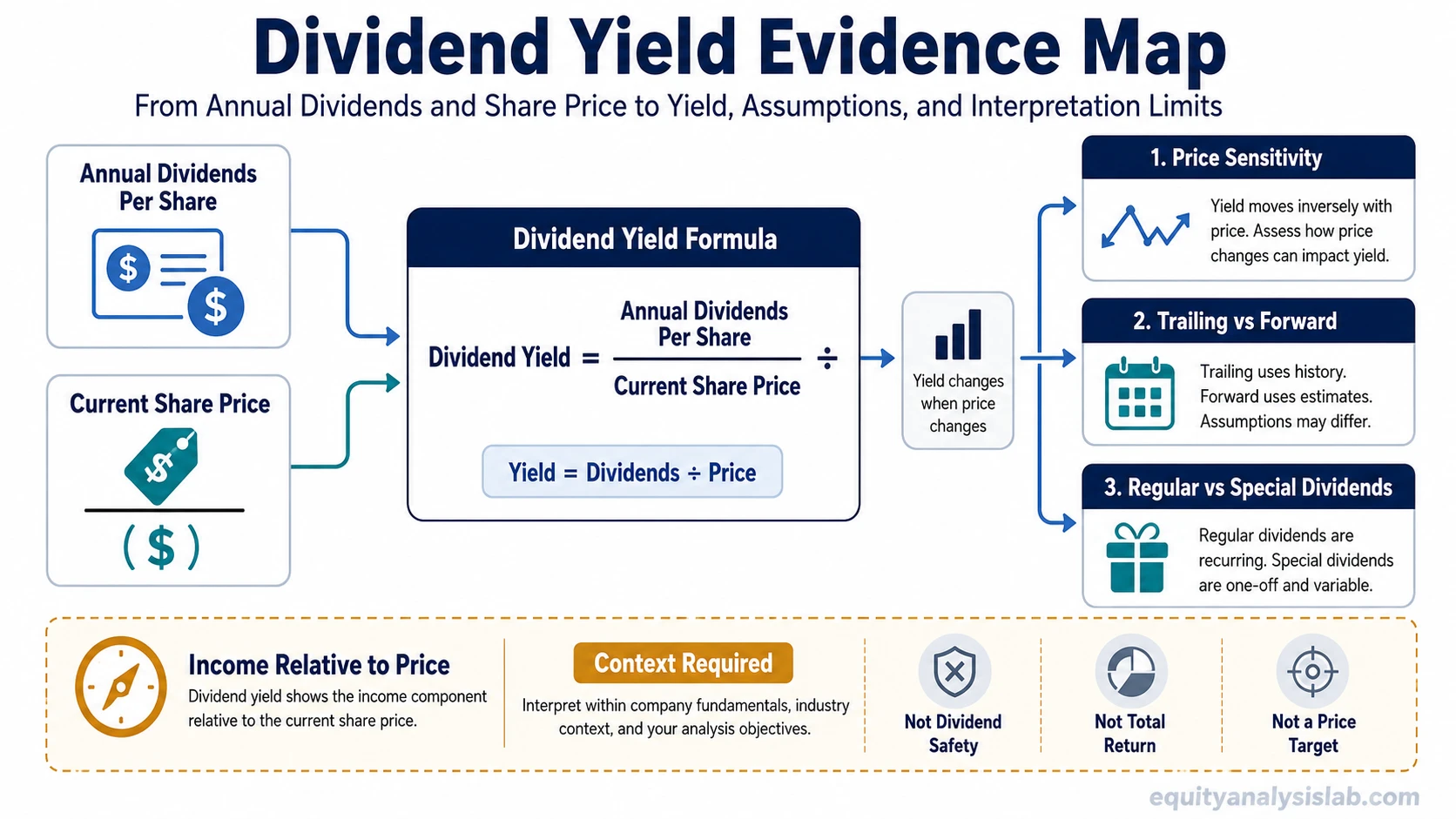
Dividend yield is the annual dividend per share divided by the current share price, usually expressed as a percentage. It compares cash dividends with price, but it does not prove dividend safety, stock quality, total return, or valuation by itself.
Definition: Dividend yield measures how much annual dividend income a stock pays relative to its current market price. The metric is useful as an income comparison, but its meaning depends on the dividend input, the price denominator, and whether the dividend is supported by the underlying business.
Key Points
- Dividend yield equals annual dividends per share divided by current share price.
- A rising yield can come from a higher dividend, a lower share price, or both.
- Dividend yield measures income relative to price, not total return or dividend safety.
- High yield can be attractive, distorted, or risky depending on earnings, cash flow, payout policy, and balance-sheet context.
What Dividend Yield Means
Dividend yield answers a narrow question: how much annual dividend income is being paid for each dollar of current share price. A 4% dividend yield means the annual dividend equals 4% of the current share price, before taxes, reinvestment decisions, transaction costs, and any future dividend change.
The metric is part of capital-return analysis. It does not say whether the stock is cheap, whether the dividend will continue, or whether the investor’s total return will be positive. Price movement, business quality, dividend durability, and valuation still need separate analysis.
Dividend Yield Formula
The basic dividend yield formula is:
Dividend yield = annual dividends per share ÷ current share price
After the division, the result is normally shown as a percentage. If a company pays $2.00 in annual dividends per share and the stock trades at $50.00, the dividend yield is 4%.
| Formula input | What it represents | Why it matters |
|---|---|---|
| Annual dividends per share | Total expected or trailing dividends paid for one share over a year | The dividend input must match the calculation convention being used |
| Current share price | The market price used as the denominator | The yield changes when price changes, even if the dividend stays flat |
| Percentage output | Dividend income relative to current price | The number is a comparison metric, not a complete investment conclusion |
Dividend Yield Example
A company pays a quarterly dividend of $0.50 per share. Over a full year, that equals $2.00 in annual dividends per share. If the current share price is $50.00, the calculation is:
$2.00 ÷ $50.00 = 0.04, or 4%
The 4% figure means the annual dividend equals 4% of the current share price. It does not mean the investor will earn 4% in total return. The share price can rise or fall, the dividend can change, and the business may become stronger or weaker after the calculation date.
What Dividend Yield Actually Tells Investors
Dividend yield is most useful when it is treated as a starting signal for capital-return analysis. It can help compare dividend income across stocks, but only after the calculation inputs are understood.
A lower yield can reflect a modest dividend, a high share price, or a company that returns capital in other ways. A higher yield can reflect a generous dividend policy, a falling share price, or market concern that the dividend may not be sustainable. The same percentage can therefore carry different meanings in different business contexts.
Interpretation boundary: Dividend yield compares dividends with price. It does not measure earnings quality, free cash flow support, balance-sheet flexibility, dividend growth, or management’s future capital-allocation choices.
Why Dividend Yield Changes When Price Changes
The price denominator makes dividend yield sensitive to market movement. If the dividend stays the same and the share price falls, the yield rises. If the dividend stays the same and the share price rises, the yield falls.
| Annual dividend per share | Current share price | Dividend yield | Interpretation boundary |
|---|---|---|---|
| $2.00 | $40.00 | 5.0% | Higher yield may reflect a lower price, not a stronger dividend |
| $2.00 | $50.00 | 4.0% | Same dividend, moderate price denominator |
| $2.00 | $80.00 | 2.5% | Lower yield may reflect a higher price, not a weaker dividend |
A rising yield can mean a higher dividend, a lower share price, or both. The same percentage can represent a stable income comparison, a falling-price warning, or a temporarily distorted number depending on dividend quality and business context.
Assumptions That Can Distort Dividend Yield
Dividend yield depends on the dividend figure used in the numerator and the price used in the denominator. Small input differences can change the output, especially when dividends are irregular or the stock price has moved sharply.
| Assumption | Possible distortion | Cleaner interpretation |
|---|---|---|
| Trailing dividend yield | Uses dividends already paid, which may not represent the future dividend rate | Useful for historical income comparison when the dividend policy is stable |
| Forward dividend yield | Uses expected future dividends, which may change if policy or business conditions shift | Useful only when the forward dividend assumption is explicit |
| Special dividends | Can inflate the annual dividend figure if treated like a recurring payment | Separate regular dividends from one-time distributions when possible |
| Fast price movement | Can make the yield look unusually high or low without any dividend change | Check whether the yield changed because of price, dividend policy, or both |
Dividend Yield vs Dividend Payout Ratio
Dividend yield compares dividends with current share price. Dividend payout ratio compares dividends with earnings. The two metrics answer different questions.
Dividend yield: How much annual dividend income is paid relative to the stock price?
Dividend payout ratio: How much of earnings are being paid out as dividends?
A stock can have a high dividend yield and still have weak dividend support if earnings or cash flow are under pressure. A stock can also have a modest yield but a conservative payout policy if the dividend is small relative to earnings and cash generation.
High Dividend Yield Risk
A high dividend yield is not automatically positive or negative. It can reflect a strong capital-return policy, but it can also appear after the share price has fallen. That makes the reason behind the yield more important than the percentage alone.
Common mistake: Treating dividend yield as a complete income-quality signal. A high percentage can come from a falling share price, a temporarily high distribution, or a dividend level that may not be supported by earnings and cash flow.
Dividend sustainability usually requires a wider check of earnings, free cash flow, debt pressure, capital needs, and management’s payout policy. Yield can point to a question worth examining, but it does not answer the sustainability question by itself.
Related Capital Return Metrics
Dividend yield is only one way to study capital returned to shareholders. Buyback yield looks at repurchases relative to market value, which can matter when a company returns cash through share reduction instead of dividends.
Dividend support can be tested more directly through dividend coverage ratios, which focus on whether earnings or cash flow can support the distribution.
The income picture also changes when dividend growth is strong, weak, or inconsistent over time.
For an investor who receives dividends, what happens after dividends are received can change compounding behavior, but reinvestment is separate from the yield calculation itself.
FAQ
What is dividend yield?
Dividend yield is annual dividends per share divided by current share price, expressed as a percentage. It measures dividend income relative to price.
How do you calculate dividend yield?
Divide annual dividends per share by the current share price, then convert the result into a percentage. For example, $2.00 in annual dividends divided by a $50.00 share price equals 4%.
Is a higher dividend yield always better?
No. A higher yield can reflect a larger dividend, a lower share price, or both. The yield needs to be checked against earnings, cash flow, payout policy, and balance-sheet pressure.
What is the difference between dividend yield and dividend payout ratio?
Dividend yield compares annual dividends with current share price. Dividend payout ratio compares dividends with earnings. Yield is price-based, while payout ratio is earnings-based.
Can dividend yield predict total return?
No. Dividend yield measures dividend income relative to price. Total return also depends on share-price movement, dividend changes, reinvestment choices, taxes, and future business performance.