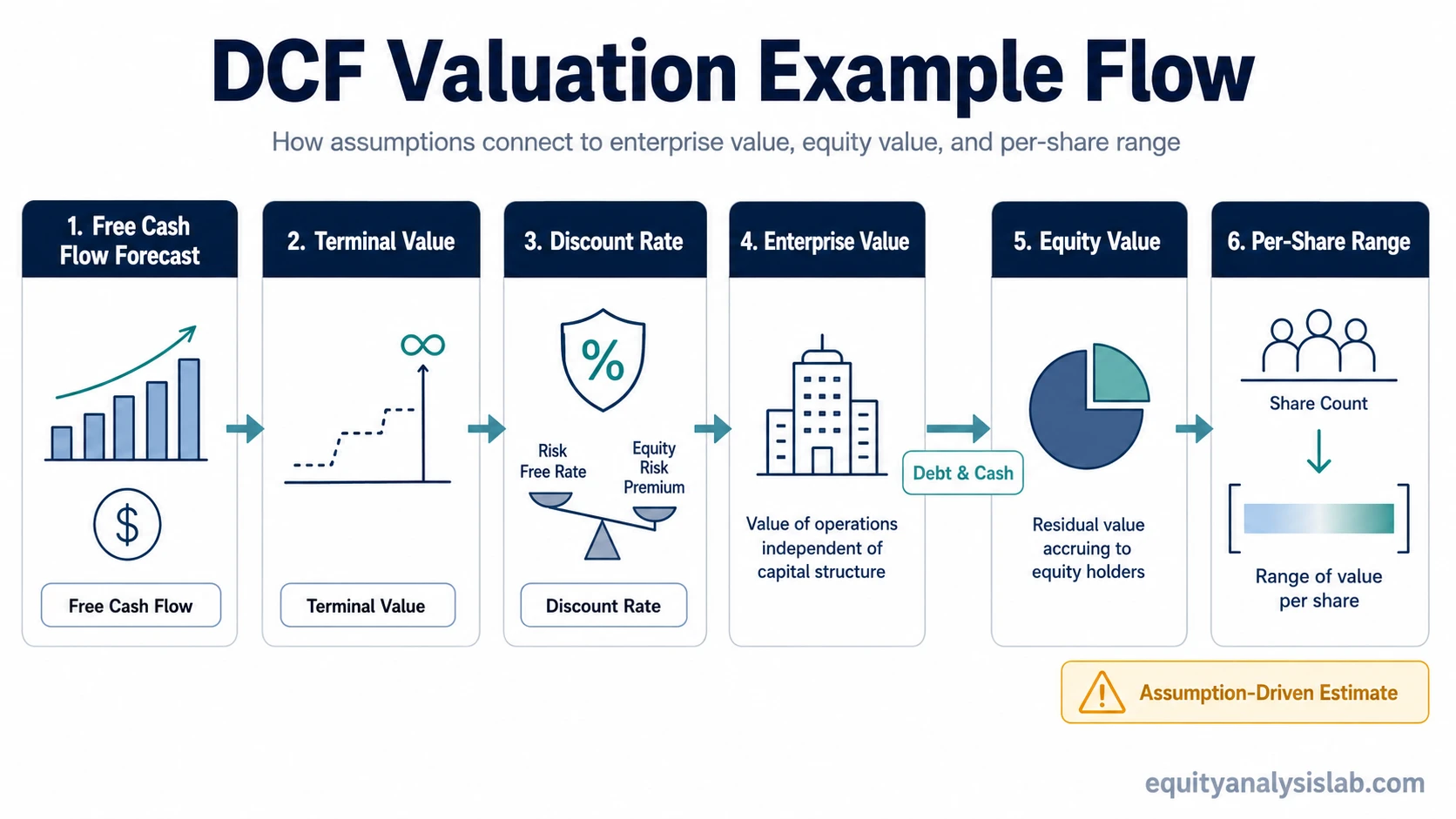
A discounted cash flow valuation example is a worked illustration of valuation logic in which projected cash generation, discounting, and long-term assumptions are combined inside one valuation structure. The emphasis is on how those elements connect, not on treating the output as a definitive statement of what a business is worth.
A discounted cash flow method defines the framework in conceptual terms, while a valuation example shows how forecasts, present value mechanics, and long-run assumptions appear when arranged into a usable sequence. The result is not a universal model. It is a structured expression of how valuation reasoning is organized in example form.
What a DCF valuation example is meant to show
A DCF valuation example turns an abstract valuation principle into a visible analytical process. The core idea behind the method is that a business can be viewed through the present value of the cash it may generate over time. An example page helps by showing how that idea is expressed through a forecast period, a discounting framework, and a residual value beyond the explicit projection window.
The value of the example lies in connection, not in isolated formulas. Growth assumptions, operating profitability, reinvestment needs, discounting, and long-run continuation value do not matter independently. Their meaning comes from the way they interact. A DCF example makes those dependencies easier to read because it places them inside one ordered valuation sequence rather than scattering them across separate definitions.
Within Valuation Examples, a DCF example shows how valuation ideas behave when assembled into a complete structure. It demonstrates how valuation logic moves from future cash expectations to a present value estimate without turning the analysis into a spreadsheet tutorial, a company-specific appraisal, or a step-by-step model-building guide.
Main components in a DCF valuation example
Most DCF examples are built from a small set of recognizable blocks. The first is the explicit forecast period. This is where assumptions about future business performance are translated into projected cash outcomes. Revenue growth, margins, taxes, investment requirements, and working capital behavior appear here as parts of an expected operating path rather than as detached data points.
The second block is the valuation translation layer. Forecast assumptions describe how the business may perform, but they do not by themselves produce present value. That requires a separate mechanism that expresses future amounts in current terms. This is where the discounting structure becomes important, because it converts projected cash flows into a value estimate that can be read in the present.
A third block is the long-duration component beyond the detailed forecast. In many examples, this is where terminal value enters the model. Keeping it distinct from the explicit forecast makes the example easier to interpret. The forecast years describe individually modeled periods, while the terminal component represents the continuation of value after that visible horizon ends.
When these pieces are laid out clearly, the example becomes easier to follow. One part describes expected business performance, one part converts those expectations into present value terms, and one part extends the valuation beyond the modeled forecast window. The finished estimate emerges from the interaction of all three, not from any single line item standing on its own.
How assumptions shape a DCF valuation example
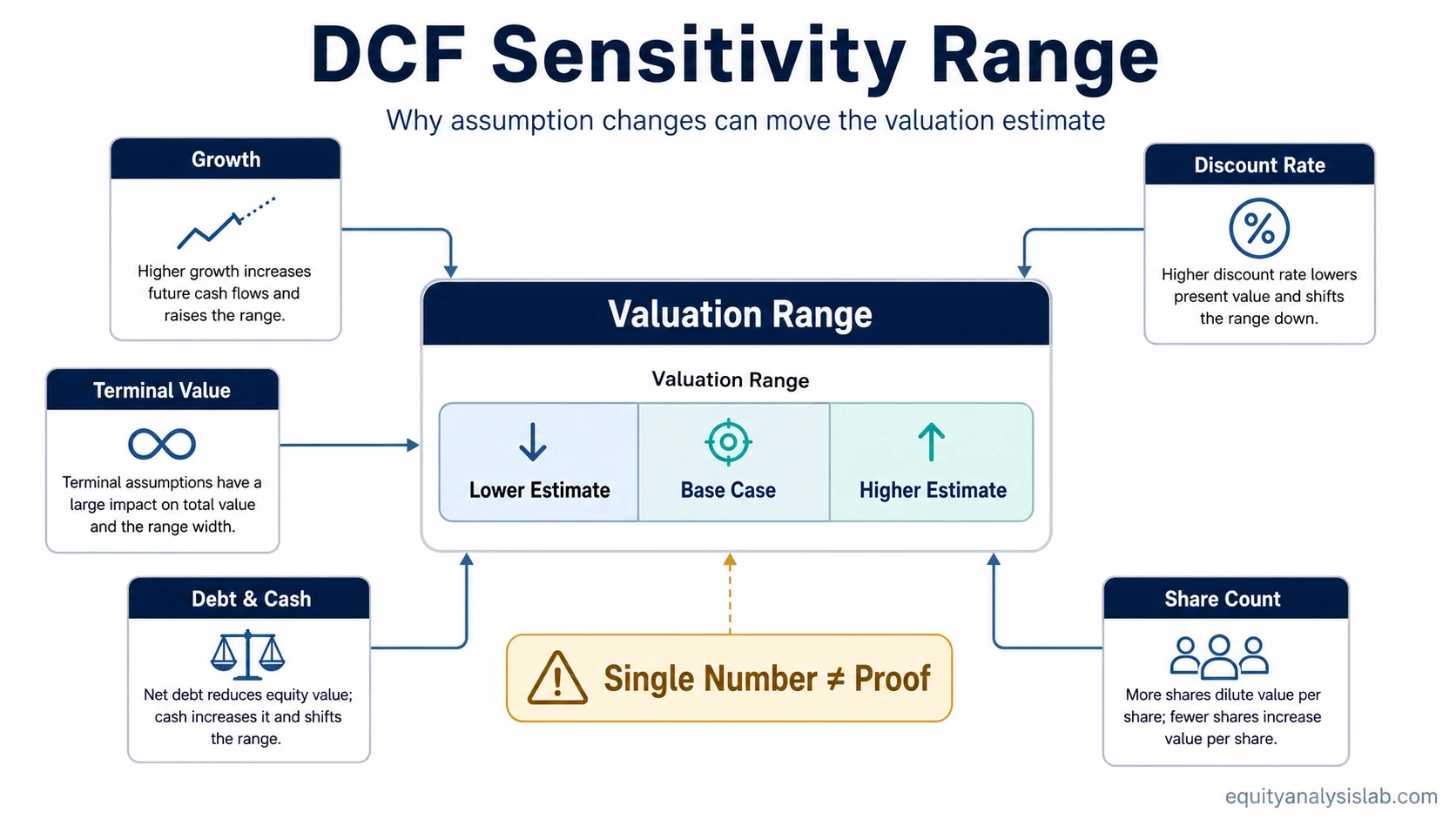
A DCF example is highly sensitive to the shape of its assumptions because the output depends on a chain rather than on one input in isolation. Growth affects the size of the future cash flow base. Margins affect how much of that activity survives as operating profit. Reinvestment needs affect how much of that profit becomes distributable cash. Each layer changes the next one, which is why the result reflects the structure of the forecast rather than a single isolated judgment.
Some assumptions belong to the operating side of the model, while others belong to the valuation side. Growth, margins, capital intensity, and working capital behavior describe the expected economics of the business. The discounting framework performs a different role. It does not alter the forecast itself. Instead, it determines how heavily future cash flows are weighted when converted into present value, which is why understanding the discount rate is central to reading the example correctly.
This separation matters because two examples can tell a similar business story and still produce meaningfully different valuation outputs. A business with comparable forecasted revenue growth and margin development can look more or less valuable depending on how future cash flows are discounted and how the terminal period is framed. The example therefore teaches not only what assumptions are present, but also which layer of the model each assumption belongs to.
The role of the explicit forecast period is also different from the role of the terminal period. The explicit years usually describe a transition from current conditions toward a more normalized operating profile. The terminal period extends that ending condition into a longer-duration value expression. Reading those two parts separately makes the structure clearer and prevents the final estimate from looking more precise or more durable than the underlying assumptions justify.
How to interpret the output of a DCF valuation example
The final number in a DCF example should not be treated as a discovered fact. It is a calculated estimate produced by a particular design of assumptions. That estimate can be useful because it reveals how a valuation framework turns business expectations into present value, but it remains conditional on the structure that generated it.
This is why a DCF output is better read as an analytical result than as a market verdict. The model shows what value looks like under its own assumptions. It does not, by itself, explain whether the market must converge to that value or whether the estimated value is uniquely correct. The example is useful because it makes the logic transparent, not because it eliminates uncertainty.
Sensitivity is central to that interpretation. A modest change in discounting, long-run growth, or operating assumptions can materially alter the result even when the model’s overall structure stays the same. For that reason, a range often describes the output more honestly than a single point estimate. A narrow-looking number may create a false impression of precision when the real lesson of the example is how dependent the estimate is on its assumptions.
The relationship between modeled value and market price should also be kept separate. A DCF example can illustrate how an estimate of intrinsic value is formed, but that is not the same thing as explaining why the market is pricing an asset where it is. Market price reflects a broader and changing process. The DCF result reflects the internal logic of one valuation framework under explicit assumptions.
Main limitations of a DCF valuation example
The main limitation of a DCF example is structural. It begins with expectations about the future rather than with observable future outcomes. Revenue growth, margins, reinvestment needs, and long-run assumptions are all entered before the business has actually produced those results. As a result, the apparent precision of the output is always downstream from uncertainty embedded in the forecast.
Another limitation is that the most detailed part of the model is not always the part carrying the most weight. In many DCF examples, a large share of total value comes from the terminal component rather than from the individually forecasted years. That creates an interpretive tension. The visible detail of the explicit forecast can make the example look highly grounded, even when a large portion of the final estimate depends on much more condensed assumptions about the distant future.
The usefulness of the example also changes with the business being considered. A company with steadier demand, more stable margins, and a more legible capital structure can often be represented more clearly in this framework. Businesses facing sharp cyclicality, rapid industry change, or unstable economics are harder to describe with confidence, which makes the resulting valuation more fragile even when the method itself remains the same.
These limitations do not make the example invalid. They define how it should be read. A DCF example is strongest when used as a disciplined way to connect assumptions with valuation consequences. It is weakest when a modeled output is mistaken for a precise statement of what a business is definitively worth.
Where a DCF valuation example fits within valuation learning
A DCF valuation example occupies a specific place within valuation learning. It is one worked expression of intrinsic-value reasoning, not a complete map of valuation as a whole. Its function is to show how future cash generation, present value mechanics, and long-run continuation assumptions fit together inside one method-driven example.
That makes it different from other valuation formats. Some examples are built around internally modeled value formation, while others are built around market relationships and observable pricing comparisons. A DCF example belongs to the first group. It organizes the analysis around projected cash flows and valuation translation rather than around peer pricing or multiple-based comparison.
The subject is the structure of the valuation example itself rather than a deep analysis of one particular business or one real-world security. The emphasis stays on making the method visible in motion while keeping the example distinct from a company-specific case study or a method tutorial.
Within valuation learning, a DCF example bridges method understanding and applied interpretation. It shows how valuation concepts become a coherent example without trying to resolve every practical question about model selection or company appraisal. That role keeps example-based explanation distinct from the deeper conceptual pages surrounding the method.
FAQ
What is the purpose of a DCF valuation example?
The purpose is to show how valuation logic works when future cash flow assumptions, present value mechanics, and long-run continuation value are assembled into one coherent structure. It is meant to clarify the method in action rather than provide a definitive valuation answer.
Why does terminal value matter so much in a DCF valuation example?
Terminal value often represents the portion of the business that extends beyond the explicitly forecast years. Because companies are usually expected to continue operating after the detailed projection period ends, that long-duration component can account for a large share of the total modeled value.
What can a DCF valuation example help you understand?
A DCF valuation example helps show how forecast assumptions, discounting, and long-run continuation value combine inside one valuation structure. It is useful for understanding how the parts of the method connect, even though the final output remains dependent on the assumptions used.
How is a DCF valuation example different from a comparable company analysis example?
A DCF valuation example is built around projected future cash flows and discounting logic. A comparable company analysis example is built around market-based reference points and relative pricing relationships. They belong to the same broader valuation field, but they organize evidence in different ways.