
Comparable company analysis estimates value by applying valuation multiples from similar public companies to a target company’s financial metric. The output depends on peer selection, market-date consistency, metric quality, accounting adjustments, and the capital-structure bridge, so it should be read as a market-implied range rather than proof of fair value.
Comparable company analysis: a valuation method that compares a target company with similar public companies and applies selected peer multiples to the target company’s revenue, EBITDA, earnings, free cash flow, or another financial metric.
The method is often called comps analysis or CCA. It uses observable market prices, but the final estimate still depends on judgment about which companies are comparable, which metrics are relevant, and how the financial data should be standardized.
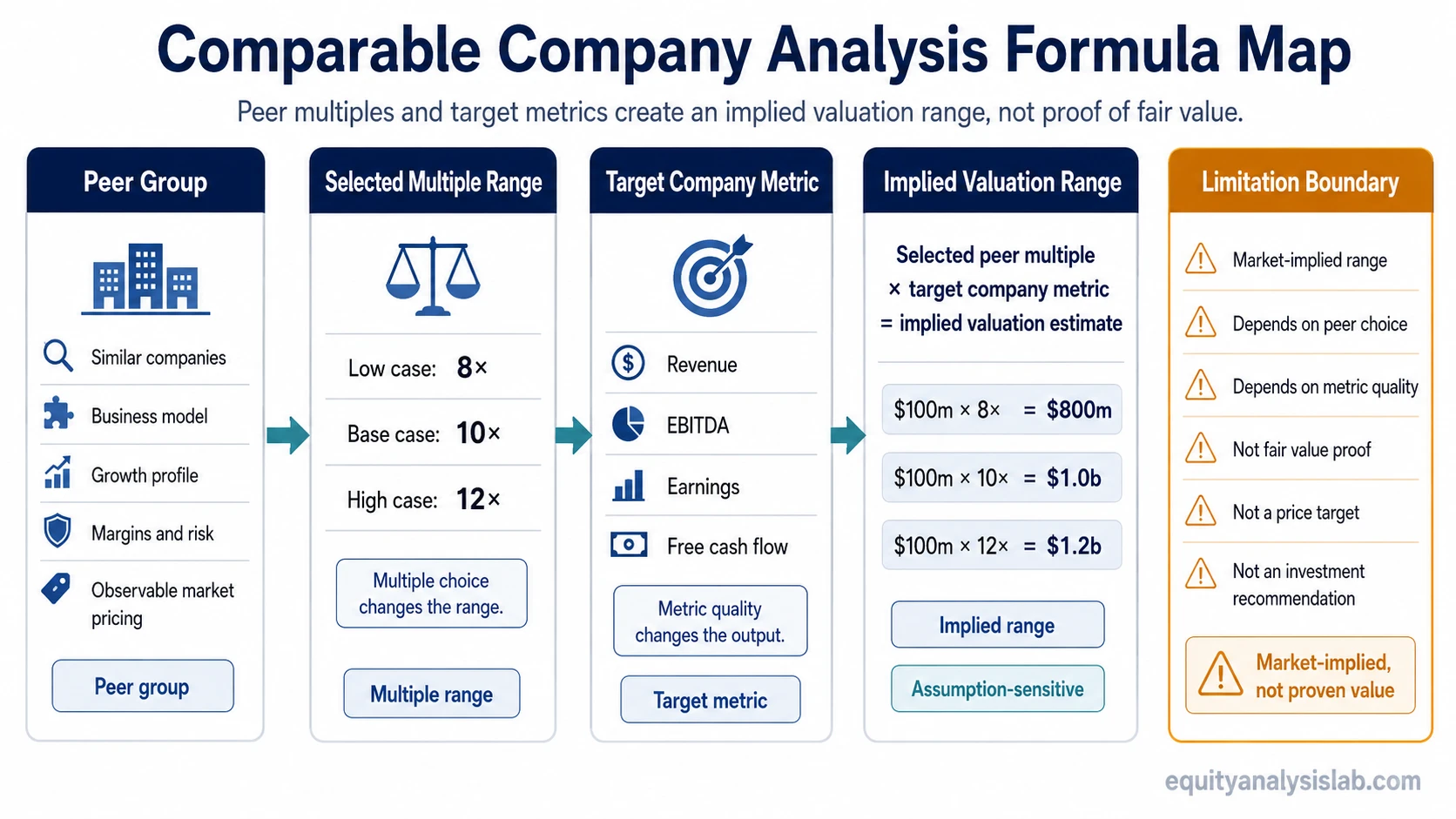
Key Points
- Comparable company analysis is a peer-based form of valuation using market multiples from similar public companies.
- The workflow includes more than peer selection. The analyst also needs consistent market dates, comparable financial periods, normalized metrics, and a correct value bridge.
- Enterprise-value multiples and equity-value multiples do not follow the same path.
- A comps output is a market-implied benchmark, not intrinsic value and not an investment conclusion.
- Period mismatch, weak normalization, and poor peer quality can materially distort the implied valuation range.
What Comparable Company Analysis Means
Comparable company analysis is a narrower form of relative valuation. Relative valuation is the broader method family. Comparable company analysis applies that logic specifically to a target company and a selected set of similar public companies.
The method does not begin by forecasting every future cash flow. Instead, it begins with how the market currently prices a comparable peer group, then applies a selected multiple range to the target company’s own metric. That makes CCA useful for market context, but it also means the estimate can inherit market optimism, pessimism, or peer-group distortions.
Comparable Company Analysis Step by Step
A useful comps model is a sequence of standardization decisions rather than one formula. The simplified relationship is straightforward, but each step can change the output.
Simple mechanism: selected peer multiple × target company metric = implied valuation estimate.
| Step | What the analyst does | Why it matters |
|---|---|---|
| Define the comparable universe | Select companies with reasonably similar business model, growth profile, margins, risk, and capital structure. | The peer set creates the benchmark range used in the analysis. |
| Gather market and financial data | Collect consistent market prices, enterprise values, share counts, and relevant financial metrics. | The result depends on the data date and the quality of the underlying numbers. |
| Align periods | Decide whether the comparison is LTM, NTM, or another comparable period basis. | The same multiple can produce different implied values if the periods do not match. |
| Normalize the metrics | Review non-recurring items, accounting differences, and comparability adjustments. | An unadjusted denominator can make one company look artificially cheaper or more expensive. |
| Calculate peer multiples | Build the peer multiple set from the standardized market and financial data. | The selected multiple defines which part of the business is being compared. |
| Select the reference range | Choose the benchmark statistic or range to apply to the target company. | The output changes when the reference multiple changes. |
| Apply the benchmark and bridge the result | Apply the selected peer multiple to the target metric, then convert the result into enterprise value, equity value, or value per share as needed. | The final output depends on the correct value bridge as well as the multiple itself. |
Peer selection can become detailed quickly. For that narrower question, see how to choose comparable companies. This page stays focused on the overall comps workflow after the peer set has been defined.
What a Comps Table Standardizes
A comps table is useful because it forces the analyst to standardize the comparison rather than rely on loose similarity. Companies can operate in the same industry while still being difficult to compare if the dates, periods, adjustments, or capital scope are inconsistent.
| Standardization Item | Why It Is Needed | Risk If Ignored |
|---|---|---|
| Market data date | Peer prices should be captured on a consistent date basis. | Different market conditions can be mixed into the same peer table. |
| Financial period | Peers and target should use comparable LTM or forward periods. | An NTM multiple applied to an LTM metric can distort the estimate. |
| Normalization | One-time items and obvious comparability issues should be reviewed before comparing metrics. | Reported figures may look comparable while measuring different underlying economics. |
| Capital scope | Enterprise-value multiples and equity-value multiples must be kept separate. | The implied value can be distorted by mixing enterprise logic with equity-only metrics. |
| Share count basis | Per-share outputs require a clearly defined diluted share count. | Value per share can be misestimated even when enterprise value is correct. |
Enterprise-Value and Equity-Value Paths
A valuation multiple connects a value measure with a financial measure. The capital scope has to match the question being asked.
| Multiple Type | Examples | Initial Output | Next Step |
|---|---|---|---|
| Enterprise-value multiple | EV/EBITDA, EV/EBIT, EV/Revenue | Implied enterprise value | Bridge to equity value by adjusting for net debt and other relevant claims, then divide by shares if a per-share output is needed. |
| Equity-value multiple | P/E, P/FCF, P/B | Implied equity value or implied value per share | No EV-to-equity bridge is required if the denominator already belongs to common equity. |
Matching rule: enterprise-value multiples should be paired with operating metrics. Equity-value multiples should be paired with common-equity metrics.
Match the Period Before Applying the Multiple
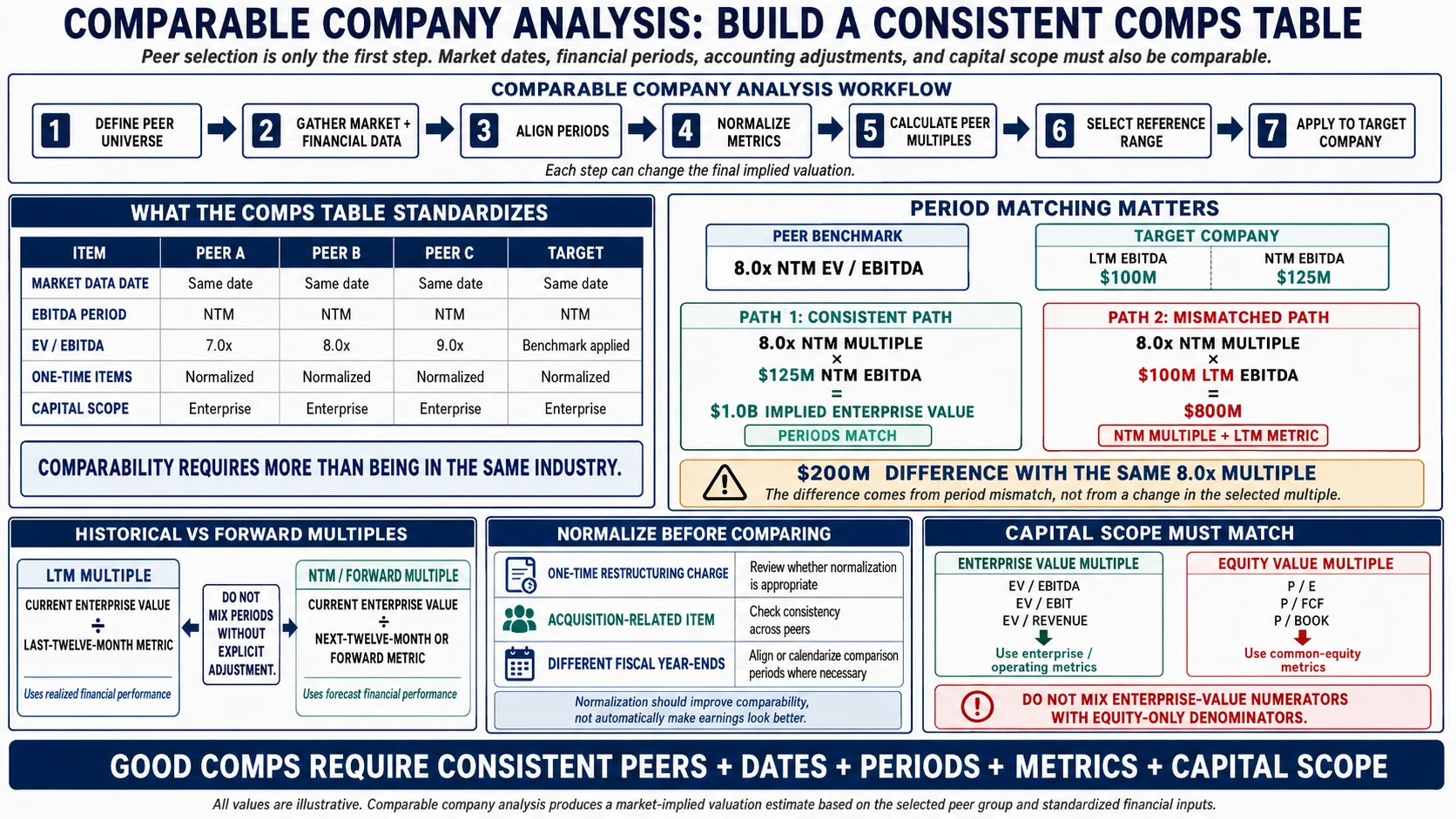
One of the easiest ways to distort a comps output is to mix historical and forward periods without noticing it. A peer multiple only makes sense when it is applied to a target-company metric measured on a comparable basis.
Assume the selected peer benchmark is 8.0x NTM EV/EBITDA. Now assume the target company has:
| Target Metric | Illustrative Amount |
|---|---|
| LTM EBITDA | $100 million |
| NTM EBITDA | $125 million |
If the 8.0x NTM peer multiple is applied correctly to the target company’s NTM EBITDA, the implied enterprise value is:
8.0 × $125 million = $1.0 billion implied enterprise value
If the same 8.0x NTM multiple is incorrectly applied to the target company’s LTM EBITDA instead, the implied enterprise value becomes:
8.0 × $100 million = $800 million implied enterprise value
The selected multiple did not change. The $200 million difference came entirely from period mismatch.
LTM vs Forward Multiples
Historical and forward multiples answer related but different questions. The difference matters most when performance is changing quickly or when the market is already pricing future improvement or deterioration.
| Multiple Basis | What It Uses | Main Interpretation Point |
|---|---|---|
| LTM multiple | Current enterprise value or equity value divided by last-twelve-month financial performance | Anchored to realized results |
| Forward or NTM multiple | Current enterprise value or equity value divided by next-twelve-month or forward financial performance | Anchored to expected future results |
Forward multiples can be useful when the analyst wants the comparison to reflect expected future performance rather than reported trailing results. They also require more caution because forecast metrics, timing assumptions, and fiscal-year alignment can differ across the peer group.
Normalize Before Comparing
Comparable company analysis becomes weaker when peer metrics appear similar on the surface but are not economically comparable. Normalization is the step that tries to improve comparability.
| Issue | Why It Matters | Cleaner Review Question |
|---|---|---|
| One-time restructuring charge | A temporary item can depress reported earnings or EBITDA in one period. | Does removing the item improve comparability, or does it hide real economics? |
| Acquisition-related item | Acquisition costs, integration expenses, or purchase-accounting effects can make peers less comparable. | Are similar adjustments treated consistently across peers? |
| Different fiscal year-ends | Companies may report on different timing bases even when the business cycle is the same. | Should the periods be aligned or calendarized before comparing? |
| Accounting-policy differences | Lease treatment, stock-based compensation, capitalization policy, and revenue recognition can change reported metrics. | Are the peer metrics still comparable after those differences are considered? |
Normalization should improve comparability. It should not be used automatically to make earnings look better.
Comparable Company Analysis Example
Assume a target company has $125 million of NTM EBITDA, $250 million of net debt, and 50 million diluted shares. If the selected peer EV/EBITDA range is 8x to 12x, the implied enterprise value, equity value, and value per share change materially across the range.
| Case | Selected EV/EBITDA Multiple | Implied Enterprise Value | Implied Equity Value | Implied Value Per Share |
|---|---|---|---|---|
| Low case | 8x | $1.0 billion | $750 million | $15.00 |
| Base case | 10x | $1.25 billion | $1.0 billion | $20.00 |
| High case | 12x | $1.5 billion | $1.25 billion | $25.00 |
The example shows how the comps output becomes a range rather than a single precise number. The same company metric can support very different implied values depending on the selected peer benchmark.
What Comparable Company Analysis Can and Cannot Tell You
Comparable company analysis can help frame how the market values similar companies. It can show whether a target company appears high, low, or broadly in line relative to a selected peer group, but that comparison is only as strong as the peer set and metric quality behind it.
CCA can help with: market-implied valuation context, peer multiple ranges, sector comparison, and sensitivity to denominator choice.
CCA cannot prove: intrinsic value, fair value, expected return, investment merit, or a target price.
A discounted cash flow analysis approaches valuation from projected cash flows and a discount-rate framework. Comparable company analysis approaches valuation from market multiples. The two methods can complement each other, but one does not automatically validate the other.
Limitations of Comparable Company Analysis
False precision: a clean spreadsheet can hide weak peer selection or inconsistent periods.
Peer mismatch: companies in the same sector may differ materially in growth, margins, geography, customer concentration, cyclicality, or capital intensity.
Market-cycle distortion: peer multiples reflect current market conditions, which can be temporarily optimistic, pessimistic, or dislocated.
Metric mismatch: EV/EBITDA, EV/Revenue, P/E, and free-cash-flow multiples do not answer the same valuation question.
Accounting differences: non-recurring items, stock-based compensation, lease treatment, revenue recognition, and acquisition effects can reduce comparability.
Value-bridge risk: enterprise-value outputs still need a careful bridge to equity value when debt, cash, preferred equity, minority interests, or diluted share count matter.
Comparable Company Analysis vs Other Valuation Methods
Comparable company analysis is most useful when the reader needs market context from similar public companies. It is less useful when the company has no clean peers, when near-term metrics are heavily distorted, or when the main question depends on long-term cash-flow assumptions.
| Method | Main Valuation Logic | Best Use |
|---|---|---|
| Comparable company analysis | Applies peer-company multiples to a target-company metric | Market-implied valuation context |
| Relative valuation | Compares valuation across priced assets or companies | Broader comparison framework |
| Discounted cash flow | Values expected future cash flows using a discount-rate framework | Forecast-driven valuation work |
| DCF formula | Shows the mechanics of discounting projected cash flows | Understanding the calculation structure |
| Dividend discount model | Values a stock from expected dividends and required return assumptions | Dividend-centered valuation cases |
For formula mechanics, the DCF formula is a separate route. For dividend-centered valuation, the dividend discount model uses a different input structure. Comparable company analysis should remain focused on peer multiples and the standardization work that makes those multiples useful or fragile.
How to Read a Comparable Company Analysis Result
A CCA result is strongest when it is read as a range with conditions attached. The range becomes more useful when the peers are economically similar, the selected metric reflects durable performance, the balance-sheet bridge is handled carefully, and the market-pricing date and period basis are clear.
Useful interpretation: “Based on this peer group, this metric basis, and these adjustments, the market-implied valuation range is X to Y.”
Unsafe interpretation: “The comps output proves the company is worth X.”
FAQ
Is comparable company analysis the same as relative valuation?
No. Comparable company analysis is one form of relative valuation. Relative valuation is the broader method family, while CCA focuses specifically on valuing a target company using peer-company multiples.
How do you do comparable company analysis?
The basic workflow is to define the peer group, gather market and financial data, align periods, normalize the metrics, calculate peer multiples, select the benchmark range, and then apply that benchmark to the target company with the correct value bridge.
Why does period matching matter in comps?
A peer multiple only makes sense when it is applied to a target-company metric measured on a comparable basis. Applying an NTM multiple to an LTM metric can materially distort the implied valuation output.
Does comparable company analysis show fair value?
It can provide a market-implied valuation range, but it does not prove fair value. Peer quality, metric quality, normalization, market pricing, leverage, and the value bridge all affect the output.
Why can two comparable company analyses produce different results?
Different analysts may choose different peers, use different periods, normalize financial metrics differently, select different multiples, or apply different bridge adjustments. Those choices can materially change the implied valuation range.