
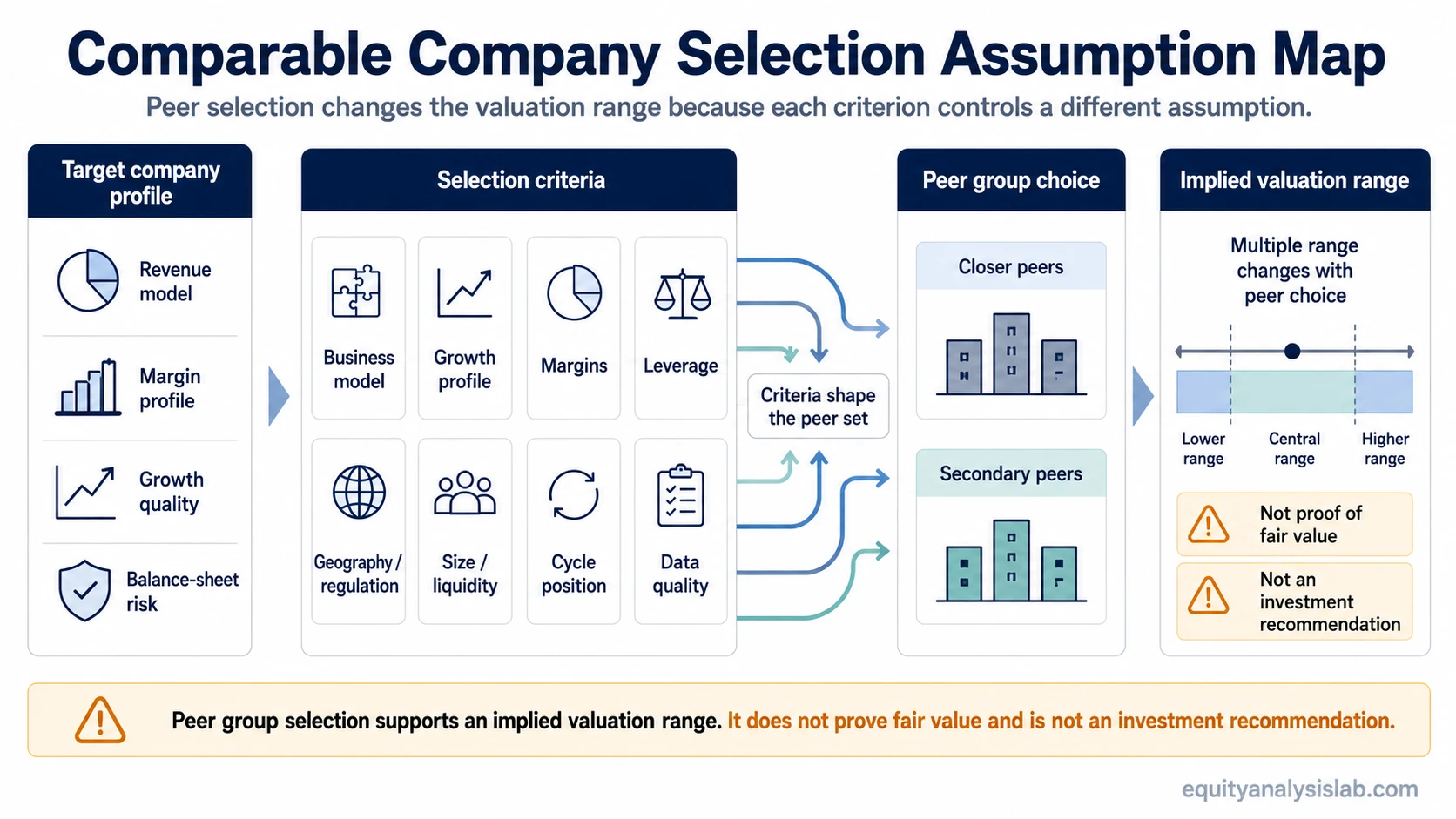
Choose comparable companies by matching the target company to peers with similar business models, customer exposure, growth, margins, leverage, geography, and cycle position. The goal is not to find identical companies. The goal is to build a peer set that can support a useful valuation benchmark in comparable company analysis.
A peer group is a valuation assumption. If the selected companies have stronger growth, better margins, lower leverage, or cleaner revenue quality than the target company, the implied valuation can look too high. If the peer group is weaker than the target company, the same exercise can look too conservative.
Key Points
- Industry similarity is a starting point, not the final answer.
- Peer selection works best when economic fit and financial fit are reviewed separately.
- Comparable companies do not all deserve the same role. Some belong in the core group, some belong in a secondary or context-only group, and some should be excluded.
- The same peer can be useful for one valuation multiple and weak for another.
- A peer group supports a market comparison. It does not prove fair value.
What comparable-company selection means
Comparable-company selection is the process of deciding which public companies provide a useful market reference for valuing another company. A comparable company does not need to be identical, but it should face similar enough economics that its valuation multiple says something useful about the target company.
The strongest peer set usually combines business similarity with financial similarity. Industry label alone is not enough. A software company selling subscriptions, a software company selling one-time licenses, and a software-enabled services company can all share an industry label while carrying different revenue durability, margin structure, and growth assumptions.
Two stages of comparable-company selection
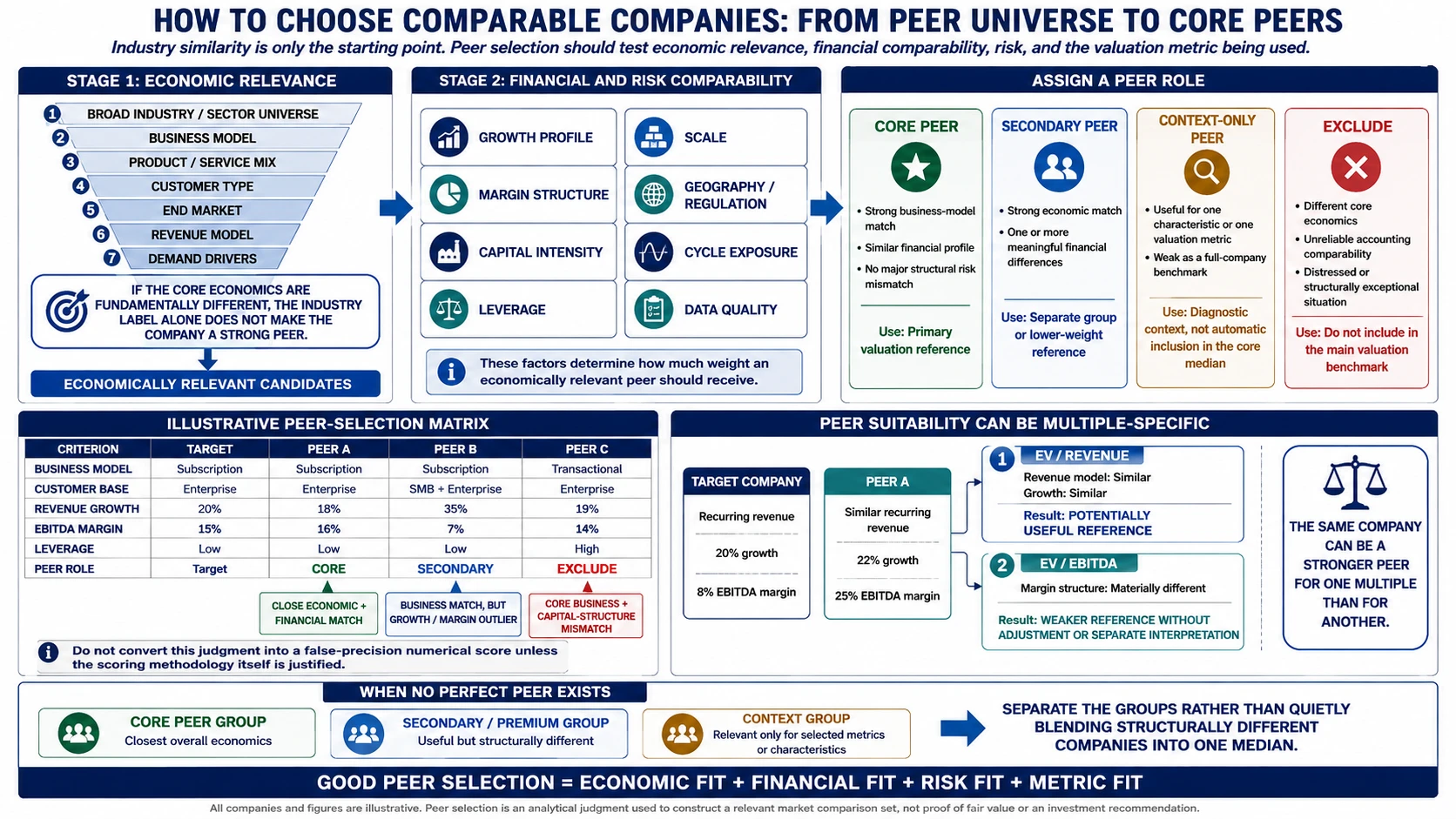
Peer selection usually works better when it is split into two stages. First, check whether the business is economically relevant to the target company. Second, check how close the financial and risk profile is.
| Stage | What to review | Why it matters |
|---|---|---|
| Economic relevance | Business model, product mix, customer type, end market, revenue model, and demand drivers | If the core economics are different, the company may not be a strong peer even when the industry label looks similar. |
| Financial and risk comparability | Growth, margins, capital intensity, leverage, geography, regulation, size, liquidity, cycle exposure, and data quality | These factors determine whether the peer belongs in the core group, a secondary group, a context-only group, or should be excluded. |
Criteria for choosing comparable companies
Each selection criterion controls a different part of the valuation assumption. The table below is most useful when it is read as a decision tool rather than a checklist to fill mechanically.
| Selection criterion | Valuation assumption controlled | What can go wrong if ignored |
|---|---|---|
| Business model | How revenue is earned, repeated, retained, and protected | A company with recurring revenue may be compared with a transactional business that deserves a different multiple. |
| End market and customers | Demand drivers, customer concentration, pricing power, and cyclicality | Peers exposed to different buyers or budget cycles can distort the implied range. |
| Growth profile | How much future expansion the market is pricing into the multiple | High-growth peers can make a slower target look undervalued when the difference is really growth quality. |
| Profitability and margins | Operating efficiency, scale economics, and business quality | Low-margin and high-margin companies may trade at different multiples for structural reasons. |
| Capital intensity | How much reinvestment is needed to sustain growth | Asset-heavy peers may not be comparable with asset-light businesses even when revenue growth looks similar. |
| Capital structure | Financial risk, interest burden, and equity value sensitivity | A highly levered company may appear cheap on equity metrics while carrying more balance-sheet risk. |
| Geography and regulation | Country risk, tax exposure, regulation, reporting comparability, and market maturity | Peers in different regulatory or regional environments may deserve different discount or premium assumptions. |
| Size and liquidity | Scale, market access, investor base, and public-market depth | Small or illiquid peers can trade at multiples that reflect size and liquidity discounts, not operating similarity. |
| Cycle position | Whether current earnings are normal, depressed, or peak-cycle | Peak-cycle peers can make the target appear cheaper than it is on normalized earnings. |
| Data quality | Whether the metric is measured consistently across the peer group | Different accounting treatments or one-time items can create false precision in the multiple range. |
Core, secondary, context-only, and excluded peers
Not every company that survives the first screen should receive the same weight. A more useful peer set assigns a role to each candidate instead of forcing every name into one blended average.
| Peer role | When it fits | How to use it |
|---|---|---|
| Core peer | Strong business-model match, similar financial profile, and no major structural risk mismatch | Primary valuation reference |
| Secondary peer | Good economic match, but clear differences in growth, margins, size, or risk | Use with lower weight or in a separate subgroup |
| Context-only peer | Useful for one metric or one characteristic, but weak as a full-company benchmark | Use as context, not as automatic input in the core peer median |
| Exclude | Different core economics, unreliable comparability, distress, or a structurally exceptional situation | Do not include in the main benchmark |
This structure usually produces a cleaner valuation framework than quietly blending structurally different businesses into one median or average.
Peer suitability can be multiple-specific
The same company can be a better peer for one valuation multiple than for another. That happens when some parts of the business profile match closely, but another part of the profile differs enough to weaken comparability.
For example, imagine a target company with recurring revenue, 20% growth, and an 8% EBITDA margin. A peer with a similar recurring-revenue model and similar growth may still carry a much higher EBITDA margin. In that case, the peer may be reasonably informative for an EV/Revenue comparison, but a weaker reference for EV/EBITDA because the margin structure is materially different.
Important boundary: a peer set does not have to be identical across every valuation multiple. The best peer set for revenue-based comparison may not be the best peer set for margin-based or earnings-based comparison.
Illustrative peer-selection matrix
The example below shows how several seemingly similar companies can still end up with different peer roles.
| Criterion | Target | Peer A | Peer B | Peer C |
|---|---|---|---|---|
| Business model | Subscription | Subscription | Subscription | Transactional |
| Customer base | Enterprise | Enterprise | SMB + Enterprise | Enterprise |
| Revenue growth | 20% | 18% | 35% | 19% |
| EBITDA margin | 15% | 16% | 7% | 14% |
| Leverage | Low | Low | Low | High |
| Peer role | Target | Core | Secondary | Exclude |
Peer A is a strong overall match. Peer B still shares the business model, but the growth and margin profile are different enough to justify a secondary role. Peer C is weakened by a different business model and much higher balance-sheet risk, so excluding it can produce a cleaner benchmark.
When to exclude or down-weight a comparable company
A company should usually be excluded when its economics are too different to support the valuation question. Different business models, unreliable accounting comparability, distressed balance sheets, major one-time events, or very different regulatory environments can make the peer more misleading than useful.
Down-weighting is different from excluding. A peer may still offer helpful market context if it shares several important traits with the target company but differs on one or two dimensions. In that case, it can remain in the analysis with a clear explanation of why its influence should be limited.
| Peer issue | Better treatment | Reason |
|---|---|---|
| Different core business model | Exclude | The multiple may price a different revenue and margin structure. |
| Similar business but much faster growth | Down-weight or place in a premium subgroup | The peer may still be informative, but the growth premium should not be applied mechanically. |
| Temporary earnings distortion | Normalize, down-weight, or exclude | The current metric may not represent sustainable earnings power. |
| Major accounting or data inconsistency | Exclude unless adjustments are reliable | The comparison may look precise while the underlying metric is not comparable. |
When no perfect peer exists
Pure-play peers are not always available. Multi-segment companies, regional differences, mixed revenue models, or unusual capital structures can make a clean peer set hard to build.
In that situation, it is often better to separate the universe into tiers:
- Core peer group: closest overall match.
- Secondary or premium group: useful peers with meaningful structural differences.
- Context group: companies relevant only for selected metrics or selected characteristics.
This is usually more informative than forcing all candidates into one blended average. If the peer set still requires too many exceptions, the valuation question may need more than one method, including a separate discounted cash flow analysis.
Common mistakes and limitations
Comparable-company selection can improve a valuation framework, but it cannot remove judgment. A peer group shows how the market prices selected business profiles at a point in time. It does not prove that the market is correct or that the target company deserves the same multiple.
- Industry-only selection: companies can share a sector label while carrying different economics.
- False precision: a large peer list can look analytical even when comparability is weak.
- Mixing premium and weak peers without explanation: the average can hide more than it reveals.
- Ignoring cycle position: peak or depressed earnings can distort the multiple.
- Forcing one peer set on every multiple: comparability can differ across EV/Revenue, EV/EBITDA, P/E, and other metrics.
- Treating the peer range as fair value: the output is a market reference, not proof of worth.
A practical sequence for choosing peers
Start with the closest business model, then test the financial profile and risk profile. A practical order is business model, customer and end-market exposure, growth, margins, capital intensity, leverage, geography, cycle position, and data quality.
After that, assign roles to the remaining companies. Core peers can carry most of the weight. Secondary peers can provide a wider context. Outliers should be explained, adjusted, down-weighted, or removed rather than quietly blended into the benchmark.
The final peer set should make the valuation logic easier to understand. If the group still needs too many caveats, that is a sign that the target company may not have one clean public-market comparison set.
FAQ
How many comparable companies should be used?
There is no fixed number that works for every valuation. A smaller group of highly relevant peers is usually more useful than a larger group that mixes different business models, growth profiles, or risk levels.
Should comparable companies be in the same industry?
They should usually share an industry or end-market link, but industry alone is not enough. Business model, growth, margins, leverage, geography, and cycle position often matter more than the label.
Can the same peer be useful for one multiple and weak for another?
Yes. A company can be a strong peer for a revenue-based multiple and a weaker peer for a margin-based or earnings-based multiple if the business model matches but the profitability structure does not.
When should a comparable company be excluded?
Exclusion is usually more appropriate when the company has different core economics, unreliable accounting comparability, major distress, a structurally different regulatory environment, or a business profile that would distort the valuation benchmark.
Can a peer group prove what a company is worth?
No. A peer group can support an implied valuation range, but it does not prove fair value. The result depends on the peer set, the selected metric, the quality of the data, and the assumptions behind the comparison.