
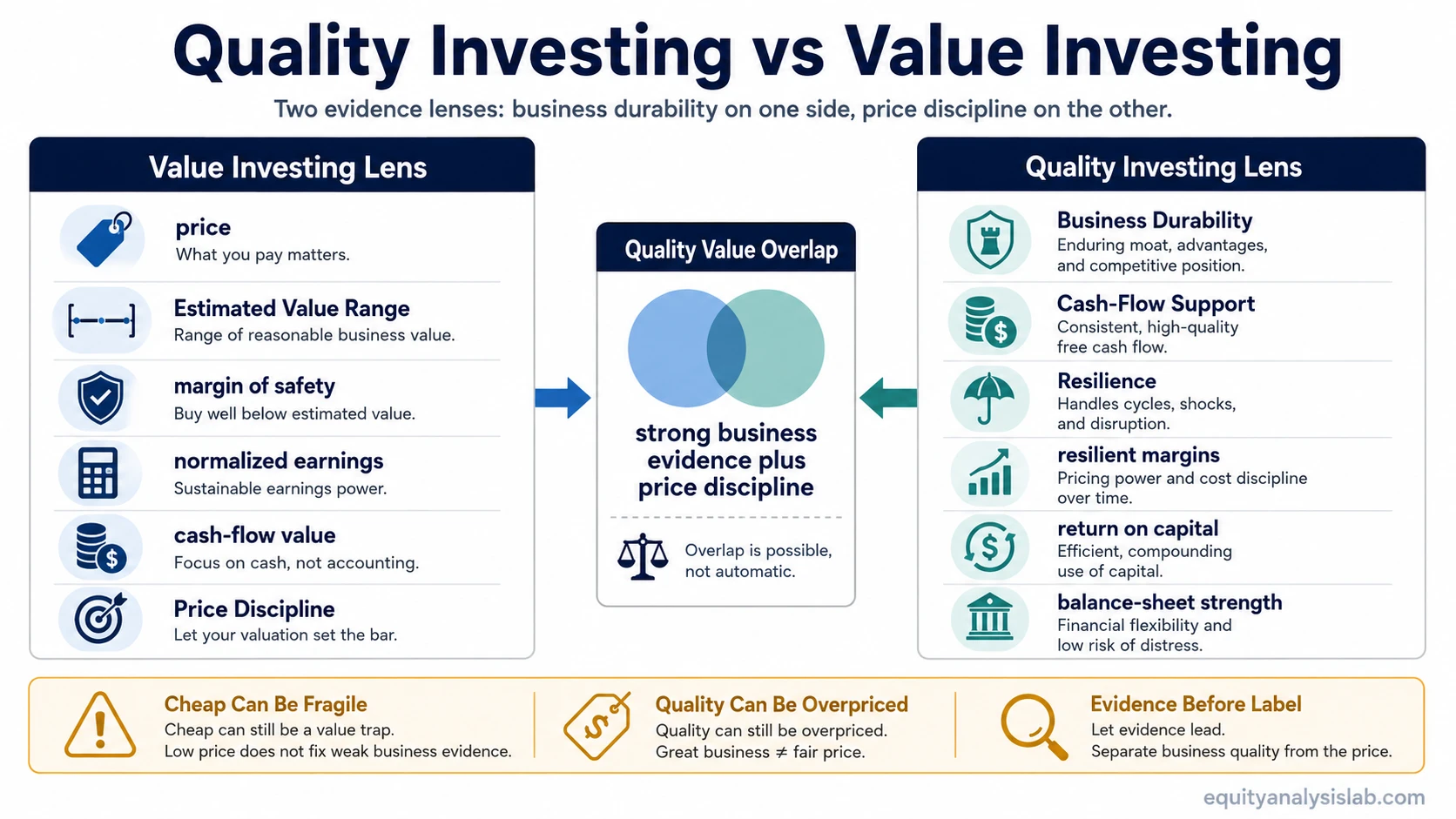
Value investing and quality investing both use fundamentals, but they start from different questions. Value investing asks whether the price is low enough relative to a defensible estimate of business value. Quality investing asks whether the business is durable enough, cash-supported, and resilient enough to deserve confidence in its economics.
The confusion appears because a strong business can also be undervalued, and a cheap stock can sometimes belong to a durable company. The two lenses can overlap, but they are not interchangeable. One starts with price discipline. The other starts with business durability.
Working distinction: Value investing judges the gap between price and estimated value. Quality investing judges whether the business deserves confidence in its economics, cash generation, and resilience.
Key Points
- Value investing starts with price versus estimated business value.
- Quality investing starts with durability, cash-flow support, resilience, and business economics.
- Quality and value are two separate analytical dimensions, not opposite ends of one scale.
- A cheap stock can still be a value trap if the business evidence is weak.
- A high-quality company can still offer poor value if expectations already price in too much strength.
The Core Difference
The value lens begins with market price and a reasonable estimate of business value. That estimate may use normalized earnings, free cash flow, assets, comparable multiples, or a valuation range. The central discipline is price: a business can be attractive, but the value case weakens when the current price leaves little room for error.
The quality lens begins with whether the business has enough durability to make its earnings and cash flows meaningful. That durability may come from strong margins, recurring demand, pricing power, return on invested capital, balance-sheet resilience, or consistent cash conversion. The central discipline is business evidence: a low price is less useful when the underlying economics are fragile.
Main distinction: value investing pressures the price and valuation assumptions first. Quality investing pressures the business economics and evidence quality first.
Quality and Value Are Two Separate Axes
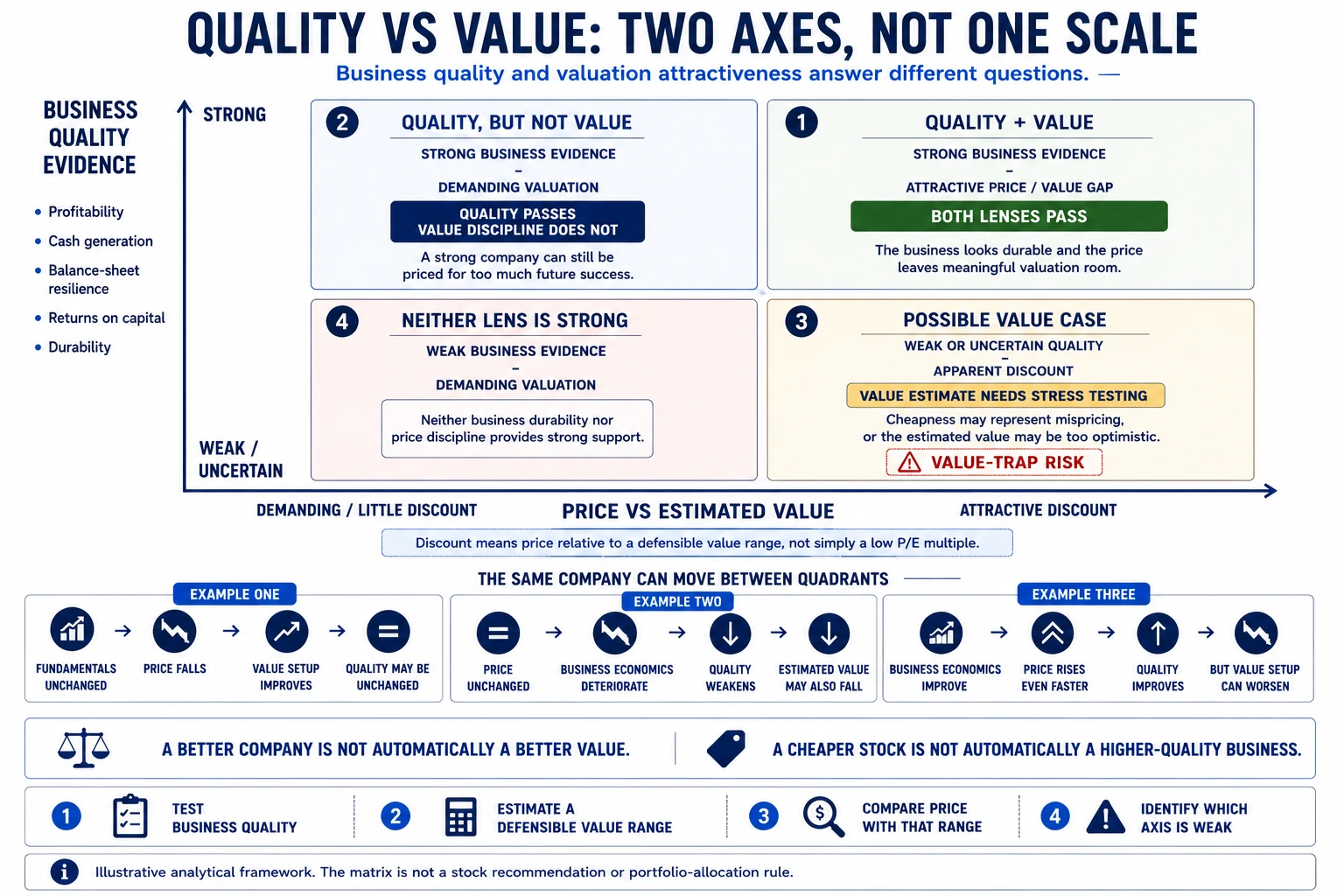
A cleaner comparison treats quality and value as two independent dimensions. One dimension asks whether the business shows strong evidence of durability. The other asks whether the current price offers an attractive price-to-value setup.
That creates four broad states:
| Business quality evidence | Price versus estimated value | Interpretation |
|---|---|---|
| Strong | Attractive discount | Quality + Value: the business looks durable and the price leaves meaningful valuation room. |
| Strong | Demanding valuation | Quality, but not value: the business may be strong, but the current price may already reflect too much future success. |
| Weak or uncertain | Attractive discount | Possible value case: the stock may be cheap, but the value estimate can be fragile and value-trap risk may be high. |
| Weak or uncertain | Demanding valuation | Neither lens is strong: the business evidence is weak and the price does not offer much valuation protection. |
Core insight: a better business is not automatically a better value, and a cheaper stock is not automatically a higher-quality business.
This is why the comparison should not be framed as if investors must choose a single point on one spectrum. Quality and value do not cancel each other. They diagnose different risks: overpayment risk on one side, and business-quality risk on the other.
How the Same Company Can Move Between the Four States
The same company can move between these states without becoming a completely different business. What changes is often the interaction between business evidence and current price.
Stage 1, strong business, demanding price: A fictional company has high margins, low debt, steady free cash flow, and a long record of reinvesting at attractive returns. The quality lens may approve the business. The value lens may still hesitate if the price already assumes years of strong execution and premium growth.
Stage 2, business largely unchanged, price falls: Suppose the business remains strong, but the share price declines materially after a broad market selloff or temporary sentiment shift. The quality reading may stay similar, while the value setup becomes more attractive because the price-to-value gap improves.
Stage 3, price unchanged, business weakens: Now assume the share price does not move much, but margins weaken, cash conversion deteriorates, and balance-sheet flexibility declines. The quality reading weakens, and the reasonable estimate of value may also fall. What looked like a value case can become much less convincing even without a price increase.
The practical lesson is that quality and value can change independently. Price can improve while quality stays the same. Quality can improve while the valuation case worsens. A useful comparison keeps both axes visible instead of collapsing them into one style label.
Quality vs Value Comparison Table
| Criterion | Value investing lens | Quality investing lens |
|---|---|---|
| Main question | Is the price low enough relative to estimated business value? | Is the business durable enough to support confidence in its economics and cash generation? |
| Evidence focus | Valuation range, intrinsic value estimate, normalized earnings, margin of safety, asset value, or cash-flow value | Cash flow, margins, returns on capital, debt resilience, reinvestment quality, competitive position, and durability |
| Main risk | The stock is cheap for a reason, and the low valuation reflects deteriorating economics | The company is strong, but the price already assumes too much future success |
| Failure mode | Value trap | Quality at any price |
| Overlap | Quality can strengthen value evidence by making estimated value more durable | Valuation still matters because business strength can be overcapitalized into the price |
Common Confusion and Failure Modes
| Confusion | Why it happens | Cleaner interpretation |
|---|---|---|
| Cheap means value | A low multiple can look attractive before the business evidence is tested. | Value requires a gap between price and estimated value, not only a low headline multiple. |
| Quality means safe | Strong companies can look more reliable than weaker companies. | Quality can still be priced too richly, and valuation risk can remain high. |
| Metrics prove the style | ROE, ROIC, margins, debt ratios, and valuation multiples can look decisive in isolation. | Metrics still need context: accounting quality, cash conversion, cyclicality, reinvestment needs, and expectations matter. |
| Quality value is one automatic category | Investors often combine the terms when a strong business appears discounted. | The combined label still needs two separate checks: business durability and price discipline. |
Balanced limitation: value investing can fail when cheapness reflects permanent business deterioration. Quality investing can fail when strong business evidence is already priced for perfection. Neither lens removes the need for valuation context, cash-flow review, balance-sheet analysis, and expectation risk.
How to Keep the Comparison Clear
A clean comparison separates price, durability, expectation risk, and cash-flow support before style labels are applied. A low price belongs to the value question only after estimated value is tested. High returns on capital belong to the quality question only after durability, accounting quality, cash conversion, and reinvestment needs are checked.
The most useful process is simple:
1. Test business quality: Are margins, returns, cash generation, resilience, and balance-sheet strength strong enough to support confidence?
2. Estimate a defensible value range: What valuation range is reasonable under conservative assumptions?
3. Compare price with that range: Is there enough room between price and value to justify the risk?
4. Identify the weaker axis: Is the bigger problem business durability or overpayment risk?
Business strength and valuation discipline can support each other, but they can also conflict. The useful comparison is not which label sounds better. The useful comparison is which uncertainty still needs the most evidence.
FAQ
What is the main difference between quality investing and value investing?
Value investing focuses on price versus estimated business value. Quality investing focuses on business durability, cash-flow support, resilience, and the strength of the company’s economics.
Can a stock be both high quality and value?
Yes. A company can have durable business economics and still trade below a reasonable estimate of value. The overlap is often called quality value, but both tests still need to be checked separately.
Why can a cheap stock fail a quality investing screen?
A cheap stock can fail a quality screen when low valuation reflects weak cash flow, high debt, declining margins, poor reinvestment economics, or a business model that no longer looks durable.
Why can a quality company still fail a value investing screen?
A quality company can fail a value screen when the price already assumes too much future strength. Strong margins, cash flow, and returns on capital do not remove overpayment risk.