
Writing an investment thesis means building a structured claim about why a stock or business deserves further investor research, then testing that claim against evidence, valuation context, risk assumptions, and review triggers.
A useful investment thesis framework is not a prediction, a price target, or an automatic buy or sell rule. It connects a business claim to the evidence that would support it, weaken it, or force it to be revised.
The strongest thesis structure usually separates six questions: what must be true, what evidence supports it, how valuation changes the interpretation, what could break the thesis, how the position would fit a portfolio, and what should be monitored after the thesis is written.
Key Points
- An investment thesis should start with a clear claim, not a vague opinion about a company or stock price.
- Business quality, financial evidence, valuation context, risk boundaries, and review triggers should support the claim together.
- No single input is enough. Revenue growth, a low multiple, a strong story, or a price decline can all be misleading when viewed alone.
- A thesis should define what would make the original view weaker, incomplete, or wrong.
- The thesis prepares the investor decision process, but it does not replace position sizing, portfolio fit, or personal suitability work.
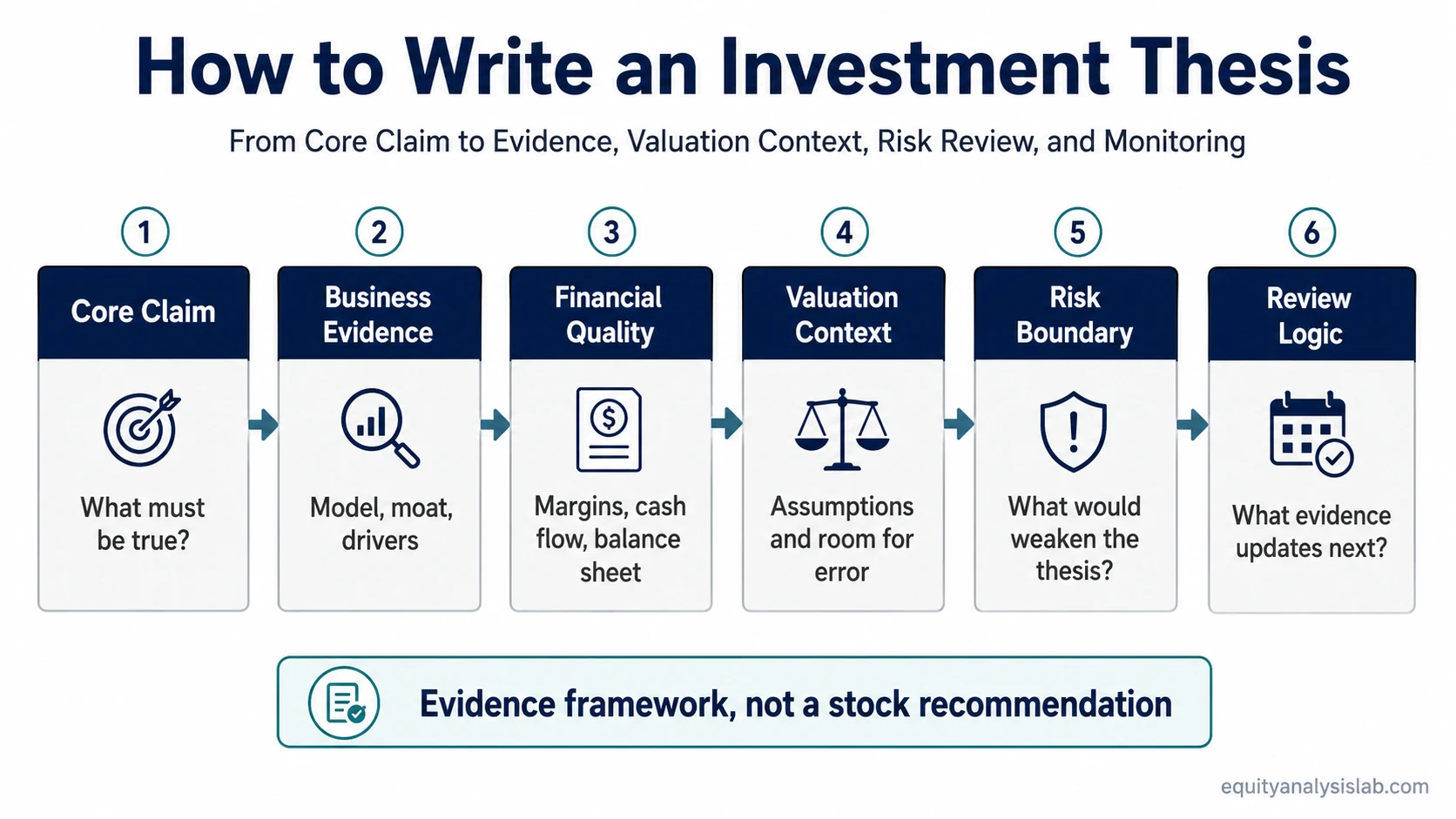
What an Investment Thesis Needs to Prove
An investment thesis needs to prove that the core claim is specific enough to be tested. A weak thesis says that a company is “high quality,” “cheap,” or “well positioned.” A stronger thesis explains which part of the business matters, why that evidence matters, and what would need to remain true for the claim to hold.
The claim should usually connect the company’s business model, competitive position, financial quality, valuation assumptions, and risk boundary. For example, a thesis built only on revenue growth is incomplete if it does not address margins, cash conversion, balance-sheet pressure, dilution, or valuation expectations.
A practical thesis statement can follow this logic: the company may deserve further investor attention because a specific business driver is improving, the improvement appears supported by financial evidence, the valuation does not already assume too much, and the key risks are identifiable enough to monitor.
The Evidence Stack Behind a Thesis
An investment thesis becomes more useful when the evidence is stacked in layers. Each layer answers a different question. If one layer is missing, the thesis may still be interesting, but it is less complete.
| Thesis layer | What it answers | What weakens it |
|---|---|---|
| Core claim | What must be true for the thesis to make sense? | The claim is vague or based only on price movement. |
| Business evidence | Does the company have a clear operating reason for the thesis? | The company lacks durable economics, pricing power, or a defensible economic moat. |
| Financial quality | Are earnings, margins, and cash flow supporting the story? | Accounting profit rises while cash conversion or free cash flow generation weakens. |
| Valuation context | Is the current price being compared with reasonable value assumptions? | There is no valuation anchor, or the assumptions require unrealistic growth, margins, or multiples. |
| Risk boundary | What would make the thesis wrong or incomplete? | The thesis has no invalidation condition, ignores downside evidence, or treats uncertainty as resolved. |
| Review logic | What evidence should be monitored after the thesis is written? | The thesis is treated as static even when fundamentals, valuation, or risks change. |
This stack keeps the thesis from becoming a single-factor argument. A low valuation multiple may be relevant, but not if earnings quality is deteriorating. A strong brand may matter, but not if margins are compressing and cash flow is weak. A price decline may create interest, but not a complete thesis by itself.
How to Build the Evidence Checklist
The evidence checklist should not be a mechanical template. It should identify the evidence that matters most for the specific company and business model. A mature cash-generative company, a cyclical commodity producer, and a high-growth software business usually require different evidence emphasis.
Start with the business model. Identify how the company earns money, which segment drives the thesis, whether revenue quality is improving or weakening, and what operating variable matters most. Then check whether the company has a durable advantage, such as scale, switching costs, network effects, cost structure, brand strength, or another defensible source of profitability.
Next, test the financial evidence. Revenue growth is not enough if margins are unstable, working capital is absorbing cash, or reported earnings are not translating into durable cash generation. A thesis becomes more grounded when the income statement, balance sheet, and cash flow statement point in the same direction.
Finally, write down the assumptions. A thesis that depends on margin expansion, lower capital intensity, new product adoption, debt reduction, or multiple expansion should state that dependency clearly. Hidden assumptions are often where thesis risk begins.
How Valuation Context Changes the Thesis
Valuation does not prove that a stock should be bought, but it changes how the thesis should be interpreted. A good business can be a weak investment candidate if the price already assumes excellent execution. A messy business can look cheap for valid reasons if the risks are structural.
The valuation section should connect the thesis to intrinsic value assumptions. This does not require false precision. It requires the writer to explain which drivers matter: revenue growth, margin durability, reinvestment needs, capital intensity, discount rate assumptions, terminal expectations, or comparable valuation ranges.
A useful valuation paragraph often answers three questions: what assumptions are needed for the thesis to work, which assumptions are most uncertain, and how much room exists for error if the assumptions are too optimistic. The point is not to create a guaranteed valuation answer. The point is to prevent the thesis from becoming a narrative with no price discipline.
Risk, Invalidation, and Review Triggers
A thesis should include the evidence that would weaken it. This is not a pessimistic exercise. It is a way to stop the thesis from becoming detached from new information.
Business invalidation: The company loses pricing power, competitive position deteriorates, customer concentration increases, or the expected operating driver fails to appear.
Financial invalidation: Margins compress for structural reasons, cash conversion weakens, debt risk rises, dilution offsets per-share progress, or reported earnings become less reliable.
Valuation invalidation: The thesis depends on assumptions that become too aggressive, or the price no longer leaves a buffer between estimated value and price.
Process invalidation: The thesis becomes a defense of the original opinion rather than a review of current evidence.
Portfolio Fit and Review Logic
An investment thesis should also clarify how the idea would be reviewed inside a broader portfolio process. This does not mean giving allocation advice. It means identifying whether the thesis depends on concentrated company-specific risk, cyclical exposure, factor exposure, sector assumptions, or a long time horizon.
A thesis may be analytically coherent but still incomplete if it ignores opportunity cost. Capital tied to one idea cannot be used elsewhere. That makes the review process important: the thesis should be revisited when new filings, earnings results, capital allocation decisions, valuation changes, or business-quality signals change the original evidence stack.
The review schedule does not need to be complicated. The written thesis should specify which evidence matters most and when that evidence is likely to update. Earnings releases, annual reports, margin trends, cash flow changes, debt refinancing, competitive developments, and management capital allocation can all become review triggers.
Illustrative Thesis Scenario
Consider a generic company with strong revenue growth and a persuasive market narrative. A weak thesis might stop there and argue that growth alone makes the stock attractive. A stronger thesis would ask whether the growth is recurring, whether margins are improving or being subsidized by spending, whether cash conversion supports reported earnings, and whether competitors can pressure pricing.
The same thesis would then test valuation. If the current price already assumes high growth, stable margins, and flawless execution, the thesis has less room for error. If the balance sheet is stretched or dilution is rising, the evidence stack becomes weaker even if the revenue story remains appealing.
The useful output is not a recommendation. The useful output is a clearer decision boundary: which facts support the thesis, which assumptions carry the most risk, and which future evidence would require revision.
Common Thesis-Writing Mistakes
Writing a price-only thesis: A stock being down, cheap-looking, or near a prior level is not a complete investment thesis. Price can create a research trigger, but the thesis still needs business evidence, valuation context, and risk review.
Confusing a story with evidence: A strong narrative may explain why investors care, but the thesis should still test revenue quality, margins, cash flow, balance-sheet risk, and competitive durability.
Ignoring valuation assumptions: A thesis that never states what the price already implies can become a business-quality essay rather than an investor decision framework.
Skipping invalidation: If nothing could weaken the thesis, the thesis is probably too vague. A useful thesis should say what would make the original claim less defensible.
Treating the thesis as the final decision: A thesis organizes evidence. It does not automatically determine position size, timing, suitability, tax treatment, or portfolio construction.
When an Investment Thesis Is Not Enough
An investment thesis is only one part of the investor decision process. It can make the reasoning clearer, but it cannot remove uncertainty, guarantee returns, or replace separate portfolio-level judgment.
The thesis is not enough when the writer cannot identify the key assumptions, when valuation depends on unrealistic inputs, when risk cannot be bounded, or when the evidence stack depends on one fragile data point. It is also not enough when the conclusion moves straight from “interesting company” to “investment action” without checking opportunity cost and portfolio context.
A better use of the thesis is to separate evidence from action. The thesis can show whether the idea deserves further research, whether the assumptions are testable, and whether the future review process is clear enough to avoid reacting only to price movement.
The boundary is simple: the thesis can organize the evidence, but the final decision still requires separate judgment about valuation discipline, opportunity cost, portfolio role, and risk tolerance.
FAQ
What is the first step in writing an investment thesis?
The first step is to write a clear claim about what must be true for the business or stock to deserve further investor attention. The claim should be specific enough to test against business evidence, financial quality, valuation assumptions, and risk factors.
Is an investment thesis the same as a stock recommendation?
No. An investment thesis organizes evidence and assumptions. It does not automatically create a buy, sell, or hold recommendation, and it does not replace suitability, portfolio construction, or risk-management decisions.
How long should an investment thesis be?
An investment thesis should be long enough to state the core claim, supporting evidence, valuation context, risks, invalidation conditions, and review triggers. A short thesis can work if it is specific and testable. A long thesis can still be weak if it hides assumptions or avoids risk.
What makes an investment thesis weak?
A thesis is weak when it relies on price movement, a broad story, one valuation multiple, or unsupported confidence. It becomes more useful when it states what evidence supports the claim and what future evidence would weaken it.