
Dividend growth investing is an investor framework for evaluating companies that raise dividends over time. The core question is not whether the dividend has grown before, but whether future distributions are supported by cash flow, payout capacity, balance-sheet strength, reinvestment needs, and valuation.
Dividend growth investing focuses on companies with a record or expectation of increasing dividends, but the useful analysis starts after the dividend history is identified. A rising dividend can be a sign of durable cash generation, disciplined capital allocation, or shareholder-return intent. It can also mask payout pressure if earnings quality weakens, debt rises, or reinvestment needs are being underfunded.
For company analysis, dividend growth is not a standalone conclusion. It is one capital-return signal that must be tested against the company’s cash generation, payout burden, balance sheet, competitive position, and valuation. A dividend that grows slowly from a strong base can be more informative than a high payout that grows only because management is trying to preserve an income narrative.
Key Points About Dividend Growth Investing
- Dividend growth history is starting evidence, not proof that future dividends are safe.
- High dividend yield and dividend growth quality are different tests.
- Payout ratio, dividend coverage, and free cash flow help judge whether distributions are funded by the business.
- Reinvestment needs, debt, cyclicality, and valuation can change the interpretation of the same dividend-growth record.
- Dividend growth can fail through cuts, debt-funded payouts, weak cash conversion, payout expansion, or overpayment for a defensive-looking stock.
Dividend Growth Investing vs High Dividend Yield
Dividend growth investing is different from simply choosing the stock with the highest current dividend yield. Yield shows the current dividend relative to price. Dividend growth analysis asks whether the dividend can keep rising without weakening the business or forcing management into a fragile payout policy.
| Question | High dividend yield focus | Dividend growth investing focus |
|---|---|---|
| Starting signal | How large is the current dividend relative to the stock price? | Has the company increased dividends, and can that increase continue? |
| Main risk | The yield may be high because the stock price has fallen or the payout is stressed. | The growth record may look strong even as payout capacity weakens. |
| Useful next test | Check whether the current dividend is covered by earnings and cash flow. | Check whether dividend growth is supported by free cash flow, payout discipline, and reinvestment capacity. |
| Investor interpretation | Current income may be attractive, but it can become a yield trap if fundamentals deteriorate. | Rising dividends may signal quality, but only if the company can fund them without reducing business resilience. |
The distinction matters because a high yield can be backward-looking while dividend growth analysis should be forward-looking. A company can have a modest yield and a strong dividend-growth profile, or a high yield and a fragile payout. The label alone does not determine how much weight the dividend signal deserves in the analysis.
Dividend Growth Investing vs Growth Investing
This framework should also be separated from generic growth investing. Growth investing usually emphasizes expanding revenue, earnings, market opportunity, or reinvestment runway. Dividend growth investing looks for companies that can raise distributions while still maintaining enough capital to defend the business, reinvest where needed, and avoid balance-sheet strain.
The useful distinction: growth investing asks whether the business can compound value through expansion. Dividend growth investing asks whether the business can return more cash to shareholders over time without sacrificing the conditions that support future value creation.
A company can grow earnings quickly and still be a weak dividend-growth candidate if it needs most of its cash for reinvestment, acquisitions, working capital, or debt reduction. Another company can grow slowly but support a durable dividend path if cash generation is steady, reinvestment needs are moderate, and the payout policy remains disciplined.
The Dividend Growth Sustainability Sequence
The central mistake in dividend growth investing is treating the dividend record as the whole analysis. A stronger framework starts with the record, then tests whether the company’s financial statements and capital-allocation needs can support future increases.
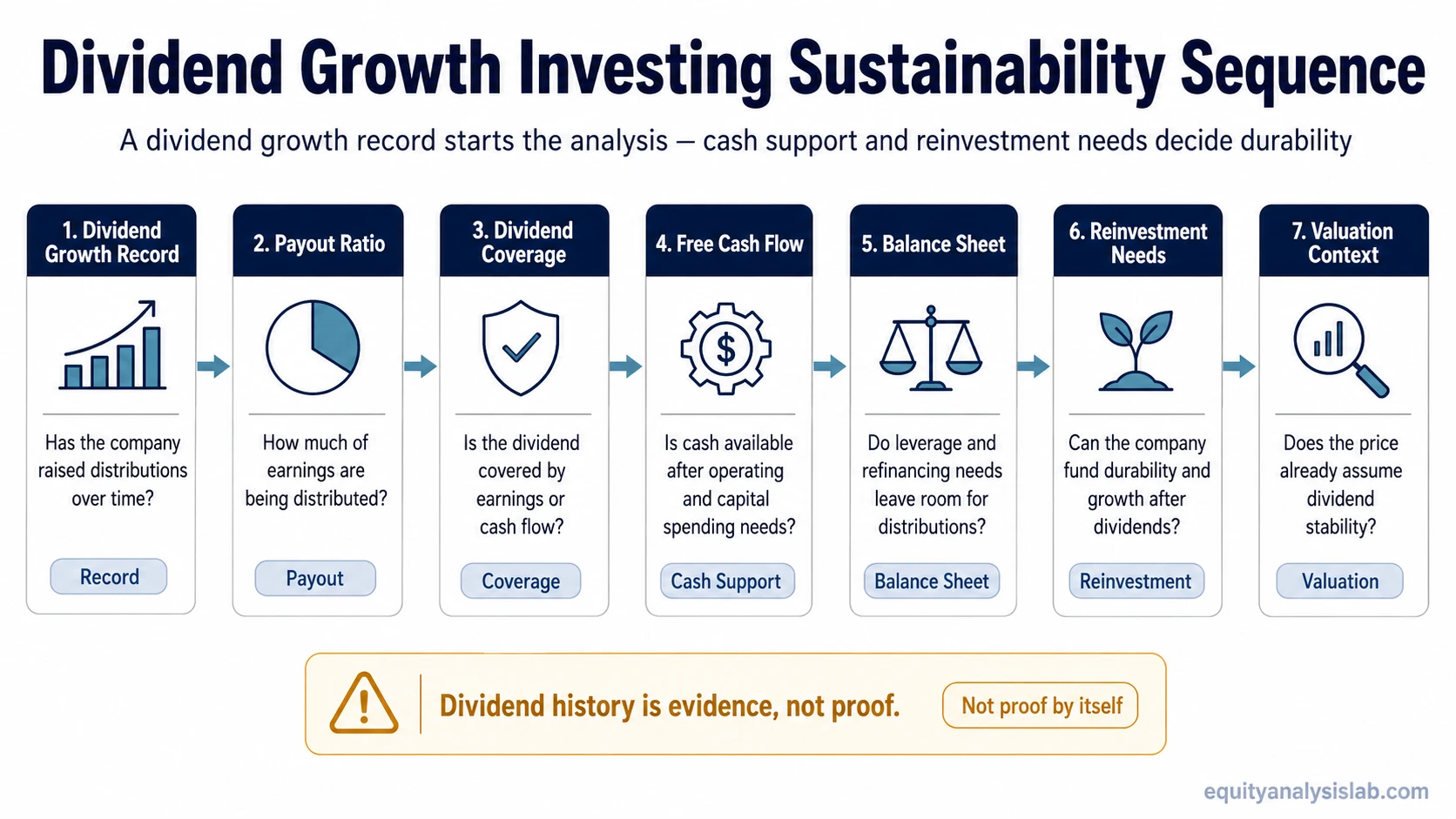
Dividend Growth Sustainability Sequence: dividend growth record → payout ratio → dividend coverage → free cash flow → balance sheet → reinvestment needs → valuation and total return context.
| Step | What the step tests | What can weaken the signal |
|---|---|---|
| Dividend growth record | Whether the company has a pattern of raising distributions over time. | A long record can become less useful if the business model, leverage, or cash conversion has changed. |
| Dividend growth rate | How quickly the dividend has been growing. | Fast dividend growth can be unsustainable if it runs ahead of earnings and cash flow growth. |
| Dividend payout ratio | How much of earnings are being distributed instead of retained. | A rising payout ratio can leave less room for downturns, reinvestment, or balance-sheet repair. |
| Dividend coverage ratio | Whether the dividend is covered by the relevant earnings or cash-flow base. | Coverage can weaken before the dividend is cut, especially when profits are cyclical or cash conversion is poor. |
| Free cash flow | Whether the business generates cash after operating and capital-spending needs. | A dividend funded by accounting earnings but not cash flow may be less durable. |
| Balance sheet | Whether leverage, interest costs, and refinancing needs leave room for distributions. | Debt-funded dividends can preserve the dividend temporarily while increasing future risk. |
| Reinvestment needs | Whether the company can fund operations, maintenance, growth, and competitiveness after dividends. | Underinvestment can make the dividend look shareholder-friendly while weakening the business. |
| Valuation and total return context | Whether the price paid already assumes a premium for dividend stability. | Even a high-quality dividend grower can disappoint if the valuation leaves little room for lower growth or multiple compression. |
Evidence Checks Before Relying on Dividend Growth
A dividend-growth screen can identify candidates, but the evidence check should decide whether the dividend record deserves weight in the investment analysis. The focus should be on consistency between the dividend policy and the underlying business economics.
| Evidence check | Investor question | Interpretation boundary |
|---|---|---|
| Earnings trend | Are earnings growing enough to support higher distributions? | Earnings growth is less useful if it is volatile, low quality, or not converting into cash. |
| Cash conversion | Does reported profit become usable cash? | Weak cash conversion can make dividend growth look stronger than the funding reality. |
| Capital intensity | How much cash must be reinvested to maintain the business? | High maintenance capital needs can reduce the cash available for sustainable dividend growth. |
| Leverage and interest burden | Can the company maintain the dividend without relying on borrowing? | Debt can bridge short-term pressure, but it does not replace recurring cash generation. |
| Cyclicality | How does the business behave in weak demand, commodity, rate, or credit conditions? | A dividend that looks covered at peak margins may be less secure across a full cycle. |
| Capital allocation alternatives | Would reinvestment, debt reduction, or buybacks be a better use of cash under current conditions? | A dividend increase can be less attractive if it crowds out higher-return uses of capital. |
The best dividend-growth interpretation usually comes from the interaction of these checks. A single metric may look acceptable while the full sequence shows pressure building elsewhere.
When Dividend Growth Investing Can Give False Comfort
Dividend growth investing can become misleading when the dividend history receives more attention than the company’s current financial capacity. A company can maintain or raise a dividend for a period even while the underlying margin of safety is shrinking.
- Backward-looking dividend record: a long history of increases does not guarantee that the next cycle will support the same policy.
- Yield trap risk: a high yield can reflect a falling share price or market concern about the dividend rather than genuine income quality.
- Payout expansion: dividend growth funded by a rising payout ratio may reduce flexibility if earnings slow.
- Debt-funded dividends: borrowing can support distributions temporarily, but it can also raise future refinancing and interest-cost risk.
- Weak free cash flow: a dividend can appear affordable on accounting earnings while cash flow tells a weaker story.
- Sector concentration: Dividend-growth screens can become sector-skewed, especially when they favor mature, cash-generative companies; that exposure should be recognized instead of treated as automatic diversification.
- Tax and reinvestment friction: dividends may create different after-tax and reinvestment outcomes depending on investor circumstances, so dividend growth should not be treated as universally superior.
Dividend Growth, Reinvestment, and Total Return
Dividend growth is only one way a company can use excess cash. A business can also reinvest in operations, reduce debt, repurchase shares, make acquisitions, or hold cash for flexibility. Dividend growth becomes more meaningful when it fits the company’s opportunity set rather than replacing better uses of capital.
| Use of cash | What it can signal | What investors still need to test |
|---|---|---|
| Dividend growth | Management believes recurring cash generation can support higher distributions. | Whether the payout remains covered after reinvestment and balance-sheet needs. |
| Business reinvestment | The company may have attractive internal opportunities. | Whether reinvested capital earns acceptable returns. |
| Share repurchases | Management may view shares as an attractive use of cash. | Whether repurchases occur at sensible valuations and avoid masking dilution. |
| Debt reduction | Management may be prioritizing resilience and lower financial risk. | Whether the balance-sheet improvement creates better long-term flexibility than a higher payout. |
Total return depends on more than the dividend stream. Valuation, earnings growth, reinvestment returns, balance-sheet risk, and market expectations all affect the outcome. A dividend grower can be a strong business but a weak investment if the price already discounts too much stability.
Practical Scenario: Testing Dividend Growth Quality
Consider two hypothetical companies. This is an illustrative scenario, not a recommendation or a real company comparison.
| Diagnostic point | Company A | Company B |
|---|---|---|
| Current dividend yield | Lower | Higher |
| Dividend growth record | Moderate and steady | Fast but recently dependent on a higher payout |
| Free cash flow | Consistently covers dividends and maintenance spending | Volatile after working-capital and capital-spending needs |
| Balance sheet | Manageable leverage with room for downturns | Debt rising while dividends continue to increase |
| Reinvestment needs | Funded without stretching the payout | Potentially underfunded if dividend growth is prioritized |
Company B may look more attractive on yield or recent dividend growth alone, but Company A may have a stronger dividend-growth profile if its increases are supported by cash flow, balance-sheet flexibility, and reinvestment capacity. The useful conclusion comes from the sequence, not from the dividend label.
Common Mistakes in Dividend Growth Investing
- Using dividend streaks as proof: a streak is useful evidence, but it does not replace current cash-flow and balance-sheet analysis.
- Confusing dividend growth rate with dividend quality: a high growth rate can be fragile if it is not matched by earnings and free cash flow growth.
- Ignoring valuation: a durable dividend grower can still produce weak investor outcomes if the stock is priced for unrealistic stability.
- Overlooking reinvestment needs: a company that pays too much out may weaken its competitive position over time.
- Treating dividends as the only shareholder return: buybacks, debt reduction, and reinvestment can also affect long-term value creation.
Related Capital-Return Metrics
Dividend growth investing is clearer when treated as a sequence of checks rather than a single label. These related metrics separate the pieces of the analysis:
- Dividend growth rate: shows how quickly the dividend has increased.
- Dividend yield: shows the current dividend relative to the stock price.
- Dividend payout ratio: tests how much of earnings are being distributed.
- Dividend coverage ratio: helps judge whether the dividend is supported by the company’s earnings or cash-flow base.
- Free cash flow: helps test whether distributions are supported by actual cash after operating and capital-spending needs.
FAQ
Is dividend growth investing the same as chasing high dividend yield?
No. High dividend yield focuses on the current dividend relative to price. Dividend growth investing focuses on whether a company can raise dividends over time without weakening its cash position, payout flexibility, reinvestment capacity, or balance sheet.
Does a long dividend growth history make a dividend safe?
No. A long history can be useful evidence, but dividend safety still depends on current earnings quality, free cash flow, payout ratio, leverage, reinvestment needs, and business conditions. The past record should start the analysis, not end it.
Can dividend growth investing underperform growth investing?
Yes. Dividend growth investing can underperform when investors overpay for stability, when faster-growing companies reinvest capital at higher returns, or when dividend-focused companies face weak earnings growth, payout pressure, or sector headwinds.