
Economies of scope occur when a company can offer multiple products, services, or revenue lines more efficiently because they share capabilities, assets, customers, data, brand, distribution, or operations.
For investors, the important question is not whether the company has more variety. The question is whether that variety improves margins, unit economics, revenue durability, or cash conversion without adding more complexity than the business can absorb.
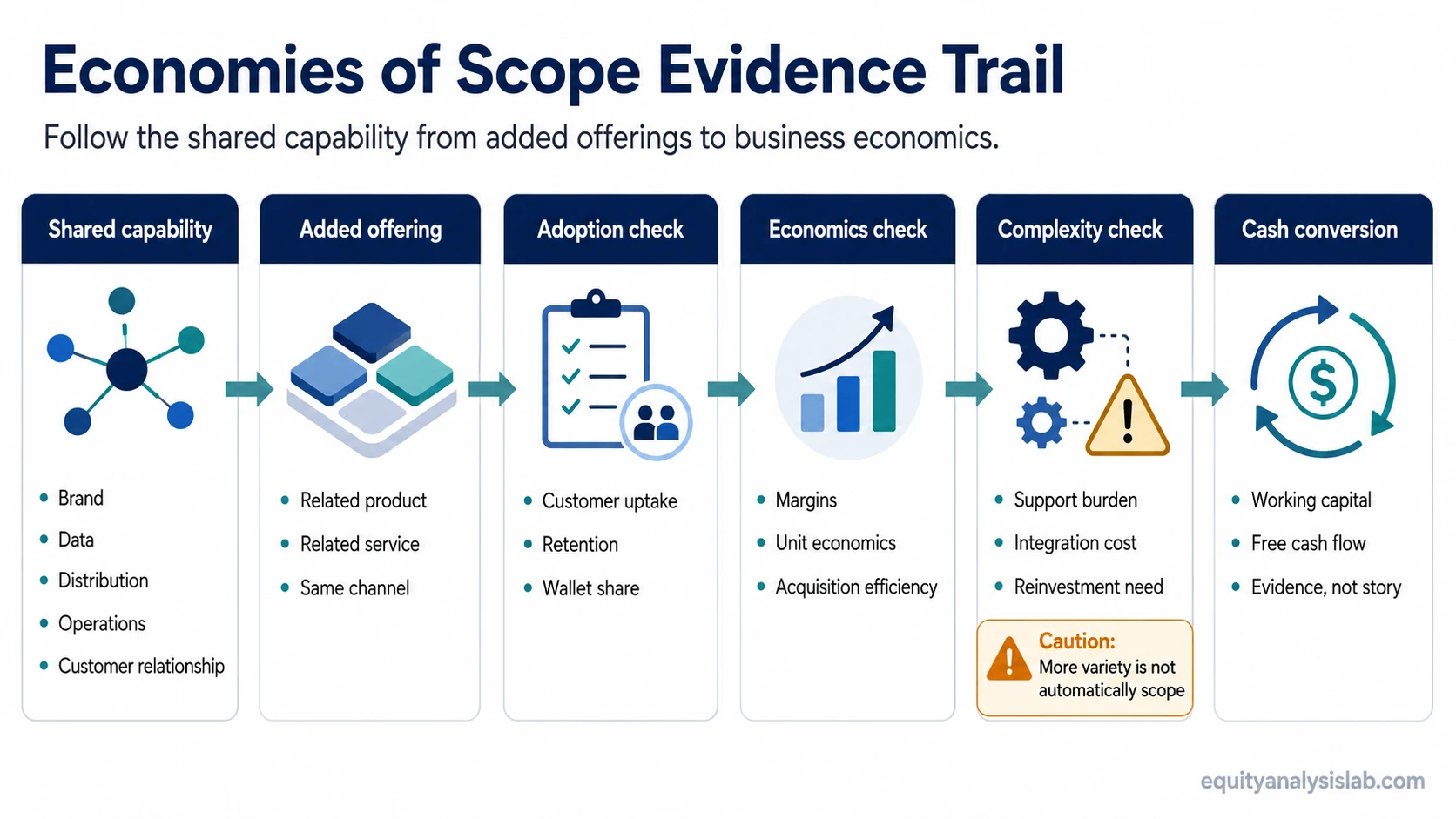
What Economies of Scope Mean
Economies of scope are about efficiency from variety. A company may gain a scope advantage when the same capability supports more than one product or revenue line. The shared capability might be a distribution network, customer relationship, brand, data asset, operating process, technical know-how, or physical asset.
Definition: Economies of scope exist when producing or selling a combination of products together is more efficient than producing or selling those products separately.
The idea is not simply that a company sells many things. Product variety only becomes a scope advantage when the shared capability improves the economics of serving customers, making products, distributing services, or converting revenue into cash.
A concise way to express the concept is that the combined cost of producing two related offerings can be lower than the cost of producing them separately. The formula is useful as a concept check, but investors usually need operating evidence, not only a cost equation.
Economies of Scope vs Economies of Scale
Economies of scope and economies of scale are often confused because both can lower costs. The difference is the source of the efficiency. Scope comes from sharing capabilities across variety. Scale comes from producing more volume through a similar activity base.
| Question | Economies of scope | Economies of scale |
|---|---|---|
| Main idea | Efficiency from variety using shared capabilities. | Efficiency from volume using larger output. |
| Business question | Can one capability support multiple products, services, or revenue lines? | Does more output lower average cost or improve utilization? |
| Investor evidence | Shared margins, cross-sell quality, retention, lower acquisition cost, and cash conversion. | Unit cost decline, procurement leverage, asset utilization, and operating efficiency. |
| Common mistake | Assuming diversification creates scope just because products look related. | Assuming size creates business quality just because output is larger. |
A larger company may have scale without scope if it produces more of the same thing. A broader company may have scope without scale if a shared customer base, data asset, brand, or distribution system supports several offerings before the company becomes very large.
How Scope Advantages Show Up in a Business Model
Scope advantages usually appear through three routes: cost, revenue, and capability. The cost route is visible when shared infrastructure or shared operations reduce the cost of supporting additional products. The revenue route is visible when the same customer relationship supports multiple purchases. The capability route is visible when a brand, dataset, technical process, or know-how base can be reused across more than one offering.
Shared distribution is a common mechanism. A company that already reaches a customer group may be able to add a related product without rebuilding the whole sales channel. Shared data can also matter when insights from one product improve another product, although that only helps if customers adopt the added offering and the cost of maintaining the broader system stays controlled.
Scope can also appear in support functions. A single billing platform, service team, supplier network, or operating process may serve several product lines. The investor test is whether the shared system keeps incremental complexity low enough for the added revenue to improve business quality rather than dilute it.
Evidence Investors Can Check
A scope claim becomes more credible when it appears in observable economics. A company may describe product adjacency or cross-selling potential, but the evidence should show whether shared capabilities improve the business rather than only expand the product list.
| Claimed scope advantage | Evidence to check | What weakens the claim |
|---|---|---|
| Shared customer base | Higher customer wallet share, better retention, lower acquisition cost, and stronger unit economics. | Weak adoption, heavy discounting, rising sales expense, or dependence on a narrow customer group. |
| Shared brand | Lower trust barrier for new products, stable pricing, and repeat demand across related offerings. | Brand dilution, customer confusion, lower product quality, or weaker pricing discipline. |
| Shared operations | Stable or improving gross margin, operating margin, service quality, and fulfillment efficiency as variety expands. | Complexity costs, inventory strain, service failures, or management distraction. |
| Shared channel or distribution | More revenue through the same channel without a proportional rise in selling cost. | Channel conflict, higher commissions, weak conversion, or rising customer support burden. |
| Shared data, assets, or know-how | Better product adoption, higher utilization, improved decision quality, or lower cost to launch adjacent offerings. | Higher reinvestment need, integration cost, privacy risk, or weaker cash conversion. |
| Scope concentrated in one buyer group | Durable demand across several customer types, segments, or use cases. | Rising customer concentration risk if the scope benefit depends too heavily on one customer group or channel. |
The most useful evidence often comes from margins, retention, acquisition efficiency, product adoption, and cash conversion moving in the same direction. If revenue variety expands while margins fall and working capital needs rise, the scope story may be weaker than it first appears.
When Economies of Scope Are Overstated
Limitation: Economies of scope are not automatically a sign of a better business. A company can add products that look related but still lose the benefit through complexity, higher reinvestment, weaker margins, poor integration, or lower cash conversion. The claimed scope advantage must show up in economics, not just in the story.
The risk is that management describes every adjacent product as strategic fit even when the added activity creates new costs. More offerings can require more suppliers, more inventory, more sales training, more compliance work, more customer support, or more technology maintenance. If those costs rise faster than the shared capability helps, the company may become broader without becoming more efficient.
If the added products require heavy facilities, inventory, software investment, or integration spending, the scope claim should be tested against rising capital intensity and weaker cash conversion. The business may still grow, but the economics of that growth require closer review.
Simple Example of Economies of Scope
Example: A company already sells a core service to small businesses through a direct sales team, support desk, and billing platform. It then adds a related service that uses the same customer relationship and the same billing infrastructure. The scope case is tempting because the company does not need to rebuild the entire sales channel for the second service.
The stronger case appears if customers adopt the second service, acquisition cost per dollar of revenue falls, support quality remains stable, and margins improve or hold steady. The weaker case appears if the new service needs a separate sales motion, creates support problems, lowers gross margin, or delays cash collection. The useful comparison is not only whether revenue increased, but whether the shared capability improved the economics of the combined business.
Business Model Features Often Confused With Scope
Economies of scope are one business model feature, not a full business quality verdict. They focus on shared capability across product or service variety. Other features can interact with scope, but they answer different questions.
Operating leverage asks how profit changes when revenue grows against a fixed-cost base. Network effects ask whether the value of a product improves as more users join. Recurring revenue asks whether revenue repeats with enough durability to make future cash flows more visible. Those features may support a scope story, but they do not replace the evidence check for shared capabilities, complexity, margins, and cash conversion.
FAQ
What is an example of economies of scope?
An example is a company using the same customer relationship, brand, distribution channel, or operating system to support more than one related product. The scope advantage is stronger if the added product improves revenue or margins without adding too much extra cost or complexity.
Are economies of scope the same as economies of scale?
No. Economies of scope come from sharing capabilities across different products or revenue lines. Economies of scale come from producing or selling more volume so average cost can fall.
Do economies of scope always make a company better?
No. Scope can be overstated when added products increase complexity, require more reinvestment, weaken margins, or reduce cash conversion. The claimed advantage needs to appear in business economics, not only in the growth narrative.
How can investors test economies of scope?
Investors can compare the scope claim with evidence such as margins, acquisition efficiency, retention, product adoption, customer concentration, working capital needs, and cash conversion. The signal is stronger when variety expands while economics remain stable or improve.