
Operating leverage describes how a company’s fixed-cost structure can cause operating income to change faster than revenue. When part of the operating cost base does not move quickly with sales, each additional dollar of revenue can have a larger effect on operating profit after fixed costs are covered.
Operating leverage connects revenue growth, cost behavior, margin sensitivity, and profit scalability. It is not a verdict on business quality by itself. High operating leverage can help margins expand when revenue rises, but it can also pressure operating income when revenue falls or when the fixed-cost base grows ahead of demand.
What Operating Leverage Means
Operating leverage measures the sensitivity of operating income to changes in revenue. A company with meaningful fixed operating costs may show a larger percentage change in operating income than in sales because part of the cost base is already in place.
The mechanism starts with cost structure. Fixed costs, such as certain salaries, rent, platform costs, depreciation, or support infrastructure, may not rise in direct proportion to revenue in the short run. Variable costs, such as direct materials, commissions, or usage-based costs, tend to move more closely with sales.
For investor analysis, the useful test is whether the observed profit sensitivity is durable, understandable, and supported by the company’s disclosures.
Key Points
- Operating leverage measures how sensitively operating income responds to changes in revenue.
- It usually comes from a cost structure with meaningful fixed operating costs.
- The degree of operating leverage, or DOL, is not a permanent company trait. It can change materially as the operating-profit base changes.
- A very high DOL can appear when operating income is small, not only when the business is structurally more scalable.
- High operating leverage can amplify upside and downside, so it should be interpreted together with margins, cycle position, and cash conversion.
Operating Leverage Formula
The most common measure is the degree of operating leverage, often shortened to DOL:
Degree of operating leverage = percentage change in operating income ÷ percentage change in revenue
A second formula is often used to explain why DOL changes at different profit levels:
Degree of operating leverage = contribution margin ÷ operating income
Contribution margin is revenue minus variable operating costs. If revenue rises by 10% and operating income rises by 25%, the DOL is 2.5. In plain language, operating income changed 2.5 times as much as revenue during that period.
The formula should be read as a diagnostic ratio, not as a stable law. It depends on the period measured, the starting margin base, cost classification, and unusual expenses. Because operating income usually comes from the income statement, the calculation is stronger when recurring operating activity is separated from temporary distortions.
Practical limitation: public companies often do not disclose fixed and variable operating costs cleanly, so contribution-margin DOL may require estimation rather than direct extraction from the financial statements.
Operating Leverage Changes With the Profit Base
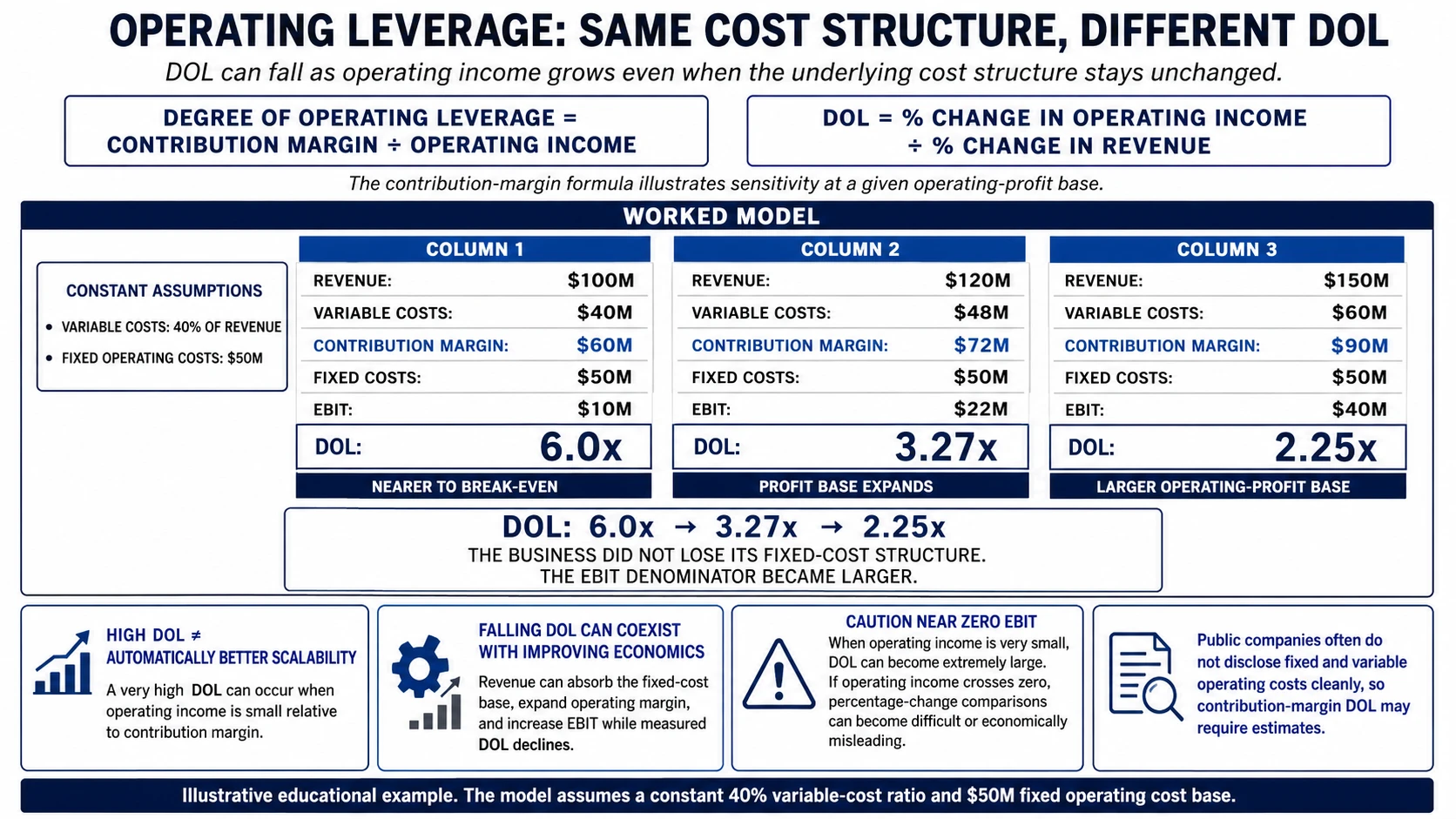
One of the most useful investor insights is that operating leverage is state-dependent. The same business can show a very high DOL near break-even and a much lower DOL after margins expand, even if its underlying cost structure has not fundamentally changed.
Assume a company has variable costs equal to 40% of revenue and fixed operating costs of $50 million. At $100 million of revenue, contribution margin is $60 million and operating income is $10 million, which implies a DOL of 6.0. If revenue rises to $120 million, contribution margin becomes $72 million and operating income becomes $22 million, so DOL falls to about 3.27. If revenue rises further to $150 million, contribution margin reaches $90 million and operating income reaches $40 million, so DOL falls again to 2.25.
The business did not lose its fixed-cost structure. The key change is that the operating-profit denominator became larger. As the fixed-cost base is absorbed more comfortably, each new revenue gain still helps profit, but measured DOL can decline.
Main interpretation rule: high DOL does not automatically mean better scalability, and falling DOL does not automatically mean weaker economics. A very high DOL can simply reflect a small operating-income base.
This also explains why operating leverage can become hard to interpret near zero operating income. When EBIT is very small, DOL can become extremely large. If operating income crosses zero, percentage-change comparisons can become unstable or economically misleading.
Fixed Costs, Variable Costs, and Margin Sensitivity
Operating leverage exists because fixed costs can create profit amplification. Once a company covers a fixed cost base, additional revenue may contribute more heavily to operating income because those fixed costs do not need to be rebuilt for every unit of sales.
A more variable cost structure behaves differently. If costs rise almost dollar for dollar with revenue, operating income may grow more steadily but with less amplification. That can reduce upside sensitivity, but it can also reduce downside pressure when sales weaken.
| Cost structure | What usually happens when revenue rises | What usually happens when revenue falls | Investor interpretation |
|---|---|---|---|
| Higher fixed-cost base | Operating income may rise faster than revenue | Operating income may fall faster than revenue | More sensitivity to volume, utilization, and the starting margin base |
| Higher variable-cost base | Operating income may grow more gradually | Cost flexibility may soften the decline in operating income | Less amplification, but often less fixed-cost pressure |
This is why operating leverage should be interpreted together with operating margin. Operating margin shows the current profitability level, while operating leverage shows how sensitive that profitability may be to changes in revenue.
Operating Leverage Evidence Trail
An investor can treat operating leverage as an evidence trail rather than a single formula. The goal is to trace whether revenue changes are flowing through the cost base into operating income in a way that is repeatable and understandable.
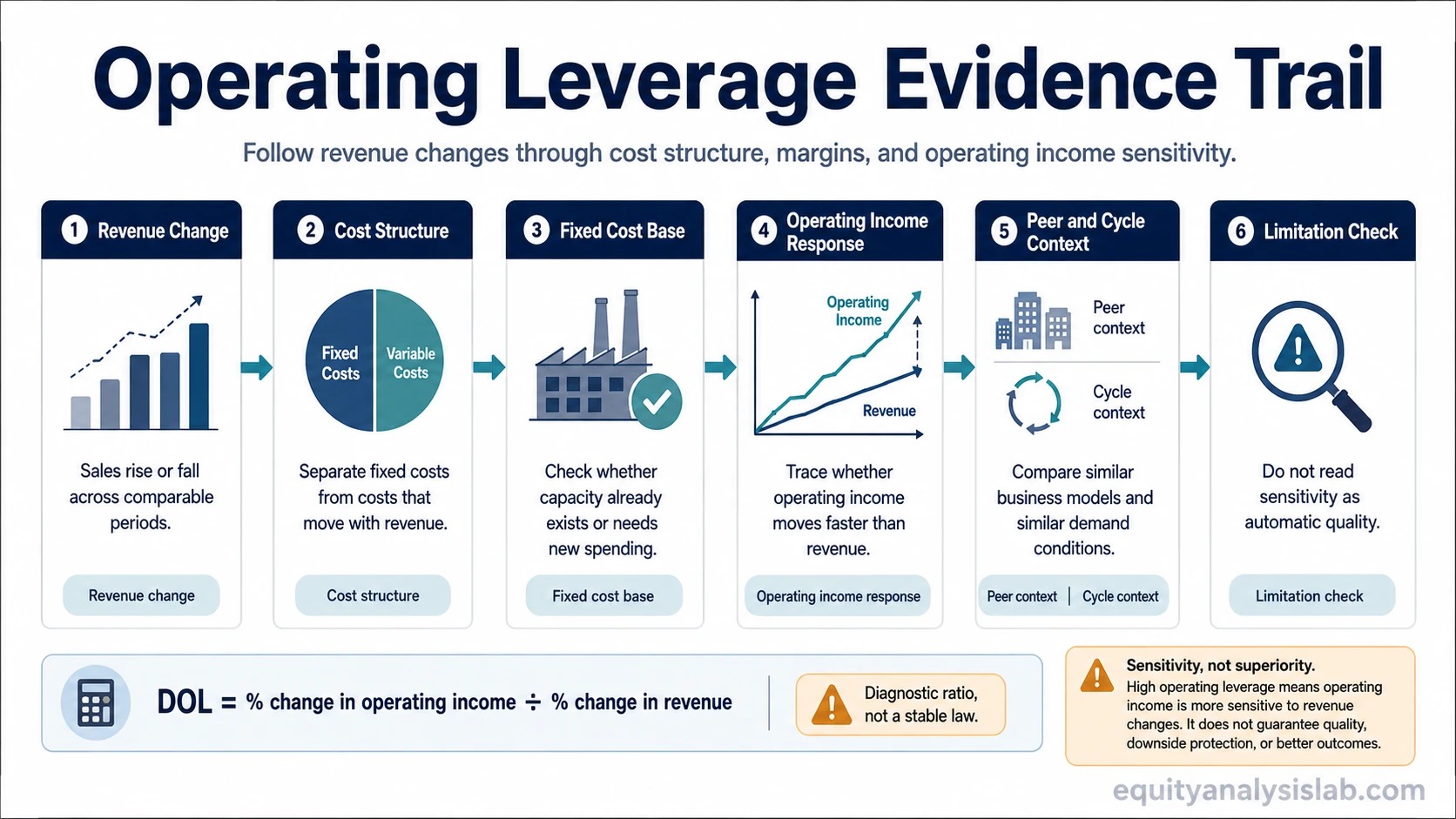
| Evidence point | What to check | Why it matters |
|---|---|---|
| Revenue change | Sales growth or decline across comparable periods | Starts the sensitivity chain |
| Operating income change | EBIT or operating income movement | Shows the profit response to revenue |
| Fixed cost base | Costs that do not move quickly with revenue | Explains why profit can amplify |
| Margin base | Starting operating margin and contribution-margin context | Helps explain whether percentage changes are economically meaningful |
| Peer set | Companies with similar business models and cost structures | Prevents weak comparisons |
| Cycle point | Expansion, slowdown, recovery, or demand shock | Shows whether sensitivity is structural or cyclical |
| Disclosure quality | Cost classification, segment detail, and recurring-expense clarity | Determines how reliable the read is |
How Investors Interpret Operating Leverage
Operating leverage helps investors understand how much of a company’s earnings growth may come from revenue flowing through an existing cost base. It is especially useful when a company is moving from underused capacity toward higher utilization, or when a platform, factory, distribution network, or service infrastructure can support more revenue without equivalent cost growth.
The concept also helps separate growth quality from growth quantity. Revenue growth alone does not show how much profit the business can keep. Operating leverage asks whether incremental revenue turns into incremental operating income, and whether that relationship is likely to persist.
Peer comparison matters. A company can show stronger operating leverage than a peer because its cost structure is more scalable, but it can also look stronger because the period chosen was unusually favorable. A clean comparison should use similar business models, similar accounting treatment, and similar cycle points.
Cash conversion is the next check after accounting profit sensitivity. Operating leverage can improve operating income while cash generation still disappoints if working capital, capital spending, or collection timing absorbs the benefit. When that issue matters, the next layer is operating cash flow.
When Operating Leverage Can Mislead
- Operating income is very small: A tiny EBIT denominator can create a very large DOL reading that overstates the practical economic signal.
- Operating income crosses zero: Percentage-change comparisons can become unstable or hard to interpret economically.
- Cost classification is unclear: Investors may not be able to separate fixed and variable operating costs cleanly from public disclosures.
- Revenue is cyclical: A rebound from weak demand can make operating leverage look stronger than it is across a full cycle.
- Costs are delayed: Margins may expand temporarily if hiring, maintenance, product investment, or support spending is postponed.
- The peer set is mismatched: Comparing businesses with different cost structures can create a false high or low operating-leverage read.
- Financial leverage is mixed into the interpretation: Operating leverage concerns operating-income sensitivity before financing effects, while financial leverage concerns debt and interest obligations.
The safest interpretation is conditional. Operating leverage can help explain earnings sensitivity, but it does not prove business quality, valuation upside, or future margin expansion by itself.
Operating Leverage and Related Concepts
Operating leverage overlaps with several business-model and financial concepts, but it should not replace them.
| Concept | Core question | How it differs from operating leverage |
|---|---|---|
| Capital intensity | How much asset and reinvestment support does growth require? | Capital intensity focuses on assets and reinvestment needs, while operating leverage focuses on operating-income sensitivity through cost structure. |
| Economies of scale | Does unit cost improve as the business gets larger? | Economies of scale can support operating leverage, but operating leverage is the earnings sensitivity created by the cost base. |
| Recurring revenue | How stable and repeatable is the revenue base? | Recurring revenue can make sales more predictable, while operating leverage determines how revenue changes flow into operating income. |
| Financial leverage | How much debt or financing obligation affects equity returns? | Financial leverage sits below operating income through interest and financing structure. Operating leverage sits inside the operating model. |
FAQ
What is operating leverage?
Operating leverage is the sensitivity of operating income to changes in revenue. It usually comes from a cost structure with fixed costs that do not move directly with sales in the short run.
How do you calculate operating leverage?
A common calculation is the percentage change in operating income divided by the percentage change in revenue. Another useful form is contribution margin divided by operating income, which helps explain why DOL can change as the profit base changes.
Is high operating leverage good or bad?
High operating leverage is neither automatically good nor bad. It can amplify profit growth when revenue rises, but it can also amplify profit declines when revenue falls or fixed costs become too heavy.
What is the difference between operating leverage and financial leverage?
Operating leverage comes from fixed operating costs and affects operating income. Financial leverage comes from debt or financing structure and affects earnings after interest and financing costs.
Why can operating leverage mislead investors?
It can mislead when operating income is very small, cost classification is unclear, the period is unusual, revenue is cyclical, or peer comparisons use businesses with different cost structures.