
Threshold vs calendar rebalancing compares two different portfolio review rules. Calendar rebalancing reviews a portfolio on a fixed schedule. Threshold rebalancing reviews the same portfolio when allocation drift moves outside a chosen tolerance band.
Both methods belong inside rebalancing, but they answer different timing questions. A calendar rule asks whether the review date has arrived. A threshold rule asks whether the portfolio has moved far enough away from target to justify review.
Core distinction: calendar rebalancing is time-based, while threshold rebalancing is drift-based. The difference is not the portfolio itself, but the rule that decides when the portfolio gets reviewed.
Key Points
- Calendar rebalancing uses fixed review dates such as monthly, quarterly, semiannual, or annual reviews.
- Threshold rebalancing uses allocation drift, such as a tolerance band around the target weight.
- The same portfolio can trigger review differently under each rule.
- A calendar rule can be simpler to administer, but it may wait through meaningful drift between review dates.
- A threshold rule responds directly to drift, but it requires more monitoring and can create more transaction events.
- The same absolute threshold does not represent the same relative tolerance for every target weight.
What Threshold vs Calendar Rebalancing Means
Calendar rebalancing sets a review date before looking at the portfolio. The investor might review weights at the end of each quarter, once per year, or on another fixed schedule. If the portfolio has drifted enough to matter by that date, a trade may be considered.
Threshold rebalancing sets a drift rule before looking at the calendar. The investor might define a tolerance band around each target weight, then review when an asset class moves outside that band. The trigger is not the date itself. The trigger is the distance between the current weight and the target weight.
The same target allocation, current weights, cash flows, and transaction constraints can therefore lead to different review timing. The distinction is not in the portfolio inputs. It is in the trigger logic.
Key Differences Between Calendar and Threshold Rules
| Comparison point | Calendar rebalancing | Threshold rebalancing |
|---|---|---|
| Main trigger | A scheduled review date arrives. | A portfolio weight moves outside a chosen tolerance band. |
| Primary question | Is it time to review the portfolio? | Has the portfolio drifted far enough to review? |
| Monitoring burden | Lower, because review dates are known in advance. | Higher, because weights need to be monitored between review dates. |
| Drift sensitivity | May ignore drift until the next review date. | Responds directly to drift when the threshold is crossed. |
| Trading friction | Can encourage periodic trades even when drift is modest. | Can create more transaction events if bands are tight and crossed often. |
| Best understood as | A time discipline for reviewing the portfolio. | A drift discipline for controlling allocation movement. |
Same Portfolio, Different Trigger Logic
The clearest comparison holds the portfolio constant and changes only the trigger rule.
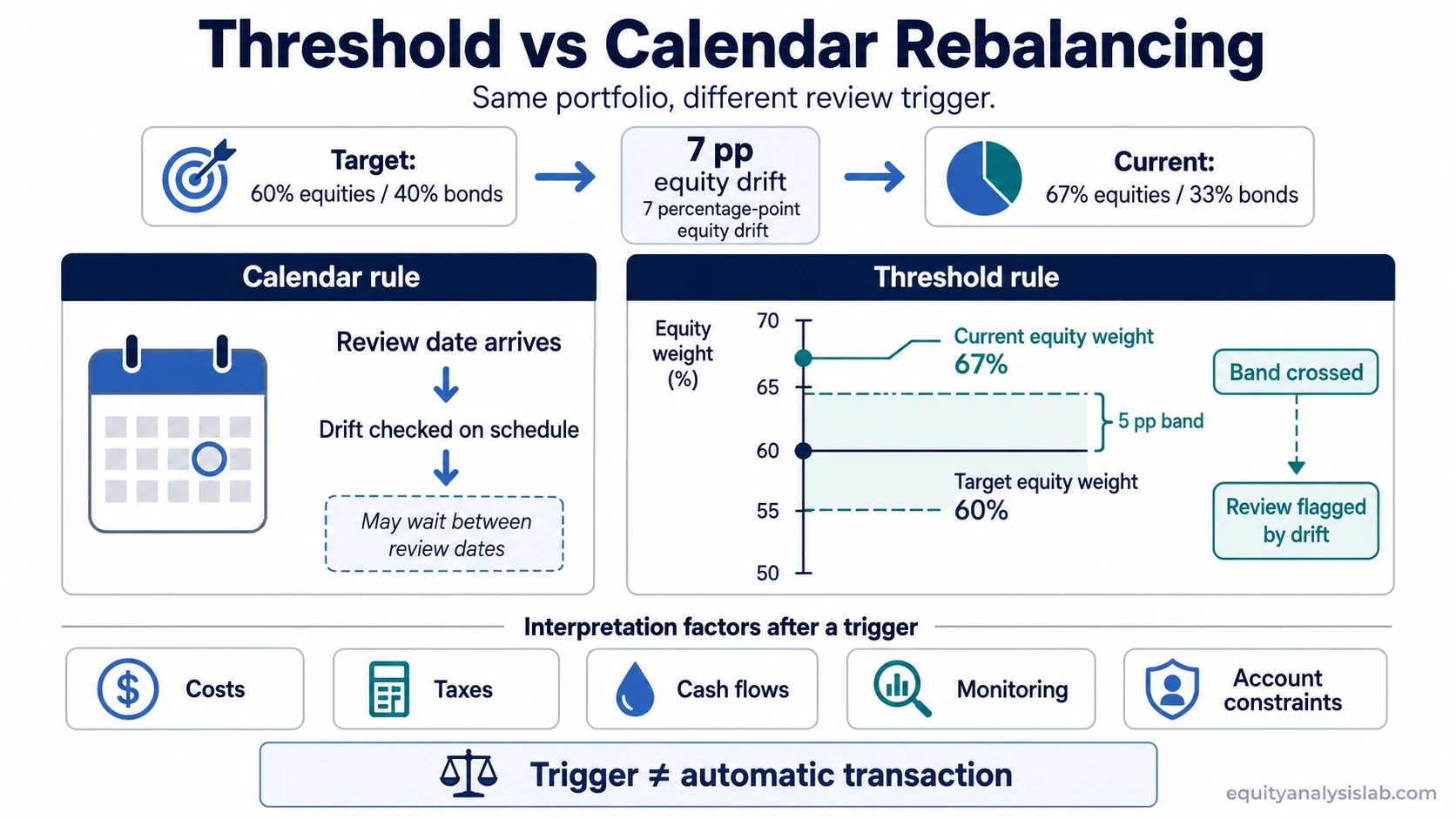
Example: an investor has a 60% equity and 40% bond target. After market movement, the portfolio is 67% equities and 33% bonds. The equity allocation is 7 percentage points above target, and the bond allocation is 7 percentage points below target.
That movement is portfolio drift. It does not automatically say whether a trade is necessary. It only measures how far the current weights have moved from the target weights.
| Rule applied to the same portfolio | What the rule notices | Possible interpretation |
|---|---|---|
| Calendar rule | The portfolio is reviewed at the next scheduled date, such as quarter-end or year-end. | If the next review date is near, the drift is assessed then. If the date is far away, the drift may persist until review. |
| Threshold rule with a 5 percentage-point band | The 67% equity weight is 7 percentage points above the 60% target. | The rule flags the portfolio because the drift has crossed the selected 5 percentage-point threshold. |
Core comparison: calendar rebalancing waits for a scheduled review. Threshold rebalancing reacts when drift crosses the chosen band. That difference changes review timing and monitoring behavior, not the underlying portfolio itself.
The Same Threshold Can Mean Very Different Drift Tolerance
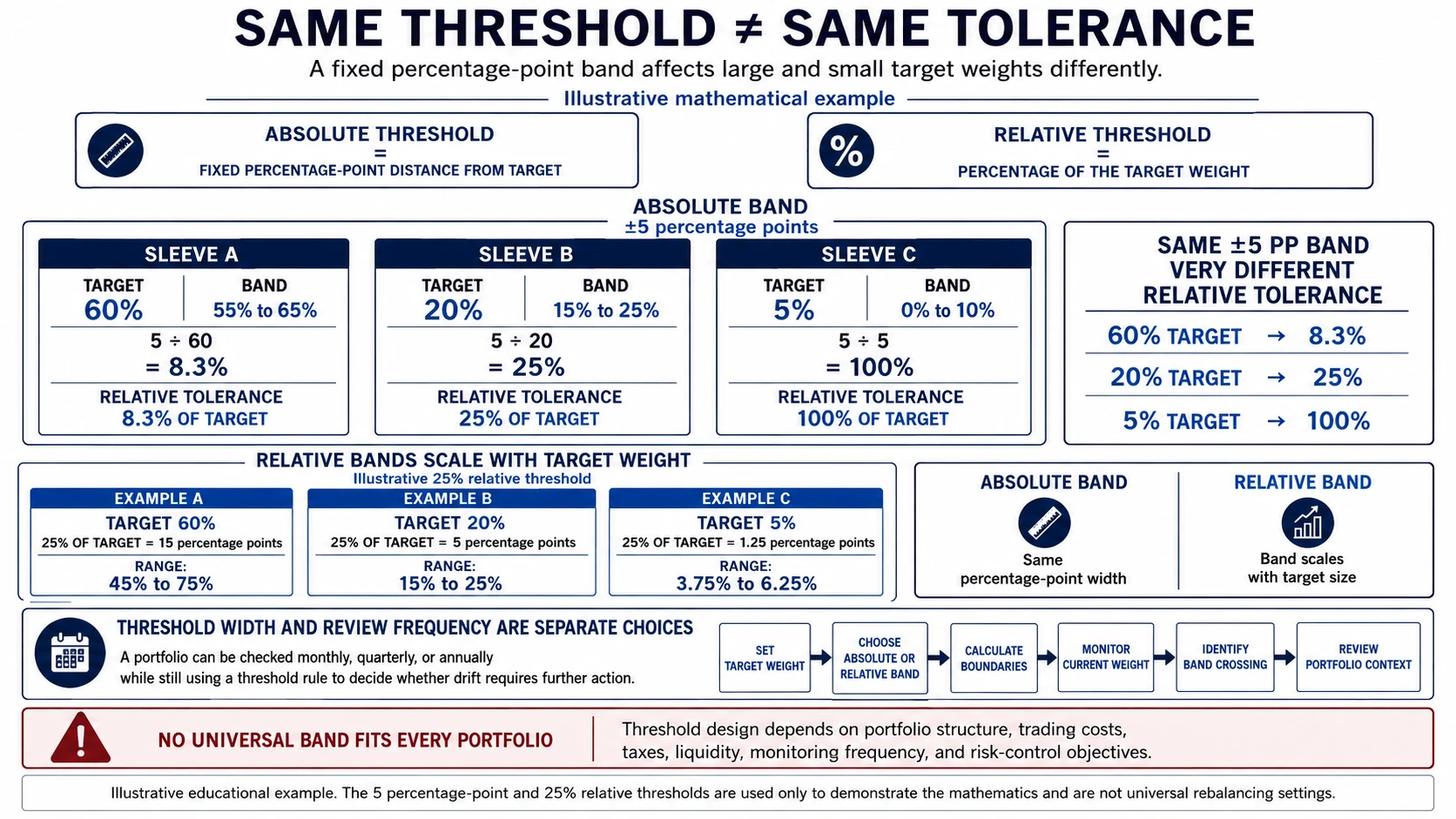
A threshold sounds simple until the band design is tested against different target weights. The same absolute threshold does not create the same effective tolerance across the whole portfolio.
Illustrative absolute threshold: ±5 percentage points.
| Target weight | Absolute band | Allowed range | Relative size of the band |
|---|---|---|---|
| 60% | ±5 percentage points | 55% to 65% | 5 ÷ 60 = 8.3% of target |
| 20% | ±5 percentage points | 15% to 25% | 5 ÷ 20 = 25% of target |
| 5% | ±5 percentage points | 0% to 10% | 5 ÷ 5 = 100% of target |
The same ±5 percentage-point band is therefore relatively tight for a large 60% sleeve, wider for a 20% sleeve, and extremely wide for a 5% sleeve. That is why the same threshold does not mean the same tolerance across the portfolio.
Main insight: a fixed percentage-point threshold is an absolute band. Its relative strictness changes as the target weight changes.
Absolute Bands vs Relative Bands
Some investors use fixed percentage-point bands. Others think in relative tolerance, where the threshold scales with the target weight. The two approaches are not interchangeable.
Illustrative relative threshold: 25% of target weight.
| Target weight | Relative band | Equivalent percentage points | Allowed range |
|---|---|---|---|
| 60% | 25% of target | ±15 percentage points | 45% to 75% |
| 20% | 25% of target | ±5 percentage points | 15% to 25% |
| 5% | 25% of target | ±1.25 percentage points | 3.75% to 6.25% |
An absolute band uses the same percentage-point width for every sleeve. A relative band scales with the size of the target weight. Neither method is automatically superior. The useful point is to recognize that threshold design itself changes how sensitive the rule will be.
Why Investors Confuse the Two Rules
Calendar and threshold rules are often mixed because a scheduled review can still use thresholds. For example, an investor might review a portfolio quarterly but only consider action if an asset class is more than 5 percentage points away from target.
Common confusion: a calendar date is not the same thing as a trade instruction, and a threshold crossing is not the same thing as a mandatory trade.
Cleaner interpretation: the calendar controls when the portfolio is checked. The threshold controls how much drift matters. The later trading decision can still depend on costs, taxes, cash flows, and account constraints.
In practice, review frequency and threshold width are separate design choices. A portfolio can be reviewed quarterly, monthly, or annually while still using a threshold rule to determine whether the drift deserves further attention.
When Each Rule Can Create Problems
Both methods can create weak outcomes when applied mechanically. A rule should clarify review discipline, not replace judgment about costs, taxes, liquidity, account type, cash flows, and the role of the target allocation.
| Risk area | Calendar rule issue | Threshold rule issue |
|---|---|---|
| Delayed response | Large drift can develop between scheduled dates. | Less likely if monitoring is frequent, but possible if the portfolio is checked too rarely. |
| Unnecessary trading | Scheduled reviews can lead to trades even when drift is small. | Tight bands can trigger repeated actions during volatile markets. |
| Monitoring burden | Lower burden because the review timing is known in advance. | Higher burden because the portfolio must be monitored against a band. |
| Tax and cost friction | Frequent scheduled trades may increase taxable or costly transactions. | Frequent band crossings can create more transaction events when thresholds are narrow. |
Important limit: thresholds such as 5 percentage points, or relative bands such as 25% of target, are illustrative rules only. No universal band fits every portfolio. The appropriate choice depends on portfolio structure, monitoring burden, liquidity, tax sensitivity, transaction costs, and the investor’s risk-control objectives.
Can Calendar and Threshold Rules Be Combined?
Calendar and threshold rules can be combined. A portfolio might be reviewed quarterly, but trades might be considered only when an asset class has moved outside a defined tolerance band. In that structure, the calendar creates the review habit, while the threshold prevents small deviations from automatically becoming trades.
Hybrid rule: review on a schedule, measure drift at the review date, then decide whether the drift is large enough to justify further action after considering costs, taxes, cash flows, and account constraints.
This hybrid structure separates monitoring discipline from transaction discipline. It also helps clarify that a review event and a trading event do not have to be the same thing.
Related Portfolio Maintenance Concepts
Threshold and calendar rules are only one part of portfolio maintenance. A rebalancing rule becomes more useful when it is connected to target allocation, drift measurement, cash use, account type, and the reason the portfolio was designed that way.
- Rebalancing: the broader process of bringing a portfolio back toward its intended allocation.
- Portfolio drift: the measurement of how far current weights have moved away from target weights.
- Cash position: available cash can sometimes reduce the need to sell overweight assets when correcting drift.
- Costs and taxes: transaction costs and tax consequences can affect whether a trigger should lead to immediate action.
FAQ
Is threshold rebalancing better than calendar rebalancing?
Threshold rebalancing is not automatically better. It responds more directly to drift, but it also requires more monitoring and can create more transaction events if bands are tight. Calendar rebalancing is simpler to schedule, but it may allow drift to persist between review dates.
Is calendar rebalancing the same as periodic rebalancing?
Calendar rebalancing and periodic rebalancing usually refer to the same idea: reviewing a portfolio on a fixed schedule. The schedule may be monthly, quarterly, annual, or another chosen interval.
Can a portfolio use both calendar and threshold rules?
Yes. A portfolio can use scheduled review dates and still require drift to cross a tolerance band before any trade is considered. In that structure, the calendar controls review timing and the threshold controls drift sensitivity.
Does crossing a threshold always mean the portfolio should be traded?
No. A threshold crossing identifies drift. Costs, taxes, cash flows, account type, and portfolio objectives can still affect whether a transaction is appropriate.