
A growth ETF and a value ETF are not interchangeable versions of the same equity fund. A growth ETF usually tilts toward companies selected for expected earnings or revenue expansion, while a value ETF usually tilts toward companies selected for lower valuation metrics, cash flow, dividends, or perceived discounts to fundamentals.
The comparison should not stop at the style label. Two funds can both sit inside the same exchange-traded structure while using different indexes, screening rules, weighting methods, rebalance schedules, sector exposures, costs, liquidity profiles, and distribution patterns. The useful question is not which label is automatically better, but what the fund actually owns and how its structure delivers that exposure.
Growth vs Value ETF: The Core Difference
- Growth ETFs emphasize companies expected to grow earnings, revenue, cash flow, or market opportunity faster than the broader market.
- Value ETFs emphasize companies that appear cheaper relative to fundamentals such as earnings, book value, cash flow, dividends, or other valuation measures.
- Fund mechanics matter because methodology, holdings, weighting, costs, liquidity, tracking, and distributions can change the investor’s real exposure.
- Neither label is automatically safer or better. Growth and value exposures can each underperform when market conditions, valuation expectations, sector leadership, or fund construction work against them.
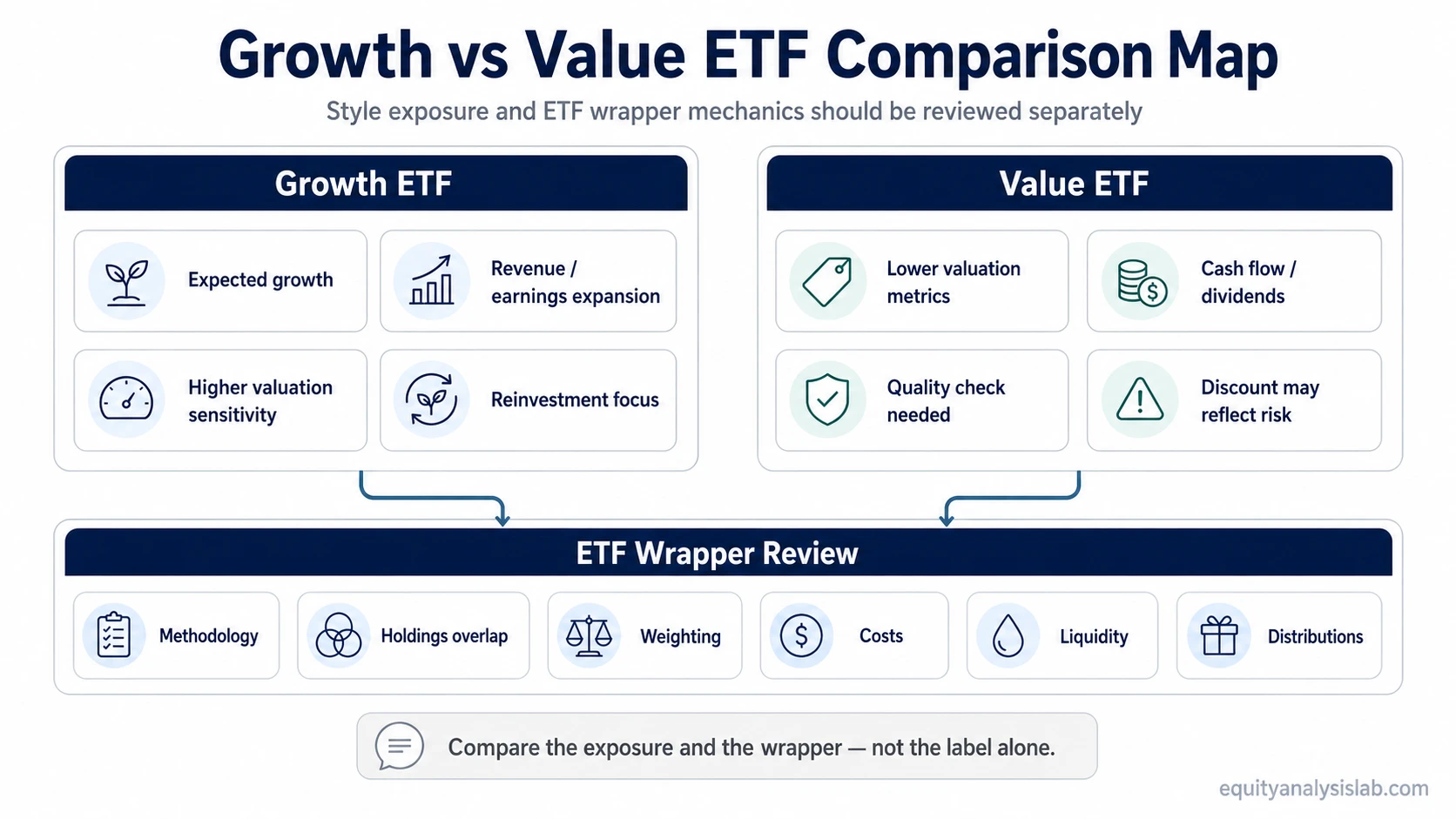
Growth ETF vs Value ETF Comparison Table
The cleanest way to compare growth and value ETFs is to separate the stock-selection style from the ETF implementation layer. The style label explains the intended equity tilt; the wrapper details show how that tilt actually appears in the fund.
| Comparison point | Growth ETF | Value ETF |
|---|---|---|
| Primary style objective | Own companies selected for above-average expected growth. | Own companies selected for lower valuations or perceived fundamental discounts. |
| Typical selection lens | Earnings growth, revenue growth, sales momentum, reinvestment, expanding addressable market, or growth-oriented index screens. | Price-to-earnings, price-to-book, cash flow, dividend yield, asset value, earnings normalization, or value-oriented index screens. |
| Valuation profile | Often accepts higher valuation multiples if growth expectations appear strong enough. | Often seeks lower valuation multiples or a gap between price and fundamentals. |
| Dividend tendency | Often lower, because many growth companies reinvest cash into expansion. | Often higher, though dividend yield alone does not prove that a fund is a good value exposure. |
| Sector concentration risk | May concentrate in the sectors where the fund’s methodology finds the strongest growth characteristics, depending on the index. | May tilt toward sectors with lower valuation metrics or higher cash-flow and dividend characteristics, depending on the index. |
| Main risk sensitivity | Can be more sensitive to valuation compression, rate changes, earnings-growth disappointment, or crowded leadership. | Can be exposed to value traps, weak earnings quality, cyclical downturns, or companies that are cheap for a reason. |
| Portfolio role | Often used to add equity exposure tied to growth expectations and long-term expansion themes. | Often used to add equity exposure tied to valuation discipline, cash-flow orientation, income tilt, or cyclical recovery potential. |
| ETF wrapper checks | Review index methodology, holdings concentration, rebalancing rules, expense ratio, liquidity, tracking, and distributions. | Review index methodology, valuation screens, holdings quality, rebalance rules, expense ratio, liquidity, tracking, and distributions. |
What a Growth ETF Holds
A growth ETF packages a group of stocks that meet the fund’s growth-oriented selection rules. Those rules may focus on earnings growth, revenue growth, sales expansion, growth forecasts, price momentum, or other style factors defined by the index or manager.
The important point is that “growth” is not a guarantee of stronger future returns. It is a description of the exposure the fund is trying to capture. A growth fund may hold companies with strong expected expansion, but the investor still has to ask whether the valuation paid for that growth is reasonable, whether the holdings are concentrated, and whether the growth assumptions are durable enough to support the exposure.
Growth ETF exposure can be attractive to investors who want participation in companies reinvesting for expansion, but it can also become fragile when expectations are already high. If earnings growth slows, rates rise, or the market becomes less willing to pay elevated multiples, the same growth label can represent a more volatile exposure than the fund name suggests.
What a Value ETF Holds
A value ETF packages a group of stocks that meet the fund’s value-oriented selection rules. Those rules may use valuation ratios, dividend yield, book value, cash flow, earnings yield, or other measures designed to identify companies trading at lower prices relative to fundamentals.
The value label does not automatically mean the holdings are high quality or low risk. A stock can look cheap because the market is overlooking durable cash flow, but it can also look cheap because the business is deteriorating, margins are under pressure, earnings quality is weak, or the sector faces structural problems.
For that reason, value ETF review should look beyond the valuation screen. The investor should check what the fund actually owns, whether the methodology filters for quality or only for cheapness, how often the portfolio rebalances, and whether the fund is concentrated in sectors that may be cheap for cyclical rather than durable reasons.
How Fund Mechanics Change the Comparison
The growth-versus-value label describes the intended style exposure, but fund mechanics control how that exposure is built, traded, rebalanced, and distributed. Two ETFs with similar labels can behave differently because their rules are different.
| Fund mechanics check | Why it matters in a growth vs value ETF comparison |
|---|---|
| Index or strategy methodology | Defines which stocks qualify as growth or value and whether the fund uses simple style screens or broader quality controls. |
| Holdings overlap | Some companies can appear in both style universes depending on the index provider, classification rules, and rebalancing date. |
| Weighting method | Market-cap weighting can concentrate exposure in the largest companies, while alternative weighting can change sector and stock-level risk. |
| Rebalancing frequency | Determines how quickly the fund updates its growth or value classification when fundamentals, prices, or index rules change. |
| Expense ratio | Costs reduce investor returns over time and should be compared against the fund’s role, not only against the style label. |
| Liquidity and spreads | Trading volume, bid-ask spread, and underlying holdings liquidity affect implementation, especially for larger orders or less liquid markets. |
| Tracking difference | Shows whether the fund’s actual results stay close to the benchmark or strategy it claims to represent. |
| Distributions and tax context | Dividend levels, turnover, capital gains distributions, and account type can affect after-tax experience, but this should be reviewed as tax context rather than tax advice. |
Same Portfolio, Different Growth and Value Readings
Consider an investor comparing two broad equity ETFs. Both funds may hold large, profitable companies, and both may appear diversified at first glance. The growth reading asks whether expected earnings and revenue expansion justify the valuation, sector concentration, and growth assumptions inside the fund. The value reading asks whether lower valuation metrics, cash flow, dividend support, or discounted fundamentals create a different kind of exposure.
The same portfolio input can therefore lead to different review questions. A growth ETF may require the investor to test whether expectations are too optimistic. A value ETF may require the investor to test whether the apparent discount reflects opportunity or weakness. The comparison is not just “which fund performed better recently?” It is “which style is being selected, and how do the fund mechanics deliver it?”
Holdings Overlap and Sector Concentration
Growth and value ETFs can look more different in name than they are in actual holdings. Some companies can sit near the boundary between styles, and different index providers may classify them differently. A company with strong earnings growth and a still-reasonable valuation may appear in one provider’s growth universe, another provider’s value universe, or a blended style category.
Sector concentration is another reason to check the holdings instead of relying on the label. A growth ETF may be heavily influenced by a small number of high-multiple sectors. A value ETF may be heavily influenced by financials, energy, industrials, or other sectors depending on the valuation screen and market cycle. The label tells the investor the intended style tilt; the holdings show the real risk concentration.
When Growth ETF Exposure May Fit a Portfolio Role
Growth ETF exposure may fit a portfolio role when the investor wants equity participation linked to companies with stronger expected expansion, reinvestment, innovation, or long-duration earnings potential. This does not mean the investor should ignore valuation. The more future growth is already priced into the holdings, the more sensitive the fund may become to earnings disappointment, higher discount rates, or a change in market leadership.
The review should focus on whether the fund adds a distinct exposure that the portfolio does not already have. If a portfolio already has heavy exposure to large growth companies through a broad-market fund, adding another growth ETF may increase concentration rather than improve diversification.
When Value ETF Exposure May Fit a Portfolio Role
Value ETF exposure may fit a portfolio role when the investor wants equity exposure with more valuation discipline, more cash-flow orientation, a dividend tilt, or a different sector mix from growth-heavy holdings. The value label can also help balance a portfolio that is already concentrated in high-multiple growth stocks.
The main caution is that cheapness alone is not enough. A low valuation ratio may reflect a temporary mispricing, but it may also reflect weaker business quality, cyclical earnings pressure, balance-sheet risk, or limited reinvestment opportunity. A value ETF should be reviewed for both valuation and quality of exposure.
Common Mistakes When Comparing Growth and Value ETFs
- Choosing the recent winner: recent performance can reflect a temporary cycle, rate environment, or sector leadership shift rather than a permanent advantage.
- Trusting the label alone: the fund name does not show holdings overlap, weighting, methodology, liquidity, or distribution behavior.
- Equating value with safety: lower valuation can reduce some risks, but it can also hide business weakness or cyclical exposure.
- Equating growth with quality: high expected growth does not automatically mean durable earnings, strong cash flow, or reasonable valuation.
- Ignoring portfolio overlap: a growth or value ETF can duplicate exposures already present in a broad-market or core ETF.
- Comparing yield without context: dividend yield may matter, but it should be reviewed alongside payout durability, sector exposure, and tax context.
Risk and Limitation Check
No growth vs value ETF comparison can identify a universally superior style. Growth may lead when investors reward expansion, earnings acceleration, and long-duration business models. Value may lead when valuation discipline, dividends, cash flow, or cyclical recovery become more important. Both styles can lag when their assumptions fail.
The safer comparison is conditional. Growth exposure depends heavily on whether future expectations are realistic. Value exposure depends heavily on whether the apparent discount is supported by durable fundamentals. The implementation layer adds another check: even if the style thesis is reasonable, the fund’s holdings, costs, liquidity, tracking, turnover, and distributions can still make the final result weaker than expected.
How to Compare a Growth ETF and a Value ETF Step by Step
A practical comparison should move from exposure to implementation. Start with the style logic, then check the fund structure that delivers it.
| Step | Question to ask | Why it matters |
|---|---|---|
| 1. Define the role | Is the fund meant to add growth exposure, value exposure, diversification, income tilt, or balance against an existing allocation? | The same ETF can be reasonable or redundant depending on the portfolio it enters. |
| 2. Read the methodology | How does the fund define growth or value? | Different indexes can classify stocks differently, even under the same broad label. |
| 3. Check top holdings | Which companies and sectors drive the fund? | The holdings reveal concentration, overlap, and actual economic exposure. |
| 4. Compare valuation and quality | Are growth expectations, cash flow, dividends, or valuation metrics consistent with the fund’s role? | Style exposure is more useful when the underlying fundamentals support the label. |
| 5. Review wrapper costs | What are the expense ratio, tracking pattern, spreads, liquidity, and turnover? | Implementation can reduce the benefit of a style exposure if costs or trading friction are high. |
| 6. Consider tax and distributions | How do dividends, turnover, and account type affect the investor’s after-tax experience? | Tax context can matter, especially when comparing income-oriented value exposure with lower-yielding growth exposure. |
Review Each ETF Style Separately
After comparing the two labels, review each style on its own terms. A Growth ETF review should focus on how the fund selects growth-oriented stocks, how concentrated the exposure is, and whether the methodology fits the intended role. A Value ETF review should focus on valuation screens, cash-flow or dividend characteristics, holdings quality, and the risk that a low valuation may reflect weaker fundamentals.
FAQ
Is a growth ETF better than a value ETF?
No. A growth ETF and a value ETF represent different equity-style exposures. Growth may work better in some market environments, while value may work better in others. The comparison should focus on holdings, methodology, valuation, costs, liquidity, distributions, and portfolio role rather than assuming one style is always better.
Can a growth ETF and a value ETF hold some of the same stocks?
Yes. Holdings can overlap because index providers use different classification rules, and some companies may have both growth characteristics and reasonable valuation metrics. That is why investors should check the actual holdings rather than relying only on the fund label.
Does a value ETF always have a higher dividend yield?
Not always. Many value ETFs have a stronger dividend tendency than growth ETFs, but dividend yield depends on the fund’s methodology, sector exposure, holdings, and distribution policy. Yield alone does not prove that a fund is a stronger value exposure.
Should growth and value ETFs be compared by recent performance?
Recent performance can be useful context, but it should not lead the decision. Performance can reflect temporary market leadership, rates, sector concentration, or valuation cycles. A better comparison starts with exposure, holdings, methodology, costs, liquidity, distributions, and portfolio fit.