
EV/Revenue helps investors compare enterprise value with revenue when profit-based metrics are weak, negative, distorted, or not yet stable. The multiple divides enterprise value by revenue to show how much total company value is being assigned to each unit of sales.
It is often used for companies where earnings, EBITDA, or EBIT are not yet the best first filter. That does not make EV/Revenue a shortcut. Revenue sits high in the income statement, so the multiple still needs context around margins, cash flow, capital intensity, dilution, and balance-sheet structure.
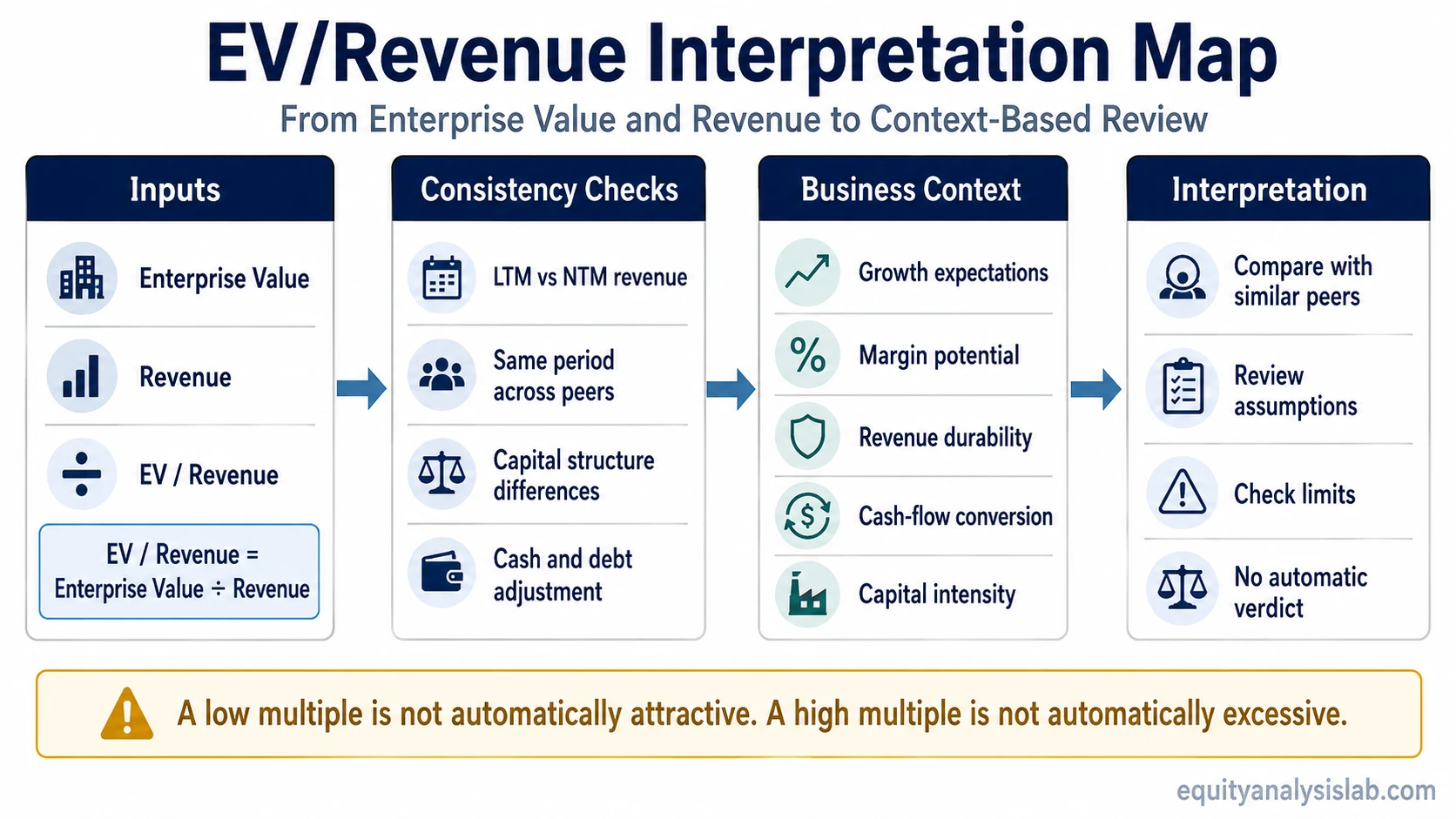
Key Points
- EV/Revenue compares enterprise value with revenue, not market capitalization with revenue.
- The formula is simple: EV/Revenue = Enterprise Value ÷ Revenue.
- The multiple can be useful when earnings, EBITDA, or EBIT are negative, distorted, or temporarily unstable.
- Interpretation depends on peer comparability, revenue quality, growth expectations, margin potential, capital intensity, cash-flow conversion, and balance-sheet structure.
- A low EV/Revenue multiple is not automatically attractive, and a high multiple is not automatically excessive.
What EV/Revenue Means
EV/Revenue, also called EV-to-Revenue, is a valuation multiple that compares enterprise value with revenue. It shows how much total business value the market is assigning to each dollar of sales.
The multiple is best used as a starting point. It can help organize comparison when profit measures are not yet reliable, but it does not show whether those sales will become durable earnings or free cash flow.
That matters because two companies can report similar revenue and still deserve very different valuations. One may have recurring revenue, strong margins, and healthy cash generation. The other may have weaker economics, heavy dilution, more debt, or large reinvestment requirements.
EV/Revenue Formula
EV / Revenue = Enterprise Value / Revenue
Enterprise value is usually calculated as market capitalization plus debt and preferred claims, minus cash and cash equivalents. The purpose is to measure the value of the operating business before isolating only the equity portion.
Revenue must also be defined consistently. Analysts may use annual revenue, last twelve months revenue, or next twelve months revenue depending on the comparison being made. A trailing multiple and a forward multiple can describe very different valuation assumptions.
The formula is straightforward. The interpretation is where most of the analytical work begins.
Real Company Example: Snowflake
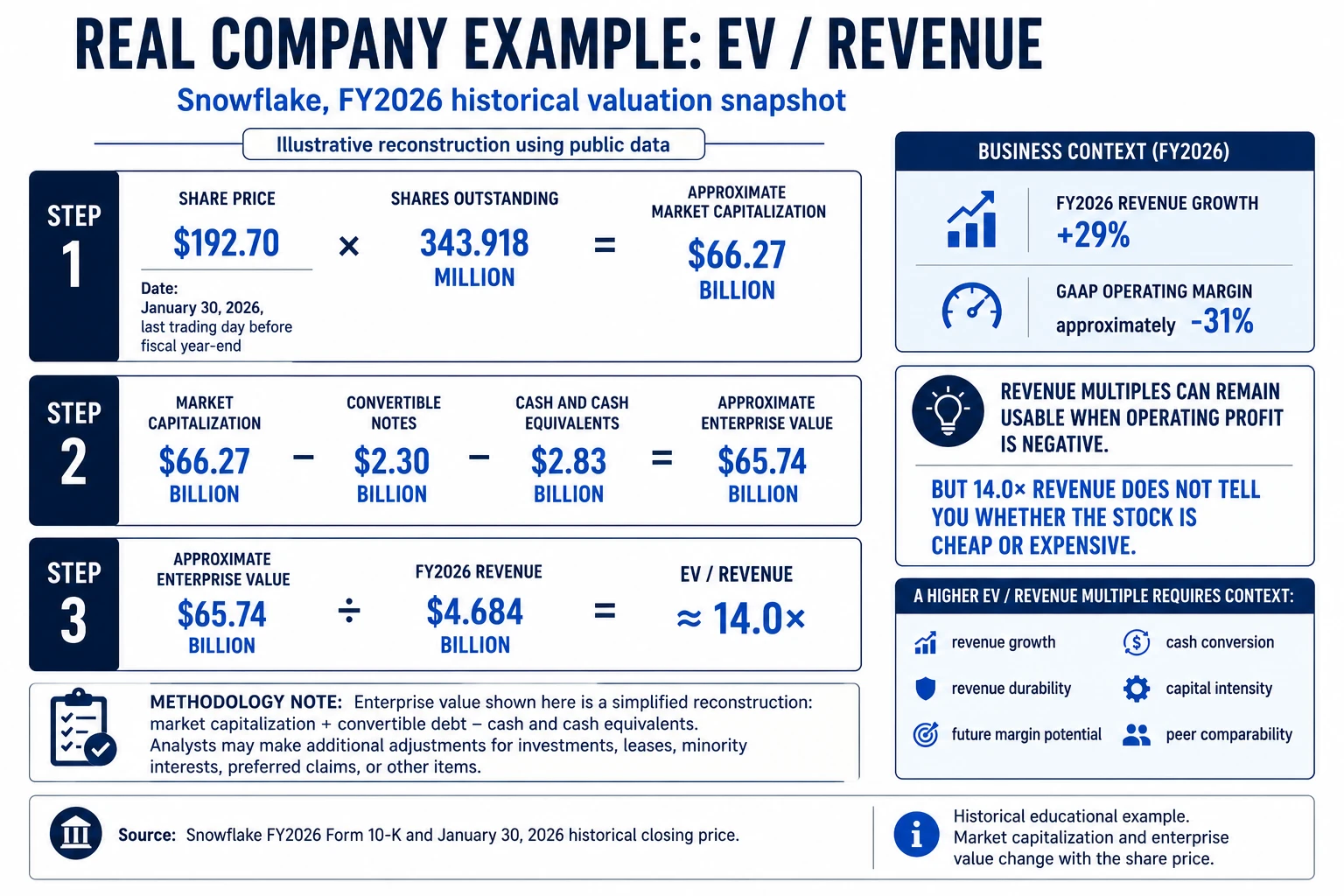
A real example makes the multiple easier to understand. Using a historical Snowflake snapshot around the end of fiscal 2026, the share price on January 30, 2026 was about $192.70, and shares outstanding at fiscal year-end were about 343.918 million. That implies an approximate market capitalization of $66.27 billion.
Snowflake also had about $2.30 billion of convertible notes and about $2.83 billion of cash and cash equivalents. Using a simplified enterprise-value bridge, that gives an approximate enterprise value of $65.74 billion.
Snowflake reported fiscal 2026 revenue of about $4.684 billion. Dividing the approximate enterprise value by reported revenue produces an EV/Revenue multiple of roughly 14.0x.
This example is useful because Snowflake still had negative GAAP operating income in the period, so a revenue-based multiple remained a common early reference point. That still does not answer whether the stock was cheap or expensive. It only shows the scale of valuation the market was assigning relative to sales.
Method note: this is a simplified historical reconstruction using public data, not a company-reported EV/Revenue figure. Analysts may make additional adjustments for investments, leases, minority interests, preferred claims, or other items. Source: Snowflake FY2026 Form 10-K.
What the Multiple Actually Compares
EV/Revenue compares a total-business value measure with a top-line operating measure. The numerator reflects the value assigned to the whole operating business. The denominator reflects the amount of revenue that business generates over a chosen period.
| Part of the multiple | What it represents | Why it matters |
|---|---|---|
| Enterprise value | Total business value after considering equity value, debt, and cash | Two companies with similar market caps can show different EV/Revenue multiples if their debt and cash positions differ |
| Revenue | Sales generated over a defined period | The same company can show a different multiple depending on whether trailing or forward revenue is used |
| Multiple | Enterprise value per unit of revenue | The number becomes more useful when compared with similar businesses and consistent denominator choices |
This is why EV/Revenue is often used when earnings are negative, margins are in transition, or accounting charges make profit measures harder to compare.
How to Interpret EV/Revenue
EV/Revenue is usually interpreted through peer comparison. A 3.0x multiple may look high in one industry and low in another because margin structure, growth durability, capital intensity, cyclicality, and revenue quality can vary a lot across business models.
A higher EV/Revenue multiple may reflect faster expected growth, stronger recurring revenue, better future margins, lower capital intensity, better cash conversion, or a cleaner balance sheet. It can also reflect expectations that are already very demanding.
A lower EV/Revenue multiple may reflect slower growth, weaker revenue quality, lower margins, more cyclicality, more debt, heavier reinvestment needs, or weaker cash generation. It can also reflect an opportunity if those concerns are overstated.
Interpretation rule: EV/Revenue becomes more useful when the peer set is close, the denominator is consistent, and the margin path behind the revenue base is explicitly considered.
EV/Revenue Assumption Stack
The surface calculation is simple, but the meaning of the multiple depends on several assumptions underneath it.
| Assumption | Question to ask | How it changes interpretation |
|---|---|---|
| Revenue durability | Are sales recurring, repeatable, or one-time? | Durable revenue can support a higher multiple than volatile or non-recurring revenue |
| Growth expectations | Is the market pricing rapid future growth or a more mature trajectory? | A high multiple often depends on growth being sustained |
| LTM vs NTM denominator | Is the denominator based on trailing revenue or forward revenue? | Forward revenue can lower the stated multiple, but it also adds forecast risk |
| Margin conversion | Can revenue convert into EBITDA, EBIT, earnings, or free cash flow? | Revenue without a credible margin path can make EV/Revenue misleading |
| Cash and debt sensitivity | Does enterprise value move materially because of debt or cash? | Two companies with similar sales can show different multiples because their capital structures differ |
| Capital intensity | How much reinvestment is needed to maintain or grow revenue? | Revenue that requires heavy capital spending may deserve a different interpretation than asset-light revenue |
When EV/Revenue Is Useful
EV/Revenue can be useful when profit-based multiples are temporarily unhelpful. This often happens when a company is growing quickly, margins are still developing, earnings are negative, or EBITDA and EBIT do not yet give a stable picture of the business.
The multiple can also help in industries where revenue scale matters as an early filter, as long as the analysis does not stop there. Revenue still needs to be checked against profitability, cash generation, reinvestment needs, and balance-sheet risk.
Used properly, EV/Revenue helps organize the next stage of analysis. It does not replace that next stage.
Where EV/Revenue Can Mislead
Core limitation: EV/Revenue does not measure profitability. A company can look modest on an EV/Revenue basis while still failing to turn sales into durable earnings or free cash flow.
The most common mistake is treating a low EV/Revenue multiple as automatically attractive. A low multiple may reflect weak margins, poor cash conversion, low-quality revenue, debt pressure, cyclicality, or a peer set that is not actually comparable.
The opposite mistake is treating a high multiple as automatically excessive. A high multiple may reflect stronger recurring revenue, better long-term margin potential, healthier cash generation, or structurally stronger economics. It may also reflect expectations that are difficult to meet.
| Misread | Why it is risky | Better check |
|---|---|---|
| Low EV/Revenue means cheap | Revenue may have weak margin or cash-flow quality | Check profitability, free cash flow, and debt burden |
| High EV/Revenue means expensive | The business may have stronger durability or future margin potential | Check growth quality, retention, and operating leverage |
| All revenue is comparable | Revenue mix, recurrence, cyclicality, and accounting treatment can differ | Compare similar business models and similar revenue definitions |
| Trailing revenue is enough | LTM revenue can understate or overstate the forward business base | Review both trailing and forward revenue when forecasts are credible |
EV/Revenue Compared With Related Multiples
EV/Revenue should stay separate from profit-based valuation multiples. EV/EBITDA valuation compares enterprise value with operating earnings before depreciation and amortization, so it moves one step closer to profitability than revenue.
EV/EBIT goes further by comparing enterprise value with operating profit after depreciation and amortization. That can matter when depreciation, asset intensity, and operating capital requirements are central to the business model.
Price-to-sales is different because it usually compares equity market value with revenue, while EV/Revenue compares enterprise value with revenue. The enterprise-value approach incorporates capital structure more directly.
Growth-sensitive metrics also have a different job. A valuation multiple can be compared with growth expectations, but a growth-adjusted multiple such as PEG uses earnings-based valuation as its starting point rather than a revenue-based enterprise-value framework.
FAQ
What is EV/Revenue?
EV/Revenue is a valuation multiple that divides enterprise value by revenue. It compares total business value with sales and is often used when earnings or operating profit measures are negative, limited, or unstable.
How do you calculate EV/Revenue?
Calculate EV/Revenue by dividing enterprise value by revenue. Enterprise value usually includes equity value plus debt and preferred claims, minus cash and cash equivalents. Revenue should come from a clearly defined period such as annual, LTM, or forward revenue.
What is a good EV/Revenue ratio?
There is no universal good EV/Revenue ratio. The right context depends on the industry, peer group, growth expectations, revenue durability, margin potential, capital intensity, and cash-flow conversion.
Is a lower EV/Revenue multiple better?
Not automatically. A lower multiple may reflect a more modest valuation, but it can also reflect weak margins, poor cash conversion, slower growth, cyclicality, debt pressure, or lower revenue quality.
How is EV/Revenue different from price-to-sales?
EV/Revenue uses enterprise value, which adjusts for debt and cash. Price-to-sales usually uses market capitalization or equity value. This means EV/Revenue can be more useful when capital structure differences are important.