
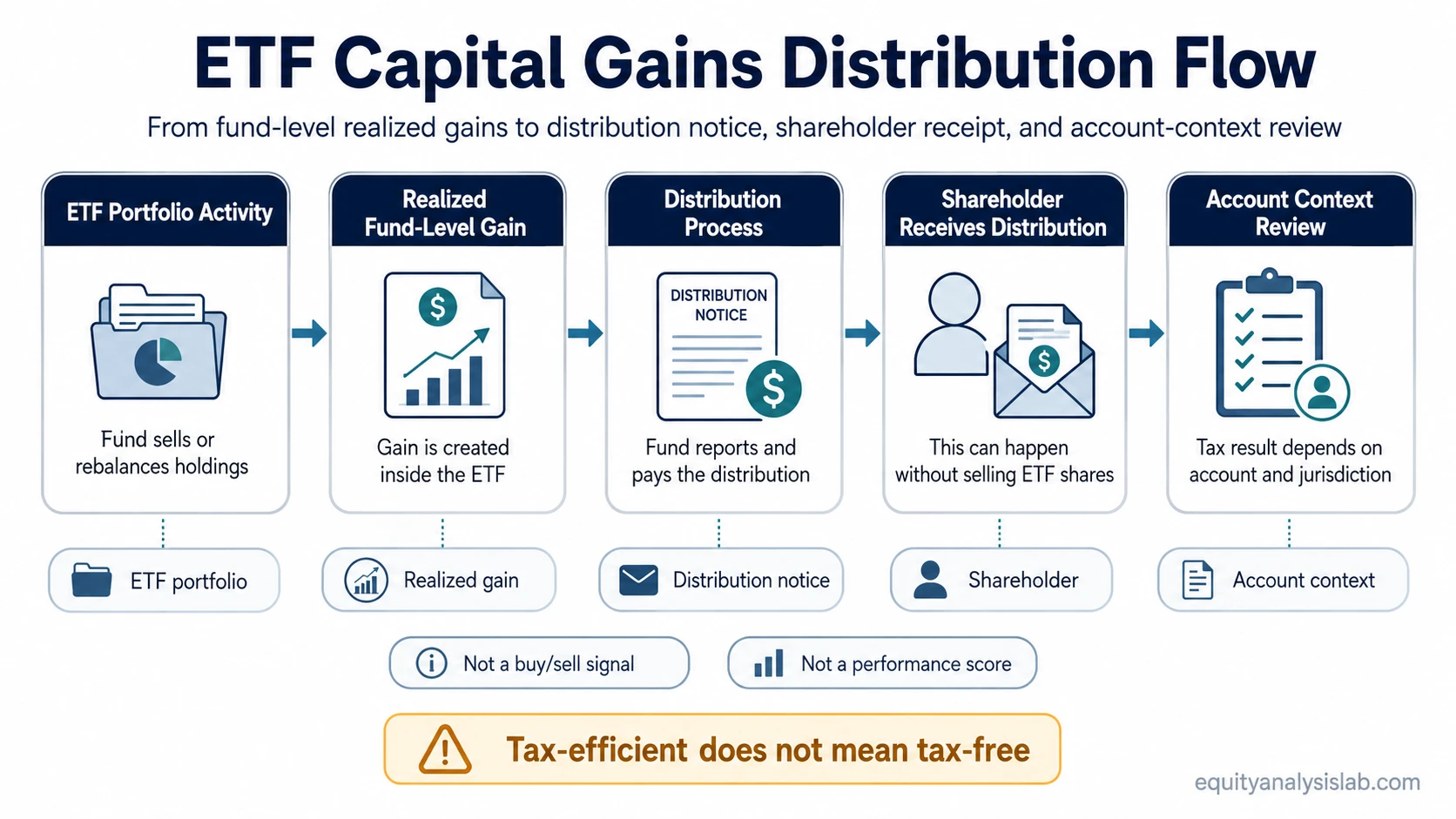
ETF capital gains distributions are realized gains generated inside an ETF portfolio and passed through to shareholders. ETF structure can reduce how often these distributions happen, but it does not make them impossible. A capital gains distribution is separate from ETF dividend income and separate from the investor’s own gain or loss from selling ETF shares.
Definition: An ETF capital gains distribution is a fund-level distribution created when the ETF realizes gains from activity inside its portfolio and passes those gains through to shareholders according to the fund’s distribution process.
Key Points
- ETF capital gains distributions come from realized gains inside the fund, not from an investor personally selling ETF shares.
- ETF structure can improve tax efficiency, but tax-efficient does not mean tax-free.
- Distributions can reflect turnover, rebalancing, index changes, strategy repositioning, redemptions, or other portfolio mechanics.
- Short-term and long-term capital gains distributions are different classifications, but the investor’s actual tax result depends on account type and jurisdiction.
- A distribution should be read as a fund-level tax and portfolio-mechanics event, not as a complete judgment about fund quality or investor suitability.
What ETF Capital Gains Distributions Mean
An ETF holds a portfolio of securities or instruments. When the fund sells something at a gain inside that portfolio, the realized gain may need to be distributed to shareholders if it is not offset or otherwise handled through the fund’s structure. The shareholder can receive the distribution even if they did not sell any ETF shares themselves.
There are two separate events to keep apart. The ETF can realize gains internally. The investor can also realize a gain or loss later by selling ETF shares. Those events may both affect after-tax results, but they come from different sources.
Important limitation: ETF capital gains distributions are possible even in ETFs that are generally tax efficient. The accurate reading is that ETF structure can reduce some taxable distribution pressure, not that every ETF avoids every fund-level realization event.
Why ETFs Can Still Distribute Capital Gains
Many ETFs use a creation and redemption process involving authorized participants. In some cases, in-kind transfers can help the fund meet redemptions without selling securities for cash, which can reduce realized gains inside the portfolio. That mechanism is useful, but it is not a guarantee that no realized gains will remain inside the fund.
Capital gains distributions can still appear when portfolio activity creates realized gains that the fund must pass through. Common triggers can include index rebalancing, index reconstitution, strategy repositioning, high turnover, corporate actions, cash redemptions, or exposure types that are harder to manage through in-kind transfers.
This is why ETF tax efficiency should be understood as a structural advantage with limits, not as a promise that every ETF will avoid capital gains distributions in every year.
Illustrative scenario: An ETF tracks an index that changes its holdings during a reconstitution. To follow the index, the fund sells some positions and buys others. If the internal sales create realized gains that are not fully offset, shareholders may receive a capital gains distribution even though they did not sell their ETF shares.
Short-Term vs Long-Term Capital Gains Distributions
ETF capital gains distributions may be classified as short-term or long-term depending on the character of the gains realized inside the fund. The classification describes the source and holding-period character of the fund-level gain. It does not by itself determine every investor’s final tax outcome.
Account and jurisdiction context: Tax treatment can depend on the investor’s account type, residence, tax jurisdiction, and applicable rules. The discussion is general and educational, not personal tax advice.
The classification helps investors understand what kind of gain the fund is distributing. The next step is to read the fund’s documents and evaluate the distribution inside the investor’s own account and tax context.
How to Read ETF Capital Gains Distribution Fields
Provider distribution pages and fund documents often list several fields around capital gains distributions. The useful question is not only how large the distribution is. The better question is what each field says about the fund event, timing, and investor interpretation.
| Distribution field | What it means | What it does not mean |
|---|---|---|
| Short-term capital gain | A realized fund-level gain classified as short-term by the fund’s reporting process. | It does not automatically describe the investor’s own holding period for ETF shares. |
| Long-term capital gain | A realized fund-level gain classified as long-term by the fund’s reporting process. | It does not mean the ETF was necessarily a better investment than another ETF. |
| Total capital gains distribution | The combined amount of capital gains the fund is distributing for the relevant period. | It is not the same as the investor’s total return. |
| Percentage of NAV | The distribution amount expressed relative to the fund’s net asset value. | It does not explain by itself why the distribution occurred. |
| Ex-date | The date used to determine whether shares trade with or without the distribution entitlement. | It is not a signal that the ETF is attractive or unattractive after that date. |
| Pay date | The date when the distribution is scheduled to be paid. | It does not determine the investor’s full tax outcome by itself. |
| Distribution history | Past distribution records that can show whether capital gains distributions are rare, recurring, or changing. | It does not guarantee the same pattern will continue. |
How Investors Can Review a Distribution Notice
A capital gains distribution notice is most useful when it is treated as a starting point for review rather than as a conclusion. The investor can check what was distributed, whether the amount is short-term or long-term, how it compares with NAV, and whether the fund’s strategy or recent portfolio changes help explain the event.
Review sequence: identify the distribution type, read the amount and percentage of NAV, check the ex-date and pay date, review the fund’s recent portfolio activity, compare the event with prior distribution history, then evaluate the account and tax context separately.
This sequence keeps the interpretation grounded. A distribution can matter for taxable-account planning, but it should not be converted into a product recommendation, a performance judgment, or a trading signal.
What Changes the Interpretation
The same capital gains distribution can mean different things depending on the ETF’s structure, strategy, and account context. A small, rare distribution in a low-turnover index ETF is different from a recurring distribution in a strategy that frequently changes holdings or uses instruments that create more taxable events.
| Context factor | Why it can matter |
|---|---|
| Portfolio turnover | Higher turnover can create more opportunities for realized gains inside the fund. |
| Index reconstitution or rebalancing | Index changes may require the ETF to sell appreciated holdings and buy replacements. |
| Active strategy repositioning | Active decisions can create realized gains if the fund exits appreciated positions. |
| Cash redemption pressure | Cash activity may require portfolio sales in situations where in-kind handling is less effective. |
| Derivatives, commodity, leveraged, or inverse exposure | Some structures and instruments can create distribution patterns that differ from plain equity index ETFs. |
| Market-access constraints | Some holdings or markets may be harder to transfer in kind, which can affect how gains are managed. |
| Account type | A taxable account and a tax-advantaged account may lead to different investor-level consequences. |
Common Mistakes When Reading ETF Capital Gains Distributions
- Assuming ETFs never distribute capital gains: ETF structure can reduce distribution pressure, but it does not remove every possible realization event.
- Treating the distribution as a return bonus: A distribution changes how gains are passed through; it is not automatically extra performance.
- Reading the distribution as a fund quality score: The amount needs context from strategy, turnover, market conditions, and portfolio activity.
- Using it as a trading signal: Distribution data explains a fund-level event; it does not replace investment analysis or suitability review.
- Confusing it with dividend income: Capital gains distributions and dividends come from different sources inside the ETF.
- Assuming tax treatment is universal: Account type, residence, and jurisdiction can change the final result.
How This Differs From Dividends and Selling Gains
ETF capital gains distributions, ETF dividends, and investor selling gains are separate ideas. They can all affect an investor’s after-tax result, but they come from different events.
| Item | Source of the event | Practical distinction |
|---|---|---|
| ETF capital gains distribution | Realized gains inside the ETF portfolio | The investor can receive it without selling ETF shares. |
| ETF dividends | Income received by the ETF from underlying holdings, such as dividends or interest | It is an income distribution category, not the same as a fund-level realized capital gain. |
| Investor selling gain or loss | The investor sells ETF shares above or below their own cost basis | It depends on the investor’s own purchase and sale price, not only on fund distributions. |
The ETF vs mutual fund tax-efficiency comparison is related, but broader. The narrower issue here is what a capital gains distribution means when it appears on an ETF distribution notice.
FAQ
Do ETFs ever distribute capital gains?
Yes. ETFs can distribute capital gains when gains are realized inside the fund and passed through to shareholders. ETF structure can reduce the frequency of these events, but it does not make them impossible.
Are ETF capital gains distributions the same as dividends?
No. Capital gains distributions come from realized gains inside the ETF portfolio. Dividends are a separate distribution category tied to income received by the ETF from its holdings.
Does a capital gains distribution mean the ETF performed better?
No. A distribution is not a standalone performance score. It should be read together with fund mechanics, NAV behavior, portfolio activity, and account context.
Can a shareholder receive a capital gains distribution without selling ETF shares?
Yes. The fund can distribute realized gains to shareholders even if the shareholder did not sell ETF shares. The shareholder’s own selling gain or loss is a separate event.